
The 10×10 and 10×20 are the two most common inline booth sizes on the trade show floor. Combined, they account for the majority of exhibit space bookings at shows like CES, HIMSS, Pack Expo, SEMA, and NAB. The decision between them is one of the most frequent questions exhibitors face when planning a new show — and one of the most consequential, because booth space is typically non-refundable after confirmation.
The 10×20 is not simply a bigger 10×10. The extra 100 square feet changes what is physically possible in terms of layout, staffing, product display, and attendee flow. Whether that change justifies the cost difference depends on what you are trying to accomplish at the show — not on the square footage itself.
This guide walks through every meaningful difference between a 10×10 trade show booth and a 10×20 trade show booth — space, layout, cost, staffing, design options, and show objectives — so you can make the right decision before you sign your space contract.
Not Sure Which Size You Need?
Get a Custom 3D Layout for Both — Decide With Visuals.
10×10 vs 10×20: At a Glance
Before diving into the individual variables, here is the direct side-by-side comparison across the factors that matter most for the booth size decision.
| Factor | 10×10 Booth | 10×20 Booth |
|---|---|---|
| Total floor space | 100 sq ft | 200 sq ft — double the 10×10 |
| Aisle exposure | Single aisle (one side open) | Single aisle (one side open) — same exposure length |
| Typical space cost | $1,500 – $4,000 / show (varies by show) | $3,000 – $8,000 / show (varies by show) |
| Rental booth cost (Pure Exhibits) | From $3,500 / show | From $5,500 / show |
| Recommended staff count | 1–2 staff | 2–3 staff |
| Storage space | Limited — small cabinet only | Dedicated back storage room possible |
| Product display capacity | 2–3 hero products | 4–6 products; full demo zone possible |
| Private meeting area | Difficult — requires divided layout | Achievable — dedicated meeting zone |
| Layout flexibility | Moderate — 4 primary configurations | High — 6+ configurations including demo + meeting |
| Best for | Focused brand presence, 1–2 objectives | Multi-objective shows, demos + meetings + display |
Space and Layout: What 100 Extra Square Feet Actually Buys You
The most important thing to understand about the 10×10 vs. 10×20 comparison is that the extra 100 square feet in a 10×20 does not simply give you more room to put things. It gives you the ability to separate functions — to run a demonstration and a private conversation simultaneously, without one interfering with the other.
What a 10×10 Layout Can Achieve
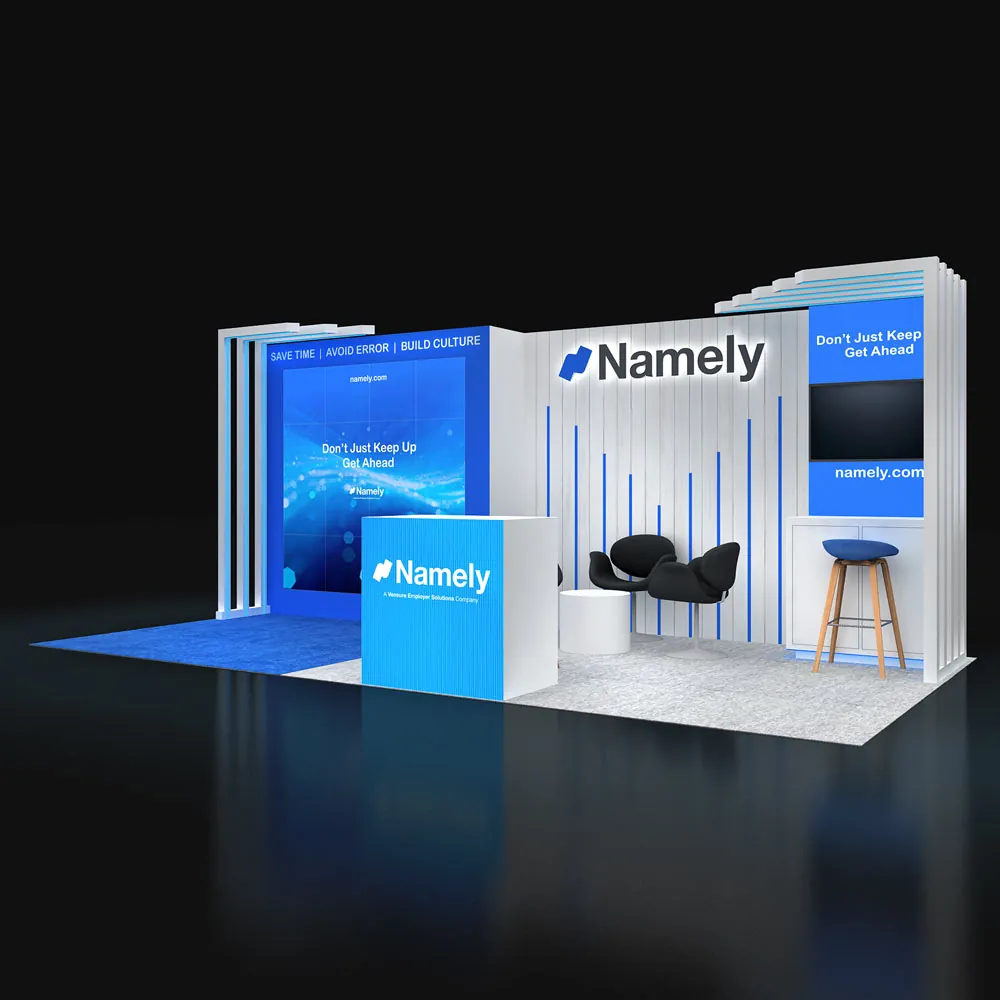
A 10×10 booth executes one primary function well. The most effective 10×10 configurations are built around a single objective — product display and lead capture, brand awareness with a demonstration, or qualified conversations with targeted visitors. Full back-wall graphic, branded counter to one side, open entry on the other side. That layout works consistently because it does not try to do more than the space allows.
The constraint is real: in a 10×10, you cannot run a live product demonstration in one area while conducting a private sales conversation in another. The space does not separate those functions. If an attendee is watching a product demo, every other attendee approaching the booth sees it as occupied.
What a 10×20 Layout Can Achieve
A 10×20 booth separates functions across the double-width footprint. The standard configuration uses the rear half of the booth for a storage room and private meeting zone, and the front half for product display and lead engagement. This gives you a functioning demo area in one zone and a private conversation space in another — simultaneously, without conflict.
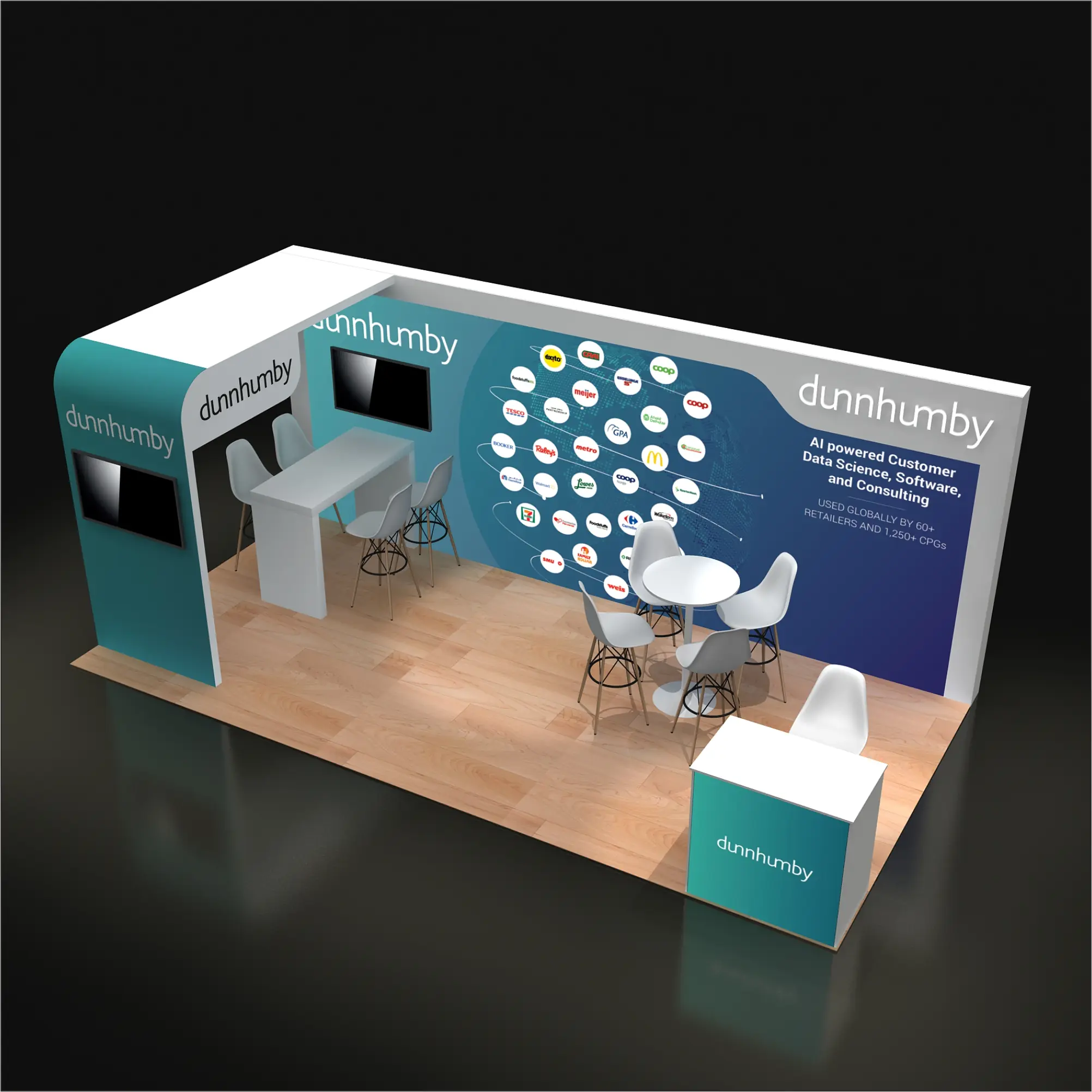
The 10×20 also opens up design elements that are physically impossible in a 10×10: a full-length graphic wall spanning the entire 20-foot back, two separate counter positions at different depths, a product display wall on one side with a demo station on the other, or a curved entry feature that creates a defined transition from the aisle into the booth space.
The Layout That Makes the 10×20 Worth the Upgrade
The layout that most consistently justifies the cost difference between a 10×10 and a 10×20 is the three-zone configuration: an open entry zone at the front center, a product display or demo zone on one side, and a meeting or conversation zone at the rear or opposite side. This layout allows one staff member to engage walk-up visitors at the entry while a second staff member runs a seated qualification conversation — two revenue-generating activities happening simultaneously in the same booth.
| Layout Zone | Function | Available in 10×10? | Available in 10×20? |
|---|---|---|---|
| Open entry zone | Aisle engagement, brand first impression | Yes | Yes — wider and more defined |
| Product / demo zone | Live demonstration or display showcase | Yes — limited to one setup | Yes — full dedicated zone |
| Storage room | Literature, cases, personal items, product stock | Counter cabinet only | Yes — full enclosed room |
| Private meeting zone | Qualified sales conversations, seated discussions | Possible with divided layout only | Yes — dedicated rear zone |
| Second counter / workstation | Secondary lead capture or staff workstation | No — too crowded | Yes — front and rear positions |
Cost Comparison: 10×10 vs 10×20 — Full Picture
The cost difference between a 10×10 and a 10×20 is not limited to the booth rental fee. Every cost category scales with booth size: show floor space, drayage (material handling), I&D labor, electrical, and graphics production. Understanding the full cost difference — not just the booth rental line — is what allows you to make an accurate ROI decision.
| Cost Category | 10×10 Estimate | 10×20 Estimate | Notes |
|---|---|---|---|
| Show floor space fee | $1,500 – $4,000 | $3,000 – $8,000 | Paid directly to show organizer; varies by show prestige |
| Booth rental (Pure Exhibits) | From $3,500 | From $5,500 | Includes design, fabrication, graphics, freight, I&D |
| Electrical order | $150 – $400 | $300 – $700 | Scales with amperage for lighting and monitors |
| Drayage / material handling | $300 – $800 | $600 – $1,500 | Charged by weight/volume by the show’s general contractor |
| Carpet / flooring | $Included or $200 – $500 | $Included or $400 – $900 | Varies by show; some include basic carpet |
| Additional monitor / AV | Optional — $200 – $600 | Often justified — $400 – $1,200 | Larger space supports second screen or touchscreen |
| Total estimated per-show cost | $5,650 – $9,800 | $9,800 – $18,300 | All-in estimate including space and services |
The total all-in cost difference between a 10×10 and a 10×20 at a mid-tier trade show typically runs $4,000 to $8,500 per event. The question is whether the additional layout capacity, lead volume, and meeting capability available in the 10×20 justifies that incremental spend relative to your show objectives.
Staffing Requirements: How Size Affects Your On-Floor Team
Booth size and staff count are directly linked. A 10×20 booth operating with only one staff member is worse than a 10×10 with one staff member — because the larger space signals a brand presence that a single person cannot support, and unattended zones create an impression of disorganization.
10×10 Staffing
A 10×10 booth runs effectively with one to two staff members. One person is sufficient for shows where your primary objective is brand awareness and inbound lead capture — the booth is designed to attract, and one confident staff member handles every interaction. Two staff members work better when you are running demonstrations and need one person to manage the demo while the other engages walk-up visitors. More than two staff in a 10×10 space is counterproductive — the booth looks crowded and leaves no room for attendees.
10×20 Staffing
A 10×20 booth is optimally staffed by two to three people. Two staff allows one person to manage the open entry and demo zone while the second handles a seated qualification conversation in the rear meeting zone. Three staff is appropriate for high-traffic shows where the demo zone is continuously occupied and the entry zone needs a dedicated greeter. A 10×20 booth running only one staff member leaves half the booth functionally unattended — which creates a different problem than being overstaffed at a 10×10.
The staffing cost implication is real. Adding one additional staff member to a show means travel, hotel, meals, and time away from their primary role. For companies with lean marketing teams, the cost of that second or third staff member at a 10×20 can exceed the incremental booth cost difference. Factor staffing fully into the size decision.
Design Options: How Each Size Shapes Your Visual Presence
Graphics and Visual Presence
A 10×10 back wall is 10 feet wide. A 10×20 back wall is 20 feet wide. The difference in graphic real estate is significant — a 20-foot backlit display wall creates a brand presence that is visible from across the hall and reads as a premium presence on any show floor. At shows like CES or SEMA where 10×20 inline exhibitors compete directly with large island neighbors, a full-width backlit 20-foot display is one of the highest-impact investments available. See how Pure Exhibits’ exhibition booth design process handles the 3D layout for both sizes.
Structural Elements Exclusive to 10×20
Several structural elements are only practical at 10×20 and wider: a full back-wall storage room with a door (requires approximately 6 feet of depth, leaving 14 feet of display space across the full width), a peninsula configuration that creates two distinct aisle-facing zones, and a double-counter setup with separate brand identities at each position for companies managing two product lines at the same show.
What 10×10 Does Better Than 10×20
A 10×10 booth with a clear single objective and a strong graphic execution frequently outperforms a 10×20 with a diluted message and inconsistent staffing. The constraint of 100 square feet forces design clarity. Exhibitors who struggle to define a focused show objective often produce better results at 10×10 — because the space does not allow them to hedge. The 10×20 rewards focus; it does not automatically create it.
Which Shows Suit Each Size — Industry Guidance
Show type, audience profile, and competitive context all influence which size performs better. The table below reflects patterns Pure Exhibits has observed across hundreds of show deployments at venues including the Las Vegas Convention Center, McCormick Place, OCCC, and the Georgia World Congress Center.
| Show Type / Industry | Recommended Size | Primary Reason |
|---|---|---|
| First-time exhibitor at any show | 10×10 | Test the show ROI before committing to higher space cost |
| Technology / SaaS — focused product demo | 10×10 or 10×20 | 10×10 if single product; 10×20 if demo + sales conversation needed |
| Healthcare / pharma — qualified lead focus | 10×20 | Private meeting zone justifies upgrade for compliance conversations |
| Consumer goods — sampling or hands-on | 10×20 | Sampling station + brand display need separation of space |
| Professional services — trust-based sales | 10×20 | Seated conversation zone is the primary value of the space |
| Industrial / manufacturing — spec-driven | 10×20 | Multiple product lines or large printed spec displays need width |
| Food & beverage at Pack Expo or similar | 10×20 | Sampling, display, and brand zone need physical separation |
| Brand awareness — no live demo | 10×10 | Strong graphic wall is sufficient; extra space not justified |
| Startup / early-stage company | 10×10 | Capital efficiency; invest savings in better graphics and staff prep |
| Established brand at anchor annual show | 10×20 or larger | Presence expectation from repeat attendees; upgrade signals growth |
Ready to Book Your Size?
Get a Custom Quote for 10×10 or 10×20 — 24-Hour Turnaround.
When to Upgrade from 10×10 to 10×20: 6 Signals
Most exhibitors start at 10×10 and evaluate an upgrade after one or more shows at that size. These are the six signals that consistently indicate a 10×20 will generate a measurable improvement in show performance.
Signal 1 — Your 10×10 Booth Feels Crowded During Peak Hours
If your booth regularly has three or more attendees present simultaneously during peak show hours and conversations are being interrupted or delayed because of space limitations, you have outgrown the 10×10. The 10×20 gives you the capacity to run two parallel conversations without either party feeling the other is present.
Signal 2 — You Are Running a Live Demonstration That Attracts a Crowd
Live demonstrations are one of the highest-performing engagement tools on the show floor — but in a 10×10, the crowd they attract blocks the entry and prevents new visitors from entering. A 10×20 positions the demo in one zone and leaves the entry clear for new arrivals, allowing both functions to run simultaneously without competing for the same square footage.
Signal 3 — You Are Managing Two Products or Two Audiences at the Same Show
If your show presence requires communicating two distinct product lines, two buyer personas, or two different value propositions, a 10×10 cannot support that without visual confusion. A 10×20 allows you to zone the booth by audience or product. This is also one of the strongest use cases for Pure Exhibits’ exhibition booth design service, which can design the 10×20 zone structure before you commit to the space upgrade.
Signal 4 — You Need a Dedicated Storage Area
If your current 10×10 setup requires visible storage — product cases on the floor, collateral stacked behind the counter, staff bags visible in the booth — the lack of a dedicated storage room is hurting your brand presentation. A 10×20 allows an enclosed storage room at the rear, keeping the display area clean and professional for the full duration of the show.
Signal 5 — Your Sales Process Requires a Seated Conversation
Some sales processes — healthcare, financial services, enterprise software, legal services — require a qualification conversation that is too sensitive or too detailed to conduct standing at an open counter. If your staff is currently conducting these conversations in the aisle, in the lobby, or not at all, a 10×20 with a rear meeting zone resolves that structural limitation.
Signal 6 — Your Competitors Have Upgraded and You Have Not
Competitive context matters on the trade show floor. If the companies you are competing with for the same audience have moved from 10×10 to 10×20 or larger, and you remain at 10×10, the visual size differential signals a resource gap to attendees before a single conversation begins. This is not a reason to upgrade in isolation — but combined with any of the five signals above, it adds urgency to the decision.
When to Stay at 10×10 Instead of Upgrading
The 10×20 is not the right answer for every exhibitor evaluating the decision. These are the situations where staying at 10×10 is the correct choice.
-
You are exhibiting at a show for the first time. Test the show’s ROI at 10×10 before committing to higher space and booth costs.
-
Your primary show objective is brand awareness or lead generation from a single product. A strong 10×10 design delivers both without the cost premium of 10×20.
-
Your show appearance is infrequent — once per year or less. The cost difference between 10×10 and 10×20 compounds quickly over multiple shows. At one show per year, the savings fund better graphics, better pre-show marketing, or an additional show.
-
You cannot staff a 10×20 with at least two people. An understaffed 10×20 is worse than a well-staffed 10×10. If your team can only send one person, stay at 10×10 and optimize that configuration.
-
Your show has a tightly constrained budget. A 10×10 with a backlit display wall, targeted LED lighting, and high-resolution graphics outperforms a 10×20 with a flat back wall and stock furniture. Quality beats square footage when budget is constrained.
10×10 and 10×20 Rentals Across All Major U.S. Markets
Pure Exhibits provides both 10×10 and 10×20 rental packages at every major U.S. show market. Whether your next show is at the Las Vegas Convention Center, McCormick Place in Chicago, the Georgia World Congress Center in Atlanta, or NRG Center in Houston, the same design process, project management, and Prebuilt Guarantee applies.
Let’s Build Something Extraordinary
Share your event details and we’ll craft a custom booth solution designed to captivate your audience and maximize your ROI.
Frequently Asked Questions
What is the main difference between a 10×10 and a 10×20 trade show booth?
The primary difference is functional capacity, not just floor space. A 10×10 booth executes one primary objective well — product display with lead capture, brand awareness, or a single demonstration. A 10×20 booth allows two functions to operate simultaneously: for example, a live product demo in one zone and a private sales conversation in a rear meeting area. The extra 100 square feet enables a three-zone layout — entry, demo or display, and meeting — that is physically impossible in a 10×10.
How much more does a 10×20 trade show booth cost than a 10×10?
The all-in cost difference — including show floor space, booth rental, electrical, drayage, and I&D — typically runs $4,000 to $8,500 more per show for a 10×20 versus a 10×10. Show floor space alone is generally double for the 10×20. Pure Exhibits’ rental packages start from $3,500 for a 10×10 and from $5,500 for a 10×20, with both prices covering the complete scope: custom design, fabrication, graphics, freight, installation, and dismantling.
How many staff members do I need for a 10×20 booth?
A 10×20 booth is optimally staffed by two to three people. Two staff is the minimum for using the 10×20’s full functional capacity — one person managing the demo or display zone and one handling private conversations in the rear meeting area. Three staff is appropriate at high-traffic shows or when the entry zone needs a dedicated greeter. Operating a 10×20 with only one staff member leaves half the booth functionally unattended, which is worse than a well-staffed 10×10.
Can a 10×10 booth have a storage room?
A standard 10×10 booth does not accommodate an enclosed storage room — the space is not deep enough to dedicate the 4 to 6 feet required without eliminating the display area entirely. The standard 10×10 storage solution is a lockable cabinet under the counter. A 10×20 booth, by contrast, routinely includes a full-width enclosed storage room at the rear of the booth with a door, leaving the full 20-foot front width for display and engagement.
Is a 10×20 worth the upgrade for a first-time exhibitor?
In most cases, no. First-time exhibitors at a new show should start at 10×10 to test the show’s ROI before committing to higher space and booth costs. A 10×10 at a show you are attending for the first time is a strategic investment with limited downside. If the show generates qualified leads and is worth returning to, upgrading to 10×20 for the second year is a well-informed decision rather than a speculative one.
What layouts are possible in a 10×20 that are not possible in a 10×10?
Several configurations are only practical at 10×20 or wider: a full 20-foot backlit display wall with a dedicated demo station in front, a three-zone layout with entry, display, and meeting areas, a back-room storage enclosure with a door, a double-counter setup for exhibitors presenting two product lines, and a peninsula configuration that creates two distinct aisle-facing sub-zones. These configurations require a minimum of 20 feet of width to function without visual crowding.
How does the graphic design differ between a 10×10 and a 10×20 booth?
The primary graphic difference is back-wall width: 10 feet versus 20 feet. A 20-foot back wall creates significantly more brand presence at aisle distance and allows the graphic to include more visual complexity — a headline, a supporting image, and a sub-message — without the crowding that makes those elements unreadable on a 10-foot panel. The 10×20 also introduces side-panel graphic surfaces that are not available in a standard inline 10×10.
Which booth size is better for healthcare and pharmaceutical trade shows?
The 10×20 is generally the better choice for healthcare and pharmaceutical exhibitors because the private meeting zone is functionally important in these industries. Conversations about clinical data, compliance requirements, formulary decisions, and procurement processes are not appropriate for an open counter discussion. A 10×20 rear meeting zone — even a semi-enclosed one with chairs and a small table — provides the privacy that these conversations require without requiring a full island exhibit.
Can I rent a 10×20 trade show booth for a single show?
Yes. Pure Exhibits offers single-show rental agreements for both 10×10 and 10×20 configurations. The rental scope for a single-show 10×20 includes custom 3D design, fabrication, graphics, freight to the advance warehouse, installation, and post-show dismantling — all for a fixed price. Annual multi-show agreements are also available and provide cost advantages for clients exhibiting at two or more shows per year.
What happens if I book a 10×20 space but can only staff it with one person?
An understaffed 10×20 is one of the most common and most avoidable show floor mistakes. If you can only send one staff member, book a 10×10 and invest the cost savings in better graphics, pre-show outreach, or a stronger post-show follow-up process. One well-prepared staff member in a focused 10×10 consistently outperforms one overwhelmed staff member in an oversized 10×20. Booth size only creates value when matched with adequate staffing.
What is the next step if my show outgrows a 10×20?
The natural upgrade path from a 10×20 is a 20×20 island or corner configuration. A 20×20 doubles the floor space again and introduces four-sided aisle exposure, overhead hanging sign options, private meeting rooms, and multi-zone layouts that are not achievable in any inline footprint. Pure Exhibits provides 20×20 rental packages with the same fixed-price, Prebuilt Guarantee model. See the 20×20 booth rental page for configuration and pricing details.
How do I decide between 10×10 and 10×20 if I am unsure?
Answer three questions: First, do you need to run two activities simultaneously — for example, a demo and a private conversation — or just one? If two, go 10×20. Second, can you staff the booth with at least two people for the full show duration? If not, stay at 10×10. Third, do you have a confirmed positive ROI from this show at 10×10? If yes, upgrade. If not, test at 10×10 again. These three questions resolve the majority of undecided cases without requiring a detailed cost model.