
Case Study
Radware
Stranger Threats at the gates of Moscone — Radware’s 20×30 all-white island at RSA Conference 2025 cracked open its own walls to reveal the glowing red eyes of the Upside Down, turning a pop-culture horror metaphor into the most visually arresting cybersecurity story on the show floor
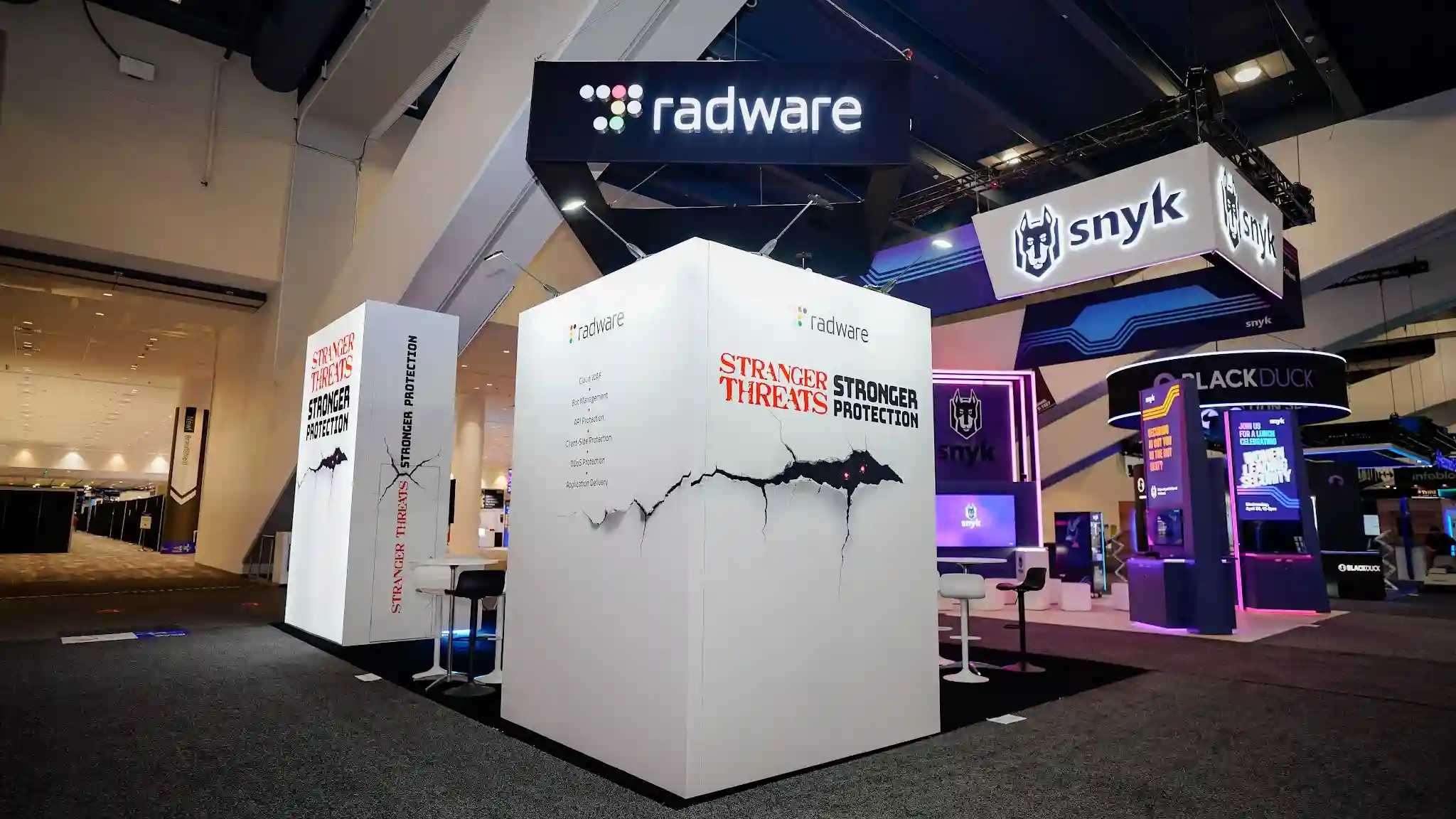
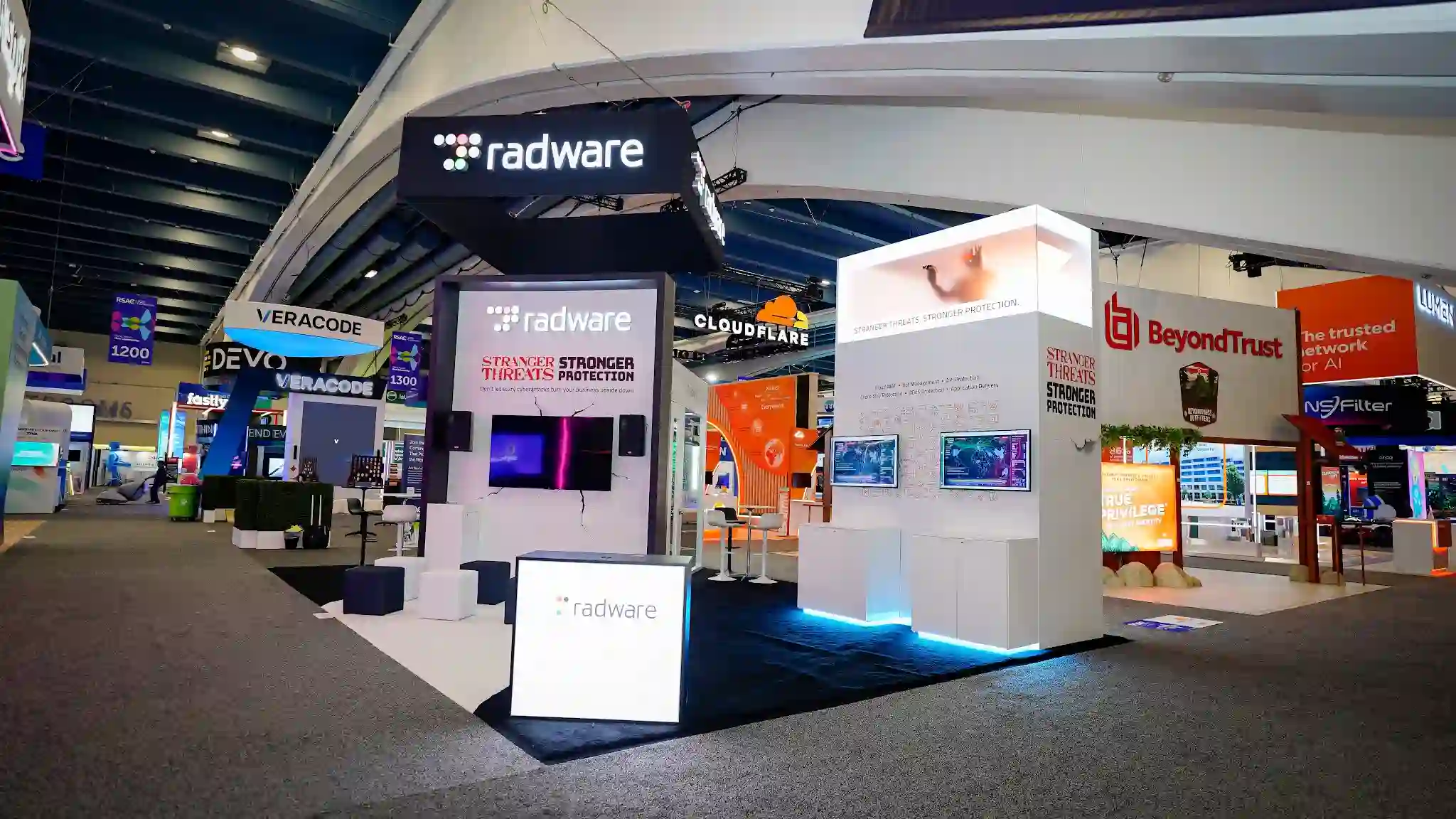
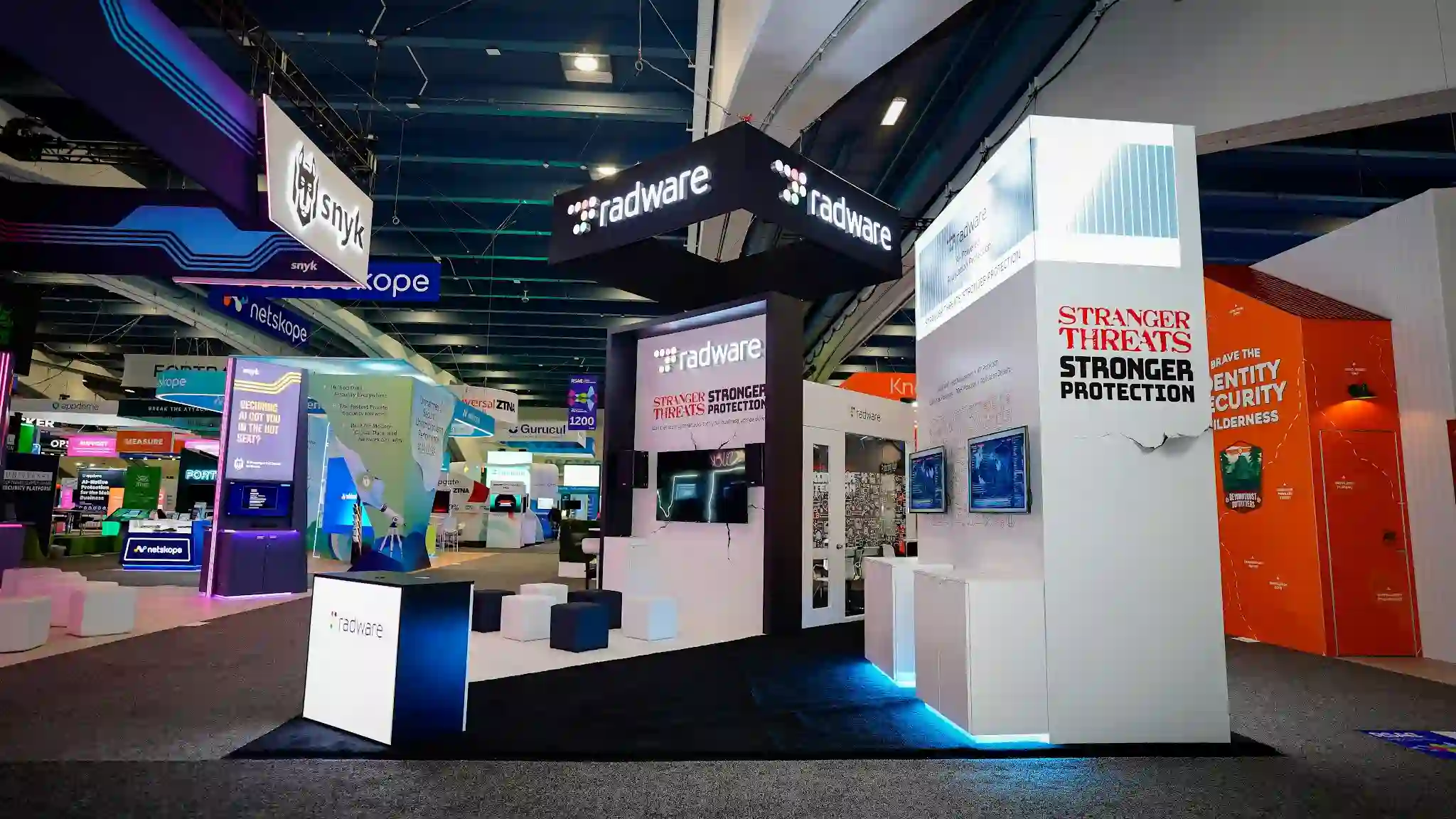
Pure Exhibits designed and built Radware’s custom 20×30 island exhibit at RSA Conference 2025 — Booth S-1227 in the Moscone Center, San Francisco, April 28–May 1, 2025 — creating a dramatic all-white modular architecture that weaponized the universally recognizable Stranger Things aesthetic to communicate the “Stranger Threats. Stronger Protection.” campaign. A dark suspended canopy bearing the Radware brand floated above three pristine white structural elements: a tall backlit SEG lightbox tower, a large central cube housing an enclosed glass-walled meeting room with dark cybersecurity-icon wallcovering, and open demo zones framed by cyan LED base lighting, white tulip-style bar stools, and round pedestal tables — all anchored by a signature cracked-wall 3D graphic with glowing red monster eyes breaking through the surface, delivering Radware’s six product lines to roughly 45,000 cybersecurity professionals at the world’s largest security conference.
The Challenge
Standing Out Among 45,000 Cybersecurity Professionals at the World’s Largest Security Conference
Radware (NASDAQ: RDWR) arrived at RSA Conference 2025 with a mandate that matched the scale of its global footprint: how does a cybersecurity company protecting 12,500+ enterprise and carrier customers worldwide — with a product portfolio spanning Cloud WAF, Bot Management, API Protection, Client-Side Protection, DDoS Protection, and Application Delivery — cut through the noise of the industry’s most crowded show floor? RSA Conference draws roughly 45,000 attendees to Moscone Center each year, and Booth S-1227 would sit among formidable neighbors including Snyk, Cloudflare, Netskope, Fortinet, BeyondTrust, Veracode, and Black Duck. The “Stranger Threats. Stronger Protection.” campaign drew on the universally recognizable Stranger Things aesthetic — the Upside Down, the cracked walls, the lurking red-eyed creatures — as a metaphor for hidden cyber threats that break through enterprise defenses from dimensions most security teams can’t see. CTO David Aviv would be presenting live with CyberRisk Alliance during the conference, and Radware’s own 2025 report had surfaced a headline-grabbing finding: 57% of e-commerce website traffic now comes from automated bots. The booth needed to translate that urgency into a physical space that stopped foot traffic cold.
The brief called for a 20×30 island that communicated both technological authority and creative storytelling — referencing the Upside Down as a metaphor for the hidden threat landscape lurking beneath every enterprise’s digital surface. The cracked wall wouldn’t just be a graphic element; it would be the booth’s entire narrative premise: something dangerous is breaking through, and Radware is the line of defense. Pure Exhibits had previously designed cybersecurity booths that tackled similar challenges of balancing technical credibility with show-floor drama — including Appdome’s Black Hat 2025 booth and SpyCloud’s Black Hat 2025 booth — but Radware’s RSA presence demanded a different register entirely: an all-white architectural fortress whose pristine surfaces existed specifically to be violated by the campaign’s signature cracked-wall creature graphic, creating a visual tension between protection and threat that attendees could feel from fifty feet away.
“Don’t let scary cyber threats turn your business upside down.”
— Radware RSA 2025 Campaign
The Creative Journey
When White Walls Crack Open
The Cracked-Wall Illusion
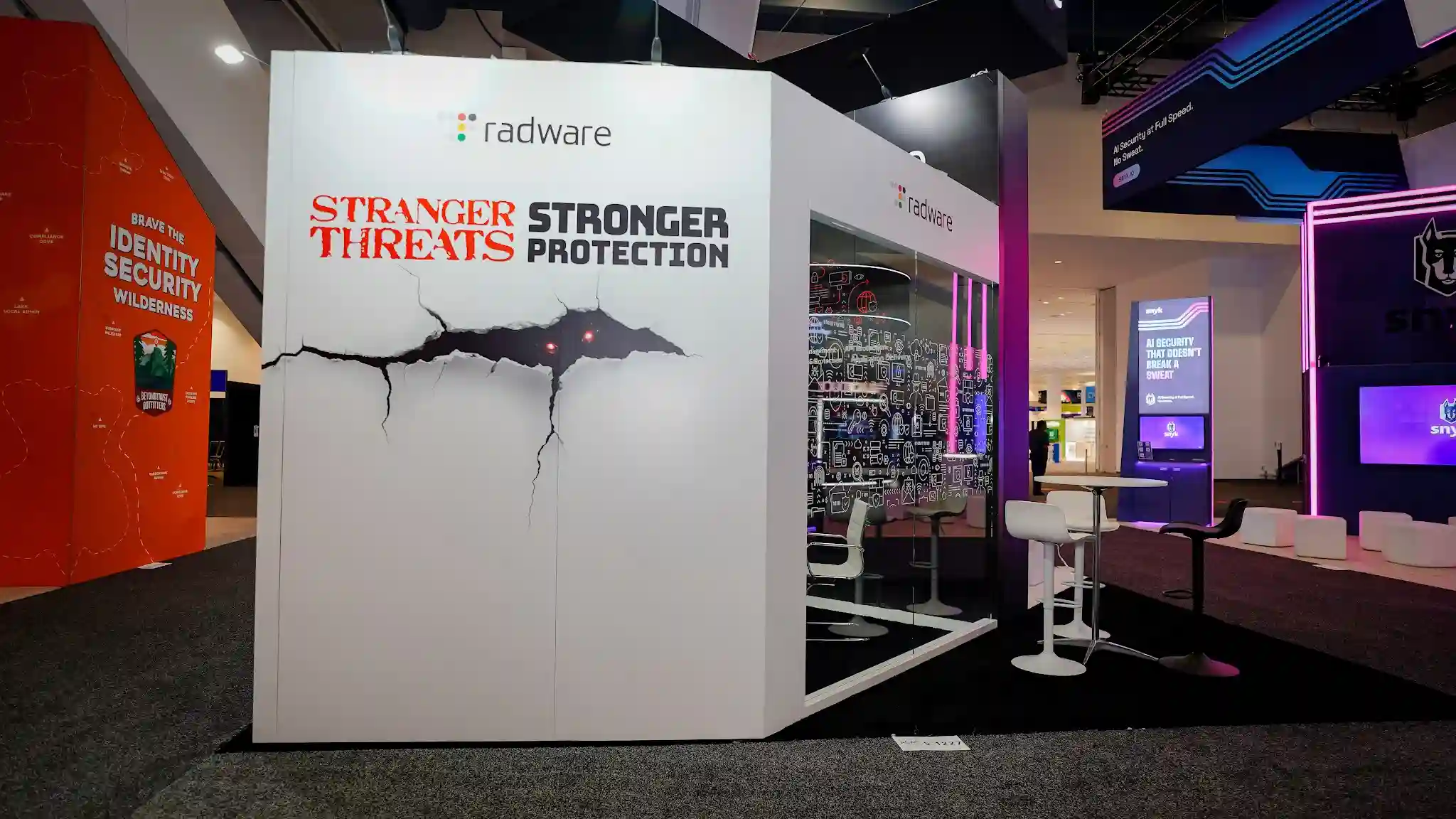
The signature creative device — and the single most photographed element on the RSA show floor — was the large-scale 3D cracked-wall graphic that dominated the booth’s primary exterior face. The pristine white surface appeared to fracture open from within, revealing glowing red bat-like creature eyes peering through the jagged tear — a direct visual homage to the Stranger Things “Upside Down” where monsters breach the barrier between dimensions. Above the crack, “STRANGER THREATS” appeared in the unmistakable red distressed horror-style font that instantly evoked the Netflix series, while “STRONGER PROTECTION” anchored below in bold black sans-serif — the tonal shift from fear to confidence happening in the space between two lines of typography. The Radware dot-cluster logo sat above both, completing the brand attribution. At trade show scale, the effect was startling: a wall that looked physically damaged, as if something from the threat landscape had literally punched through the booth’s defenses. It communicated Radware’s core message — threats are real, they’re breaking through, and Radware stops them — without a single line of body copy.
White Fortress Architecture
The booth’s architectural composition was built on a deliberate three-element structural hierarchy: a tall, narrow backlit lightbox tower that served as the campaign’s vertical billboard; a large central cube structure housing the enclosed meeting room and primary demo spaces; and a dark suspended overhead canopy that unified everything beneath the Radware brand. All three structures were finished in crisp, bright white — smooth laminate panels that read as gallery-clean and almost clinical against the dark charcoal convention floor. The contrast was the entire point. While most cybersecurity booths at RSA leaned into dark, moody aesthetics to signal “threat awareness,” Radware chose white as its power move — a pristine fortress that existed to be violated by the cracked-wall creature graphic. The electric cyan LED strip lighting running along the base of every white surface created a subtle floating effect, as if the structures were hovering above the floor on a thin line of energy. From across the Moscone hall, the trio of white forms against the dark floor looked sculptural, architectural, and unmistakably intentional — a miniature installation that demanded investigation.
The Glass-Walled War Room
Inside the large central cube, Pure Exhibits built an enclosed meeting room that functioned as the booth’s operational core — a space where Radware’s sales team could conduct private demos, host executive briefings, and walk prospects through the full product portfolio without show-floor noise. The interior walls were finished in a striking dark treatment: dense white cybersecurity icon line-art on a black background, depicting an intricate ecosystem of servers, shields, lock icons, cloud elements, and network diagrams at large scale — an immersive wallcovering that made the meeting room feel like the inside of a security operations center. Glass and transparent front panels balanced the need for privacy with visibility, allowing passing attendees to glimpse the activity inside and signaling that important conversations were happening. White tulip-base bar stools in the Eero Saarinen style paired with round pedestal tables created comfortable, extended meeting environments. Interior monitors displayed Radware’s product ecosystem maps — giving the room a dual purpose as both a private consultation space and a walk-through showcase of the company’s six-product defense portfolio.
The Lightbox Landmark
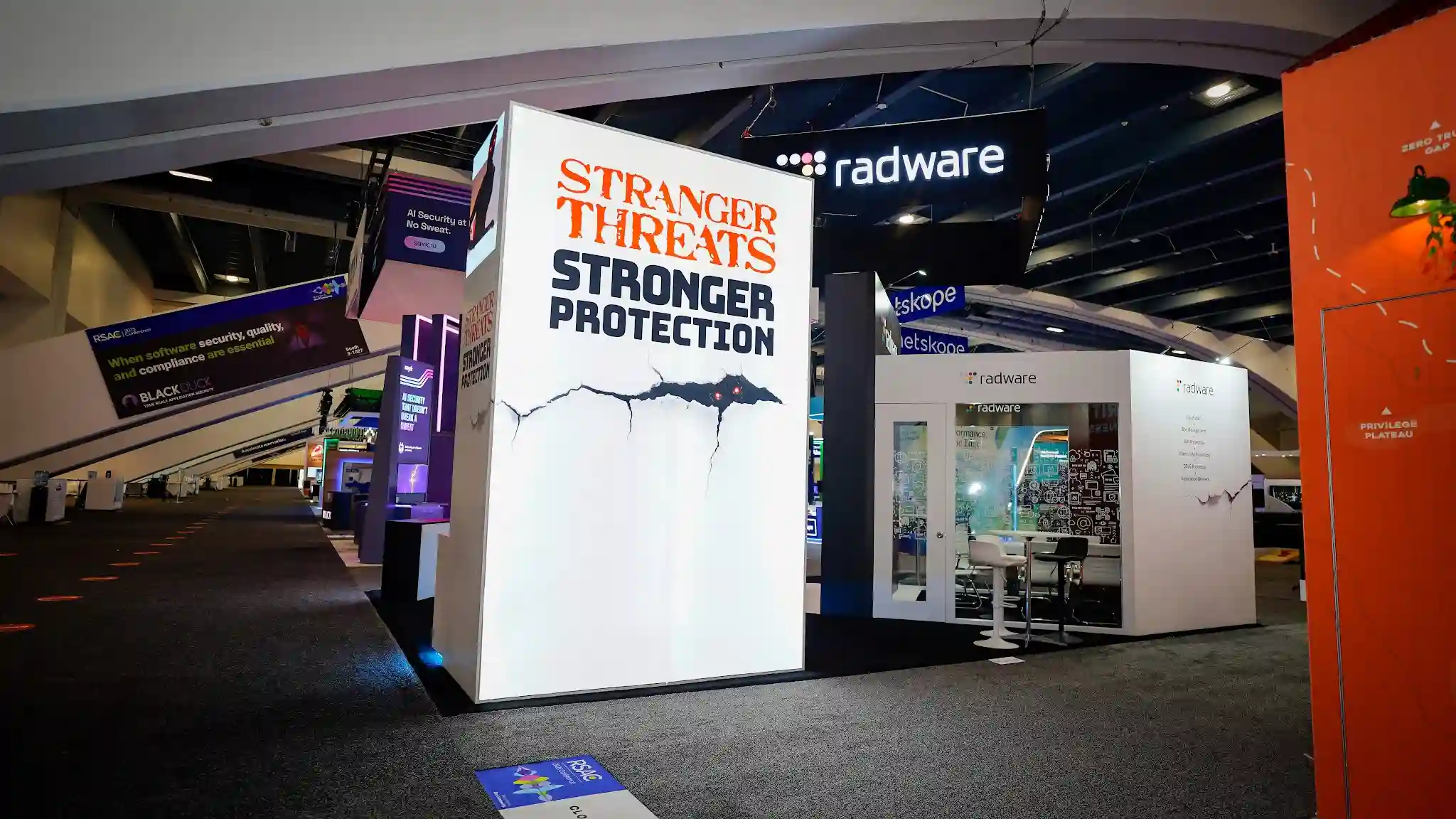
The tall, narrow backlit SEG lightbox tower — approximately four to five feet wide and ten to eleven feet tall — was the booth’s wayfinding beacon and its single most visible element from the far reaches of the Moscone show floor. Internally illuminated with uniform LED backlighting, the entire panel surface glowed with an almost supernatural luminosity that made it the brightest single object in the surrounding hall. The “Stranger Threats / Stronger Protection” campaign graphic was reproduced on the tower in full fidelity: the cracked wall, the glowing red eyes, the distressed red typography — all rendered on translucent stretch fabric that allowed the internal LEDs to push light through the image itself, making the creature’s eyes appear to genuinely glow from within. The effect was especially powerful in the relatively dim convention hall environment, where the backlit tower emerged from the darkness like a supernatural portal. Multiple faces carried the campaign messaging, ensuring 360-degree readability from any aisle approach. At distance, the tower functioned as a directional landmark — a luminous pillar that attendees could navigate toward from across the hall. Up close, it delivered the full emotional impact of the Stranger Things reference: a wall cracking open, something glowing behind it, and the unmistakable feeling that the threat is already here.
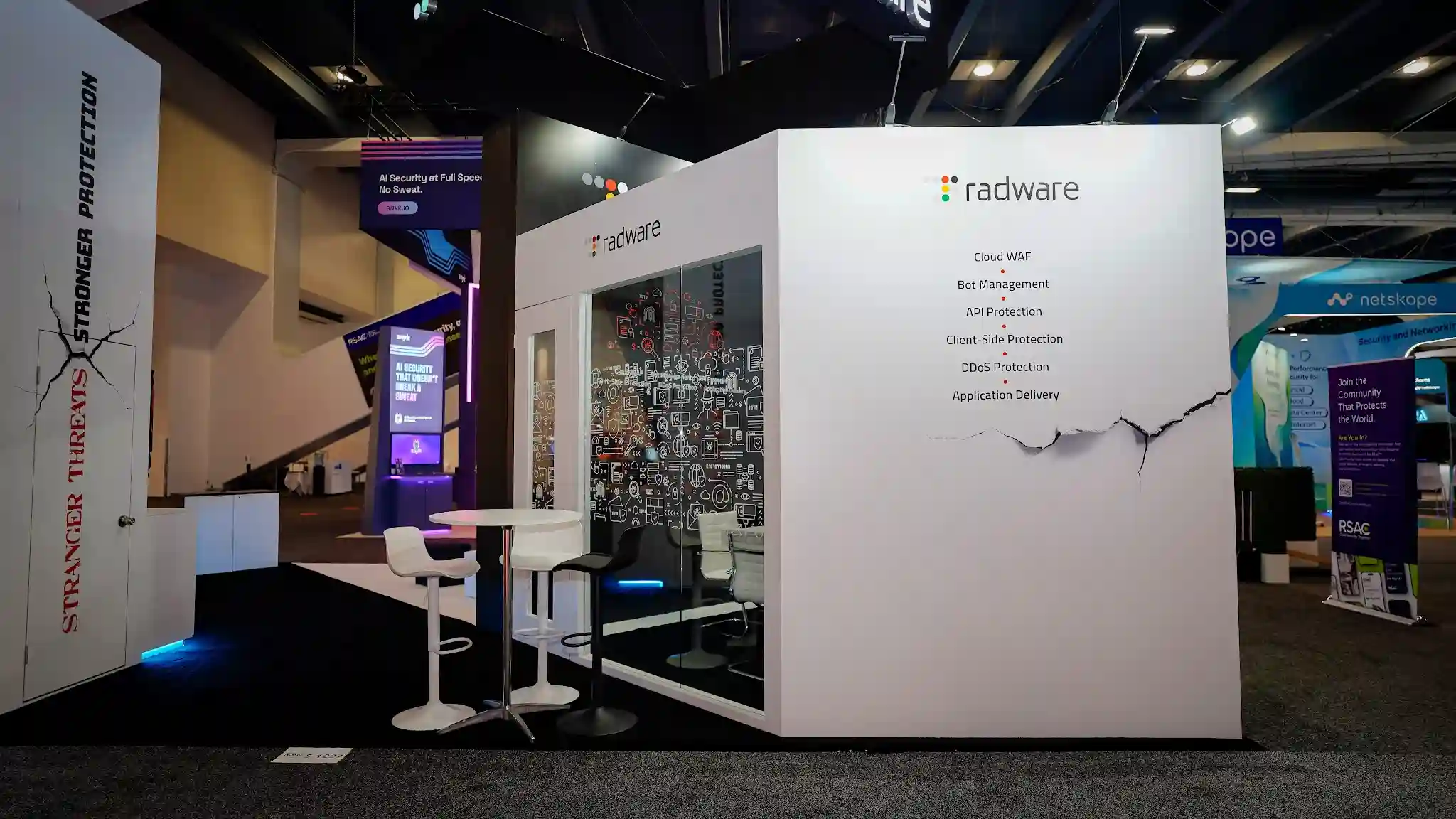
The enclosed meeting room side of Radware’s 20×30 island at Booth S-1227 — showing the glass-walled private consultation space with its dark cybersecurity-icon interior wallcovering, the product list panel displaying all six Radware solutions (Cloud WAF, Bot Management, API Protection, Client-Side Protection, DDoS Protection, Application Delivery), white tulip-style bar stools and round pedestal table for informal demos, and the cyan LED base glow that unified the entire white structural ensemble against the dark Moscone Center floor.
Gallery
The Booth in Detail
Booth Walkthrough
Experience the Booth
A full walkthrough of the Radware 20×30 custom island exhibit at RSA Conference 2025 — showcasing the signature cracked-wall 3D graphic with glowing red creature eyes, the all-white modular architecture with tall backlit SEG lightbox tower, the dark suspended canopy with Radware branding, the enclosed glass-walled meeting room with cybersecurity-icon interior wallcovering, cyan LED base lighting throughout, the “Stranger Threats. Stronger Protection.” campaign typography in red distressed and bold black, product feature panels listing Cloud WAF, Bot Management, API Protection, Client-Side Protection, DDoS Protection, and Application Delivery, white tulip-style bar stools and pedestal tables, and the full scope of Radware’s presence at Booth S-1227 on the Moscone Center show floor.
Impact & Results
By the Numbers
From the Upside Down to the Show Floor. Stranger Threats Made Visible.
RSA Conference 2025 brought 45,000+ cybersecurity professionals to Moscone Center for the industry’s largest annual gathering — four days of keynotes, product launches, threat briefings, and a show floor packed with hundreds of vendors competing for the attention of CISOs, security architects, and SOC analysts who’ve seen every booth trick in the book. For Radware — the publicly traded cybersecurity company (NASDAQ: RDWR) protecting 12,500+ enterprise and carrier customers with a six-product defense portfolio — the 20×30 island at Booth S-1227 needed to accomplish something that sheer size alone couldn’t guarantee: emotional resonance. In a hall where Snyk, Cloudflare, Netskope, Fortinet, BeyondTrust, and Veracode all fielded massive exhibits within visual range, Radware’s booth had to create a moment of recognition — the instant a passing attendee saw the cracked wall, the red eyes, and the distressed typography and thought: I know exactly what that’s referencing, and I need to see what they’re doing.
The design strategy was built on contrast at every level. Where most cybersecurity exhibitors at RSA defaulted to dark, moody palettes — blacks, deep blues, neon accents — Radware’s all-white architecture created immediate visual differentiation against the dark Moscone floor. The Stranger Things cultural reference was a calculated choice for this specific audience: cybersecurity professionals who binge the same Netflix series as everyone else, but who also understand the Upside Down as a near-perfect metaphor for the hidden threat landscape that exists beneath every enterprise’s digital infrastructure. The architectural trio — lightbox tower, enclosed cube, dark canopy — gave the booth three distinct modes of engagement: long-range wayfinding (the glowing tower), mid-range storytelling (the cracked-wall graphic), and close-range conversion (the glass-walled meeting room). Pure Exhibits had explored similar multi-mode engagement strategies in other cybersecurity builds, including SpyCloud’s cosmic-themed island at Black Hat 2025 and Appdome’s white-and-wood booth at Black Hat 2025 — but Radware’s approach was unique in how aggressively it used pop-culture narrative as a structural design principle rather than a surface-level graphic treatment.
The functional payoff matched the creative ambition. The glass-walled meeting room gave Radware’s sales team a private, acoustically separated space to conduct executive demos and prospect conversations — with the dark cybersecurity-icon wallcovering creating an immersive tech-vault atmosphere inside. The product ecosystem wall on the booth’s exterior face listed all six solutions — Cloud WAF, Bot Management, API Protection, Client-Side Protection, DDoS Protection, and Application Delivery — in clean black typography, ensuring that even attendees who didn’t stop could absorb Radware’s full portfolio at a glance. Live demo stations powered extended conversations, while CTO David Aviv’s joint presentation with CyberRisk Alliance drove traffic to the booth with the authority of Radware’s own research — including the headline finding that 57% of e-commerce traffic now comes from automated bots. The cracked-wall lightbox tower glowed long after the hall lights dimmed at the end of each day, a luminous afterimage that ensured Radware’s presence lingered in the memory of every attendee who walked the Moscone floor.