
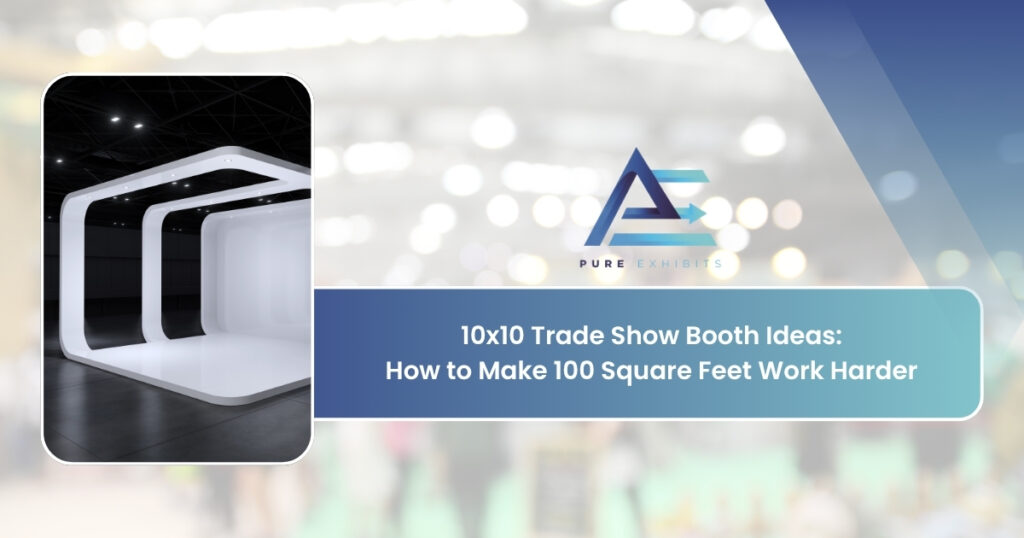
A 10×10 trade show booth is 100 square feet. That is roughly the size of a standard home office. In a convention hall where neighboring exhibitors may be running 20×20 islands with overhead signs, LED video walls, and private meeting rooms, 100 square feet can feel like very little — or it can be enough to outperform booths three times its size.
The difference is almost never the budget. It is the decisions made before move-in: where the visual anchor sits, how the entry is framed, what the first three seconds of attendee attention lands on, and whether the layout creates a reason to stop or invites a quick walk-past.
This guide covers 20+ actionable 10×10 trade show booth ideas — layout configurations, display strategies, lighting approaches, technology integrations, and design principles — drawn from Pure Exhibits’ experience designing and installing 10×10 booth rentals at shows including CES, HIMSS, NAB Show, SEMA, and Pack Expo. Use it as a planning reference before your next show.
Need a 10×10 Booth for Your Next Show?
Get a Custom 3D Design in 72 Hours.
Why 10×10 Booth Design Is Harder Than It Looks
Most exhibitors approaching a 10×10 space make one of two mistakes: they over-pack it with product and collateral until there is no room for a conversation, or they under-invest in the design because the space feels too small to justify the effort. Both approaches produce the same result — a booth that does not convert attendee attention into actual leads.
The 10×10 constraint is real. You cannot do everything. But the constraint is also a design advantage if you use it correctly. A well-designed 10×10 booth forces clarity: one primary brand message, one clear entry point, one focused action you want attendees to take. Larger booths with more space frequently dilute their own message by trying to serve too many objectives.
The ideas in this guide are organized around that clarity principle. Each one is designed to help you make a deliberate choice about what your 10×10 booth communicates — and how it communicates it. If you are comparing booth sizes, the 10×10 vs. 10×20 decision guide on the Pure Exhibits site walks through when an upgrade is worth the cost.
10×10 Booth Layout Ideas
Layout is the first decision. Before you think about graphics, lighting, or technology, you need to know where the structural elements sit — and how they shape attendee behavior when someone approaches your space.
Idea 1 — The Full Back-Wall Configuration
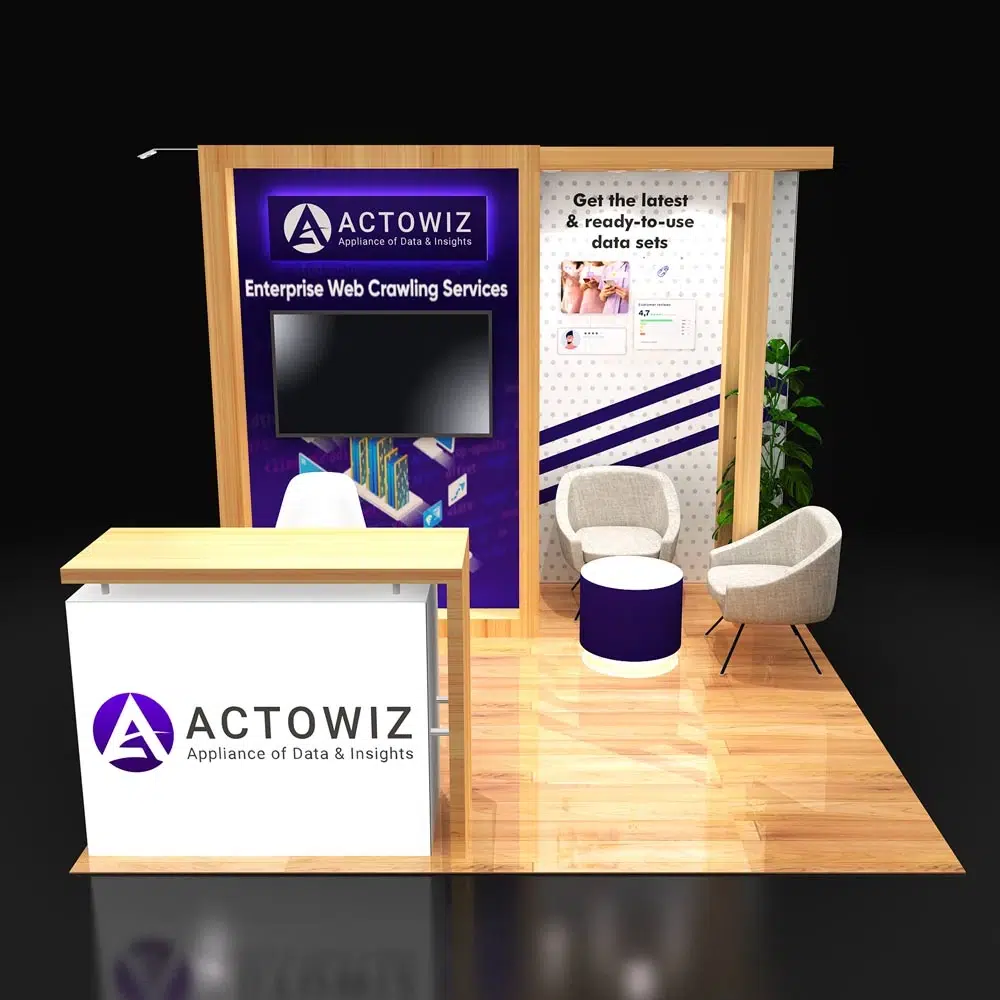
The most common 10×10 layout: a full-height graphic wall spanning all 10 feet at the back of the space, with a counter or table positioned forward and to one side. This setup maximizes your brand surface area, creates visual depth from the aisle, and leaves the front half of the booth open for conversation. It works for virtually every industry and every show environment.
The risk in this layout is the counter placement. If the counter sits centered across the front of the booth, it creates a physical barrier that unconsciously signals ‘stay out.’ Position the counter to one side, angled slightly inward, and leave the other side of the entry completely open.
Idea 2 — The L-Shape Configuration
An L-shaped layout uses one side wall and the back wall as display surfaces, with the open corner facing the aisle. This creates a defined ‘entry zone’ that feels like an invitation rather than a corridor. The L-shape is particularly effective for corner booth assignments, where you have aisle exposure on two sides, because it allows you to anchor both visible corners with brand presence.
Idea 3 — The Open Peninsula
Remove the counter entirely. Use a tall back-wall display, a freestanding product pedestal or demo station centered in the space, and keep the front completely open. This configuration communicates confidence and accessibility — there is nothing between the attendee and the product. It is the strongest layout for live demonstrations, product launches, and consumer goods shows where the product itself is the primary draw.
Idea 4 — The Divided Layout
For exhibitors who need a brief private area — a place to sit with a prospect without being interrupted by passing foot traffic — the divided layout places a waist-height partition at the rear third of the booth. The front two-thirds remain open and visible from the aisle; the back third creates a semi-enclosed meeting zone. This works well at healthcare, financial services, and enterprise technology shows where qualified conversations matter more than raw attendee volume.
| Layout | Best For | Primary Advantage | One Risk to Manage |
|---|---|---|---|
| Full back-wall | All industries, inline spaces | Maximum brand visibility from the aisle | Keep front entry open — no centered counters |
| L-shape | Corner booths, product-forward brands | Two-sided visual presence, defined entry zone | Ensure the open corner is wide enough to feel welcoming |
| Open peninsula | Product launches, demos, consumer shows | Accessibility signal; product is the focal point | No visual anchor at the back — invest in tall display element |
| Divided layout | Healthcare, finance, enterprise tech | Creates a qualified conversation zone | Back partition reduces aisle visibility — compensate with stronger header graphics |
Display and Graphic Ideas for 10×10 Booths
In a 10×10 space, every square inch of vertical surface is premium real estate. The display and graphic decisions you make determine what attendees see from 20 feet away, 10 feet away, and when they are standing inside your space.
Idea 5 — Backlit Fabric Display Wall
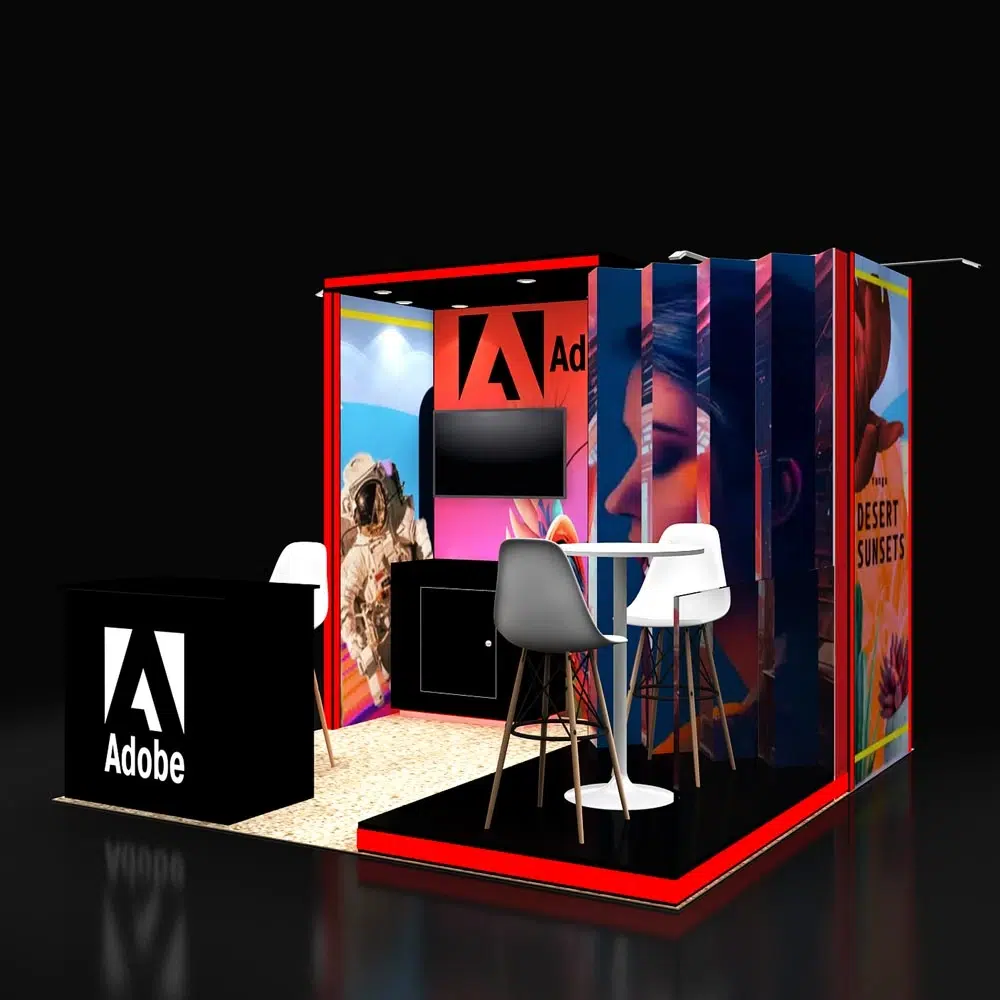
A full-height backlit tension fabric display is one of the highest-impact upgrades available for a 10×10 booth. The LED backlight makes your brand graphics visible from across the hall and eliminates the flat, print-on-foam look that signals a low-investment presence. Backlit displays are lightweight, pack into carry cases, and require no tool assembly — making them practical for exhibitors who travel frequently.
The key to making a backlit wall work is the graphic itself. A backlit display with a cluttered, text-heavy graphic is no better than a standard print. Keep the graphic to: your logo, one brand image, and one statement of four to six words. Nothing else.
Idea 6 — Modular Tower with Header
A freestanding modular tower — typically 84 to 96 inches tall — placed at the back or side of the booth creates vertical presence that is visible over the heads of attendees on a crowded show floor. Add a header panel that extends above the tower for maximum visibility at distance. This approach works particularly well at shows like CES or SEMA, where booth density is high and sightline competition is intense.
Idea 7 — Seamless Curved Back Wall
A curved back wall — using tension fabric stretched over a curved frame — eliminates the hard corner visible in a flat back-wall configuration and creates a more premium visual impression. The curve also softens the boundary between your booth and the aisle, which subtly increases the approachability of the space. Curved back walls are available in standard 10-foot widths and require no additional floor space.
Idea 8 — Floor-to-Ceiling Graphic Panels with Lighting Track
A set of rigid graphic panels — laminated prints on aluminum composite material — spanning the full back wall height, paired with a ceiling-mounted LED track light, delivers a polished, gallery-quality look at a lower cost than a full backlit system. The lighting track allows you to direct focused beams onto specific product displays or graphic zones, creating depth and visual hierarchy within the booth.
Idea 9 — Step-and-Repeat or Pattern Side Wall
If your booth has side wall exposure — typically available in corner or end-cap positions — a repeating brand pattern or logo step-and-repeat treatment on the side wall doubles your visible brand surface area without requiring any additional floor space. This is a standard tactic for brands that need to look prominent in press photographs or social media posts taken from the aisle.
Lighting Ideas for 10×10 Trade Show Booths
Lighting is the most underused tool in small booth design. The baseline lighting on a convention hall floor is functional, not flattering — it treats every booth equally. Exhibitors who add targeted lighting break out of that baseline and create a visual warmth that draws attention from exhibitors who have not invested in lighting at all.
Idea 10 — LED Spotlights on a Header Bar
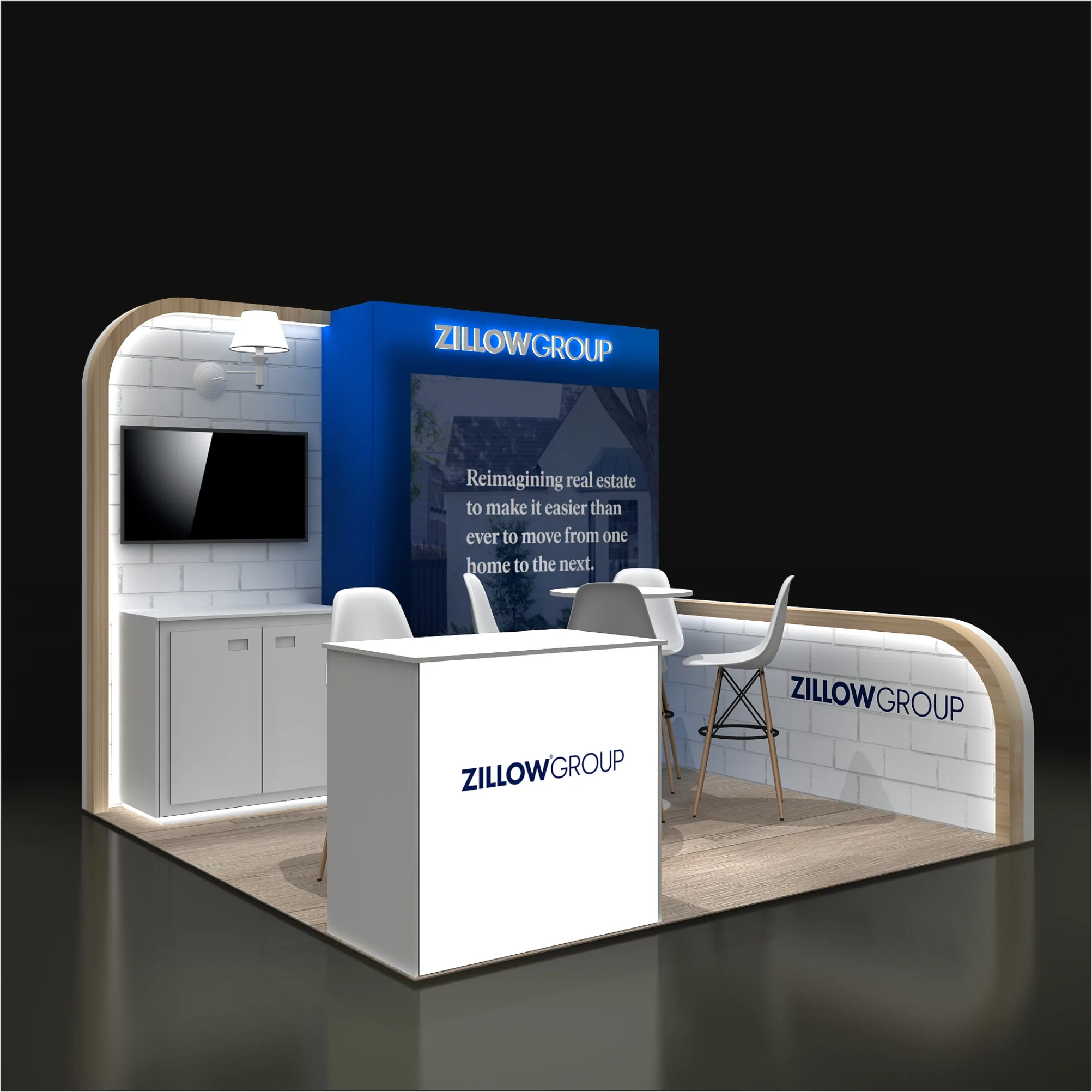
A horizontal LED bar mounted on a header or graphic frame, with two to four adjustable spot fixtures, is the single most cost-effective lighting upgrade for a 10×10 booth. Point one fixture at your back-wall graphic, one at your product display, and one at your counter surface. The result is a booth that looks professionally lit rather than passively illuminated. Total weight and power draw are minimal — most show electrical orders accommodate this without additional amperage.
Idea 11 — Backlit Counter or Pedestal
A counter or product pedestal with an illuminated interior — typically achieved with an LED strip inside a frosted acrylic panel — creates a light source at eye level that draws attention to the display surface. This works especially well for jewelry, cosmetics, electronics, and precision tools, where the product benefits from close-up illumination.
Idea 12 — Color-Wash Lighting for Brand Identity
LED color-wash fixtures can cast a tinted light across your back wall in a brand color — blue for a tech company, warm amber for a food brand, clinical white for a healthcare exhibitor. When used intentionally, color-wash lighting reinforces brand identity before the attendee reads a single word of your graphics. When overused or poorly aimed, it creates a garish effect. One color-wash fixture aimed at the back wall is enough.
Display, Technology, and Interactivity Ideas
Technology integrations have become more accessible for smaller booth footprints. A 10×10 exhibitor in 2025 can run interactive experiences that were exclusive to island exhibits five years ago — without the weight, power, or cost overhead that previously made them impractical at this scale.
Idea 13 — 32-Inch to 43-Inch Monitor on a Counter Mount
A mid-size monitor mounted on a counter arm or integrated into a counter display panel runs product videos, demo reels, or digital lookbooks on a loop. This is the entry-level technology option for a 10×10 booth and requires only a standard 5-amp electrical connection. The monitor gives your booth motion and depth without requiring any attendee interaction. Pair it with a QR code that links to the full video or product catalog so interested attendees can continue reviewing your content after the show. See how this element works within a broader exhibition booth design framework for larger footprints.
Idea 14 — iPad or Tablet Lead Capture Station
A single iPad mounted on an articulating arm — positioned on the counter at attendee eye level — serves two functions simultaneously: an interactive product catalog or demo tool for attendees who want to explore independently, and a lead capture form that replaces manual badge scanning. Attendees who engage with the tablet are self-qualifying. The form data goes directly into your CRM. This setup costs less than $200 in hardware beyond a standard tablet and takes ten minutes to configure.
Idea 15 — 55-Inch Touchscreen Display
A 55-inch commercial touchscreen panel — available as a rental add-on from most general service contractors at major shows — transforms a passive video loop into an interactive experience. Attendees can navigate product categories, watch demos on demand, and request information without waiting for a staff member. For technology, SaaS, and complex B2B product exhibitors, a touchscreen display converts the constraint of limited staff in a small booth into a self-service advantage.
Idea 16 — Product Demo Zone with Defined Footprint
If your product can be demonstrated physically — a tool, a device, a piece of software — dedicate the entire front half of your 10×10 space to the demonstration, not to display. Clear a surface, add a spotlight, and script a 90-second demo that any staff member can deliver consistently. Live demonstrations create crowds, and crowds signal activity to passing attendees. A 10×10 booth with three people watching a demonstration looks more active than an empty 20×20.
Furniture and Space Optimization Ideas
Furniture choices in a 10×10 booth directly determine how many meaningful conversations happen per hour. The wrong furniture configuration closes the space and signals to attendees that their visit will be short. The right configuration creates a reason to stay.

Idea 17 — Eliminate the Standard Table
The standard 6-foot skirted table that arrives with most basic booth packages is one of the worst furniture choices for a 10×10 space. It is wide, static, and creates a barrier that separates staff from attendees. Replace it with a custom counter at bar height (42 inches) with two stools on the attendee side. Bar-height counters facilitate standing conversation without the barrier signal of a table, and the stools give attendees a reason to stay for longer discussions.
Idea 18 — One Branded Counter, One Storage Cabinet
A branded counter with lockable storage underneath eliminates the need for a separate storage area or visible collateral bins. Staff can keep literature, giveaways, and personal items in the cabinet and present only what is currently in use on the counter surface. The booth looks clean and intentional rather than cluttered.
Idea 19 — Floating Shelves for Product Display
Wall-mounted floating shelves on the back wall — available in aluminum extrusion systems that attach to standard display hardware — allow you to display physical products at multiple heights without consuming any floor space. Three shelves, staggered at 36, 54, and 72 inches, turn the back wall into a vertical product gallery. Add individual spotlights for each shelf level.
Idea 20 — No Chairs Inside the Booth
This is counterintuitive but consistently effective: remove chairs from inside the booth entirely. Staff who sit in chairs inside a 10×10 booth are visually unavailable — they look occupied, resting, or disengaged. Staff who stand at the counter edge, slightly forward into the aisle, are actively present. If your show format requires seated conversations, use the divided layout described earlier and keep chairs only in the back partition zone.
Industry-Specific 10×10 Booth Ideas
Different show environments call for different executions of the same principles. The ideas below are organized by industry category. Most principles transfer across categories — the specifics differ.
| Industry | Priority Design Element | Recommended Layout | Key Idea to Apply |
|---|---|---|---|
| Technology / SaaS | Screen real estate and live demo space | Open peninsula | 55-inch touchscreen + iPad lead capture + no chairs |
| Healthcare / Pharma | Credibility, compliance imagery, and quiet conversation space | Divided layout | Backlit fabric wall + private meeting zone + tablet catalog |
| Food & Beverage | Sampling station and sensory branding | Open peninsula | Counter sampling surface + backlit product display + scent or audio element |
| Consumer Products | Product in the attendee’s hands as fast as possible | Open peninsula or L-shape | Product demo zone + floating shelves + illuminated pedestal |
| Manufacturing & Industrial | Spec sheets and technical credibility at scale | Full back-wall | Monitor loop + branded counter with storage + modular tower |
| Professional Services | Trust signals and qualified conversation | Divided layout | Curved back wall + bar-height counter + tablet lead capture |
| Fashion / Apparel / Jewelry | Product presentation and visual premium signal | L-shape or full back-wall | Backlit display + illuminated counter + floating display shelves |
What to Avoid in a 10×10 Trade Show Booth
-
Avoid putting more than two products on display simultaneously. If you have a broad catalog, use a digital screen or tablet to show the range. Physical product overload signals disorder.
-
Avoid floor-level displays. Anything placed below waist height on a crowded show floor is invisible. Every display element should sit between 36 and 84 inches from the floor.
-
Avoid text-heavy back-wall graphics. A graphic that requires reading is a graphic that gets skipped. If your back wall has more than 15 words on it, the design needs a revision.
-
Avoid having more than two staff members in the booth at once. Three or more staff in a 10×10 space leaves no room for attendees. Rotate staff in shifts.
-
Avoid generic stock imagery on your graphics. Convention hall attendees see hundreds of stock photos per hour. A real product photo, a real customer result, or a real application image is always more effective.
-
Avoid collateral stacks. A visible stack of brochures or catalogs signals that many people have already passed without taking one. Use a closed display holder and replenish it frequently so it always looks full.
Want a 10×10 Booth Designed Around These Ideas?
See Pure Exhibits’ Rental Packages.
How Rental vs. Purchase Affects Your 10×10 Booth Options
Most of the ideas in this guide are fully achievable with a rental booth. Pure Exhibits’ 10×10 rental packages include custom design, backlit or standard back-wall options, branded counter with storage, and graphics — all sized for a 10×10 inline space. The rental structure is built to the same quality standard as a purchased exhibit, and the Prebuilt Guarantee ensures it assembles correctly at the show without on-site adjustments.
Rental makes particular sense for 10×10 exhibitors who: exhibit at one to three shows per year, exhibit in different cities each time, are testing a new show before committing to an annual presence, or want to update their design between shows without buying new hardware. Purchasing a 10×10 exhibit makes sense for companies with a fixed annual show schedule, a consistent display concept, and the storage and logistics infrastructure to manage the asset between events.
If your show calendar includes multiple cities — Las Vegas, Atlanta, Chicago, Houston — Pure Exhibits manages the full logistics chain from our Las Vegas facility to each venue.
10×10 Booth Planning Checklist
| Planning Step | Key Decision | Deadline Before Move-In |
|---|---|---|
| Define one primary objective | Lead capture, product awareness, or sales conversation? | 10 weeks out |
| Choose your layout | Full back-wall, L-shape, open peninsula, or divided? | 9 weeks out |
| Brief your designer | Brand assets, booth number, aisle exposure, primary objective | 8 weeks out |
| Approve 3D rendering | Confirm layout, graphic placement, furniture position | 7 weeks out |
| Finalize graphics | Back wall, counter graphic, header — maximum 15 words on back wall | 6 weeks out |
| Order electrical | Specify amperage for monitor, lighting track, and tablet charger | 5 weeks out |
| Confirm freight routing | Advance warehouse vs. direct-to-show — confirm deadline with show | 4 weeks out |
| Brief booth staff | 90-second open, qualification question, demo sequence, lead capture process | 1 week out |
| Verify advance warehouse receipt | Confirm your crates were received and signed for | 3 days before move-in |
| Post-show lead follow-up | First follow-up email within 24 hours of show close | Day after show |
Let’s Build Something Extraordinary
Share your event details and we’ll craft a custom booth solution designed to captivate your audience and maximize your ROI.
Frequently Asked Questions
What is the most effective layout for a 10×10 trade show booth?
The full back-wall configuration — a full-height graphic wall at the rear with a counter positioned to one side — is the most consistently effective layout for a 10×10 space. It maximizes brand visibility from the aisle, keeps the entry open, and works across virtually every industry and show environment. For exhibitors in corner positions or with demonstration-heavy products, the L-shape and open peninsula layouts outperform the standard back-wall configuration for their specific use cases.
How do I make a 10×10 trade show booth stand out on a crowded floor?
Three elements make a 10×10 booth stand out from neighboring spaces: vertical presence (a tall display element visible above attendee head height), targeted lighting (at minimum, an LED spotlight on your back-wall graphic), and staff positioning (standing forward at the counter edge rather than sitting inside the booth). These three changes require no additional floor space and can be implemented in any 10×10 configuration. High-resolution, brand-specific photography on the back wall adds a fourth layer of differentiation.
How many products should I display in a 10×10 booth?
Display a maximum of two to three hero products in a 10×10 space. More than that creates visual clutter that makes the booth look crowded and makes it harder for attendees to identify what you are actually selling. If you have a broader catalog, use a digital screen, tablet catalog, or QR code to show the full range. The physical display should represent your best work — not your complete inventory.
What is the best way to create privacy for conversations in a 10×10 booth?
The divided layout achieves the best balance of conversation privacy and aisle visibility in a 10×10 space. A waist-height partition at the rear third of the booth creates a semi-enclosed meeting zone without fully closing off the back of the space from the aisle. This configuration works for healthcare, financial services, enterprise technology, and any industry where qualified one-on-one conversations are more valuable than high attendee volume.
Is a backlit display worth the cost for a 10×10 booth?
Yes, in most cases. A backlit tension fabric display is the single highest-return lighting investment for a 10×10 booth. The LED illumination makes the booth visible from across the convention hall, eliminates the flat appearance of standard print graphics, and communicates a premium brand presence that non-backlit booths cannot match at any aisle distance. The cost premium over a standard fabric display is typically $500 to $1,500 for a rental, depending on the frame system and graphic size.
Can I use a monitor or screen in a 10×10 trade show booth?
Yes. A 32-inch to 55-inch monitor is a practical and effective addition to a 10×10 booth. A 32-inch to 43-inch screen mounted on a counter arm requires only a standard 5-amp electrical connection and provides a continuous product video loop that adds motion and depth to the space. A 55-inch touchscreen — available as a rental add-on from most show general contractors — enables interactive product exploration. Confirm the electrical requirements for your specific show and order the required amperage through the show’s official electrical contractor.
How should I brief my booth staff for a 10×10 exhibit?
Staff briefing for a 10×10 booth should cover four elements: a 90-second opening that establishes who you are and what you solve (not a product feature list), a single qualification question that determines whether the attendee is a real prospect, a focused demonstration or explanation sequence for qualified prospects, and a lead capture process that takes less than 30 seconds. In a 10×10 space, staff performance is the primary variable in lead quality — the booth design creates the opportunity, and the staff converts it.
What furniture works best in a 10×10 trade show booth?
A bar-height branded counter (42 inches) with one or two stools on the attendee side is the most effective furniture configuration for a 10×10 space. The bar height facilitates standing conversation without the barrier signal of a standard table, and the stools give attendees a reason to stay for a longer discussion. A counter with lockable storage underneath eliminates the need for a separate storage area. Avoid placing chairs inside the booth for staff — seated staff appear visually unavailable to passing attendees.
What graphics work best on a 10×10 back wall?
A 10×10 back-wall graphic that performs at the show floor level has three elements: your logo at the top third of the wall (visible above attendee heads), one full-bleed brand image that communicates your category without text, and one statement of four to six words maximum that answers the question ‘what do you do?’ The graphic should be designed for viewing at 15 to 20 feet, not at arm’s length. Avoid small text, paragraph copy, multiple headlines, and feature lists on the back wall — those belong on your counter literature or digital screen.
What is the difference between renting and buying a 10×10 trade show booth?
Renting a 10×10 booth eliminates the capital expenditure, storage costs, and logistics overhead of ownership. Pure Exhibits’ rental packages include custom design, fabrication, freight, installation, and dismantling — all for a fixed per-show fee. Purchasing makes sense for companies with a stable annual show schedule, consistent display requirements, and internal logistics capacity. For exhibitors who show once or twice per year, vary their cities, or want to update their design frequently, rental provides equivalent quality at lower total cost.
How do I maximize lead capture in a 10×10 booth?
Place your lead capture tool — a badge scanner, an iPad form, or a QR code linked to a landing page — at the single most natural interaction point in your booth: the counter surface or the tablet mount beside your product demo. Do not make lead capture feel like a separate step. Build it into the natural conversation flow: ‘Can I grab your contact information so I can send you the full spec sheet?’ works better than a clipboard at the booth exit. Follow up within 24 hours of show close — response rates drop significantly after 48 hours.
Can a 10×10 trade show booth look as professional as a larger exhibit?
Yes — with the right design decisions. A backlit back wall, targeted LED lighting, a branded counter, and print-quality graphics produce a 10×10 booth that reads as professional and intentional from the aisle. The size difference becomes invisible when the design quality is high. The booths that look inferior to their neighbors at 10×10 are almost always the result of underinvestment in graphics and lighting, not the result of insufficient space.