
Las Vegas is the single most competitive trade show market in the United States. More major shows are held here than in any other city — CES alone draws 140,000+ attendees and 4,000+ exhibitors to the Las Vegas Convention Center each January. SEMA fills the LVCC with 2,400+ exhibitors in November. NAB Show, Pack Expo Las Vegas, and HIMSS rotate through the LVCC and neighboring properties on an annual calendar that runs nearly year-round.
What that density means for booth design is straightforward: the design standard in Las Vegas is higher than at regional or single-industry shows. Exhibitors who rely on a back wall and a folding table at a Midwest trade show find themselves invisible at CES. The attendees are more experienced, the neighboring booths are more polished, and the decisions about which booths are worth entering are made faster and more ruthlessly than anywhere else.
This guide covers what trade show booth design in Las Vegas actually requires — venue-specific considerations, design principles that hold across LVCC shows, and the approaches that consistently produce lead volume at the most competitive events in the country. Pure Exhibits is based in Las Vegas and designs and installs booths at every major LVCC venue. See our Las Vegas trade show booth rental page for rental package details and our exhibition booth design service for the full design process.
Exhibiting in Las Vegas?
Get Your Custom 3D Booth Design in 72 Hours.
Why Trade Show Booth Design in Las Vegas Demands a Higher Standard
Most trade show markets have a natural floor — a minimum design quality that the average exhibitor meets. In smaller regional shows or single-industry events, a clean 10×10 with a standard back wall and a branded counter performs respectably because the competition around it is at a similar level.
Las Vegas does not have that floor. At CES, your 10×10 booth in the Venetian Expo sits next to a company that spent $150,000 on a custom island with LED walls, overhead rigging, and a dedicated product launch stage. At SEMA, your inline exhibit competes for foot traffic against custom automotive installations with working vehicles and multi-story structures. At NAB Show, technology companies demonstrate broadcast and production gear with immersive AV environments that are essentially mini production studios.
This does not mean a small exhibitor cannot compete at Las Vegas shows. It means the design approach must account for the competitive context — and that generic, catalog-style booth designs will not generate meaningful foot traffic in this environment, regardless of how strong the underlying product or service is.
| Design Factor | Regional Show Standard | Las Vegas Show Standard |
|---|---|---|
| Back wall graphics | Printed fabric or foam board; brand logo and tagline | High-resolution backlit or tension fabric; photography-driven, minimal text |
| Lighting | Convention hall overhead; no supplemental lighting common | Targeted LED on every display surface; backlit displays standard at 10×10+ |
| Structural height | Standard 8-foot back wall | 10- to 16-foot back wall or tower where rules allow; hanging signs at island |
| Counter design | Standard draped table or generic rental counter | Branded custom counter; integrated monitor or illuminated surface |
| Technology integration | Optional — not expected | Expected at CES, NAB, and technology shows; touchscreen or demo monitor standard |
| Staff positioning | Often seated behind table | Standing at booth edge; active aisle engagement required at high-traffic shows |
Las Vegas Trade Show Venues and Design Rules That Affect Your Booth
Each Las Vegas venue has specific structural regulations that constrain — and in some cases expand — what is possible in booth design. Understanding these rules before the design phase prevents costly revisions during fabrication or on-site rejections during move-in.
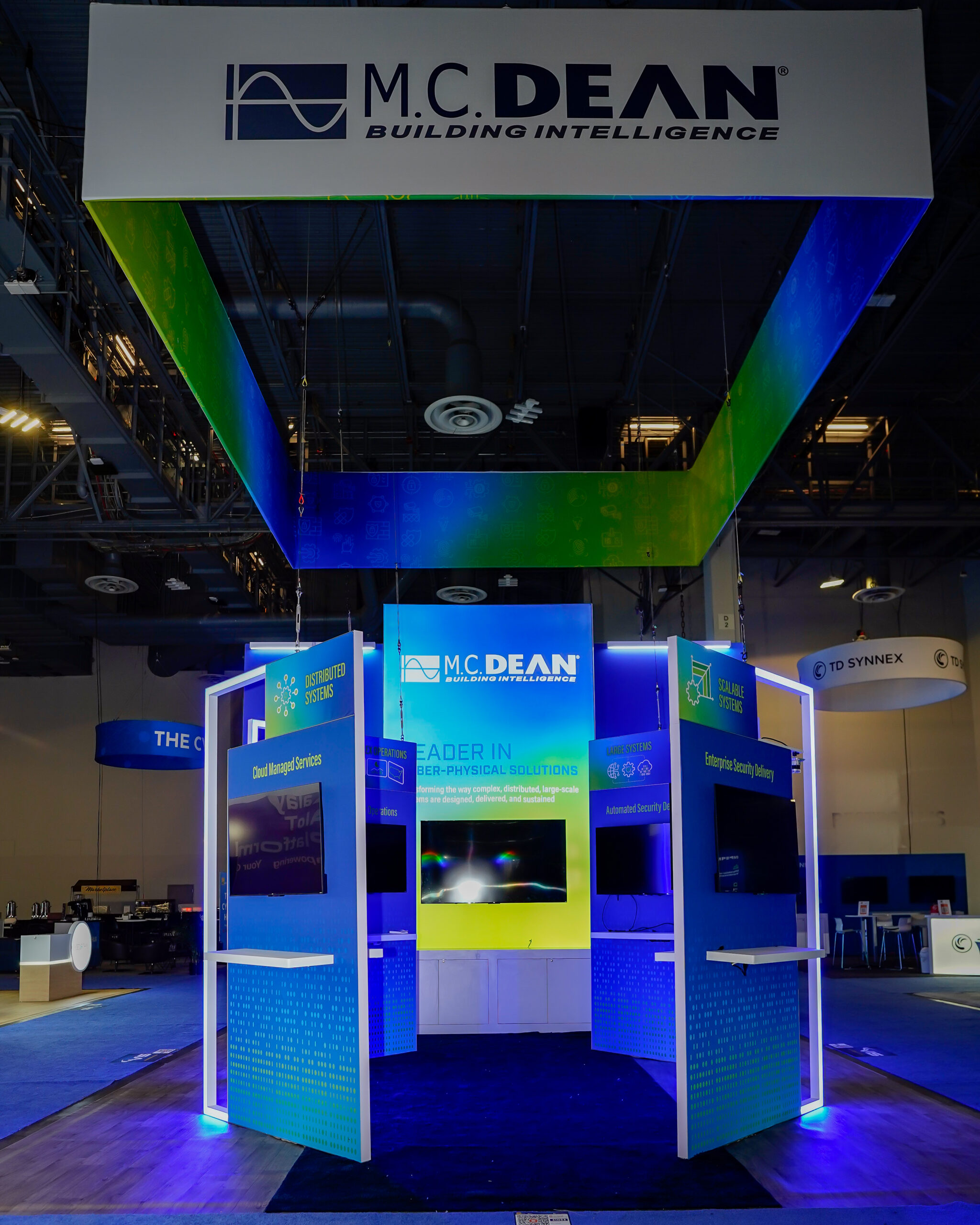
Las Vegas Convention Center (LVCC)
The LVCC is the primary venue for CES, NAB Show, SEMA, Pack Expo Las Vegas, and dozens of other major shows. The facility includes the North, Central, South, and West halls, plus the 1.4-million-square-foot West Hall expansion opened in 2021. Inline booth height limits at the LVCC are typically 8 feet for standard inline positions, with end-cap and island configurations allowing greater height — up to 16 feet or higher depending on the show’s specific rules. Hanging signs and overhead elements require advance approval from the general service contractor (Freeman handles much of the LVCC calendar) and must comply with the venue’s rigging regulations.
The LVCC’s West Hall features higher ceilings than the older halls, which gives island exhibitors more structural options for towers and elevated elements. Inline exhibitors in West Hall also benefit from more generous aisle widths, which increases sightline distance and makes tall graphic displays more effective.
Mandalay Bay Convention Center
Mandalay Bay is the primary venue for HIMSS, one of the largest healthcare IT conferences in the world, as well as several other annual healthcare and finance events. The venue has a more contained footprint than the LVCC, with lower ceiling heights in some hall segments. Booth designs for Mandalay Bay events should account for the lower ambient light levels in certain hall configurations — backlit displays perform especially well here because they provide their own light source rather than relying on overhead convention lighting.
Venetian Expo and Caesars Forum
The Venetian Expo (formerly Sands Expo) hosts CES overflow exhibits, cybersecurity events, and several major technology and finance conferences. Caesars Forum opened in 2020 and handles mid-size events and conferences with a premium hotel-adjacent exhibit environment. Both venues attract exhibitors who invest heavily in design — the typical attendee profile at these properties is senior-level and accustomed to polished brand environments.
MGM Grand Conference Center
MGM Grand hosts smaller shows and satellite events that attract targeted audiences rather than mass floor traffic. For these events, booth design can prioritize meeting functionality over display scale — a high-quality 10×10 or 10×20 with a strong private conversation zone outperforms a large display-focused configuration when the show format is appointment-driven.
Show-Specific Booth Design Guidance for Las Vegas Events
The same booth design does not work equally well across all Las Vegas shows. Audience profile, show density, floor traffic patterns, and engagement style vary significantly from CES to SEMA to HIMSS. The table below summarizes what works — and what to prioritize — at the major Las Vegas shows.
| Show | Venue | Design Priority | Key Design Element |
|---|---|---|---|
| CES | LVCC, Venetian Expo | Technology demonstration and visual scale | Large monitor or video wall + interactive demo station + backlit display |
| SEMA | LVCC | Brand boldness and product presentation at scale | Maximum graphic height, illuminated product pedestals, bold color treatment |
| NAB Show | LVCC | AV quality and production environment immersion | High-resolution display walls, professional lighting rig, sound management |
| Pack Expo Las Vegas | LVCC | Functional product demonstration | Working equipment display, clear sightlines, demo zone with safety clearance |
| HIMSS | Mandalay Bay | Clinical credibility and private conversation | Clean corporate design, backlit display, dedicated meeting zone |
| Re:Invent (AWS) | Venetian / Caesars | Brand innovation signal and developer engagement | Interactive touchscreen, open entry, tech-forward material palette |
| MJBizCon | LVCC | Differentiation in a high-density show | Strong brand color, distinctive structural element, visible product display |
| CONEXPO-CON/AGG | LVCC + Las Vegas Festival Grounds | Equipment scale and outdoor presence | Structural height, heavy equipment display, premium branded surround |
Design Principles That Hold Across All Las Vegas Trade Shows
Show-specific adjustments matter, but certain design principles apply regardless of which Las Vegas venue or show you are exhibiting at. These are the fundamentals that separate consistently high-performing booth designs from designs that look good in renderings but underperform on the floor.

Principle 1 — Design for 20-Foot Visibility First
At a Las Vegas show, attendees are making approach decisions from 20 to 40 feet away. The design must communicate your brand category and primary value proposition from that distance — before the attendee is close enough to read body copy, see product details, or engage with staff. This means the back-wall graphic must work as a silhouette: your logo, one strong image, and a maximum of five to seven words of headline text. Everything else belongs in collateral, on a screen, or in a conversation.
Exhibitors who design their back wall for close-up reading — detailed product specs, multi-paragraph descriptions, dense feature lists — produce graphics that communicate nothing from 20 feet. The booth gets bypassed before the detailed content is ever seen.
Principle 2 — Vertical Presence Is Non-Negotiable
Las Vegas show floors are dense. Attendee sightlines at floor level are blocked by neighboring exhibits, product displays, and the movement of thousands of people. Vertical presence — a display element that rises above attendee head height and is visible over the crowd — is the single most reliable way to make a booth locatable and memorable from a distance. This applies to every booth size from 10×10 through custom islands. At 10×10 and 10×20, a tall back-wall tower or a header graphic extension achieves this. At 20×20 and larger, hanging signs and canopy structures carry the vertical presence function.
Principle 3 — Lighting Is Not Optional at Las Vegas Shows
Convention hall lighting at the LVCC and most Las Vegas venues provides functional illumination, not brand illumination. Exhibitors who add targeted LED spotlights to their display surfaces, backlit panels to their graphic walls, and illuminated counters to their work surfaces create a warm, distinctive visual environment that stands out sharply against the flat overhead lighting of non-investing neighbors. At a show like SEMA or CES where floor traffic peaks at 50,000+ attendees per day, a well-lit booth draws attention continuously — even from attendees who were not originally planning to visit your space.
Principle 4 — The Entry Must Be Unmistakably Open
Crowded Las Vegas show floors condition attendees to assess entry availability before committing to an approach. A booth where the entry is visually blocked — by a counter across the full front, by staff standing in the entry, or by display elements that close off the front face — signals ‘occupied’ to approaching attendees even when staff are available. The entry point of every booth should be the physically clearest, most visually open part of the design. Everything else in the layout should direct attention toward that entry point, not compete with it.
Principle 5 — Material Quality Signals Brand Quality
At Las Vegas shows, the physical quality of exhibit materials is evaluated by sophisticated attendees who have seen thousands of trade show booths. Fabric prints that sag, graphics printed at insufficient resolution, laminate surfaces that show wear, and lightweight plastic components that flex under handling all communicate a brand quality level to the attendee — whether the exhibitor intends them to or not. Pure Exhibits fabricates rental structures to the same material specification as custom purchased exhibits specifically because this quality signal matters on a Las Vegas show floor.
Booth Size Recommendations for Las Vegas Trade Shows
The competitive density of Las Vegas shows shifts the size recommendation thresholds compared to regional markets. A 10×10 booth that performs well at a single-industry regional show may need to be a 10×20 or 20×20 at CES or SEMA to achieve the same relative presence. The table below reflects those adjusted thresholds.
| Exhibitor Profile | Recommended Las Vegas Size | Reasoning |
|---|---|---|
| First-time Las Vegas exhibitor, any show | 10×10 minimum — 10×20 preferred | 10×10 is viable if design investment is high; 10×20 recommended at CES and SEMA |
| Technology / SaaS at CES or Re:Invent | 10×20 minimum | Demo environment needs physical separation from entry; single screen not competitive at CES scale |
| Healthcare brand at HIMSS | 10×20 with meeting zone | Private conversation zone is functionally required for clinical and procurement discussions |
| Automotive at SEMA | 20×20 or larger | SEMA island builds and product displays at 10×10 are visually overwhelmed by competition |
| Industrial at Pack Expo Las Vegas | 10×20 with equipment clearance | Working equipment requires demo zone separation; 10×10 insufficient for most equipment footprints |
| Emerging brand / startup at any LV show | 10×10 with maximum design investment | Better to have a strong 10×10 than an under-designed 10×20; design investment beats square footage |
| Established brand, annual LV presence | 20×20 or larger | Returning audience has brand expectations; size signals stability and growth |
Designing for a Las Vegas Show?
See Pure Exhibits’ Rental Packages and Design Process.
Pure Exhibits’ Booth Design Process for Las Vegas Shows
Pure Exhibits is headquartered in Las Vegas. Every booth we design for an LVCC, Mandalay Bay, Venetian, or MGM Grand show is designed by a team that works in this market year-round — not a team that visited once or designs from general trade show knowledge. The exhibition booth design process is identical for Las Vegas as for any other market, but the design decisions that inform the 3D rendering are calibrated specifically for the show environment your booth will be installed in.
Step 1 — Discovery Brief with Las Vegas Context
Every Pure Exhibits project starts with a structured brief. For Las Vegas shows, the brief includes show-specific questions that do not apply to other markets: Which hall are you in at the LVCC? What is the aisle configuration — will you have two or four sides of exposure? Are hanging signs permitted by show management? What are the neighboring booth sizes in your floor section? These questions directly inform design decisions around height, sightline angles, and graphic priority zones.
Step 2 — 3D Rendering in 72 Hours
The initial 3D rendering is delivered within 72 hours of your approved brief. For Las Vegas shows, the rendering includes the booth placed in a simulated convention hall environment with adjacent exhibits and aisle traffic represented, so you can evaluate the design as it will actually appear from the show floor — not in isolation against a white background. This context-aware rendering is the single most useful tool for identifying design adjustments before fabrication begins.
Step 3 — Fabrication and Prebuilt Guarantee
After design approval, the booth is fabricated at Pure Exhibits’ Las Vegas facility. Every structure is fully assembled and inspected before it is crated and shipped to the show — the Prebuilt Guarantee. For Las Vegas shows, this means the booth is pre-verified at the same facility where it was built, by the same team that will install it at the venue. If a component fails inspection, it is replaced before the crate leaves the building. The crew installing your booth at the LVCC is working with a pre-verified structure, not discovering problems at 5 a.m. on move-in morning.
Step 4 — Installation by LVCC-Experienced I&D Crew
Pure Exhibits’ I&D crews have installed booths at the LVCC across all four halls, at Mandalay Bay, at the Venetian Expo, and at MGM Grand. They know the loading dock schedules, the hall-specific move-in window assignments, the Freeman and GES coordination process for each venue, and the electrical grid layouts that affect booth positioning. This institutional knowledge eliminates the trial-and-error that crews new to a venue experience on their first installation at any given show.
Common Trade Show Booth Design Mistakes at Las Vegas Shows
-
Designing the back wall for close-up reading. At CES or SEMA, attendees will never be stationary in front of your booth long enough to read paragraph text. Every word on your back wall that requires the attendee to stop and read is a word that gets skipped.
-
Using stock photography on graphics. Las Vegas show attendees process hundreds of brand images per hour. Stock photography registers as generic immediately. Real product photography, real customer environments, and real application shots are distinguishable from stock within seconds.
-
Under-investing in lighting relative to neighbors. At a Las Vegas show, an unlit booth next to a backlit booth looks like the venue side wall. The lighting differential is not subtle — it is the primary factor that makes one booth visually present and another visually absent.
-
Placing the counter across the full booth front. A counter spanning the full width of a 10×10 or 10×20 is a physical barrier that prevents attendee entry. This mistake is more damaging at Las Vegas shows, where floor traffic is continuous and the decision to enter a booth is made in seconds.
-
Scaling down design investment because the booth is small. A 10×10 booth at CES with a $15,000 design investment outperforms a 10×10 at CES with a $3,000 design investment — because design quality is the primary competitive variable at this size. Budget allocation matters more than square footage at inline sizes.
-
Ignoring Freeman or GES deadlines for hanging signs and rigging. At LVCC shows, hanging sign approval and rigging orders must be submitted weeks in advance of move-in. Exhibitors who miss these deadlines either install without the overhead element or pay premium rush charges. Pure Exhibits tracks all applicable deadlines as part of the standard project scope.
Las Vegas as Part of a Multi-City Exhibit Program
Most exhibitors at major Las Vegas shows also exhibit at events in other cities. Pure Exhibits’ national installation network means the same design process, fixed pricing, and Prebuilt Guarantee applies whether your next show after Las Vegas is in Atlanta, Chicago, or Houston. For multi-city programs, Pure Exhibits holds your booth configuration in inventory between shows and manages freight from our Las Vegas facility to each venue. One project manager, one pricing structure, one consistent quality standard across every event on your calendar.
Let’s Build Something Extraordinary
Share your event details and we’ll craft a custom booth solution designed to captivate your audience and maximize your ROI.
Frequently Asked Questions
What makes trade show booth design in Las Vegas different from other cities?
Las Vegas hosts more major trade shows than any other U.S. city, which means the competitive density on the show floor is higher. At CES, SEMA, and NAB Show, your booth design competes directly with exhibitors who have invested heavily in custom structures, LED walls, and immersive brand environments. Design decisions that are sufficient at regional shows — standard back wall, generic counter, no supplemental lighting — are invisible in this context. Las Vegas requires a higher baseline design investment at every booth size to achieve the same relative presence.
What is the standard inline booth height at the Las Vegas Convention Center?
For standard inline positions at LVCC shows, the typical maximum height is 8 feet at the back wall. End-cap configurations generally allow 12 feet on all sides visible from the aisle. Island configurations allow heights up to 16 feet or higher in many LVCC halls, depending on the specific show’s rules and the hall’s ceiling clearance. Hanging signs at island positions require advance approval from the general service contractor and must comply with the venue’s rigging weight limits. Pure Exhibits reviews the height rules for your specific show and hall before designing your booth.
Which Las Vegas trade show requires the highest design investment?
CES and SEMA are consistently the most design-competitive Las Vegas shows. CES draws 4,000+ exhibitors and 140,000+ attendees, with neighboring booths ranging from 10×10 startups to $5-million island builds from global technology brands. SEMA features automotive builds and product displays that set a visual standard matched by few other shows anywhere in the country. For exhibitors at either show, design investment is the primary variable distinguishing booths that generate floor traffic from booths that do not.
Does Pure Exhibits design booths specifically for CES and SEMA?
Yes. Pure Exhibits designs and installs booths at CES, SEMA, NAB Show, HIMSS, Pack Expo Las Vegas, and all other major LVCC events. The design brief for each show includes show-specific questions about hall location, aisle configuration, hanging sign eligibility, and competitive context. The 3D rendering accounts for the physical environment of the specific hall rather than a generic convention floor, which means the design performs as expected when installed.
How far in advance should I start designing my Las Vegas trade show booth?
For major Las Vegas shows — CES, SEMA, NAB Show, HIMSS — Pure Exhibits recommends initiating the design project ten to twelve weeks before move-in. This allows time for brief development, 3D rendering, revision rounds, fabrication, and advance warehouse shipping without rushing any phase. For shows where hanging signs or overhead rigging are planned, the timeline should extend to twelve to fourteen weeks, as rigging approval from Freeman or GES requires advance submission that must be factored into the design schedule.
What general service contractor handles most Las Vegas Convention Center shows?
Freeman is the official general service contractor for the majority of LVCC shows, including CES, NAB Show, and Pack Expo Las Vegas. GES handles a portion of the LVCC calendar as well. Shepard and other contractors manage shows at Mandalay Bay, Venetian Expo, and MGM Grand. Pure Exhibits identifies the correct GSC for each specific show and manages all required coordination — advance warehouse authorization, drayage orders, rigging approvals, and electrical rough-in — as part of the standard project scope.
Is a hanging sign worth the cost at a Las Vegas trade show?
For island exhibit positions at LVCC shows, a hanging sign is almost always worth the investment. The sign provides overhead visibility above the crowd — making the booth locatable from across the hall — and signals a premium presence that inline and corner exhibitors cannot match. For 20×20 and larger island positions, a hanging sign is standard. For 10×10 and 10×20 inline positions, hanging signs are generally not permitted, making vertical back-wall elements the primary tool for above-head-height visibility.
Can I rent a custom-designed booth for a Las Vegas trade show?
Yes. Pure Exhibits provides custom-designed rental booths for Las Vegas shows at all sizes from 10×10 through full custom islands. The rental structure is designed specifically for your brand and show, fabricated at our Las Vegas facility, and installed by our LVCC-experienced I&D crew. The Prebuilt Guarantee ensures every rental structure is verified before it arrives at the show. Rental pricing is fixed per show and includes the complete scope — design, fabrication, graphics, freight, installation, and dismantling.
What is the best booth design approach for HIMSS in Las Vegas?
HIMSS exhibitors at Mandalay Bay benefit from a design approach that prioritizes clinical credibility and private conversation capacity. The recommended configuration is a clean corporate design — backlit display wall, branded counter, minimal visual noise — combined with a dedicated rear meeting zone where qualified clinical, procurement, or administrative conversations can occur without interruption from the open exhibit floor. Mandalay Bay’s hall lighting is lower than the LVCC, which makes backlit displays particularly effective at this venue.
How does Pure Exhibits handle Freeman coordination for Las Vegas shows?
Pure Exhibits manages all Freeman coordination for LVCC shows as part of the standard project scope. This includes submitting advance warehouse authorization, completing the material handling order, submitting hanging sign and rigging applications where applicable, and coordinating with the Freeman on-site supervisor during installation. Clients are not required to navigate the Freeman contractor portal or manage these administrative processes directly. Your project manager handles the complete Freeman interface from initial submission through show close.
What booth materials work best on the Las Vegas Convention Center show floor?
For the LVCC environment, Pure Exhibits recommends: backlit tension fabric for primary graphic surfaces (resists the washed-out appearance of standard prints under LVCC overhead lighting), powder-coated aluminum extrusion for structural frames (durable under repeated assembly and disassembly), high-pressure laminate for counter surfaces (resists wear over multi-day shows), and LED strip lighting for counter and shelf illumination. These material choices perform consistently across LVCC’s range of ambient lighting conditions and hold up through the heavy move-in and move-out traffic typical of major Las Vegas shows.
Does the booth design need to change between Las Vegas shows at different venues?
Structural changes between venues are rarely necessary for inline exhibits. A 10×10 or 10×20 designed for the LVCC can install at Mandalay Bay or the Venetian Expo without modification. Hanging sign configurations may need to be removed for venues with lower ceiling clearances. For island exhibits, height adjustments may be required if moving between the LVCC West Hall (high ceilings) and older LVCC halls or Mandalay Bay segments with lower clearances. Pure Exhibits reviews venue-specific height and rigging requirements for each show as part of the standard pre-installation checklist.