What is drayage? It is the fee you pay to move your trade show materials from the loading dock of the venue to your booth — and back again after the show closes. It is separate from your shipping costs, it is required at most large US convention centers and trade shows, and it is the expense that catches first-time exhibitors completely off guard.
Trade Show Drayage Definition: Trade show drayage (also called material handling) is the cost charged by a show's general contractor to move exhibit freight from the venue loading dock to an exhibitor's booth, store empty crates during the show, and return freight to the dock after the event. The terms drayage and material handling are used interchangeably in exhibitor services manuals.
Picture this: Your show went well. You stayed on budget. You packed up on the last day and flew home. Three weeks later, you open a final invoice from the show's general contractor. There is a line item you do not recognize — "material handling" or "drayage" — for more than you paid to ship your entire booth from your home city to the show. You are not alone. This happens to exhibitors at every show, at every venue, every year.
This guide explains exactly what drayage is, why it exists, how it is calculated, and what you can do before your next show to pay less of it.
What Does Trade Show Drayage Include?
Drayage is not a single action — it is a coordinated sequence that happens before the show opens, during the show, and after it closes.
Before the show:
- Your freight arrives at the venue loading dock or advance warehouse
- The general contractor's team unloads your shipment from the carrier's vehicle
- Freight is checked against your bill of lading and delivery documents
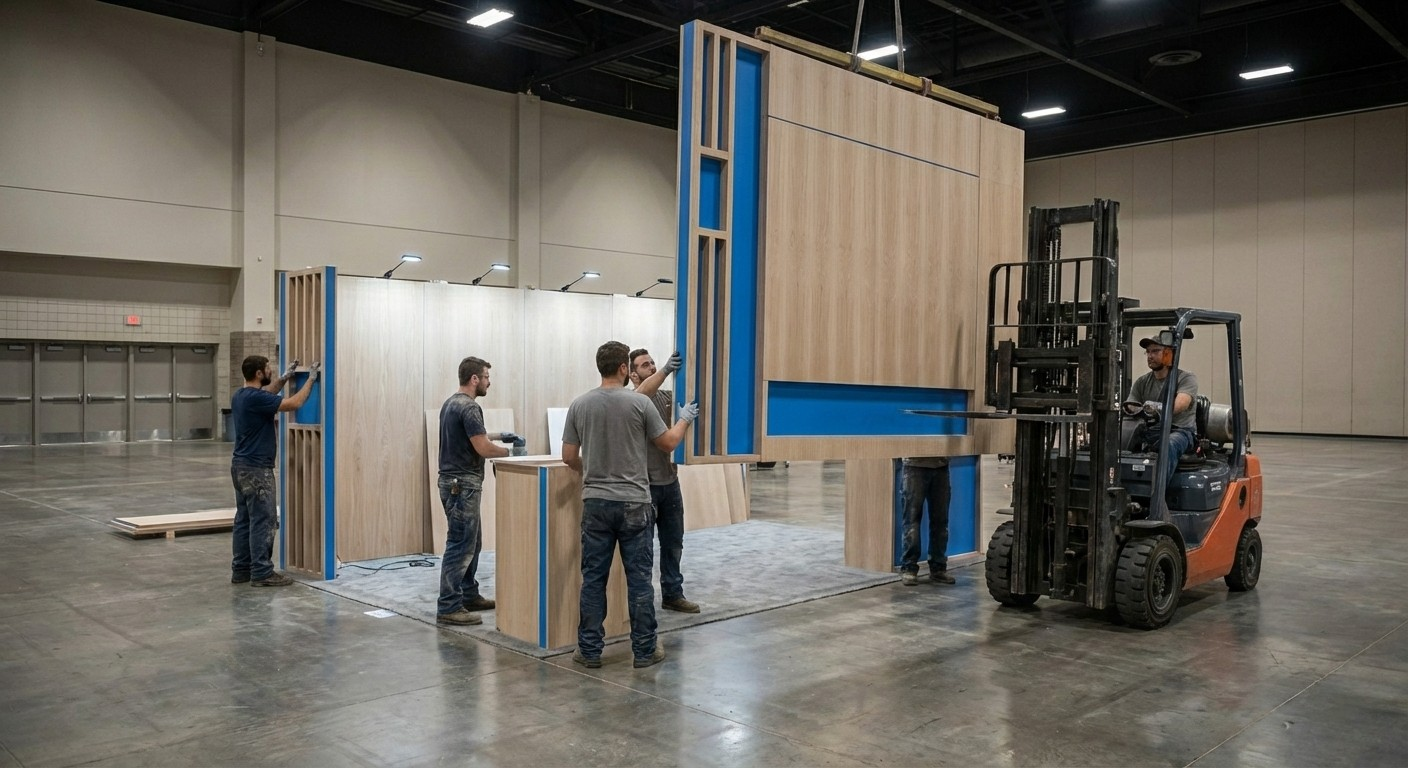
- Your materials are transported from the dock to your booth space using forklifts, pallet jacks, or hand trucks
- Empty crates, cases, and pallets are collected from your booth and taken to storage
During the show:
- Your empty crates and packaging are stored on-site or at a nearby facility
- They are held and tracked throughout the show
After the show:
- Empty crates are returned to your booth so you can repack
- Your repacked freight is collected from the booth
- Materials are transported from the booth back to the loading dock
- Your freight is loaded onto your outbound carrier's vehicle
- Outbound paperwork and bills of lading are completed
Every one of those steps is included in your drayage bill. The charge covers the labor, equipment, and time involved across the entire sequence — not just the move from the dock to your booth.
Why Trade Show Drayage Exists
Understanding why drayage exists is what makes the charge make sense — even if it never makes it feel less painful.
At every major US trade show, the show organizer designates a single company — called a General Contractor, or GC — as the exclusive provider of material handling services. Common GCs you will encounter at major shows include Freeman, GES, and Shepard. Exhibitors can hand-carry small items onto the show floor themselves, but any freight arriving via the loading dock must be handled exclusively by the show's general contractor. Your exhibit house cannot move it. Your own staff cannot move it for dock-delivered freight. The GC has exclusive rights over anything that comes through the loading dock — which is why you cannot shop around for a better drayage rate the way you can shop around for a shipping carrier.
The GC negotiates this exclusive arrangement with the show organizer in exchange for a package of services the organizer needs to run the show. Here is the part most guides do not explain: at many shows, some of those costs — aisle carpeting, registration counters, directional signage, the infrastructure of hosting the entire event — get rolled into exhibitor drayage bills. The material handling fees cover the cost of operating the advance warehouse and the venue's marshaling yard, the wages of forklift operators and other laborers, and the expense of maintaining the equipment itself.
In some show contracts — commonly referred to as a zero invoice arrangement — the show organizer pays the GC little or nothing directly, and the GC recoups its costs entirely through exhibitor service fees. This varies by show contract, but the underlying dynamic is consistent: most exhibitors do not realize they are partially subsidizing the show's own operating costs when they pay their drayage bill.
This is also why drayage is almost exclusively a US phenomenon. Exhibitors from outside the US who exhibit at American shows consistently report surprise at drayage as a separate cost item. In most countries, these logistics are handled differently and are not billed to exhibitors as a distinct line item.
How Trade Show Drayage Is Calculated
Drayage is calculated primarily by weight, measured in units called CWT — hundred-weight, or per 100 pounds. Every piece of freight you ship to a show is weighed, and that weight is rounded up to the next 100 pounds. Your total drayage bill is your total weight in CWT multiplied by the show's CWT rate.
Important: Not all shows use the CWT model. Since the pandemic, a growing number of shows — have moved to a per-pound model, where drayage is billed as a flat rate per pound rather than in CWT increments. Before your next show, check the exhibitor services manual to confirm whether your show charges by CWT or per pound. The manual will include a rate table for both inbound and outbound handling.
Example: You ship a crate that weighs 215 pounds. The show rounds up to 3 CWT (300 pounds). The CWT rate for that show is $100. Your drayage charge for that crate: $300.
The base CWT rate varies by show, city, and general contractor. Seven factors affect the final rate you pay:
- Where your freight delivers: Advance warehouse vs. direct-to-show is not a simple choice — the biggest determinant is the show city. Advance warehouse is not automatically less expensive. In Las Vegas, where GCs maintain established warehouse infrastructure near major venues, advance warehouse shipping tends to cost less because the GC can plan deliveries systematically and has space to do it efficiently. In cities where warehouse space is limited or logistics are more complex, direct-to-show can be the less expensive option. Check both rate tables in the exhibitor services manual and compare before deciding.
- When your freight delivers: Every show specifies delivery windows in the exhibitor services manual. Freight that arrives outside those windows — before they open, after they close, or during overtime hours — is billed at an overtime rate. Overtime rates vary significantly by show and city — they can range from 25 percent above the standard rate to double the standard rate. Check the exhibitor services manual for the specific show before booking your carrier.
- What type of carrier delivers it: Common carriers (TForce Freight, FedEx Freight, standard LTL carriers) deliver freight floor-loaded on pallets, which is easy to move by forklift and attracts lower drayage rates. Specialized carriers that blanket-wrap items, stack freight, or deliver mixed loads require additional labor and time, and attract higher drayage rates. Standard handling charges for specialized carrier freight can increase your drayage cost by up to 30 percent — the exact surcharge is listed in the exhibitor services manual.
- The type of freight: Standard crated or palletized freight gets the base rate. Fragile items, oversized items, items without pallets, or anything requiring special handling gets billed at a higher rate. Some shows add surcharges for items that cannot be moved by a standard forklift.
- Minimum charges per shipment: Every show has a minimum drayage charge per shipment — typically 200 pounds or 2 CWT. This is where packaging decisions have an outsized impact. If you ship five separate 25-pound boxes and the show charges a 2 CWT minimum per shipment, each of those boxes gets billed as 200 pounds. Five boxes that together weigh 125 pounds generate a drayage bill for 1,000 pounds. Consolidated into a single shipment, you pay 200 pounds.
- Rounding and weight management: Because drayage rounds up to the next 100 pounds, the weight of your crates matters in a specific way. A crate that weighs 308 pounds rounds up to 400 pounds — 4 CWT. A crate that weighs 398 pounds also rounds up to 400 pounds — 4 CWT. Ninety pounds of difference, same bill. If you have flexibility in how you pack your materials, keeping weights close to the upper end of each 100-pound band saves money. Note that some GCs allow a small weight buffer before rounding up — a few pounds of tolerance before the next CWT kicks in — but do not count on this. The safest approach is to pack as if rounding is exact.
- Show city and venue: Drayage rates in Las Vegas are generally lower than in cities with higher labor costs or more limited logistics infrastructure. New York, Boston, and San Francisco consistently show higher drayage rates than Las Vegas or cities with newer, purpose-built convention infrastructure.
Advance Warehouse vs Direct Shipping for Trade Show Drayage
This is the most consequential logistics decision you make before each show. It affects both your shipping costs and your drayage rate — and the right answer depends on the show city, not a universal rule.
Advance warehouse means shipping your freight to a GC-operated warehouse in the show city weeks before the event. The GC stores it and delivers everything to the show floor on a coordinated schedule during move-in. The window for advance warehouse deliveries is typically two to four weeks before the show opens — check the exhibitor services manual for exact dates.
Direct to show site means your carrier delivers freight directly to the venue's loading dock during the move-in window. The dock is busy, timing is tight, and carriers may face long wait times.
In Las Vegas, advance warehouse shipping tends to be the less expensive option because GCs maintain established warehouse facilities near the LVCC, Venetian Expo, and Mandalay Bay and can process freight efficiently. In other cities where warehouse space is limited, direct-to-show can be competitive or less expensive. Always check both rate tables in the exhibitor services manual — they are listed side by side — and run the numbers for your specific shipment before deciding.
10 Ways to Reduce Trade Show Drayage Costs
None of these requires renegotiating with the GC. They all work within the system as it exists.
- Consolidate shipments: Never ship small items separately if you can combine them. Each shipment incurs a minimum charge. Fewer shipments equals lower total cost.
- Use common carriers wherever possible: TForce Freight, FedEx Freight, and standard LTL carriers attract lower drayage rates than specialized exhibit carriers. Use them for freight that does not require special handling.
- Reduce total weight: Every pound you do not ship is a pound you do not pay drayage on. Switch from heavy printed literature to digital displays. Choose lighter booth materials. Every ounce matters when multiplied by the CWT rate.
- Pack for forklift access: Freight on pallets or in standard crates that a forklift can move without special handling gets the standard rate. Freight that requires hand-carrying, blanket-wrapping, or special equipment costs more. Design your packing with a forklift in mind.
- Check both rate options before choosing advance warehouse or direct ship: In Las Vegas, advance warehouse tends to cost less. In other cities, direct-to-show can be competitive. Always check both rate tables in the exhibitor services manual and run the numbers for your specific shipment weight.
- Deliver within the specified window: Late deliveries are billed at overtime rates that can reach double the standard rate. Know the delivery windows from the exhibitor services manual before you book your carrier.
- Manage your weights deliberately: If you have flexibility, adjust packing so crate weights sit close to the upper end of each 100-pound band rather than just above the lower end. A 398-pound crate costs the same as a 308-pound crate.
- Label everything correctly: Mislabeled freight causes delays, manual sorting, and sometimes additional handling charges. Use the GC's official labels from the exhibitor services manual and apply them to every piece.
- Check your invoice before you leave: With thousands of inbound and outbound shipments processed at a single show, mistakes happen. Keep records of every crate, its weight, and its delivery time. If something on your drayage invoice does not match your records, dispute it at the GC service desk before you leave the show.
- Hand-carry small items from your hotel: Any item you personally carry onto the show floor bypasses the drayage system entirely. Ship small items — promotional materials, product samples, personal equipment — to your hotel and carry them yourself. At major Las Vegas shows, this can meaningfully reduce your total drayage bill for lightweight items you would otherwise have consolidated into a crated shipment.
Drayage and the Rental Booth Advantage
One drayage reduction strategy that most guides cannot mention: rent your booth instead of owning it.
When you own a booth and ship it across the country to Las Vegas or Chicago, you are paying freight costs plus drayage on the full weight of every component — structure, graphics, furniture, AV equipment, flooring. The larger the booth size, the more components, and the higher the drayage bill. When you rent from a Las Vegas-based exhibit company, your booth is already in Las Vegas. It travels from a warehouse near the venue to the show floor. Freight costs are eliminated or dramatically reduced. Drayage applies only to the materials you bring yourself — literature, products, personal items.
For exhibitors at Las Vegas shows, this math is significant. A 20x20 exhibit shipped from the East Coast generates meaningful freight and drayage costs at every show. The same booth rented from a local Las Vegas company eliminates most of that expense. The savings on freight and drayage alone can offset a large portion of the rental cost, depending on show frequency.
Pure Exhibits manages freight coordination as part of every Las Vegas booth rental — which means shorter freight distances, lower shipping costs, and a team that already knows the advance warehouse process at the LVCC, Venetian Expo, and Mandalay Bay. Your team arrives focused on the show, not on tracking crates. See how Las Vegas booth rentals work.
For a full breakdown of what Las Vegas booth rental costs include — and what they eliminate — see the trade show booth rental pricing guide.
What to Do Before Your Next Show
Drayage is not negotiable, but it is manageable. The exhibitors who get surprised by drayage bills are the ones who did not read the exhibitor services manual, shipped loose boxes instead of consolidated crates, or missed the advance warehouse window.
The exhibitors who control their drayage costs do four things: they read the rate tables in the exhibitor services manual before booking their carrier, they consolidate everything into as few shipments as possible, they ship to the advance warehouse when it makes sense, and they work with an exhibit partner who knows the venue and the process well enough to flag problems before they become invoices.
If you are exhibiting at a Las Vegas show, Pure Exhibits manages freight coordination as part of every booth rental — so your team arrives focused on the show, not on tracking crates.
About Pure Exhibits
Pure Exhibits is a premium American trade show booth rental company based in Las Vegas, Nevada — 20 minutes from Las Vegas Convention Center, Venetian Expo, and Mandalay Bay. We provide full-service, all-inclusive trade show booth rentals nationwide, with transparent pricing published on our website. No last-minute surprises. No hidden fees.
From first design concept to final dismantling, every project is managed by a single dedicated project manager — one point of contact, complete accountability.
Trusted by Fortune 500 companies and fast-growing brands across technology, healthcare, automotive, and consumer goods.
Let's Build Something Extraordinary
Share your event details and we'll craft a custom booth solution designed to captivate your audience and maximize your ROI.
Frequently Asked Questions
What is drayage at a trade show?
Drayage is the fee charged by the show's general contractor to move your exhibit materials from the venue's loading dock to your booth before the show, store your empty crates during the show, and return your freight to the dock after the show closes. It is separate from your shipping cost and is required at most large US convention centers and trade shows. Exhibitors can hand-carry small items personally, but any freight arriving via the loading dock must be handled by the designated GC.
Why is trade show drayage so expensive?
Trade show drayage is expensive because the show's general contractor holds exclusive rights to move dock-delivered freight at the venue. The GC's fees also cover the cost of operating the advance warehouse, the venue's marshaling yard, forklift operators, and equipment maintenance. At many shows, some of the event's own infrastructure costs are recovered through exhibitor drayage bills. Union labor requirements at major venues add to the cost.
Is drayage the same as freight?
No. Freight is the cost of shipping your materials from your origin location to the trade show city — you can shop this with multiple carriers. Drayage is the cost of moving materials from the venue's loading dock to your booth — you cannot shop this. It is charged exclusively by the show's designated general contractor.
How is trade show drayage calculated?
Most shows calculate drayage by weight in units called CWT (hundred-weight, or per 100 pounds). Your total freight weight is rounded up to the next 100 pounds and multiplied by the show's CWT rate. A growing number of shows now use a per-pound model instead — check the exhibitor services manual to confirm which model applies to your specific show.
What is CWT in drayage?
CWT stands for hundred-weight — the cost per 100 pounds of freight. If the show charges $100 per CWT and your crate weighs 215 pounds, your crate rounds up to 3 CWT and your drayage charge is $300. Every 100 pounds (or partial 100 pounds) is billed as a full CWT. Some GCs allow a small weight buffer before rounding up, but the safest approach is to plan as if rounding is exact.
What is an advance warehouse in trade shows?
An advance warehouse is a GC-operated storage facility near the show venue where you can ship your freight weeks before the event. The GC delivers everything to the show floor on a coordinated schedule during move-in. Whether advance warehouse or direct-to-show is less expensive depends on the show city — in Las Vegas, advance warehouse tends to cost less because GCs maintain established warehouse facilities near major venues. Always check both rate tables in the exhibitor services manual before deciding. If you want to minimize what you ship altogether, see what to bring to a trade show for a guide to packing only what you actually need.
Can I avoid drayage at a trade show?
You cannot avoid drayage entirely at most major US trade shows. But you can reduce it significantly by consolidating shipments, using common carriers, reducing total weight, hand-carrying small items from your hotel, and managing crate weights to minimize rounding-up charges. Renting a booth from a local exhibit company eliminates the freight component entirely — see types of trade show booths for how different booth configurations affect the total weight you need to ship.
Who handles drayage at Las Vegas trade shows?
Drayage at Las Vegas Convention Center, Venetian Expo, and Mandalay Bay is handled by the designated general contractor for each specific show — typically Freeman, GES, or Shepard. The GC is assigned by the show organizer and holds exclusive rights to material handling at the venue for that event.