
How to Negotiate Show Services and Save 25% on Your Next Event
If you’ve been exhibiting for any length of time, you already know the show services kit is where budgets go to die. You lock in your space, you nail the booth design, and then the exhibitor services manual lands in your inbox and suddenly you’re staring at $4,200 for carpet, $1,800 for a single 20-amp electrical drop, and internet that costs more per day than your home plan costs per year. It’s not random — it’s a system designed to extract maximum spend from exhibitors who either don’t know they can push back or don’t know how to push back effectively.
The good news: trade show services negotiation is absolutely possible, and experienced exhibitors do it every cycle. Here’s what actually works.
Understand Who You’re Actually Negotiating With
This is where a lot of seasoned exhibitors still get it wrong. The show services you’re ordering — electrical, rigging, cleaning, material handling — are typically run by the general contractor (GC), not the show organizer. Freeman, Shepard, GES, Fern — these are the players. The show organizer sets the rules of engagement but doesn’t control the GC’s pricing structure or discretionary discounts.
That distinction matters because your leverage points are different depending on which entity you’re talking to. With the show organizer, your leverage is spend commitment, booth size upgrades, and multi-year contracts. With the GC, your leverage is order volume, early ordering, and bundling.
Before you pick up the phone or send an email, know which relationship you’re working. If you’re doing a 20×20 at a major show and you’ve been exhibiting for three years, you have more leverage with the GC than you probably realize — especially if you’re a returning account.
The Bundling Strategy That Reddit Gets Half Right
There’s been solid discussion in r/Entrepreneur and similar communities about bundling electrical, carpet, and internet to negotiate a package rate. The concept is sound — GCs would rather lock in your full services order early than have you shop individual line items. But the execution matters.
The mistake most people make is asking for a discount after they’ve already submitted their order form. That’s not negotiating — that’s asking for a retroactive favor. The window for real leverage is before you submit, ideally 8–10 weeks before move-in when the GC’s account team is actively trying to hit early-order revenue targets.
Here’s a practical approach that works:
- Price out your full services order before you contact the GC’s exhibitor services rep. Know your total number.
- Call, don’t email. Email is easy to ignore or route to a junior rep. A phone call gets to someone with actual authority faster.
- Lead with your total anticipated spend: “I’m looking at roughly $8,500 in services for this show — electrical, carpet, and internet. I want to place the full order now if we can work out a package rate.”
- Ask specifically for 10–15% off the bundle. They’ll often counter at 8%, which you take. On an $8,500 order that’s $680 back in your pocket before you’ve done anything else.
The key is making it easy for them to say yes. You’re not asking them to break policy — you’re asking them to use discretion they already have.
Convention Center Fee Negotiation: The Layer Most People Skip
Beyond the GC, there’s a second layer of convention center fee negotiation that most exhibitors don’t engage with at all. This is particularly relevant at major venues like the Las Vegas Convention Center, McCormick Place, or the Orange County Convention Center, where the venue itself charges for certain services separately from the GC.
Venue-controlled fees typically include things like building utilities (power to the floor, water/drain), rigging points in some halls, and sometimes internet infrastructure fees. These are often buried in your services kit as line items that look non-negotiable.
They’re not always non-negotiable — but you need to go through the show organizer to address them, not the GC. If you’re a significant exhibitor (1,000+ square feet, multi-year presence), the show organizer has relationships with the venue that you can leverage through them. Frame it as: “We’re committed to this show long-term, but our services cost is making the ROI math harder to justify. Is there anything the venue can do on the utility fees for committed exhibitors?”
This doesn’t work for every show or every exhibitor. But it works more often than people expect, particularly for shows where organizer-venue relationships are tight and exhibitor retention matters. If you’re planning around major Las Vegas shows in 2026, it’s worth having this conversation early in your planning cycle.
Show Service Discounts You’re Probably Leaving on the Table
Beyond bundling, there are specific show service discounts that are available to almost everyone but claimed by almost no one.
Early-Order Discounts — But Read the Fine Print
Every services kit has an early-order deadline, typically 30 days before move-in. Most exhibitors know this. What fewer people do is actually calculate the differential — it can be 20–40% on individual line items. If you’re ordering carpet for a 20×20 and the standard rate is $3.25/sq ft but the early rate is $2.10/sq ft, you’re looking at $460 in savings on that line alone. Stack that across electrical, furniture, and AV and you’re at real money.
Cancellation and Modification Windows
Over-order strategically, then cancel what you don’t need before the deadline. Order the higher-tier internet package, then downgrade if your tech needs are covered otherwise. Most GCs allow modifications without penalty up to 10–14 days before move-in. This gives you optionality without risk.
Use Your Exhibit House’s Relationships
This is underutilized. If you’re working with an exhibit house — especially one with a significant footprint at a given show — they often have preferred rates with the GC that aren’t available to individual exhibitors. A booth partner handling your full-service booth rental may be able to pull those services under their account at a lower rate than you’d get ordering independently. Ask explicitly. Don’t assume they’ll volunteer it.
Forklift and Material Handling Timing
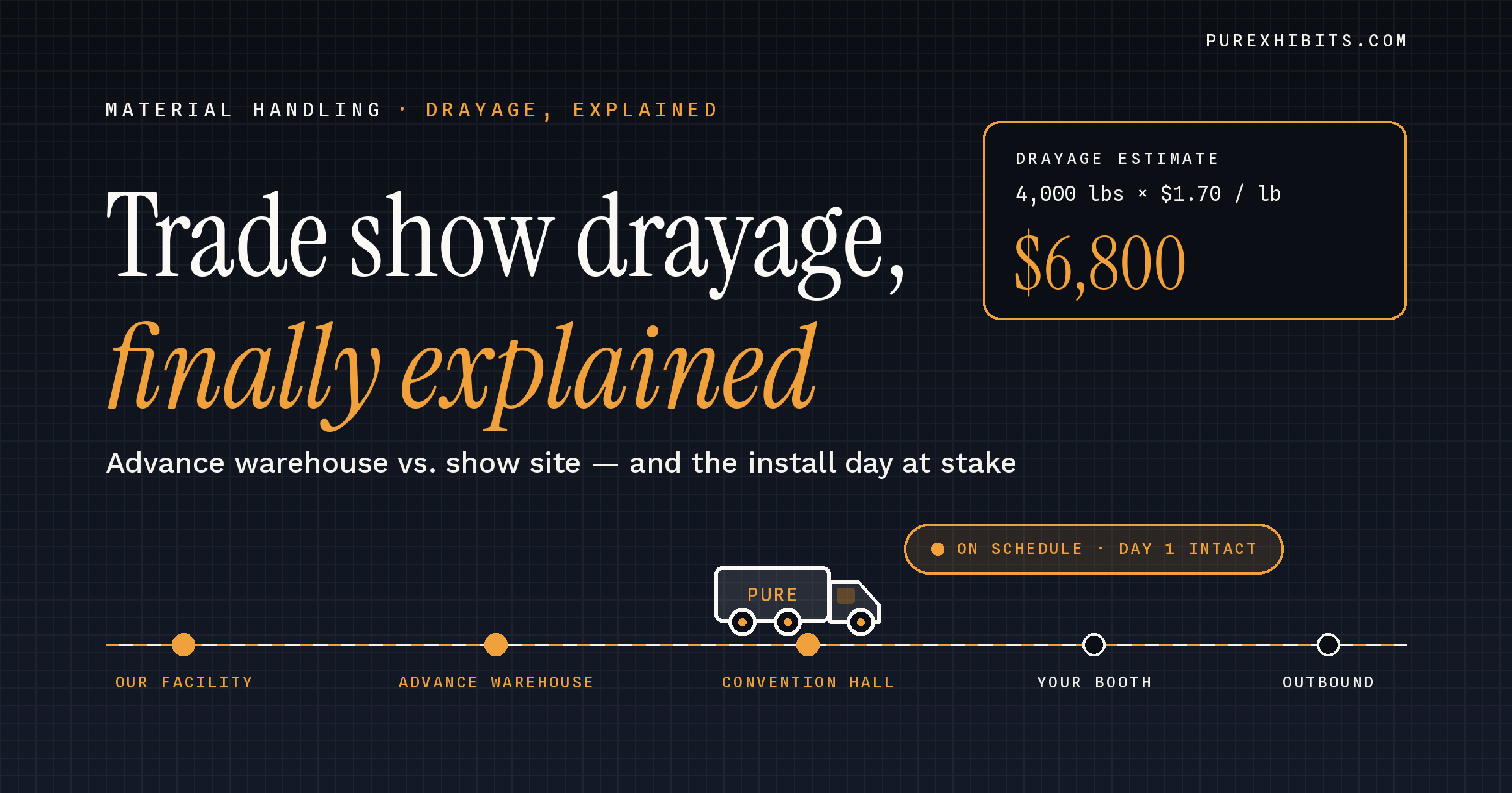
If you understand how drayage pricing actually works, you already know that straight-time vs. overtime vs. double-time labor rates can swing your I&D costs by 30–50%. Scheduling your install during straight-time hours isn’t always possible — but when it is, it’s the fastest way to cut your labor bill without any negotiation required.
Multi-Show Leverage: Your Most Underused Asset
If you’re running 4+ shows a year, you have negotiating leverage that single-show exhibitors don’t — and most multi-show exhibitors never consolidate it into a coherent strategy.
GCs want predictable revenue. Show organizers want committed exhibitors. If you can walk into a conversation with a GC and say, “We’re doing three Freeman shows this year — PACK EXPO, NPE, and one more TBD — and I want to talk about what a preferred account relationship looks like,” you’ve changed the dynamic entirely.
The same logic applies with show organizers. Multi-year booth contracts with early commitment often come with services credit, upgraded positioning, or complimentary add-ons. The Aftership team at Shoptalk is a good example of how a well-executed show presence — negotiated smartly from the start — drives ROI that justifies exactly this kind of long-term commitment.
Build a simple spreadsheet tracking your GC relationships across shows. Which GC runs each show you attend? What’s your historical spend with each? That’s the foundation for an annual negotiation conversation, not a per-show transactional ask.
What 25% Savings Actually Looks Like in Practice
Let’s make this concrete. On a typical 20×20 booth at a major convention center, show services often run $15,000–$22,000 depending on the show, city, and union jurisdiction. That’s before your booth itself — just electrical, carpet, internet, furniture, cleaning, and material handling.
Here’s where the savings stack:
- Early-order discounts on electrical and carpet: $800–$1,400
- Bundle negotiation with GC: $600–$1,200
- Straight-time I&D scheduling: $1,000–$2,500 (show-dependent)
- Exhibit house preferred rates on services: $400–$900
- Multi-show account relationship discounts: $500–$1,500
Add it up and you’re consistently in the $3,300–$7,500 range in savings on a mid-size booth — which is exactly where that 25% figure lands. None of this requires confrontation or unrealistic asks. It requires systematizing what most exhibitors do ad hoc.
The exhibitors who execute this well treat trade show services negotiation as a program, not a one-off task. They build vendor relationships between shows, not just during them. They know their spend history and use it as leverage. And they partner with exhibit houses who bring additional institutional leverage to the table.
If you’re planning your next show and want a partner who’s already navigated these conversations at venues like the LVCC, Mandalay Bay, and beyond, Pure Exhibits works with exhibitors across Las Vegas convention venues and understands the specific GC relationships and early-order windows that matter most. Whether you’re looking at a 20×20 rental or a larger custom footprint, the right partner brings more than just a booth — they bring the vendor relationships and show knowledge that translate directly into a lower total cost. Get a clear picture of what your show investment should actually look like and start your next negotiation from a position of strength.