Knowing what to bring to a trade show is the difference between a smooth show and a stressful one. The booth design gets most of the attention during planning. But experienced exhibitors know that what you pack — and what you forget — determines how the show actually runs. A missing cable kills a demo. Running out of business cards kills a conversation. Forgetting your COI paperwork can delay move-in by hours.
This checklist covers every category in the order you will need it — from move-in day through the final hour of the show. It also includes a dedicated section on what to know before exhibiting at Las Vegas venues, where union rules change what you are and are not allowed to handle yourself.
How to Use This Checklist
Many exhibitors search for a trade show exhibitor checklist before their first event — especially when preparing booth materials, technology, and logistics for multi-day shows. Print this checklist and assign each category to a specific person on your team before you leave for the show.
Do not treat it as a single-owner document. Your marketing lead owns collateral. Your tech lead owns devices and cables. Your logistics lead owns paperwork and shipping confirmations.
Run a final category-by-category review two days before departure — not the morning you leave. Two days give you time to order anything you missed. The morning of departure gives you panic.
If you are working with Pure Exhibits, your project manager handles the booth structure, graphics, freight, installation, and teardown. Your checklist responsibility begins where the booth ends — with everything your team needs to run the show floor once the doors open.
Booth Materials and Display Essentials
If you are working with a full-service rental company like Pure Exhibits, your booth structure, graphics, furniture, and installation are handled before you arrive. But there are booth-level items every exhibitor should carry regardless of who builds the booth.
- Printed brand guidelines or brand book — for on-site reference if graphics need adjustment
- Extra business cards — more than you think you need
- Product samples or demo units — tested and charged before packing
- Printed one-pagers, brochures, or spec sheets — at least 20% more than expected attendance
- Branded giveaways — pens, tote bags, or any planned promotional items
- Lead capture forms or printed sign-up sheets as a backup if your digital system fails
- Velcro, zip ties, and gaffer tape — for last-minute fixes that are not structural
- Scissors and a box cutter — for opening shipments during setup
Pro tip: Pack booth materials in a clearly labeled carry-on bag, not in a checked shipment. If your freight is delayed, your team can still operate with the essentials on day one.

Technology and AV Equipment
Technology failures at trade shows are common. The fix is always the same: bring backups for everything that your demo depends on.
- Laptops and tablets — fully charged, software demo loaded and tested offline
- Extra charging cables for every device — USB-C, Lightning, HDMI
- Power strips and extension cords — know your booth's electrical order in advance
- HDMI and DisplayPort adapters — venues and monitors rarely match your laptop port
- Wireless presentation clicker — for any scheduled presentations
- Portable battery pack — for personal devices when you step away from the booth
- Hotspot or backup internet device — venue Wi-Fi at large shows like CES or Black Hat is unreliable during peak hours
- Extra batteries for any wireless equipment
Test every device the night before move-in. Do not wait until the show floor to discover a software update broke your demo. Load your demo in offline mode and confirm it runs without an internet connection.
Marketing and Sales Materials
Everything in this category exists to start or continue a conversation after the attendee walks away from your booth. A well-prepared booth should also support your broader trade show marketing strategy, including lead qualification, demo scheduling, and post-show follow-up.
- Business cards — enough for every staff member, with extras
- Branded folders or presentation packets for scheduled meetings
- Printed pricing guides or capability decks — one per meeting room if applicable
- QR codes linking to your website, case studies, or demo booking page — printed and laminated so they survive three days on a booth counter
- Lead capture app loaded on a tablet — most major shows have an official app; download and test it before arriving
- A notepad and pens — for notes during conversations when a device is not appropriate
Paperwork and Documentation
This is the category most exhibitors underpack and the one that causes the most problems on show day. Have digital and printed copies of everything listed below.
- Certificate of Insurance (COI) — required by most venues before move-in is permitted; have a printed copy and a digital copy accessible in your email
- Exhibitor Appointed Contractor (EAC) forms — if your booth company needs floor access during move-in
- Show services order confirmations — electrical, rigging, AV, furniture rentals
- Advance warehouse receipts and tracking numbers — proof your shipments arrived
- Emergency contacts for your booth company — the direct line to your project manager, not just a general number
- Photo ID for every staff member — most large convention centers require badge check at every entrance
Many exhibitors choose to work with experienced Las Vegas exhibit builders who handle union coordination, shipping logistics, and installation planning before the show.
If you are working with Pure Exhibits, your project manager handles logistics coordination on your behalf — confirm with your project manager which specific forms they cover for your show. Carry printed copies of everything regardless. Venue service desks ask for documentation constantly during move-in.
What to Know Before Exhibiting at a Las Vegas Trade Show
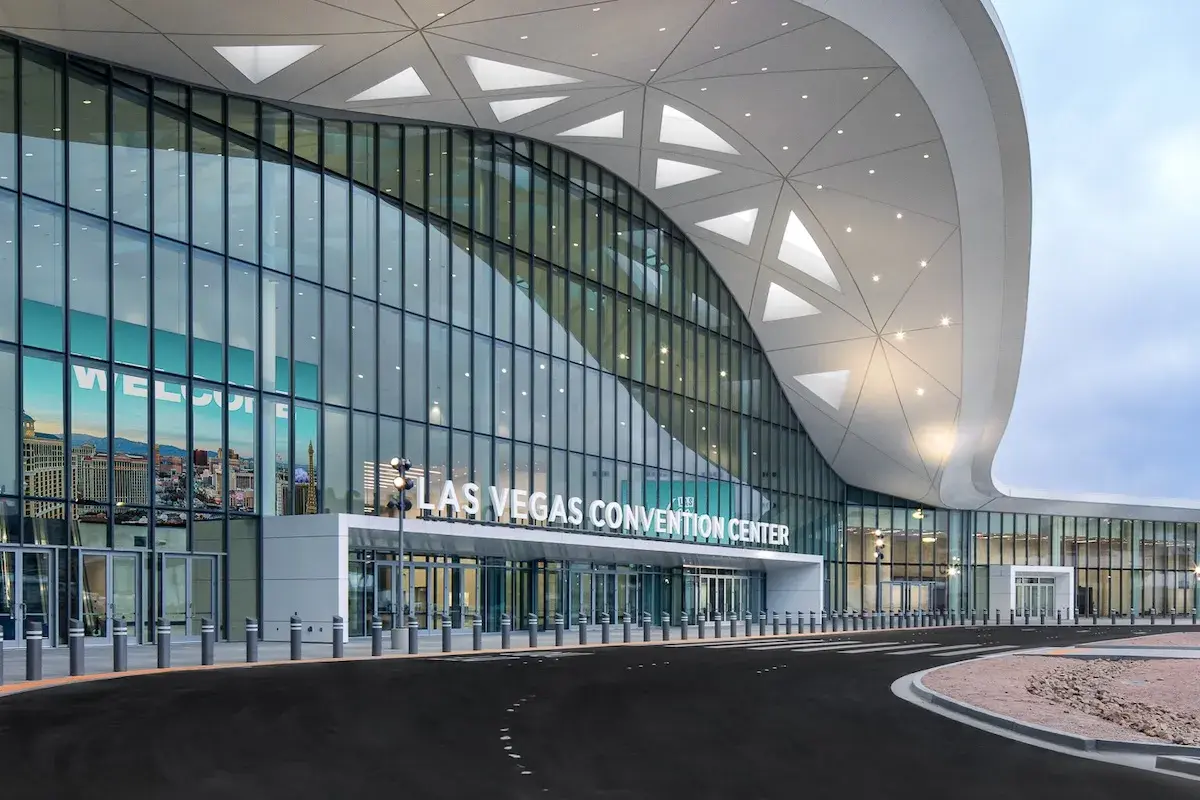
Las Vegas hosts more trade shows than any other city in the United States. The Las Vegas Convention Center (LVCC), Mandalay Bay, and the Venetian Expo are all union facilities. This changes what you are allowed to do yourself during move-in and what must be handled by union labor — and it directly affects what you bring.
If this is your first time exhibiting in the city, it helps to understand how the rental process works before the show begins. This guide on how to rent a trade show booth in Las Vegas walks through booth selection, logistics, and installation timelines.
What You Can Do Yourself at LVCC
Full-time employees of the exhibiting company may set up their own booth display at the Las Vegas Convention Center, provided the work can be completed without the use of power tools or ladders. You can hand-carry small items and boxes through the convention center's main entrance. You can open cartons containing your products and place products on display. You can plug in your own equipment and use clip-on lights without a ladder.
Pro tip: Proof of employment — a payroll stub, business card, or company ID — is required for any exhibitor doing their own setup at LVCC. Have this with every staff member during move-in.
What Requires Union Labor at LVCC
Any work requiring power tools, ladders, or material handling equipment must be performed by union labor at LVCC. The Teamsters (Local #631) have jurisdiction over all freight — meaning any materials that cannot be hand-carried must go through the standard drayage process. You cannot use a dolly, hand truck, or motorized cart to move materials. Hanging signage must go through the general contractor's rigging crew — EACs cannot assemble hanging signs at LVCC. All electrical work beyond plugging in your own equipment requires a licensed electrician.
Attempting to do union work yourself — even something that seems minor, like using a screwdriver on a booth fixture — can result in a grievance, a stop-work order, or delay your move-in. When in doubt, check your exhibitor manual or contact show management before picking up a tool.
Specific Items to Add to Your Packing List for Las Vegas Shows
- Proof of employment for every staff member doing setup (payroll stub, company ID, or business card)
- Exhibitor manual — downloaded and accessible offline on your phone
- All electrical orders confirmed and printed — last-minute electrical at LVCC costs significantly more than advance orders
- Direct contact for your show's general contractor — Freeman, GES, or Shepard depending on the event
- No personal power tools — screwdrivers, drills, or any powered equipment cannot be used by exhibitors at LVCC unless you are a full-time employee and the task does not require a ladder
Pro tip: Las Vegas straight-time union labor hours are 8:00 AM to 5:00 PM Monday through Friday. Work performed outside these hours — evenings, weekends — is billed at overtime rates. Schedule your move-in within straight-time hours whenever possible to control labor costs.
Personal Essentials for Show Staff
Trade shows run long. Setup often starts at 6 AM. The show floor closes late. Your team needs to perform at full capacity across all of it.
- Comfortable shoes — convention center floors are concrete; bring footwear you can stand in for eight to ten hours
- An extra change of professional clothes — spills happen, especially at shows with food and drinks in the booth
- Snacks and water — large show floors are far from food vendors and lines are long during peak hours
- Pain relievers and any personal medication — trade show fatigue sets in by day two
- Portable phone charger — for use on the show floor away from the booth
- Breath mints — for a full day of face-to-face conversations
- A small first aid kit — blister pads especially, for feet on days two and three
Emergency Kit — The Items That Save Shows
Every experienced exhibitor has a version of this kit. It lives under a counter or in a cabinet inside the booth and stays packed until something goes wrong. These are separate from the booth materials listed earlier — this is your on-site repair and recovery kit.
- Gaffer tape — not regular tape; gaffer tape does not leave residue on booth surfaces
- Zip ties — for cable management and emergency fixes
- Velcro strips — for attaching signage or collateral cleanly
- Black marker and white label stickers — for last-minute labeling
- A multi-tool — for minor hardware adjustments that fall within what exhibitors are permitted to do
- Cleaning wipes and a microfiber cloth — for screens, counters, and glass surfaces
- A small sewing kit — for wardrobe fixes that would otherwise end a staff member's day
- Headache tablets, antacids, and throat lozenges — three days of talking takes a toll
What to Confirm Before You Leave for the Show
Packing the right items is only half the equation. Before you leave for the show, work through this confirmation list:
- Booth is pre-staged and approved — if using Pure Exhibits, the booth is pre-staged at their US facility and inspected before it ships to the venue
- All lead capture devices are synced, tested, and loaded with the official show app
- Every staff member knows the demo script, key talking points, and the day's meeting schedule
- COI and EAC documentation are in your email and printed
- Advance warehouse delivery is confirmed with tracking numbers saved
- Show floor map and booth number are saved offline on every staff member's phone
- Electrical, rigging, and AV orders are confirmed and printed
- Hotel and transportation logistics are confirmed for all staff
How Many Business Cards Should You Bring to a Trade Show?
A common rule among experienced exhibitors is 50 cards per staff member per show day, plus a 25% buffer. For a three-day show with four staff members, that is approximately 750 cards total. At major shows like CES or NAB where attendance runs into the tens of thousands, round up further.
The cost of printing extra cards is negligible compared to the cost of running out during a productive show. Order before you leave. Do not rely on hotel business centers or on-site print vendors — quality is inconsistent and turnaround is unreliable during busy show weeks.

Packing Adjustments by Show Type
Not every show requires the same setup. Adjust your checklist based on the type of event.
Large National Shows (CES, NAB, SEMA, HIMSS)
These shows run for three to five days across massive halls. Prioritize: a robust emergency kit, extra collateral (minimum 30% above expected attendance), offline demo capability (venue Wi-Fi is unreliable), and full documentation for union labor coordination. Book all show services well in advance — last-minute orders at major venues carry significant surcharges.
Smaller Regional or Niche Shows
Smaller shows often have less formal union jurisdiction and lighter logistics requirements. Your focus shifts to ensuring the booth makes a strong impression in a more intimate setting. Bring more personalized materials for one-on-one conversations and fewer mass-produced giveaways.
First-Time Exhibitors
If this is your first trade show, prioritize simplicity. A well-prepared trade show packing checklist prevents last-minute problems during move-in.
A clean, focused setup with reliable technology, ample business cards, and one strong interactive element outperforms a complicated booth where something goes wrong. Overpack your emergency kit and underpack your product displays — conversations close deals, not collateral volume. A well-prepared trade show packing checklist prevents last-minute problems during move-in.
Ready for the Show Floor?
The booth is one part of a successful trade show. The other part is showing up prepared to run it. Pure Exhibits handles the design, fabrication, shipping, installation, and teardown — so your team arrives to a booth that is built, inspected, and ready. What you bring from here determines how the show runs.
Browse trade show booth rentals at purexhibits.com or get a quote for your next show.
Need More Help Planning Your Trade Show?
Packing the right materials is only one part of preparing for a successful trade show. If you're planning an upcoming event, these guides explain booth rentals, pricing, marketing strategy, and what to expect when exhibiting in Las Vegas.
Trade Show Booth Rental Cost: Complete Pricing Guide
Understand real trade show booth rental costs by size and city, including what affects pricing and how to budget for your next show.
Read the guide →
Trade Show Marketing Strategy That Actually Drives ROI
Learn how to turn trade show participation into real pipeline with smarter pre-show outreach, booth engagement strategies, and fast post-show follow-up.
Read the guide →
How to Rent a Trade Show Booth in Las Vegas
A step-by-step walkthrough of how booth rentals work in Las Vegas, including timelines, union labor coordination, and installation planning.
Read the guide →
Trade Show Display Rentals in Las Vegas: What to Know Before You Sign
Find out what full-service display rentals actually include and the key questions exhibitors should ask before choosing a vendor.
Read the guide →
Las Vegas Exhibit Builders: How to Choose the Right Partner
Learn what separates experienced exhibit builders from general contractors and why local expertise matters at venues like LVCC and Mandalay Bay.
Read the guide →
About Pure Exhibits
Pure Exhibits is a premium American trade show booth rental company based in Las Vegas, Nevada — 20 minutes from Las Vegas Convention Center, Venetian Expo, and Mandalay Bay. We provide full-service, all-inclusive trade show booth rentals nationwide, with transparent pricing published on our website. No last-minute surprises. No hidden fees.
From first design concept to final dismantling, every project is managed by a single dedicated project manager — one point of contact, complete accountability.
Trusted by Fortune 500 companies and fast-growing brands across technology, healthcare, automotive, and consumer goods.
Let's Build Something Extraordinary
Share your event details and we'll craft a custom booth solution designed to captivate your audience and maximize your ROI.
Frequently Asked Questions
What should I bring to a trade show as an exhibitor?
The essentials are: business cards, demo devices with backup power and offline capability, marketing materials, lead capture tools, your COI and EAC documentation, show services order confirmations, and a personal emergency kit with tape, zip ties, and cleaning supplies. If your booth is built and installed by a full-service company like Pure Exhibits, the structural and logistics side is handled — your job is to bring what you need to run the show floor.
What do you need to bring to a trade show booth?
At minimum: working demo equipment with backups, branded collateral, lead capture capability, COI documentation, and enough business cards for the full run of the show. Add a small emergency kit and personal supplies for multi-day events.
What documents do I need as a trade show exhibitor?
Certificate of Insurance (COI), Exhibitor Appointed Contractor (EAC) forms if your booth company needs floor access, show services order confirmations (electrical, rigging, AV, furniture), advance warehouse receipts with tracking numbers, and photo ID for every staff member. At union venues like the Las Vegas Convention Center, full-time employees doing their own setup must also carry proof of employment.
What should I pack in a trade show emergency kit?
Gaffer tape, zip ties, Velcro strips, a multi-tool, a black marker, cleaning wipes and a microfiber cloth, a small sewing kit, and a basic medical kit with headache tablets, antacids, and throat lozenges. Pack this kit separately from your collateral and keep it accessible inside the booth throughout the show.
How many business cards should I bring to a trade show?
Plan for 50 cards per staff member per show day, plus a 25% buffer. For a three-day show with four staff, that is approximately 750 cards. At large national shows, round up further. The cost of printing extra is negligible compared to the cost of running out mid-show.
What paperwork do I need to bring to a trade show?
Certificate of Insurance, EAC forms if applicable, show services order confirmations, advance warehouse receipts, and photo ID for every staff member. At the Las Vegas Convention Center, staff doing their own setup must carry proof of employment. Most venues require the COI before granting move-in access — have a printed copy and a digital copy in your email.
What technology should I bring to a trade show?
Bring all demo devices fully charged and tested with software loaded offline. Pack backup cables, HDMI and DisplayPort adapters, power strips, a portable hotspot, and a portable battery pack. Venue Wi-Fi at major shows is unreliable during peak hours — do not depend on it for live demos.
Do I need to know union rules before exhibiting in Las Vegas?
Yes. The Las Vegas Convention Center and most Las Vegas casino convention spaces are union facilities. Full-time employees of the exhibiting company may set up their own booth without power tools or ladders, but all freight, rigging, and electrical work must go through union labor. Attempting union-jurisdiction work yourself can result in a stop-work order or move-in delay. Review your exhibitor manual before move-in day and confirm all service orders well in advance.
What should I avoid bringing to a trade show booth?
At union venues, avoid bringing personal power tools — you will not be permitted to use them. Avoid bringing only printed brochures with no interactive element; static booths generate less foot traffic. Avoid packing everything in checked freight with no carry-on backup; if a shipment is delayed, you need core materials on hand to operate. And avoid overpacking the booth counter with too many items — a cluttered booth reads as disorganized regardless of how strong the individual pieces are.
How do I avoid forgetting things when packing for a trade show?
Build your checklist by category — booth materials, tech, marketing, paperwork, personal, and emergency kit — and assign each category to a specific person. Run a final review two days before departure, not the morning you leave. Two days gives you time to order anything that is missing. The morning of departure is too late to fix gaps.