
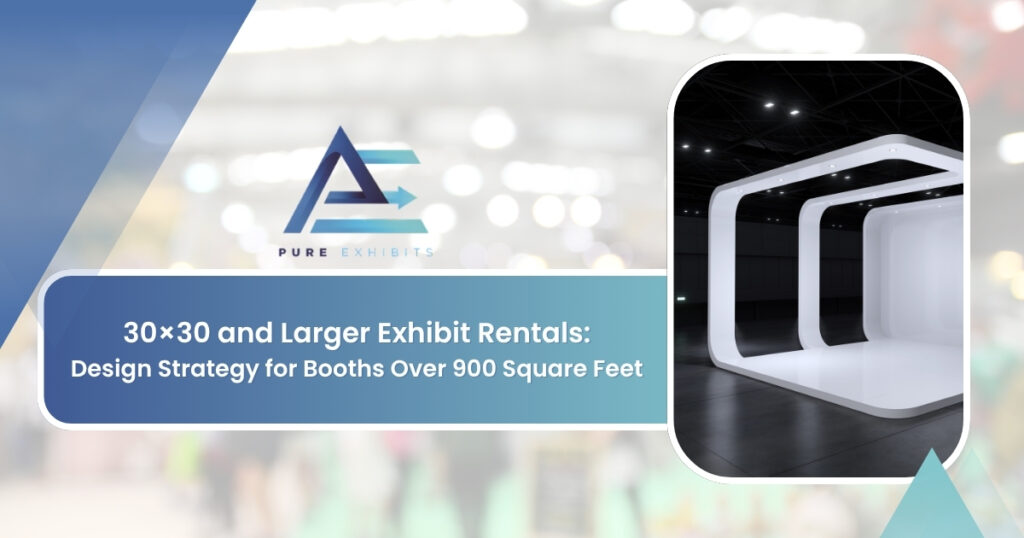
At 900 Square Feet, You’re Not Designing a Booth Anymore — You’re Designing a Brand Environment
Most exhibitors treat a 30×30 trade show booth rental like a scaled-up 20×20. They add more monitors, a bigger header, maybe a conference room tucked in the corner — and then wonder why their $60,000 investment feels like a crowded showroom floor instead of a destination.
The ones who consistently hit ROI at this footprint think completely differently. They start with traffic flow, not aesthetics. They design zones before they design graphics. And they treat every square foot like real estate with a cost-per-lead attached to it.
Here’s what actually works when you’re operating at 900 square feet and above.
The Real Cost of Getting This Wrong
A 30×30 trade show booth rental runs $40,000–$80,000 depending on complexity, venue, and show services. A 40×40+ footprint pushes $60,000–$120,000+. That’s before you factor in drayage, I&D labor, electrical, rigging, and show services — which at a venue like McCormick Place can add another 30–45% on top of your booth cost.
At SEMA or CES at the Las Vegas Convention Center, a poorly zoned large island booth can burn through a $75,000 budget and generate 40% fewer qualified leads than a tighter 20×40 configuration with smarter traffic routing. We’ve seen it happen. The square footage isn’t the variable — the strategy is.
Before you approve a single rendering, review your complete cost breakdown so nothing blindsides you at the show site invoice.
Zone Design: The Framework That Changes Everything
At 900+ square feet, you have enough space to build a genuinely multi-functional environment — but only if you commit to intentional zoning from day one of design. Most exhibitors let the furniture vendor drive zone placement. That’s backwards.
Start with four non-negotiable zones and build around them:
- Engagement Zone (front 30–40% of footprint): Open, permeable, designed for aisle traffic capture. No barriers. Demo stations angled toward the aisle. This is where your first 8 seconds of impression happen.
- Discovery Zone (middle section): Product displays, interactive touchpoints, content screens. Staff-to-visitor ratio here should run about 1:3 during peak hours.
- Conversion Zone (private or semi-private meeting space): For a 30×30, budget at least 80–100 sq ft for a closed meeting room. At 40×40+, you should be running 2–3 separate meeting configurations.
- Hospitality Zone (if applicable): Catering, lounge seating, bar counter. At shows like NAB or HIMSS, a well-executed hospitality area adds 25–35 minutes to average dwell time per visitor — and dwell time is directly correlated with lead quality.
The Engagement Zone is where most large-booth budgets get wasted. Exhibitors spend $15,000 on a backwall that faces the interior of the booth instead of the aisle. Flip the visual hierarchy. Your highest-impact brand statement should be readable from 30 feet away while someone is walking, not standing still inside your space.
Private Meeting Rooms: Build Them Right or Don’t Build Them
A private meeting room in a 30×30 trade show booth rental is either your best ROI decision or a dead zone that eats 120 square feet and sits empty. The difference is almost entirely pre-show scheduling discipline.
If your sales team isn’t booking that room at 60%+ capacity before the show opens, you’ve built a liability. At a show like HIMSS at the Orange County Convention Center or Moscone, your meeting room slots should be calendared out by the Tuesday before the show opens — not Monday morning on the floor.
Structural considerations that get skipped too often:
- Acoustic separation: Thin fabric walls don’t block noise on a loud show floor. If you’re doing confidential product demos or sales conversations, invest in solid-panel construction or acoustic baffling. Budget an additional $1,500–$3,500 for proper sound management.
- Independent climate control: Enclosed rooms at LVCC’s Central Hall get hot fast under show lighting. A small supplemental fan unit costs under $500 to rent. A sweating VP of Sales costs you a deal.
- A/V integration: Run your presentation content through a single media player with local control inside the room. Don’t depend on the booth’s main media server — signal drops at the wrong moment are a real risk.
For a deeper look at how leading brands are handling enclosed environments in large footprints, the 2025 exhibition booth design trends breakdown covers what’s working right now.
I&D Complexity at This Scale: What Your Timeline Actually Needs to Look Like
This is where experienced managers know the budget variance lives. A 30×30 island booth with rigging, a meeting room, AV integration, and custom millwork isn’t a two-day install. At a union hall like McCormick Place or Javits, you’re looking at a minimum 3–4 day build with a crew of 6–10 depending on scope.
Run your advance warehouse timeline backward from the show’s exhibitor move-in date. Most GCs require freight to arrive at the advance warehouse 30 days out for large exhibits. Miss that window and you’re paying direct-to-show rates — which at McCormick Place can run 15–25% higher in drayage costs alone.
Our I&D and shipping service handles coordination across all major venues, and our on-site supervision team catches the issues that show-site foremen miss — wrong graphic panels, missing hardware, electrical routing conflicts — before they become show-day emergencies.
One non-negotiable: have your project manager on-site for at least the final day of installation and first day of show. That’s not a luxury at this footprint — it’s insurance.
Theater Presentations: The Highest-ROI Feature Most Exhibitors Under-Execute
At 40×40 and larger, a dedicated presentation theater is one of the most effective lead-generation tools on the floor — and one of the most consistently botched.
The math is straightforward. A 20-seat theater running 4 presentations per day at a 3-day show reaches 240 prospects in structured content sessions, versus the same number of unstructured floor conversations that yield inconsistent messaging and minimal data capture.
But only if you execute the logistics correctly:
- Seating sight lines matter: Every seat needs a clean view of the presentation screen. A 16:9 screen at 120″ diagonal requires minimum 8 feet of clear viewing distance. Don’t let the booth designer compress this to save square footage.
- Audio separation: Your theater audio will bleed into adjacent zones without directional speaker placement and careful volume management. This degrades both the presentation experience and nearby sales conversations.
- Attendance capture: Badge scanning at theater entry is standard, but the 15-minute post-presentation window is your highest-conversion lead-nurture opportunity. Staff the theater exit, not just the entry.
For a broader look at how traffic flow dynamics affect these decisions, the island vs. inline traffic impact analysis is worth revisiting before you finalize your layout.
The Rental vs. Buy Calculation at This Scale
At 30×30 and above, the rent-vs-own math shifts even more decisively toward rental than it does at smaller footprints. A custom-built 30×30 purchase runs $150,000–$300,000+ with refurbishment, storage, and logistics adding $15,000–$25,000 per show year.
A 30×30 trade show booth rental at $40,000–$80,000 gives you full design flexibility per show, zero storage liability, and no depreciation exposure. If your show schedule varies year to year — different cities, different footprint requirements — rental is almost always the correct financial decision.
The 60% savings case for rentals breaks down the full lifecycle cost comparison if you need to make this argument internally to a CFO or VP of Marketing.
For shows in Las Vegas specifically — CES, NAB, SEMA, MJBizCon — our Las Vegas trade show booth rental program is built around this exact footprint range, with fully custom configurations available for brands that need something beyond a modular solution.
The Pure Exhibits portfolio includes large-format island builds across multiple industries if you want to see how these zone strategies translate to actual built environments. And if you’re earlier in the planning process, the trade show planning guide is a solid framework for sequencing decisions at this scale.
Frequently Asked Questions
How much does a 30×30 trade show booth rental cost?
A 30×30 trade show booth rental typically ranges from $40,000 to $80,000 for the exhibit structure, graphics, and furniture. Total show costs — including drayage, I&D labor, electrical, and show services — commonly add another 30–50% depending on the venue and show. See our full trade show booth rental cost breakdown for a complete picture.
How long does it take to install a 30×30 island booth?
At a union venue like McCormick Place or Javits Center, a 30×30 island booth with rigging, AV, and an enclosed meeting room typically requires 3–4 days of installation with a crew of 6–10. Plan your move-in schedule accordingly and confirm union labor jurisdiction rules with your GC before finalizing your timeline.
What zones should a 30×30 trade show booth include?
At minimum: an open engagement zone facing the aisle, a product discovery zone, a private or semi-private meeting area of at least 80–100 square feet, and — depending on your show strategy — a hospitality or lounge zone. Brands that add a structured hospitality area at major shows report 25–35% longer average dwell times per visitor.
Is a 40×40 booth worth the upgrade from a 30×30?
It depends on your meeting volume and presentation strategy. If you’re running more than 8 scheduled meetings per day or want a dedicated theater presentation area with 15+ seats, the 40×40 footprint at $60,000–$120,000+ justifies the cost. If your primary activity is product demos and aisle engagement, a well-zoned 30×30 will outperform a poorly planned 40×40 every time.
Can I rent a 30×30 booth for a trade show outside Las Vegas?
Yes. Pure Exhibits manages large-format booth rentals across all major U.S. venues including McCormick Place in Chicago, Moscone Center in San Francisco, Javits Center in New York, and the Orange County Convention Center in Orlando. We handle advance warehousing, I&D coordination, and on-site supervision regardless of venue.
What’s the biggest mistake exhibitors make with large island booths?
Designing for aesthetics before traffic flow. The single most common error we see is placing the highest-impact brand visual on an interior wall that’s only visible once someone is already inside the booth. At 900+ square feet, your visual hierarchy should be engineered from the outside in — readable from 30 feet away, compelling enough to pull traffic off the aisle before any personal interaction happens. Our guide on 12 trade show booth mistakes covers this and the other most expensive errors in detail.
If you’re finalizing scope for an upcoming large-format exhibit, start with a booth consultation focused specifically on zone strategy and traffic routing — not just design aesthetics. That 60-minute conversation before the design brief is written is consistently where the most expensive show-floor problems get caught before they’re built in.