
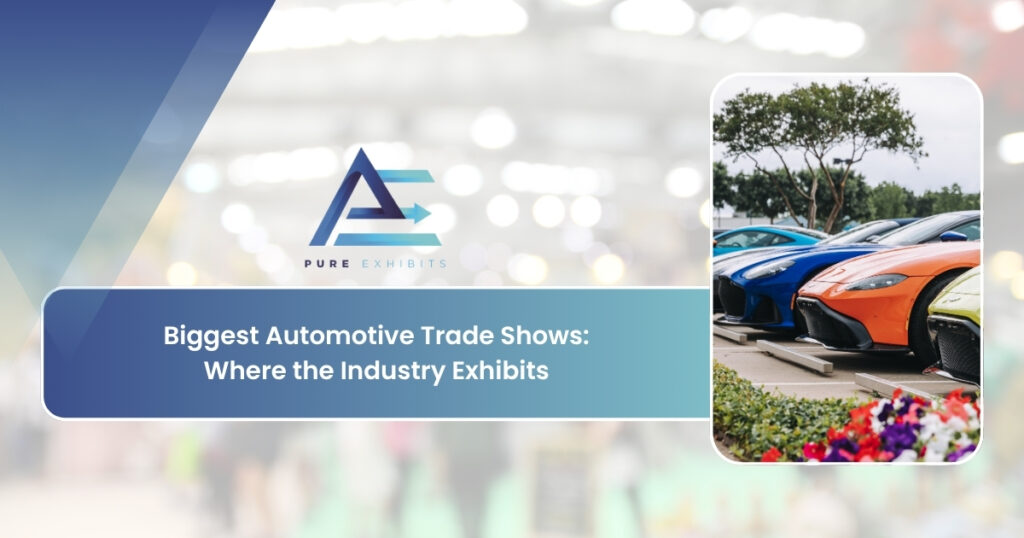
The automotive industry consolidates its buying and selling into a handful of events each year where purchasing decisions get made, new product lines launch, and supplier relationships that drive the next twelve months of business get established. An aftermarket parts manufacturer that misses SEMA misses the room where specialty retailers, distributors, and fleet buyers all converge in November. A dealership technology vendor that skips NADA misses the show where franchise dealers evaluate and budget for the tools they will deploy the following year. In a fragmented industry that spans OEM supply chains, dealership networks, aftermarket retail, and fleet operations, the biggest automotive trade shows are not optional events for serious exhibitors — they are the primary commercial calendar.
This guide covers the largest and most commercially significant automotive trade shows in North America, what each show’s audience looks like from an exhibitor’s perspective, and what booth investment is appropriate for each show’s competitive standard. For the complete cost breakdown of exhibiting at any of these events, the trade show booth rental cost guide covers every line item by booth size and market — including the Las Vegas shows where Pure Exhibits provides local design and installation support.
Exhibiting at SEMA, AAPEX, or Another Las Vegas Automotive Show?
Pure Exhibits Builds and Delivers Your Booth Directly to the Show Floor.
What Are the Biggest Automotive Trade Shows in North America?
The automotive industry spans multiple distinct market segments — each with its own trade show ecosystem. The aftermarket and specialty equipment segment has SEMA and AAPEX. The new vehicle and franchise dealer segment has NADA. The heavy-duty and commercial vehicle segment has NTEA’s Work Truck Show. The automotive technology and mobility segment has the Consumer Electronics Show’s automotive pavilion and dedicated events like the Automotive Aftermarket Industry Week. The biggest automotive trade shows in each segment draw different buyer profiles, require different booth investment levels, and serve different commercial objectives.
The chart below maps the most significant events by segment, typical timing, and primary buyer audience. Dates shift year to year — always verify current dates with the show organizer before committing to a travel or exhibit budget.
| Show | Segment | Typical Month | Location | Primary Buyer Profile |
|---|---|---|---|---|
| SEMA Show | Specialty Equipment & Aftermarket | November | Las Vegas Convention Center | Specialty retailers, distributors, jobbers, media, and enthusiast brands; trade-only |
| AAPEX (Automotive Aftermarket Products Expo) | Aftermarket Parts & Service | November | Venetian Expo, Las Vegas | Auto parts retailers, professional installers, repair shops, fleet buyers; trade-only |
| NADA Show | New Vehicle & Dealership Operations | January (varies) | Various US cities (rotates) | Franchise dealership owners, GMs, F&I managers, technology and service buyers |
| The Work Truck Show (NTEA) | Commercial & Fleet Vehicles | March | Indiana Convention Center, Indianapolis | Fleet managers, upfitters, commercial vehicle buyers, municipal purchasers |
| AAIW (Auto Industry Week) | Aftermarket Industry | November | Las Vegas (concurrent with SEMA/AAPEX) | Industry professionals attending multiple concurrent Las Vegas automotive events |
| CES Automotive Pavilion | Automotive Technology & Mobility | January | Las Vegas Convention Center | OEMs, technology executives, mobility investors, autonomous and connected vehicle buyers |
| Global Automotive Aftermarket Symposium (GAAS) | Aftermarket (Invite/Executive) | May | Chicago area | Senior aftermarket executives, investors, industry analysts — invitation-heavy |
What Makes SEMA the Flagship Automotive Aftermarket Trade Show?
The SEMA Show — produced by the Specialty Equipment Market Association and held annually in November at the Las Vegas Convention Center — is the single largest automotive specialty products trade show in North America, occupying more than a million square feet of exhibit space across the Convention Center’s central and South halls, the lower south hall, and multiple connected outdoor display areas. For las vegas trade show booth rentals, SEMA is one of the most demanding and most rewarding shows on the calendar: demanding because the visual and product standard set by category-leading exhibitors is exceptionally high, and rewarding because the buyer concentration — specialty retailers, warehouse distributors, jobbers, media, and international buyers — is unmatched in the specialty aftermarket.
Who Attends SEMA and What They Are Buying
SEMA is a trade-only event — consumer access is not permitted, which means every badge on the show floor represents an industry professional. The attendee mix includes specialty parts retailers from independent shops and chain operations, warehouse distributors who supply the retail tier, jobbers and direct buyers for fleet and commercial operators, automotive media who evaluate and amplify new products across print, digital, and video channels, and international buyers who use the show as a sourcing event for their home markets. The show spans product categories from wheels, tires, and suspension to lighting, performance engine components, truck accessories, restoration parts, and in-car technology.
What Booth Size Is Competitive at SEMA?
SEMA is a show where booth visual impact is a direct commercial signal. The category leaders — the brands that set the visual standard in any given product segment — run 20×20 and larger island or peninsula configurations, often with vehicle displays that require 30×30 or larger footprints. For a company entering SEMA for the first time or testing a new product category at the show, a 10×20 trade show booth is the credible entry-level configuration — large enough to accommodate a product display, a conversation area, and a counter, without requiring the production investment of a full island. A 10×10 at SEMA is viable in secondary sections of the hall but is genuinely undersized relative to the visual standard on the main aisles of the central and South halls, where most qualified buyer traffic concentrates.
The Pre-Build Advantage for SEMA Exhibitors
SEMA’s move-in timeline is compressed relative to its setup complexity — a million-square-foot show with vehicle builds, hanging signs, and complex modular exhibits moving in simultaneously creates serious labor and logistics pressure. For Las Vegas-based exhibit programs, a local exhibit house that pre-assembles the booth at its facility before the show opens — confirming fit, graphics quality, and lighting performance before the crate ever reaches the convention floor — eliminates the risk of discovering structural or graphic issues during the narrow move-in window. The exhibition booth design process for SEMA starts with understanding both the booth space configuration and the product display requirements, then builds a structure that accommodates both the visual standard and the physical product within the available floor plan.
What Is AAPEX and How Does It Differ From SEMA?
AAPEX — the Automotive Aftermarket Products Expo — runs concurrently with SEMA each November in Las Vegas, held at the Venetian Expo (formerly the Sands Expo). Where SEMA concentrates on specialty equipment, performance products, and enthusiast categories, AAPEX serves the replacement parts and service side of the aftermarket: brake pads, filters, gaskets, electrical components, shop tools, service equipment, and the thousands of SKUs that professional repair shops and parts stores stock for maintenance and repair work.
The AAPEX Buyer Profile
AAPEX buyers are professional service and retail operators: automotive repair shops (independent and chain), auto parts retailers sourcing replacement parts inventory, fleet maintenance operators managing vehicle upkeep for commercial fleets, and the warehouse distributor tier that supplies the entire retail and service channel. The buying conversation at AAPEX is driven by price per SKU, coverage breadth (how many vehicle applications a product line covers), minimum order quantities, delivery reliability, and technical support — not the lifestyle and visual storytelling that drives SEMA purchasing decisions. Exhibitors at AAPEX need product samples, specification sheets, and coverage data accessible in the booth; they need sales staff who can talk applications and fitment, not brand ambassadors who talk product lifestyle.
Exhibiting at Both SEMA and AAPEX in the Same Week
Many automotive aftermarket companies exhibit at both SEMA and AAPEX simultaneously — a logistical challenge that requires coordinating two separate booth installations at two venues less than a mile apart during the same move-in window. For companies with products that span both the specialty and replacement segments, running both shows significantly increases the total addressable audience for the week. The key logistics consideration is staffing: each show requires a dedicated team who understands that show’s buyer profile and buying conversation. Splitting staff between the two shows without adequate headcount at each location is the most common execution failure for dual-show programs during SEMA/AAPEX week.
What Does the NADA Show Offer Automotive Exhibitors?
The National Automobile Dealers Association (NADA) Show is the primary trade show for the new vehicle franchise dealership segment of the automotive industry. Where SEMA and AAPEX serve the aftermarket supply chain, NADA serves the retail end of the new and used vehicle business: the dealership owners, general managers, finance and insurance managers, and department heads who operate the nation’s franchise dealership network. The show rotates cities annually — it has been held in Las Vegas, Dallas, New Orleans, San Francisco, and other major convention markets.
Who Exhibits at NADA and Why
Exhibitors at NADA are selling to the dealership: dealer management systems (DMS), CRM platforms, F&I products and compliance tools, service lane technology, digital retailing platforms, reconditioning services, training programs, marketing agencies, and the full ecosystem of vendor services that a modern dealership operation requires. The buyer at NADA is making technology and service purchasing decisions for a business that may operate multiple rooftops and generate eight to nine figures in annual revenue. The ROI conversation at NADA is driven by dealership profitability improvement, compliance risk reduction, and operational efficiency — not product aesthetics.
Booth Strategy at NADA
NADA’s show floor is smaller and denser than SEMA’s, with a higher concentration of decision-maker buyers relative to total attendee count. A well-positioned 10×20 with demonstration-ready technology, clear ROI messaging, and experienced sales staff who understand dealership operations outperforms a larger booth with generic corporate branding and staff who cannot speak the dealer’s language. Meeting scheduling — pre-booked appointments with target dealership groups and dealer principals — is more important at NADA than aisle traffic conversion, because the buyer is sophisticated and time-constrained and expects to see vendors by appointment rather than by walk-in.
Need Quick Booth?
Pure Exhibits Designs and Installs Automotive Show Booths at SEMA, AAPEX, and Every Major Las Vegas Convention Venue.
What Other Major Automotive Trade Shows Should Exhibitors Know About?
The Work Truck Show (NTEA)
Produced by the National Truck Equipment Association and held annually in Indianapolis each March, the Work Truck Show is the primary event for the commercial and fleet vehicle market — upfitters, truck body manufacturers, fleet managers, municipal vehicle buyers, and the suppliers of equipment, tooling, and technology that commercial vehicles require. The show is smaller by floor space than SEMA or AAPEX but highly concentrated: the buyers in the room are making purchasing decisions on fleet-scale quantities. Exhibitors selling work truck bodies, utility equipment, fleet management technology, commercial tires, or upfitting components will find a more commercially dense audience at the Work Truck Show than at any general automotive event.
CES Automotive Pavilion
The Consumer Electronics Show held each January in Las Vegas has grown into one of the most significant automotive technology showcases in the world, with a dedicated automotive pavilion drawing OEM executives, Tier 1 automotive suppliers, mobility investors, and connected and autonomous vehicle technology developers. For companies selling software, sensors, connectivity systems, EV charging infrastructure, or in-vehicle technology to the OEM and Tier 1 supply chain — rather than to the retail aftermarket — CES’s automotive pavilion reaches buyers that no dedicated automotive show matches in terms of technology executive density and investment community presence.
AAPEX + SEMA Concurrent Week: The Las Vegas Automotive Hub
The concurrent running of SEMA and AAPEX in Las Vegas each November has created an automotive industry ecosystem for that week that extends beyond the two official shows. Industry-specific events, brand activations, distributor meetings, media days, and networking events run throughout the week, making Las Vegas the single most concentrated automotive industry gathering of the year. For exhibitors with budgets that allow only one major show per year, the combined SEMA/AAPEX week gives the broadest reach across aftermarket buyer segments of any event on the calendar. A 10×10 trade show booth at AAPEX during this week reaches a different buyer profile than a 10×10 at any standalone regional event — the concentration of qualified buyers during that single week is unmatched in the automotive aftermarket calendar.
How Do the Biggest Automotive Trade Shows Compare for Exhibitors?
Choosing between the biggest automotive trade shows is a function of matching the show’s buyer profile to your sales target, your product category, and your program budget. The table below compares the primary exhibitor considerations across the major events.
| Show | Buyer Decision Type | Min. Credible Booth Size | Relative Space Cost | Best For |
|---|---|---|---|---|
| SEMA Show | Specialty/lifestyle purchasing; new product launches; distribution partnerships | 10×20 inline; 20×20 for main-aisle presence | High (large LV event) | Aftermarket brands, performance parts, accessories, truck/Jeep/SUV segments |
| AAPEX | Replacement parts; service equipment; coverage breadth and price evaluation | 10×10 inline (denser format); 10×20 for product-heavy displays | Moderate | Parts manufacturers, tool and equipment suppliers, service technology vendors |
| NADA Show | Dealership technology; F&I products; marketing services; operational tools | 10×20 with demo-ready tech setup | Moderate-High (rotates cities) | DMS, CRM, F&I, digital retail, dealership service vendors |
| Work Truck Show | Fleet and commercial vehicle equipment; upfitting; fleet management | 10×20; larger for vehicle displays | Moderate (Indianapolis) | Commercial vehicle upfitters, fleet technology, work truck component suppliers |
| CES Automotive | OEM and Tier 1 technology; mobility platforms; EV infrastructure | 20×20 minimum for credibility among OEM audience | Very High (LV peak January) | AV/EV technology, connectivity, in-vehicle systems, mobility platforms |
How Do You Budget for the Biggest Automotive Trade Shows?
The total cost of exhibiting at a major automotive trade show spans five categories: booth space rental (paid to the show organizer), exhibit design and production or rental (paid to the exhibit house), general services contractor charges (drayage, electrical, I&D labor — paid to the show’s appointed GSC), staff travel and accommodation, and marketing and collateral. For SEMA and AAPEX — both held in Las Vegas in November — the trade show budget template provides the full per-category cost framework with ranges by booth size, so you can model total program cost before committing to any show registration.
SEMA Space Costs and GSC Charges
SEMA booth space costs vary by hall and position. Central hall and main South hall locations command premium rates relative to secondary halls and outdoor areas. The general services contractor for SEMA — typically Freeman — charges drayage, electrical, and I&D labor rates that reflect the scale and complexity of the show. Drayage at SEMA is calculated per hundredweight (per 100 lbs of freight) with separate rates for advance warehouse delivery and direct-to-show delivery. Electrical costs depend on the total amperage draw of the booth’s lighting and technology. I&D labor is charged at union rates for setup and dismantle during SEMA’s narrow move-in windows. Advance ordering all GSC services before the advance deadline — typically 30 days before the show — reduces GSC costs by 25 to 40 percent relative to standard and on-site rates.
The Las Vegas Local Exhibit Advantage for SEMA and AAPEX
For SEMA and AAPEX, the single most consequential cost and risk management decision is whether to ship an exhibit from another city or rent from a Las Vegas-based exhibit house. Round-trip freight for a 10×20 exhibit from a distant city costs $4,000 to $10,000 per show, adds 5 to 10 transit days in each direction, and creates freight damage risk that can strand an exhibit house in another city when the exhibitor needs support on the SEMA show floor. A Las Vegas-based exhibit house delivers the booth from its local facility directly to the convention floor, pre-assembles and verifies the exhibit before delivery, and provides on-site support during the show. For a program that includes SEMA or AAPEX as a primary annual event, local Las Vegas exhibit sourcing is the structural cost and risk advantage that compounds across every show year.
Staff Investment at Major Automotive Shows
SEMA runs for four days (Tuesday through Friday); AAPEX runs concurrently for three days. Staffing each show requires experienced automotive industry professionals who understand the buying conversations specific to that show’s audience — not generalist event staff. For companies running both SEMA and AAPEX simultaneously, budget for two separate staffing pools at two separate venues. The trade show booth staffing guide covers how to build a staffing model for major shows — including the qualification script, lead capture process, and the staff-to-visitor ratio that maintains conversation quality during peak traffic hours.
How Do You Maximize ROI at Major Automotive Trade Shows?
The biggest automotive trade shows deliver ROI in proportion to how seriously the exhibitor treats the full program cycle — not just the show floor execution. Companies that arrive with a well-designed booth, a trained staff, pre-scheduled meetings with target buyers, a defined lead qualification process, and a 48-hour post-show follow-up sequence consistently outperform companies that invest in the same booth size but treat the show as a passive visibility exercise. For the full return calculation methodology, the trade show ROI guide covers how to set pre-show revenue targets, track leads through the pipeline, and calculate the true return on a trade show investment across the full post-show conversion cycle.
Pre-Show Outreach: The SEMA Appointment Calendar
SEMA’s buyer pool is large enough that walk-in traffic alone can generate strong lead volume — but the highest-value meetings at SEMA are the pre-scheduled ones. National retail chain buyers, large distributors, and international sourcing agents often set their SEMA meeting schedules weeks before the show opens. Exhibitors who send appointment requests to their target accounts in the 6 to 8 weeks before SEMA — with a specific product or innovation to discuss, not a generic ‘come see us at the show’ message — secure the meetings that generate the largest post-show purchase conversations. Walk-in traffic captures opportunistic leads; pre-scheduled appointments generate pipeline.
Product Display Strategy at Automotive Shows
Vehicle and product displays are the dominant engagement tool at automotive trade shows in a way they are not at most other industry events. A product installed on the right vehicle — built, wrapped, and lit professionally — stops qualified buyers in an aisle faster than any banner headline. The investment in a hero vehicle or product build for SEMA is measured against the attention it generates across the full show: not just the buyers who stop at the booth, but the media coverage, the social amplification, and the credibility signal it sends to every distributor and retailer evaluating the brand’s commitment to the market. For exhibitors where a vehicle or product build is part of the booth concept, the exhibit structure must be designed around the display’s dimensions and clearances from the first design consultation.
Conclusion
The biggest automotive trade shows are not interchangeable. SEMA serves the specialty equipment and enthusiast aftermarket. AAPEX serves the replacement parts and professional service channel. NADA serves the franchise dealership network. The Work Truck Show serves commercial vehicle and fleet operators. CES’s automotive pavilion serves the OEM and mobility technology sector. Choosing the right event — or the right combination of events — requires matching your product category, your target buyer, and your program budget to the show’s actual audience composition, not its name recognition or show floor size.
For exhibitors at the Las Vegas automotive shows — SEMA, AAPEX, and CES’s automotive content — booth quality is a direct commercial signal in a room full of competitors who invest heavily in their display. As a trade show booth builder operating out of Las Vegas, Pure Exhibits designs, produces, and installs automotive show booths directly at the convention floor — eliminating freight cost, freight risk, and the coordination complexity of managing a distant exhibit vendor during SEMA’s demanding move-in window.
Let’s Build Something Extraordinary
Share your event details and we’ll craft a custom booth solution designed to captivate your audience and maximize your ROI.
Frequently Asked Questions
What is the biggest automotive trade show in the world?
By exhibitor count and floor space in the specialty equipment and aftermarket segment, the SEMA Show held each November in Las Vegas is the largest automotive specialty products trade show in North America and one of the largest in the world. The show spans more than a million square feet of exhibit space at the Las Vegas Convention Center and attracts tens of thousands of industry professionals — specialty retailers, distributors, international buyers, and automotive media — across its four-day run. For raw consumer automotive show scale, the Paris Motor Show and Frankfurt (IAA) Motor Show have historically been among the largest globally, but these are consumer-facing events rather than trade-only B2B shows for industry professionals.
What is the difference between SEMA and AAPEX?
SEMA (Specialty Equipment Market Association Show) focuses on specialty equipment, performance products, lifestyle accessories, and enthusiast categories — wheels, tires, suspension lifts, lighting, truck accessories, restoration parts, and branded lifestyle products. AAPEX (Automotive Aftermarket Products Expo) focuses on replacement parts and service products — the brake pads, filters, gaskets, tools, and service equipment that professional repair shops and auto parts retailers stock for maintenance and repair. Both shows run concurrently in Las Vegas each November but at different venues — SEMA at the Las Vegas Convention Center and AAPEX at the Venetian Expo. Many companies exhibit at both simultaneously if their product line spans specialty and replacement categories.
When and where is the SEMA Show?
The SEMA Show is held annually in November at the Las Vegas Convention Center in Las Vegas, Nevada. The show typically runs for four days, from Tuesday through Friday of the first full week of November. Exact dates vary slightly year to year — always verify the current year’s dates on the SEMA Show’s official website (semashow.com) or in the exhibitor kit. SEMA has been held in Las Vegas at the Las Vegas Convention Center for several decades and shows no indication of relocating, given the venue’s capacity to accommodate the show’s scale.
How much does it cost to exhibit at SEMA?
SEMA exhibiting costs span several categories. Booth space rental from SEMA’s organizer varies by hall and location — rates are published in the exhibitor prospectus and typically run higher for central and South hall positions than for secondary halls. The exhibit itself (design, structure, graphics, lighting) costs from $8,000 to $15,000 for a professionally executed 10×20 rental program to $30,000 and above for a custom-built 20×20 or larger configuration. General services contractor charges for drayage, electrical, and I&D labor at a large Las Vegas show like SEMA add $2,000 to $8,000 or more depending on booth size and service scope. Staff travel and accommodation in Las Vegas during SEMA week — one of the highest-demand weeks of the year — adds significant cost. Total program cost for a well-executed 10×20 at SEMA typically runs $25,000 to $50,000 inclusive.
What should first-time SEMA exhibitors know?
First-time SEMA exhibitors consistently underestimate four things: the visual standard set by category-leading competitors (walk the show as an attendee before your first exhibiting year if possible), the move-in timeline pressure (SEMA’s move-in is compressed and penalties for not meeting your assigned move-in window are real), the drayage cost (freight handling at a show this size adds up quickly — order GSC services in advance to capture advance pricing), and the need for pre-scheduled meetings (the highest-value buyers at SEMA are often fully booked before the show opens — reach out to target accounts 6 to 8 weeks in advance). Engaging a Las Vegas-based exhibit house that has serviced SEMA multiple times gives you access to institutional knowledge of how the show runs that no amount of pre-show research fully replicates.
Is NADA Show the same as a car show?
No. The NADA Show is a trade show for the franchise dealership industry — it is not an automotive consumer event or car show. It is a B2B event where vendors sell products and services to dealership owners and operators: dealer management systems, CRM platforms, F&I tools, marketing services, reconditioning equipment, and the full ecosystem of technology and services that a modern franchise dealership network deploys. The attendees are business owners and managers, not consumers shopping for vehicles. The NADA Show rotates cities annually, unlike SEMA and AAPEX which are permanent Las Vegas events.
Are automotive trade shows only for manufacturers and large companies?
No. Companies of all sizes exhibit at automotive trade shows. AAPEX, in particular, has a high proportion of small and mid-size parts manufacturers, distributors, and specialty suppliers whose target audience — professional repair shops and auto parts stores — is concentrated on the AAPEX floor in a way that no other event matches. SEMA similarly has exhibitors ranging from large brands occupying 30×30 island configurations to small specialty manufacturers in 10×10 spaces launching a single new product line. The question for any exhibitor is not company size but whether the show’s buyer profile matches the company’s target customer — and whether the total program investment is justified by the revenue opportunity the show represents.
What booth size do I need for SEMA?
The minimum credible configuration for SEMA’s main halls is a 10×20 inline booth. A 10×10 at SEMA is viable in secondary sections but is genuinely undersized relative to the visual standard on the main aisles of the central and South halls where qualified buyer traffic concentrates. For companies in high-visibility categories — wheels, tires, exterior accessories, performance engines — a 20×20 or larger configuration is the competitive standard. For first-time SEMA exhibitors testing the show before scaling the program, a well-designed 10×20 with professional graphics, strong lighting, and an effective product display is a reasonable entry point. Booth size should be selected in the context of what your direct category competitors are running — walk the prior-year show floor plan (available on the SEMA website after the show) to assess the competitive visual standard before deciding on a configuration.
What is the best automotive trade show for parts manufacturers?
For replacement parts manufacturers selling to the professional service channel (repair shops, auto parts retailers, distributors), AAPEX is the primary show — the buyer concentration of professional installers and parts retail buyers at AAPEX is unmatched in the replacement parts segment. For specialty and performance parts manufacturers selling to the enthusiast and retail channel, SEMA is the primary show — the specialty retailer, distributor, and media concentration at SEMA is the defining commercial event for those categories. Companies selling to both channels often exhibit at both shows during SEMA/AAPEX week in Las Vegas. For parts manufacturers with significant international distribution ambitions, the concurrent week also draws strong international buyer attendance, making it a dual domestic-and-international sourcing event for the right product categories.
How do I find out which automotive trade shows my competitors exhibit at?
The SEMA Show and AAPEX both publish exhibitor lists after each show — these are available on their respective websites (semashow.com and aapexshow.com) and can be used to identify which companies in your category exhibit, at what size, and in which hall or section. Walking the show as an attendee in the year before your first exhibiting year gives you direct competitive intelligence on booth size, display strategy, staffing approach, and visual standard. Trade publications in your specific automotive segment (whether aftermarket, fleet, or OEM supply chain) typically publish show preview and recap coverage that maps major exhibitor activity. Industry association directories and trade directories also list companies by category, and membership in your category’s primary trade association typically includes access to the member event calendar where show participation patterns are visible.
Does Pure Exhibits support automotive trade shows in Las Vegas?
Yes. Pure Exhibits is a Las Vegas-based exhibit house that designs, produces, and installs booths for exhibitors at SEMA, AAPEX, CES, and all other major shows held at the Las Vegas Convention Center, Venetian Expo, and other Las Vegas venues. For automotive exhibitors, the advantages of a local Las Vegas exhibit house are significant: no round-trip freight cost, no freight transit risk, pre-build verification at the Las Vegas facility before the exhibit reaches the show floor, and on-site support during SEMA’s demanding move-in window. Pure Exhibits works with first-time SEMA exhibitors building their first Las Vegas program and with experienced automotive brands running annual programs who want to reduce logistics complexity and capture the cost advantage of local sourcing.
What other automotive events run during SEMA week in Las Vegas?
The concurrent SEMA and AAPEX week in November has evolved into the automotive industry’s most concentrated annual gathering, with multiple events running alongside the two official shows. The Automotive Aftermarket Industry Week (AAIW) is the umbrella designation for the full week’s programming, which includes SEMA, AAPEX, the SEMA Garage (technical and training events), the RPM Foundation’s industry development programs, media events for automotive journalists and content creators, brand-hosted distributor and retailer meetings at hotel venues throughout Las Vegas, and networking events organized by trade associations and individual companies. For automotive exhibitors, this means the commercial opportunity of SEMA/AAPEX week extends well beyond the official show hours — meetings, dinners, and hospitality events organized outside the convention halls are a significant part of the week’s total business value.