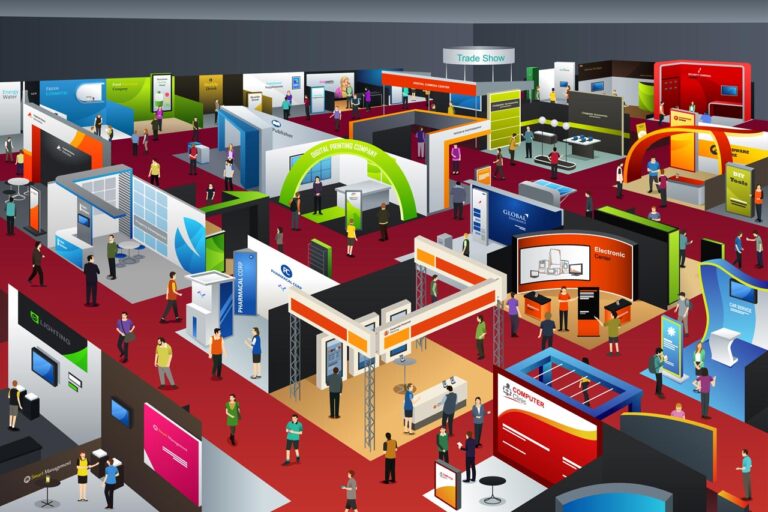

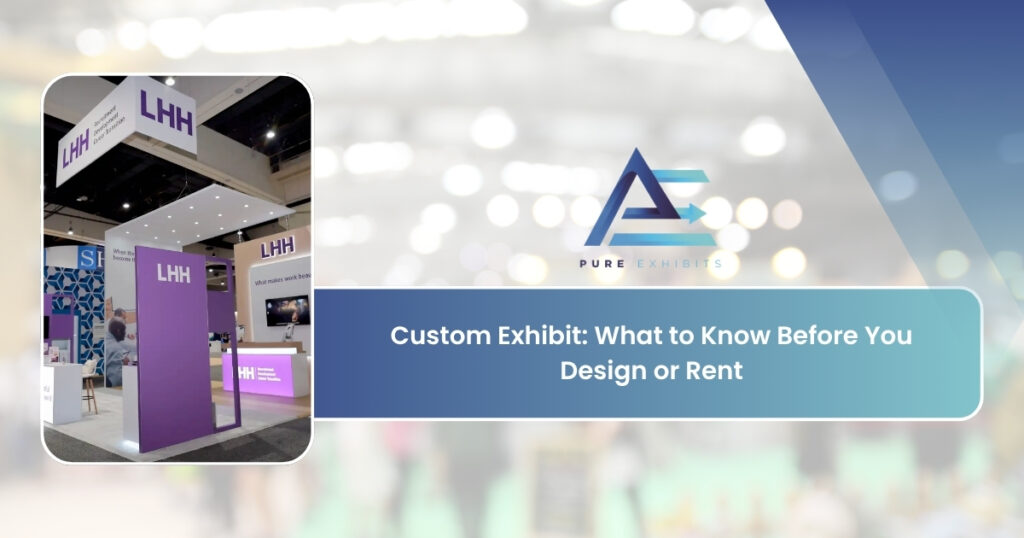
Most exhibitors start planning a custom exhibit the same way — by browsing photos online, sending a vague brief to two or three vendors, and waiting for proposals that are difficult to compare because they measure different things. The process produces confusion, missed deadlines, and booths that look good in a rendering but perform poorly on the show floor because the design was driven by aesthetics rather than by a clear understanding of the event, the audience, and how staff will actually use the space.
This guide gives you the framework to approach a custom exhibit decision methodically — what the term actually covers, which system type fits your objectives and budget, how to make the rent-versus-buy call, what Las Vegas show requirements affect your design options, and what a professionally executed build actually costs. If you have not yet determined the right footprint size for your program, start with the trade show booth size calculator before reading further — size drives every other cost and design decision that follows.
What Is a Custom Exhibit and How Does It Differ From a Standard Booth?
The word ‘custom’ in trade show exhibit terminology covers a wide range of products. It is used to describe anything from a fully bespoke, one-of-a-kind structure designed from scratch for a single client to a configurable modular system assembled from standard components in a client-specified layout with branded graphics applied. Understanding which definition a vendor is using matters — it directly determines what you are paying for, who owns the structure after the show, and how reusable or adaptable the exhibit will be.
Bespoke Custom Builds
A truly bespoke custom exhibit is designed and fabricated from scratch — custom-cut structure, unique architectural elements, purpose-built storage and demo areas, and proprietary finishes that no other exhibitor at the show will use. These builds require six to twelve weeks of lead time, dedicated fabrication labor, and a capital investment that is only justified at the 20×20 scale or larger, at flagship shows where competitive brand positioning demands a distinctive physical presence. The exhibit is owned by the client and warehoused between shows — which adds annual storage and refurbishment costs to the total program budget.
Custom-Configured Modular Systems
The more practical definition of a custom exhibit — and the category most professional exhibitors use — is a modular aluminum extrusion system configured specifically for the client’s footprint, staffing model, and show requirements, with custom-designed graphics, branded finishes, and purpose-built functional elements. These systems produce a booth that looks and functions as a custom design while using standardized components that can be reconfigured for different show sizes, shipped efficiently, and serviced by any qualified installation team. At the 10×10, 10×20, and 20×20 scale, this is the standard approach for exhibitors who want a professional, brand-consistent presence without the capital commitment of a bespoke fabrication.
Rental Systems With Custom Graphics
A rental system with custom graphics is the entry point for exhibitors who need a professional, differentiated presence but do not have the budget or program consistency to justify owning a structure. The frame, hardware, furniture, and lighting are rented from an exhibit house. The graphics — fabric back walls, overhead signs, counter wraps — are designed specifically for the client and either owned by the client or replaced each show. The result is a booth that looks custom to attendees but carries none of the ownership costs. Our trade show booth builder team designs, produces, and installs rental exhibits across all footprint sizes for Las Vegas shows, with graphics custom-designed to each client’s brand and show objectives.
What Are the Main Types of Custom Exhibit Systems Available?
Before selecting a vendor or approving a design direction, understand which structural system type your exhibit will use. Each type has different implications for shipping cost, lead time, reconfigurability, and total program cost.
| System Type | Best For | Lead Time | Reconfigurable? | Ownership |
|---|---|---|---|---|
| Aluminum extrusion modular | Most exhibitors 10×10–20×20 | 3–6 weeks | Yes | Rent or buy |
| Tension fabric pop-up | 10×10, budget-conscious first shows | 1–3 weeks | Limited | Buy or rent |
| Hybrid wood + aluminum | Island exhibits 20×20+ | 6–10 weeks | Partial | Typically buy |
| Fully bespoke fabrication | Flagship shows 20×20+ | 8–14 weeks | No | Buy |
| Rental with custom graphics | Infrequent exhibitors, all sizes | 2–4 weeks | Yes (per show) | Graphics only |
For most exhibitors at the 10×10 and 10×20 scale — particularly those exhibiting at one to three shows per year — the aluminum extrusion modular rental system with custom graphics delivers the best combination of visual impact, flexibility, and cost per show. The tension fabric pop-up is a viable starting point for a first show on a constrained budget, but it has visible limitations at design-competitive events.
How Do You Decide on the Right Size for a Custom Exhibit?
Size is the single variable that most affects what your custom exhibit can do — how many staff it accommodates, how many demo stations it supports, how visible it is from the aisle, and what structural elements are architecturally possible. The 10×10 trade show booth is the minimum footprint for a professional staffed exhibit — 100 square feet with one back wall, one corner exposure, and space for two to three staff members and one demo station. The 10×20 trade show booth doubles the footprint and adds a second aisle exposure, allowing for separate zones — a conversation area, a product demonstration area, and a reception counter — without crowding. The 20×20 trade show booth rental is the entry-level island configuration, visible from all four sides, and the minimum size for overhead hanging signs, meeting rooms, and multi-zone floor plans.
The decision between sizes is driven by three factors: the number of concurrent conversations your team needs to support, the demo or display requirements of your product line, and the competitive standard at the specific show you are exhibiting at. An exhibitor at a regional industry event has different requirements than an exhibitor at CES or HIMSS where neighboring booths set a high visual baseline. Underestimating the competitive standard at your target show is the most common reason exhibitors feel their exhibit underperformed.
What Design Elements Define a High-Performing Custom Exhibit?
A high-performing custom exhibit is designed around how attendees move through and interact with the space — not around what looks impressive in a rendering. The exhibition booth design process at Pure Exhibits starts with a conversation about staffing model, product demonstration requirements, lead capture workflow, and the specific shows and venues where the exhibit will be deployed — before a single structural element is specified.
Back Wall Visibility
The back wall is the first thing an attendee sees from the aisle. It needs to communicate your brand, your primary value proposition, and a visual signal that is distinguishable at 20 feet — before the attendee gets close enough to read body copy. A back wall that shows your logo and three lines of text in equal visual weight communicates nothing at distance. The most effective back walls show one dominant graphic element (brand photography or a product visual), one large headline (under eight words), and a company name — with everything else subordinated.
Traffic Flow and Staff Positioning
A well-designed exhibit creates a natural entry path that draws attendees in rather than creating a barrier at the aisle edge. Open corner entries, a reception counter set one to two feet inside the booth perimeter rather than flush with the aisle, and demo stations positioned toward the back rather than the front of the space all contribute to a higher stop and engage rate. Exhibits that put furniture flush with the aisle boundary create a visual wall that passive attendees walk past rather than entering.
Lighting
Overhead lighting in most convention halls produces a flat, grey appearance on booths that rely on ambient venue light. LED spotlights on the back wall graphic — focused at the top of the fabric to wash light downward — increase graphic visibility by 30 to 50 percent compared to ambient light alone. Backlit graphics at the back wall produce a completely different visual effect: the graphic appears to glow rather than be lit from outside, which is distinguishable from the aisle at significantly greater distance than a front-lit surface.
When Does It Make More Sense to Rent a Custom Exhibit Than Build One?
The rent-versus-buy decision depends on four variables: how many shows you exhibit at per year, whether your footprint size and layout stay consistent across shows, how much your brand message changes year over year, and what your capital budget looks like. The rent or buy trade show booth guide walks through the break-even math in detail — but the short answer for most exhibitors is: renting produces a better total cost per show for programs under three events per year, and renting remains competitive even beyond that threshold once you factor in ownership costs.
The Case for Renting
- No capital outlay — the exhibit hardware is rented at a per-show rate that is predictable and expensable, with no depreciation on the balance sheet.
- No storage costs — you pay nothing between shows for warehouse space, which runs $200 to $500 per month for a 10×10 kit in most major U.S. cities.
- No refurbishment costs — the exhibit house maintains the structural components. You own only the graphics, which you update as your messaging evolves without replacing the entire structure.
- Size flexibility — a rental program allows you to rent a 10×20 for your flagship show and a 10×10 for regional events within the same brand system, without owning both footprints.
- Reduced logistics complexity — for Las Vegas shows, renting from a Las Vegas exhibit house eliminates round-trip freight costs from your home city, which can equal or exceed the rental cost itself for a 10×20 kit.
The Case for Buying
- You exhibit at six or more shows per year with a consistent footprint size — at that frequency, the amortized cost of ownership falls below the rental rate per show.
- Your exhibit design includes highly proprietary structural elements — custom fabrication work, unique finishes, or product integration features — that cannot be produced in a rental system.
- Your brand guidelines require absolute consistency in materials, finishes, and structure across every appearance, which is easier to control with owned assets than with rental components managed by a third party.
What Are the Las Vegas Show Requirements That Affect Custom Exhibit Design?
Las Vegas hosts more major trade shows than any other U.S. city — CES, SEMA, NAB Show, HIMSS, and dozens of industry-specific events — and the las vegas trade show booth rentals market is structured around the specific requirements of those shows. The general service contractor at most Las Vegas Convention Center shows is Freeman. GES serves selected shows at Mandalay Bay, the Las Vegas Convention Center, and other venues. Each GSC publishes an exhibitor services manual — a show-specific document that defines the rules your booth design must comply with.
Height Restrictions
At most Las Vegas shows, inline booths — those in a standard row — are restricted to a maximum back wall height of 8 feet, with angled or stepped elements permitted toward the aisle at reduced heights (typically 4 feet within 5 feet of the aisle boundary). Island configurations — booths with aisle exposure on all four sides — have higher allowable heights, typically 16 to 20 feet for standard structural elements, and permit overhead hanging signs above the height cap with advance approval. Designs that exceed inline height restrictions will be flagged during show setup — a violation discovered on move-in morning has no practical remedy.
Neighboring Booth Sight Line Rules
Most show exhibitor manuals include rules about sight line obstruction — structural elements that block a neighboring exhibitor’s visibility from the aisle. Back walls taller than 8 feet in an inline configuration, for example, are restricted to the back half of the booth to prevent shadow on the neighboring booth behind you. Peninsula configurations — booths with one open end — have specific restrictions on which walls can be solid versus open to avoid blocking aisle traffic flow. Review the show’s exhibitor services manual with your exhibit house before finalizing any design element above 8 feet.
Electrical and Rigging Permits
Hanging signs, overhead lighting rigs, and any electrical connection beyond a standard floor power drop require advance permit applications filed with the GSC. At Freeman-managed shows, hanging sign permits require a structural engineer’s certification and must be submitted four to eight weeks before move-in. At LVCC, rigging is performed exclusively by Freeman riggers — you cannot install your own overhead elements regardless of what your exhibit house has produced. Budget the permit cost, the rigging labor rate (typically $150 to $300 per hour at union-managed venues), and the required advance timeline into any design that includes overhead elements.
What Does a Custom Exhibit Cost to Design, Build, or Rent?
Cost varies significantly by footprint size, system type, graphic complexity, and whether you are renting or buying. The trade show booth rental cost guide provides a full cost breakdown by booth size and show market. The table below gives representative ranges for the most common custom exhibit configurations as a starting reference.
| Configuration | Rental (Per Show) | Purchase (Total) | Annual Ownership Cost* |
|---|---|---|---|
| 10×10 modular rental w/ custom graphics | $3,500–$6,500 | $8,000–$18,000 | $2,000–$4,000/yr |
| 10×20 modular rental w/ custom graphics | $7,000–$14,000 | $18,000–$35,000 | $3,500–$7,000/yr |
| 20×20 island rental w/ custom graphics | $18,000–$35,000 | $40,000–$90,000 | $7,000–$15,000/yr |
| Bespoke custom fabrication 20×20+ | N/A (buy only) | $80,000–$250,000+ | $12,000–$30,000/yr |
The rental rate per show is not simply a fraction of the purchase price — rental covers the exhibit house’s amortization, maintenance, and logistics coordination, plus installation and dismantle labor at the show. For a Las Vegas-based exhibitor, renting from a Las Vegas exhibit house eliminates the round-trip freight cost — which for a 10×20 kit from Chicago or New York runs $3,000 to $6,000 per show each way — making the total program cost of a Las Vegas rental consistently lower than shipping owned assets to Las Vegas.
What Mistakes Do Exhibitors Make When Ordering a Custom Exhibit for the First Time?
- Starting with aesthetics instead of objectives. The most common first-time error is briefing an exhibit house with a visual inspiration board rather than a functional requirements document. Before sharing any visuals, define: how many concurrent conversations your team will have, what product or technology you need to demonstrate, where lead capture happens, and what the one takeaway message for an attendee should be. Visual direction follows from those answers — not the other way around.
- Underestimating the total show cost. The exhibit hardware is a fraction of the total investment at most shows. Drayage (material handling) at Freeman-managed venues runs $150 to $300 per hundred pounds. Installation and dismantle labor at union-managed Las Vegas venues runs $100 to $200 per hour per worker. Electrical service, carpet, and furniture add $1,500 to $5,000 for a 10×20 booth at a major show. Budget for the total show program — not just the exhibit hardware.
- Approving a design without a staffing model. A booth designed for three staff members that is staffed by one person on the show floor looks empty and sends a negative signal to attendees. Confirm how many staff will actually be present at each show before approving the floor plan — then design around that number.
- Missing the advance warehouse deadline. Most major shows have an advance warehouse — a staging facility that receives freight two to four weeks before show open. Freight that arrives after the deadline ships direct-to-show at a higher cost and with higher risk of delay. Build your exhibit production, graphic production, and shipping timeline from the advance warehouse deadline backward, not from the show open date.
- Using the same design for every show without evaluating show-specific requirements. A design that works well at a 10×20 inline at SEMA may not comply with NAB Show’s height restrictions or may look undersized at CES where neighboring booths are significantly larger. Review the exhibitor services manual for each specific show before assuming your standard design is compliant.
Conclusion
A custom exhibit delivers meaningful competitive advantage only when it is designed around a clear functional brief, specified to the correct footprint size for your program, and executed by a vendor who understands the specific requirements of the shows you attend. For most exhibitors, a custom-configured rental system with purpose-designed graphics produces a better result at lower total program cost than either a generic rental or a full bespoke fabrication — particularly for Las Vegas shows where proximity to the exhibit house eliminates the freight cost that makes ownership economics worse than they appear on paper.
Start with your size, define your functional requirements, review your show’s exhibitor manual before briefing any vendor, and get the total show program cost — not just the exhibit hardware cost — before comparing proposals.
Let’s Build Something Extraordinary
Share your event details and we’ll craft a custom booth solution designed to captivate your audience and maximize your ROI.
Frequently Asked Questions
What is the difference between a custom exhibit and a standard booth?
A standard booth typically refers to a pop-up or pull-up display purchased off the shelf with minimal configuration options. A custom exhibit is designed and configured specifically for the exhibiting company — custom graphics, a floor plan built around a functional brief, and structural elements chosen to match the specific show requirements and brand standards. The level of customization ranges from a rental aluminum frame system with custom fabric graphics to a fully bespoke fabricated structure built from scratch. Most professional exhibitors use the middle option: a configurable modular system with custom-designed graphics and branded finishes.
How long does it take to design and build a custom exhibit?
Lead time depends on the system type and complexity. A rental system with custom graphics can be designed, produced, and ready to ship in three to six weeks from a signed brief. A bespoke custom fabrication requires eight to fourteen weeks of lead time from approved design to completed build. For first-time exhibitors working toward a specific show date, four to six weeks is the minimum comfortable timeline for a modular rental system — less than that and graphic production, quality review, and shipping compress to the point where errors become difficult to catch before the show.
How much does a custom exhibit cost?
A 10×10 custom exhibit rental costs $3,500 to $6,500 per show, including graphics, installation, and dismantle at the venue. A 10×20 rental runs $7,000 to $14,000 per show. A 20×20 island rental runs $18,000 to $35,000 per show. Purchasing a 10×10 modular system outright costs $8,000 to $18,000 including custom graphics. These figures cover the exhibit hardware and graphics only — show services including drayage, electrical, and venue labor are separate line items that typically add 40 to 80 percent to the hardware cost at major Las Vegas shows.
Should I rent or buy a custom exhibit?
Renting produces a better cost per show for most exhibitors at fewer than five to six shows per year, once storage, refurbishment, and freight costs are included in the ownership calculation. Buying makes sense when you exhibit at six or more shows annually with a consistent footprint, or when your design requires proprietary structural elements that cannot be produced in a rental system. For Las Vegas shows specifically, renting from a Las Vegas exhibit house eliminates round-trip freight costs that can run $3,000 to $6,000 per show each way for a 10×20 kit shipped from another city.
What is included in a custom exhibit rental?
A full-service custom exhibit rental from a professional exhibit house typically includes structural components (aluminum extrusion frame, walls, counters, shelving), custom-designed graphics (back wall fabric, counter wraps, overhead signs), lighting, freight from the exhibit house’s warehouse to the show venue, installation at the show, dismantle after the show, and return freight to the exhibit house. Optional additions include furnishings, AV equipment, flooring, storage rooms, and meeting rooms. Confirm exactly what is included in any quoted price — the range of inclusions varies significantly by vendor.
Can I reuse a custom exhibit at multiple shows?
Yes — modular aluminum systems are specifically designed for multi-show reuse. The structure reconfigures to different footprint sizes (a 10×20 can reconfigure as two 10x10s, for example), and graphics can be updated independently of the structural components. Graphics printed on dye-sublimation fabric hold color fidelity through multiple shows and packings. For rental systems, the exhibit house manages the physical components between shows — you update the graphics as your messaging evolves without replacing the entire structure.
What information does a custom exhibit designer need from me before starting?
A professional exhibit designer needs: the show name and venue, your assigned booth dimensions, the number of staff who will work the booth simultaneously, what products or technology you need to demonstrate or display, your primary message to attendees (one sentence), whether you need meeting space, storage, or specific furnishings, your brand guidelines (logo files, color palette, approved photography), your production and shipping deadline, and your total budget including show services. Designers who work without this information produce designs that look good in a rendering but do not function on the show floor.
Do I need a custom exhibit designer or can I design it myself?
You can specify the functional requirements yourself — and you should. The staffing model, demo layout, and message hierarchy are things only you can define. The translation of those requirements into a structurally sound, visually effective booth — graphic file preparation, dimensional specs for SEG fabric, LED lighting placement, and compliance with show height restrictions — requires professional expertise. Most exhibitors who attempt to design without professional support either produce a result that underperforms, encounter compliance issues at move-in, or face graphic production problems that arise from incorrect file specifications.
How does a Las Vegas exhibit house serve exhibitors from other cities?
Most Pure Exhibits clients are not based in Las Vegas — they exhibit at Las Vegas shows but operate from offices in other cities. The exhibit house manages design, graphic production, freight to the show, installation, and dismantle entirely from the Las Vegas facility. The client team approves the design remotely, ships any proprietary product assets or branded materials to the Las Vegas warehouse, and arrives at the show to find the booth fully installed and ready. Pure Exhibits pre-builds every exhibit at its Las Vegas facility before shipping — graphics installed in the frame, lighting verified, all components confirmed — so there are no move-in morning surprises.
What are the Las Vegas Convention Center’s rules for custom exhibit height?
At LVCC inline booths in a standard row configuration, the maximum back wall height is 8 feet. Elements within 5 feet of the aisle must not exceed 4 feet in height. Island configurations allow structural heights up to 20 feet. Overhead hanging signs require advance permit application with a structural engineer’s certification, submitted to Freeman (the general service contractor at most LVCC shows) four to eight weeks before move-in. Rigging at LVCC is performed exclusively by Freeman riggers — exhibitors cannot install overhead elements independently. Confirm the specific rules in the exhibitor services manual for your show, as height restrictions vary by event.
What does the pre-build process involve?
A pre-build is the assembly of the complete exhibit at the exhibit house’s warehouse before it ships to the show. Every structural component is assembled, every graphic is installed in its frame, every light is connected and aimed, and every component on the packing list is physically confirmed present. This step catches graphic sizing errors, color problems, missing hardware, and installation issues before the freight leaves the warehouse rather than on move-in morning at the show venue. Pure Exhibits pre-builds every exhibit as a standard part of the production process — clients can request photos or a video walkthrough of the pre-build before approving the ship date.
How do I compare quotes from different custom exhibit vendors?
Compare quotes on total delivered cost — not exhibit hardware cost alone. Confirm whether each quote includes graphic design, graphic production, freight to the show, installation, dismantle, and return freight. Ask each vendor what their production timeline is from signed contract to shipped exhibit. Confirm whether the structural components in each quote are comparable — aluminum extrusion modular systems, pop-up frames, and bespoke fabrication are not equivalent products at equivalent price points. Ask each vendor for references from clients who have exhibited at the same show you are targeting — show-specific experience with Freeman, GES, or your venue’s GSC is a meaningful differentiator.