

You found three exhibit booth builders who all say the same things: custom design, full service, competitive pricing. Their websites look nearly identical. One is based in your city, one operates nationally, one claims to specialize in Las Vegas. And now you have a show booked in four months and no idea which company will actually deliver what they promised.
Choosing among exhibit booth builders in the USA is harder than it looks on the surface because the category spans an enormous range — from small local fabricators doing pop-up displays to full-service exhibit houses managing 50×50 island builds at major conventions. The trade show booth rental cost you are quoted reflects that range, and so does the quality and reliability of what shows up on the floor. This guide explains how to evaluate builders, what questions actually matter, and how to match the right type of company to your specific show needs.
Work With a Las Vegas Exhibit Builder Who Knows the Floor
Pure Exhibits designs, builds, and delivers rental exhibits for Las Vegas trade shows — with a pre-build guarantee before every show.
What Do Exhibit Booth Builders in the USA Actually Do?
The term “exhibit booth builder” covers a wide range of companies with different scopes, business models, and service levels. At the most basic end, a builder might produce a standard pop-up display or tension fabric frame with printed graphics — a process that involves no structural design and minimal client interaction. At the most comprehensive end, a full-service exhibit house handles concept design, structural engineering, custom fabrication, graphic production, installation and dismantle at the show, and post-show storage.
Most exhibitors working with mid-to-large booths (10×20 and above) need a company that operates across the full service chain — not just a printer who sells display hardware. The distinction matters because builders who only produce the exhibit and hand it off create responsibility gaps at the show: who handles installation if a component is missing? Who calls the show’s general service contractor if there is a floor space discrepancy?
A full-service builder stays accountable through move-in, show days, and move-out. A product seller hands over the crate and wishes you luck.
What Are the Different Types of Exhibit Companies in the USA?
The US exhibit industry organizes into four broad company types, each with different strengths, limitations, and best-fit use cases. Understanding which type you are talking to — and which type you actually need — prevents a common mistake: hiring a display vendor for a job that requires an exhibit house.
| Company Type | What They Do | Best For | Limitations |
|---|---|---|---|
| Full-service exhibit house | Design, build, install, and manage exhibits end to end; own their fabrication and I&D crews | 20×20+ booths, multi-show programs, complex builds | Higher cost; may require minimum spend thresholds |
| Rental-focused exhibit house | Design and deliver modular rental systems with custom graphics; often handle I&D | Exhibitors doing 1–6 shows/year, flexible footprints, budget-conscious programs | Less structural customization than custom fabricators |
| Display vendor / reseller | Sell or rent pop-up frames, banner stands, tension fabric displays | Tabletop and small inline 10×10 setups, low-budget first shows | No design service; no installation support; no show-floor accountability |
| Freelance / boutique designer | Handle design and project management; outsource fabrication to third parties | Smaller companies needing design expertise without a full house | Fragmented accountability; fabrication quality varies by vendor used |
Most mid-market exhibitors are best served by a rental-focused exhibit house — companies that maintain a catalog of modular structural systems and can customize them with graphics, lighting, and furniture to produce a branded exhibit at a fraction of the cost of full custom fabrication. For more on how to evaluate vendors across the full exhibit supply chain, see the trade show vendor guide.
What Design Capabilities Should You Evaluate in an Exhibit Builder?
Design capability is where the widest gap exists between exhibit builders who deliver strong results and those who produce generic, forgettable booths. The physical structure holds the exhibit together; the design is what generates attention on a crowded show floor.
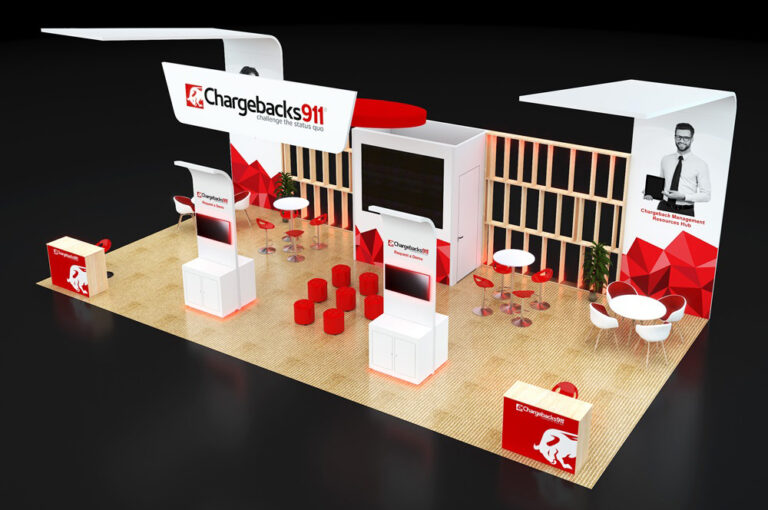
When evaluating design, ask to see 3D renders from previous projects — not just finished photography. Renders reveal how the builder thinks spatially: are sightlines clear from the aisle? Is traffic flow through the booth logical? Is there a clear focal point that draws attention from 20 feet away? These are questions of exhibition booth design that separate builders who design exhibits from those who assemble hardware.
Design Evaluation Checklist
| Design Capability | What to Ask | Red Flag |
|---|---|---|
| 3D rendering | Can you show renders from a project at the same footprint I’m planning? | Only offers photos of finished builds — no pre-build visualization |
| Graphic production | Do you produce graphics in-house or outsource to a print vendor? | Cannot confirm print resolution specs or substrate options |
| Brand standards compliance | Can your team work from our brand guidelines and Pantone color specs? | Sends generic templates and asks you to fill in your logo |
| Lighting integration | How do you incorporate lighting into the design — added after or planned from the start? | Lighting is presented as an add-on with no design rationale |
| Revision process | How many design revision rounds are included before production begins? | Charges per revision or rushes to production without approval sign-off |
| Show regulation compliance | Do you review show regulations for height limits, setback rules, and hanging sign restrictions? | Leaves compliance research entirely to the client |
How Does Location Affect Which Exhibit Builder You Should Use?
Location matters more than most exhibitors realize when selecting an exhibit builder, and the impact shows up directly in the budget. An exhibit shipped cross-country from a builder based far from your show venue generates long-haul freight costs, advance warehouse fees, and a higher risk of transit damage. Those costs add to every show and compound significantly across a multi-show program.
For shows in Las Vegas — which hosts more major trade shows than any other US city — working with a locally based builder eliminates all of those variables. A Las Vegas builder can deliver the exhibit by ground transport, often the morning of move-in, bypassing the advance warehouse system entirely. This is the core operational advantage behind las vegas trade show booth rentals from a locally based exhibit house: lower freight cost, faster response if something needs to be adjusted on-site, and a team that already knows the floor plans and union jurisdictions at the venues your show uses.
For companies with a multi-show program that includes both Las Vegas and out-of-market events, the budget implications of builder location deserve a dedicated line in the trade show budget — comparing freight and drayage costs for an out-of-state builder versus a local partner for Las Vegas dates is often where the strongest cost-reduction opportunity is found.
Las Vegas Exhibit Builder — Local Delivery, No Freight Surprises
Pure Exhibits is based in Las Vegas and delivers rental exhibits directly to show venues — no advance warehouse, no cross-country freight, no surprises on move-in day
What Questions Should You Ask Exhibit Booth Builders Before Signing?
The questions you ask during the vendor selection process reveal more than the proposals themselves. Good exhibit builders answer these questions with specifics. Builders who overpromise and underdeliver give vague, reassuring answers that do not hold up when you follow up with detail questions.
| Question to Ask | What a Strong Answer Looks Like | What a Weak Answer Looks Like |
|---|---|---|
| Do you pre-build the exhibit before delivering it to the show? | Yes — we assemble every exhibit at our facility and photograph it before delivery to confirm all components are present and fit correctly. | We build on-site and have never had a major issue. |
| Who handles installation at the show — your crew or a contracted I&D company? | Our own crew handles installation, so we are accountable if anything is missing or damaged. | We use local I&D contractors at each show venue. |
| What happens if a component is missing or damaged on move-in day? | We maintain a local inventory of backup components and can typically resolve issues within two hours. | We will ship a replacement as quickly as possible. |
| What is included in your quoted price? | The quote covers design, structure, graphics, delivery, installation, dismantle, and [list any exclusions explicitly]. | Everything you need is included — just let us know what you want. |
| Can you show me references from exhibitors at shows I’m attending? | Yes — here are three clients who have exhibited at [show name] in the past two years. | We have many happy clients — here are some general testimonials. |
| How do you handle graphic updates between shows? | We store your graphic files and can produce updated panels within [X] days of receiving approved artwork. | Just send us the new files and we will take care of it. |
What Booth Sizes and Systems Do US Exhibit Builders Typically Offer?
Most full-service and rental-focused exhibit builders in the USA offer a range of structural systems designed to fit standard show floor footprints. The most common modular systems are built around aluminum extrusion frames and silicone edge graphic (SEG) fabric panels, which produce clean backlit or front-lit graphic walls at a fraction of the cost of custom-fabricated structures.
At the entry level, a 10×10 trade show booth rental is the most common starting footprint — a single 10-foot-wide inline space that accommodates a back wall graphic, a counter, and one to two staff members. This is the right footprint for first-time exhibitors or companies testing a new show before committing to a larger space.
The 10×20 trade show booth rental doubles the floor footprint and creates significantly more opportunity for product display, demo stations, and branded visual impact. At this size, backlit SEG back walls become the standard — a full 20-foot backlit graphic wall creates aisle presence that a 10×10 cannot match. Most mid-market exhibitors find the 10×20 to be the most cost-effective footprint once their show program matures.
Above the 10×20, island booths (20×20 and larger) are open on all four sides and require a more complex structural design. Island exhibits are where full custom fabrication often becomes justified — the design complexity, hanging sign requirements, and structural coordination involved in a large island build generally exceeds what standard modular systems can deliver without significant customization.
What Installation and Service Capabilities Should an Exhibit Builder Provide?
The exhibit builder’s role does not end when the crate arrives at the convention center. What happens during move-in — and who is responsible when something goes wrong — is one of the most important differentiators between exhibit builders and display vendors. Builders who hand off the exhibit at the loading dock and disappear are not exhibit houses; they are product suppliers.
A full-service exhibit builder handles trade show installation directly, including coordinating with the show’s general service contractor, managing union labor requirements, supervising the build, and confirming the exhibit is complete and ready before show open. This level of service means the exhibitor arrives to a finished booth rather than arriving to supervise a crew that has never seen the exhibit before.
The pre-build guarantee is the strongest single signal of a capable exhibit builder. If a builder pre-assembles the complete exhibit at their facility before delivery, they know the exhibit works before it reaches the show floor. Any missing component, broken fitting, or graphic misalignment is caught and corrected at the shop — not during a compressed 14-hour move-in window when alternatives are expensive and time is gone.
Installation Service Capabilities to Confirm
| Service Capability | Why It Matters | How to Confirm |
|---|---|---|
| Pre-build at facility before delivery | Catches problems before move-in when fixes are cheap and time is available | Ask to see photos from the pre-build; confirm it is standard practice |
| Own installation crew vs. contracted I&D | Own crew = direct accountability; contracted crew = diffused accountability | Ask specifically: are the people installing my booth your employees? |
| On-site support during move-in | Supervisor presence resolves issues immediately rather than via phone | Ask who the on-site point of contact is and confirm they will be present |
| Dismantle and return freight handling | Builder handles tear-down and return shipment, not just installation | Confirm dismantle is included in the quote before signing |
| Emergency repair capability | A component breaks during the show — builder has local backup inventory | Ask: what is your response time if something fails mid-show? |
How Do You Compare Exhibit Builder Proposals Side by Side?
When multiple exhibit builders submit proposals for the same project, the prices rarely compare directly because the scope rarely matches. One builder’s “all-in” price includes installation and dismantle; another’s does not. One includes graphic revisions; another charges per round. Comparing proposals at face value leads to selecting the wrong builder for the wrong reasons.
The correct approach is to build a scope comparison before evaluating pricing. Create a standard scope document that lists every deliverable you need — design, structure, graphics, delivery, installation, on-site supervision, dismantle, storage — and require each builder to confirm inclusion or exclusion of each item explicitly. Once scope is normalized, price comparison is meaningful.
Beyond scope and price, evaluate three qualitative factors: communication speed during the proposal process (slow responses before the sale predict slow responses when you need support during show prep), portfolio relevance (have they built booths at your specific shows and footprint size?), and reference quality (can they connect you with a client who exhibited at the same venue you are planning?). These factors predict show-day performance better than the proposal document does.
Let’s Build Something Extraordinary
Share your event details and we’ll craft a custom booth solution designed to captivate your audience and maximize your ROI.
Frequently Asked Questions
What is the difference between an exhibit house and a display vendor?
An exhibit house handles the full lifecycle of a trade show exhibit: design, fabrication or rental, installation, on-site support, and dismantle. A display vendor sells or rents hardware — pop-up frames, banner stands, tension fabric displays — and the exhibitor handles everything else. Most mid-market exhibitors with inline or island booths above the tabletop level need an exhibit house, not a display vendor.
How much do exhibit booth builders in the USA charge?
Pricing varies significantly by scope. A modular rental exhibit at a 10×20 footprint with custom graphics, installation, and dismantle typically ranges from $6,000–$18,000 per show depending on show location, structural complexity, and service level. Custom fabricated exhibits at the same size range from $20,000–$60,000 for the build, plus recurring show-service costs. Getting an itemized quote from multiple builders is the only way to make a meaningful price comparison.
Should I rent or buy a custom exhibit?
Rental is the better choice for most exhibitors doing one to six shows per year. Purchasing a custom exhibit at $30,000–$80,000 requires storage, maintenance, and eventual write-off when the design ages. Rental eliminates all three costs and allows the footprint to change by show without a sunk-cost penalty. Custom fabrication makes financial sense when the annual show program exceeds eight to ten shows at the same footprint with consistent branding.
What is a pre-build guarantee and why does it matter?
A pre-build guarantee means the exhibit builder assembles the complete exhibit at their facility before delivering it to the show. Every component is checked, every graphic is inspected, and any issues are resolved before move-in. This eliminates the most common source of move-in disasters: missing parts, incorrect graphics, or structural components that do not fit discovered during a compressed move-in window when fixes are expensive and time is limited.
How do I know if an exhibit builder has experience at my specific show?
Ask directly. Request references from clients who have exhibited at the same show and same venue within the past two years. A builder with genuine show experience will be able to answer specific questions about the general service contractor, floor layout, union jurisdiction rules, and move-in logistics without hesitation. Vague answers or redirection to general testimonials are signals the experience is thin.
What should be included in an exhibit builder’s quote?
A complete quote should explicitly include: booth design and 3D rendering, structure (rental or fabrication), graphic production, delivery to the show venue, installation labor, on-site supervision during move-in, dismantle labor, and return freight. Any item not listed on the quote is a potential surprise charge. Ask each builder to confirm scope explicitly rather than assuming “all-in” means the same thing across proposals.
How far in advance should I engage an exhibit builder?
For a first-time engagement with a new builder, allow at least three to four months before the show. Design development typically takes two to four weeks, graphic production takes one to two weeks, and shipping logistics require at least two weeks for any show outside the builder’s local market. Engaging earlier gives the builder time to pre-build and gives you time to review and approve the exhibit before it leaves their facility.
Can I use the same exhibit at multiple shows?
Yes — this is one of the primary benefits of working with a rental exhibit house. Modular systems are designed to be reconfigured and reused across shows. Graphics can be updated between shows without replacing the structure. The main limitation is footprint: if your shows have different space allocations (10×10 at one show, 10×20 at another), confirm the builder’s system can scale between sizes without requiring a full rebuild.
What happens if my exhibit is damaged during shipping?
This depends entirely on who owns the freight responsibility. If you own the exhibit and shipped it yourself, damage claims go through your freight insurer. If you are renting from an exhibit house that ships the exhibit and installs it, the builder typically absorbs responsibility for transit damage — which is one of the strongest practical arguments for working with a full-service rental house rather than shipping your own exhibit.
Do exhibit builders work with union labor at trade shows?
Yes — most professional exhibit builders are familiar with union jurisdiction rules at major venues and either employ union-certified installers or contract with certified I&D crews in union markets. Nevada is a right-to-work state, but individual show contracts with unions still govern what tasks exhibitor personnel can perform versus what requires union labor. A capable builder navigates this on your behalf rather than leaving you to interpret jurisdiction rules independently.
How do I evaluate an exhibit builder’s design quality?
Ask for 3D renders from projects at the same booth size you are planning — not just finished photography. Renders reveal spatial thinking: sightlines, traffic flow, focal point placement, and graphic hierarchy. Also review the graphic quality in finished photos: are colors saturated and correctly reproduced? Are edges and seams clean? Is lighting integrated into the design or bolted on as an afterthought? Design quality is visible in the details before the exhibit ever reaches a show floor.
What is the advantage of using a local Las Vegas exhibit builder?
Las Vegas hosts more major trade shows than any other US city, and a locally based builder eliminates long-haul freight costs, advance warehouse fees, and the risk of transit damage. Local builders can deliver by ground on move-in morning, provide rapid on-site support if issues arise, and have established relationships with the convention venues and general service contractors that your show uses. For any exhibitor with one or more Las Vegas shows on their calendar, the cost and logistics advantages of a local builder are measurable and consistent.