
If You’re Doing 4+ Shows a Year and Still Booking One-Off Rentals, You’re Paying a 25% Premium You Don’t Have To
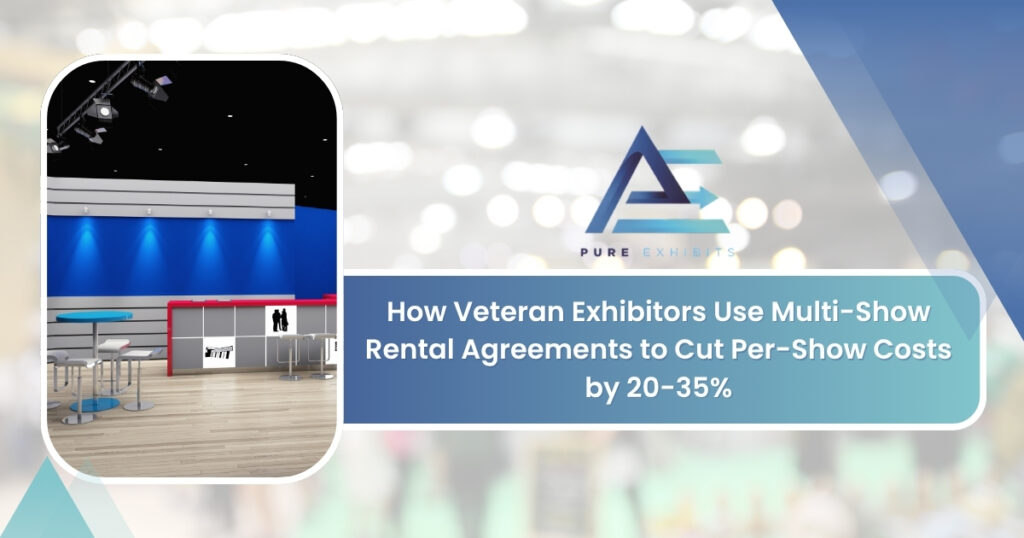
A thread in the IAEE community forums recently surfaced something most veteran exhibit managers already suspect but rarely quantify: exhibitors running four or more shows annually and treating each rental as a standalone transaction are systematically overpaying. The numbers that came up in that discussion — 20 to 35% per-show cost reduction through structured multi-show rental agreements — are consistent with what we see in our own programs at Pure Exhibits.
This isn’t about getting a loyalty discount for being a nice client. It’s a structural negotiation with real leverage on both sides. Here’s exactly how it works, where the break-even point is, and what experienced exhibit managers are actually negotiating into these agreements.
What a Multi-Show Exhibit Rental Agreement Actually Is (and Isn’t)
A multi-show exhibit rental agreement is a pre-committed contract covering three to five shows within a defined calendar period — typically 12 to 18 months — with a single exhibit house. You’re not locking in identical booths. You’re locking in a pricing framework, a design system, and a service relationship.
What it is not: a package deal where you get the same booth dragged from CES to NAB to SEMA. Your booth at the Las Vegas Convention Center for CES looks different from your presence at McCormick Place for a healthcare show. The agreement covers the pricing tier, not rigid configurations.
The key components of a well-structured agreement typically include:
- Volume pricing tier: A fixed per-show rate discount (typically 15–25%) applied to design, fabrication, and rental line items
- Priority scheduling: Your shows get slotted into the production calendar before open-market clients — critical for shows like NAB or HIMSS where lead times compress fast
- Dedicated project management: One PM who knows your brand standards, your GC relationships, and your advance warehouse preferences across every show
- Design asset banking: Graphics, structural elements, and configurations developed in year one become a library that gets refreshed rather than rebuilt from scratch
- I&D rate locks: Labor estimates baked in at contract time, not quoted fresh when union rates or crew availability shifts
The Break-Even Math: When Annual Contracts Beat One-Off Rentals
Let’s run actual numbers. A 20×20 island booth rental at a major Las Vegas show runs $18,000–$45,000 depending on configuration complexity. Call it $28,000 as a realistic mid-market figure for a clean, well-designed island with AV and graphics.
At four shows annually, that’s $112,000 in booth rental spend — before you factor in I&D and shipping, which on a 20×20 island typically adds another $6,000–$12,000 per show depending on venue and union jurisdiction.
A multi-show exhibit rental agreement negotiated at a 22% volume discount on a four-show commitment at that same spend level saves approximately $24,600 annually on rental alone. Add in the labor rate locks and reduced re-design fees (because your design library already exists), and you’re frequently looking at $30,000–$40,000 in total annual savings for a mid-tier 20×20 program.
The break-even threshold is almost always at three shows. Below three, the volume discount rarely compensates for the commitment risk. At four or more, the math almost always favors the annual agreement — sometimes dramatically.
For larger footprints, the leverage is even more pronounced. A 20×30 island program running $40,000 per show across five shows represents $200,000 in annual rental exposure. A 25% annual agreement discount on that program is $50,000 back to your budget — enough to fund an entire additional show or a serious investment in lead capture and post-show follow-up infrastructure.
What Veteran Exhibitors Actually Negotiate Into These Agreements
Most exhibit managers know to ask for a percentage discount. The ones consistently hitting strong ROI negotiate four additional provisions that matter just as much.
1. Advance Warehouse Priority and Rate Locks
If you’ve ever had a shipment hit a Las Vegas advance warehouse in the window right before SEMA or CES, you know what happens to handling costs. Multi-show clients who commit annual volume get warehouse priority and, critically, the ability to negotiate drayage and warehousing rate caps into the agreement. This alone can save $2,000–$5,000 per show at high-traffic Las Vegas events.
2. Design Refresh Budgets vs. Full Redesign Costs
A full booth redesign from scratch on a 20×20 island typically runs $8,000–$15,000 in design and fabrication prep costs. Under an annual agreement, your design assets carry forward. Refreshes — new graphics, updated messaging panels, reconfigured demo stations — run $1,500–$4,000. Over four shows, that’s potentially $26,000–$44,000 in avoided design cost.
3. Dedicated Project Management Continuity
This is the one exhibitors undervalue most until they’ve lost it. A PM who has managed your booth at Javits, Moscone, and the LVCC doesn’t need a 45-minute onboarding call before every show. They know your union labor preferences, your GC contacts, your advance warehouse timelines, and which of your graphics panels always arrives damaged from the San Francisco run. That institutional knowledge is worth real money in avoided errors and RFIs.
4. Force Majeure and Show Cancellation Provisions
Post-2020, any exhibit manager who signs a multi-show commitment without explicit show cancellation language is leaving themselves exposed. Negotiate a provision that allows one show substitution per contract year and a defined credit rollover mechanism if a show is cancelled or you need to reduce footprint. Reputable exhibit houses will accept these terms for committed annual clients.
The Hidden Cost of One-Off Rental Transactions
Most exhibitors doing four-plus shows annually don’t feel the one-off premium as a line item because it’s embedded in the friction of every transaction. It shows up as:
- Re-briefing costs: Every new project requires a fresh kick-off, design review, and approval cycle — typically 6–10 hours of internal staff time per show that compounds across vendors
- Inconsistent brand presentation: Different vendors, different fabrication tolerances, different graphic rendering. If your booth at Premiere Orlando looks materially different from your presence at the GBTA Convention in Chicago, that’s a brand problem with a dollar cost
- Rush fees: One-off clients get quoted rush premiums when production calendars fill up. Committed annual clients have reserved slots
- No leverage on mistakes: When something goes wrong on a one-off, you have no relationship equity to draw on. When something goes wrong on show three of a five-show agreement, your exhibit house has significant incentive to make it right fast
The real cost of a trade show booth rental is never just the line item on the invoice. It’s the sum of every friction point across the entire show cycle.
How to Structure the Conversation With Your Exhibit House
Come to the negotiation with your show calendar mapped for 12–18 months. Know your cities, your approximate footprints, and your budget range per show. Exhibit houses discount on predictability, not on vague promises of future business.
Present your program like this: “We have four confirmed shows — LVCC in January, McCormick Place in March, Moscone in June, and Orlando in September. Our footprints range from 20×20 to 20×40. We want one PM, a consistent design framework, and a volume pricing structure. What does a committed annual program look like for us?”
That framing puts you in a completely different negotiation than “we have a show in Vegas in January, can you quote us a 20×20?”
Ask specifically for:
- The percentage discount applied to rental, design, and on-site supervision line items
- A dedicated PM named in the contract
- Design asset ownership or perpetual license terms
- One show substitution right per contract year
- I&D rate caps tied to the agreement period
If your exhibit house won’t engage with these terms, that tells you something important about how they value long-term client relationships versus transactional volume. Review the case studies of any vendor you’re evaluating — look for evidence of multi-year client relationships, not just impressive one-off builds.
Also worth reviewing before any negotiation: the 12 most common exhibiting mistakes that cost programs money. Several of them are structural issues that a well-designed annual agreement directly addresses.
Frequently Asked Questions
How much can I actually save with a multi-show exhibit rental agreement?
Most exhibitors doing 4+ shows annually save between 20–35% per show on combined rental, design, and I&D costs under a structured multi-show exhibit rental agreement. On a mid-market 20×20 program spending $28,000 per show, that’s typically $22,000–$39,000 in annual savings — before accounting for reduced re-briefing time and avoided rush fees. See our detailed cost breakdown for line-item context.
What is the minimum number of shows needed to justify a multi-show rental contract?
The break-even point is almost universally at three shows per year. Below three, the volume discount typically doesn’t compensate for the commitment and flexibility trade-offs. At four or more shows annually, the financial case for a multi-show exhibit rental agreement is almost always compelling.
How much does a 20×20 trade show booth rental cost at a major Las Vegas show?
A 20×20 island booth rental in Las Vegas typically ranges from $18,000 to $45,000 depending on configuration complexity, AV requirements, and design customization. Under a multi-show annual agreement, that per-show cost typically drops by 20–25% for committed four-show+ clients.
Can I use different booth sizes at different shows under one annual agreement?
Yes — and this is actually one of the key advantages. A well-structured multi-show exhibit rental agreement establishes a pricing tier and design framework, not a fixed configuration. You might run a 20×20 at a regional show and a 20×40 at a flagship event, with both covered under the same agreement’s volume pricing structure.
What happens if a show gets cancelled under a multi-show rental contract?
Any credible multi-show exhibit rental agreement should include a show substitution provision — typically one substitution per contract year — and a defined credit rollover mechanism for cancelled shows. Always negotiate this in writing before signing; do not rely on verbal assurances. Post-2020, this clause is non-negotiable for sophisticated exhibit managers.
How do I find out what trade shows are worth building an annual program around in Las Vegas?
Start with a full picture of the Las Vegas event calendar — the city hosts more major trade shows than any other US market. Our guide to the top Las Vegas trade shows in 2026 covers the major events by industry vertical, which is useful for building out a multi-show calendar that anchors in Nevada and branches into secondary markets.
If you’re running four or more shows a year and want to see exactly what a multi-show program would look like for your specific calendar and footprint, the most useful next step is a direct program consultation — bring your show list, your approximate budgets, and your current vendor pain points. We’ll map out the structure and run the numbers against your actual spend. No generic pitch deck, just your program.