
I started Pure Exhibits with one belief: the trade show booth rental industry was making something complicated that didn’t need to be. Too many vendors, too much chaos, too many post-show surprises. We built Pure Exhibits around the opposite model, fixed pricing, one project manager, one invoice, and a prebuilt guarantee that means your booth is fully assembled and photographed before it ever leaves our facility.
Fifteen years on show floors across the country has given me a lot of opinions. Not polished marketing opinions, real ones, built from watching what works and what quietly destroys exhibitors’ ROI.
After 15 years on trade show floors, you start to see patterns. Different companies, different industries, but the same challenges repeat. Booth cost, ROI, staffing, and lead generation. Here’s how I think about them, based on what actually works in practice.
“Why is the whole trade show process so scattered and overwhelming?”
Completely valid. The honest answer: the trade show industry is structurally fragmented.
Four stakeholders own four different pieces of your show. The show organiser owns the floor plan and space assignment. The general contractor owns material handling and show services. Your exhibit builder owns the booth. And you are responsible for making all three work together, usually for the first time, under deadline pressure.
Nobody owns the whole experience on your behalf by default.
The exhibitors who get through their first show without chaos do one thing differently: they stop treating it like a scavenger hunt and start treating it like a workflow with a fixed sequence.
Pick the show → confirm the GC → lock your booth size early → build everything else around those fixed points. Most of the stress comes from making decisions out of order or chasing information from five different places simultaneously.
It gets significantly easier after the first full cycle. The first one is the hardest.
“What is a trade show booth rental and how does it work?”
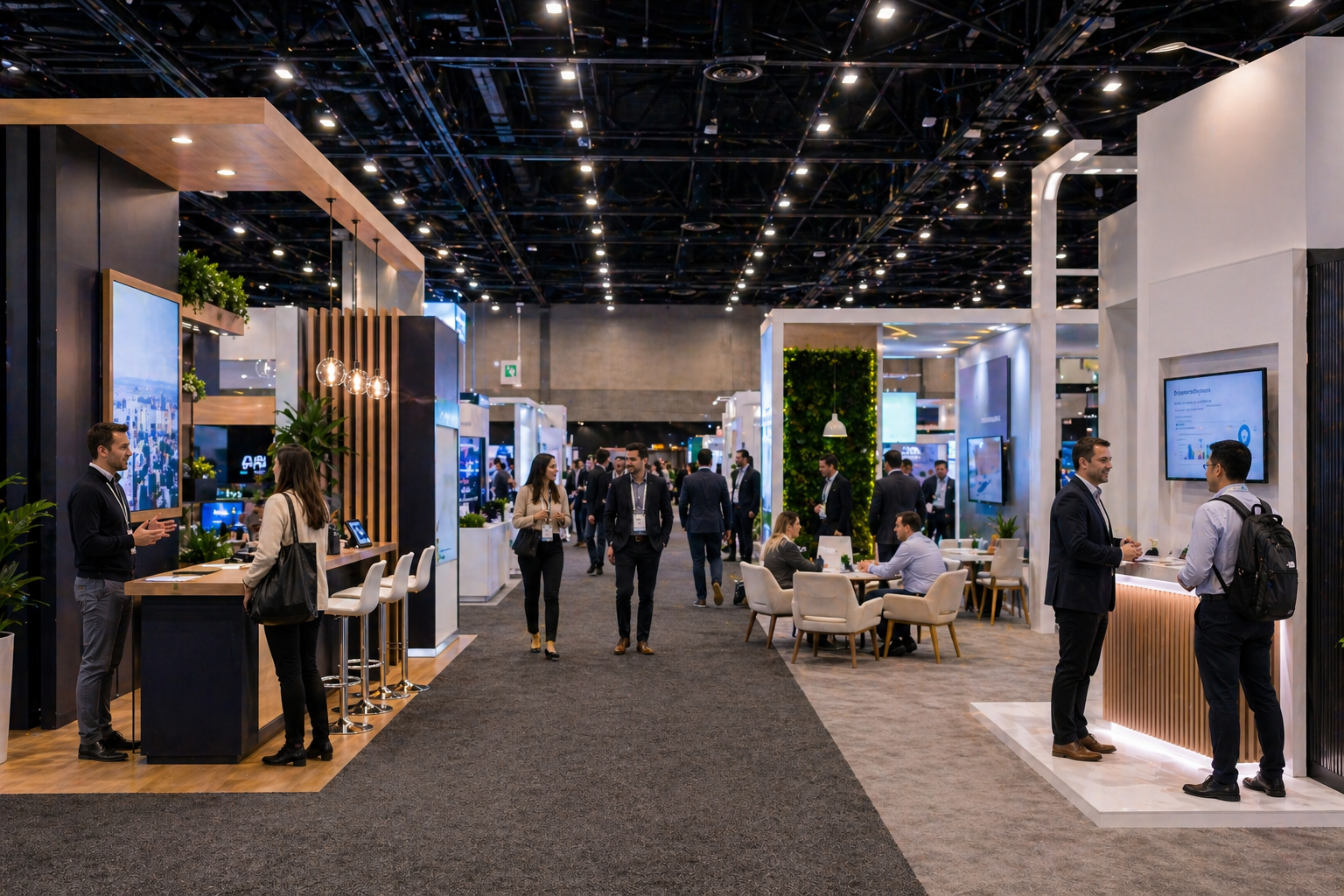
A trade show booth rental is a fully custom-built exhibit that a company uses for a specific show and returns afterwards, rather than purchasing and storing permanently. You pay a per-show fee that covers design, fabrication, graphics, freight, installation, and teardown all managed by one vendor.
The rental model exists because trade show booths are expensive to build ($15,000–$300,000+, depending on size), expensive to store ($10,000–$50,000 per year), and expensive to ship. For companies exhibiting at one to three shows per year at different venues, renting is almost always more cost-efficient than owning once you calculate the real total cost of ownership.
At Pure Exhibits, every rental comes with a fixed all-inclusive quote. The price you approve is the price on your final invoice. No post-show billing adjustments for labor overruns, graphic revisions, or show services surprises. That is the specific problem our model was built to solve.

“How much does a trade show booth cost?”
The range is wide because the variables are wide. Here is an honest breakdown:
10×10 inline booth rental: $7,000–$18,000. Your back wall, a counter, lighting, and graphics. Professional and competitive for regional shows and first-time exhibitors.
10×20 inline booth rental: $12,000–$30,000. Two functional zones — a demo area and a meeting space. The most popular step-up from a 10×10.
20×20 island booth rental: $20,000–$55,000. Four open sides, 400 square feet. Entry-level island territory. Standard for mid-market brands at major vertical shows.
20×30 and above: $35,000–$130,000+. Island exhibits with multiple meeting rooms, presentation theatres, and hospitality zones. The territory where trade shows become serious revenue infrastructure.
The floor space fee paid to the show organiser is separate from these numbers — typically $30–$100 per square foot of floor space, depending on the show.
The number I’d focus on is not the booth cost in isolation. It is the booth cost relative to what one closed deal is worth. If one deal closes at $150,000 and your 20×20 rental costs $35,000, the booth needs to generate less than one-quarter of one deal to break even. Most companies that calculate it that way find the math works.
“Rent or buy a trade show booth, which is smarter?”
Honest answer: It depends on four variables.
Renting wins when: you exhibit one to three times per year, your shows are in different cities, your brand messaging changes frequently, or you are still figuring out which shows work for your business. The rental model converts a large capital expense into a predictable per-show operating cost with no storage overhead.
Buying wins when: you exhibit five or more times per year, your shows are in the same city or very close together, your brand and messaging are stable, and your booth configuration doesn’t change. Under those conditions, the amortisation math can favour purchasing after year three or four.
The question I’d ask before deciding: Can you honestly project your show calendar for the next three years? If the answer is no — if your business is growing, evolving, or still experimenting with trade shows — renting gives you the flexibility to change course without a stranded asset.
“What is the single biggest mistake companies make with their booth?”
Trying to communicate too many things at once. A 10×10 that tries to tell your company story, showcase your full product portfolio, demonstrate three different use cases, and have a casual lounge area communicates nothing. It looks chaotic. Pick one primary function and design around it.
Overstaffing the space. A 10×20 with seven salespeople in it keeps visitors away. Two to three staff in a 10×20 is right. Enough to handle concurrent conversations, not enough to feel like a gauntlet.
Wrong booth location. One exhibitor told me their booth “might as well have been in another state.” Before committing your budget, ask the organiser specifically about traffic flow patterns and where the primary aisle footfall concentrates. A smaller booth in a high-traffic location consistently outperforms a larger booth in a corner that nobody walks past.
The table at the front. I still see this everywhere. A table positioned across the full front opening of a booth, with staff standing behind it. The exhibitor thinks this creates a professional reception area. What it actually creates is a barrier. Visitors subconsciously read it the same way they read a closed door.
“How do I actually attract people to my booth?”
Here is the answer nobody from the exhibit industry will give you, because it has nothing to do with booth design:
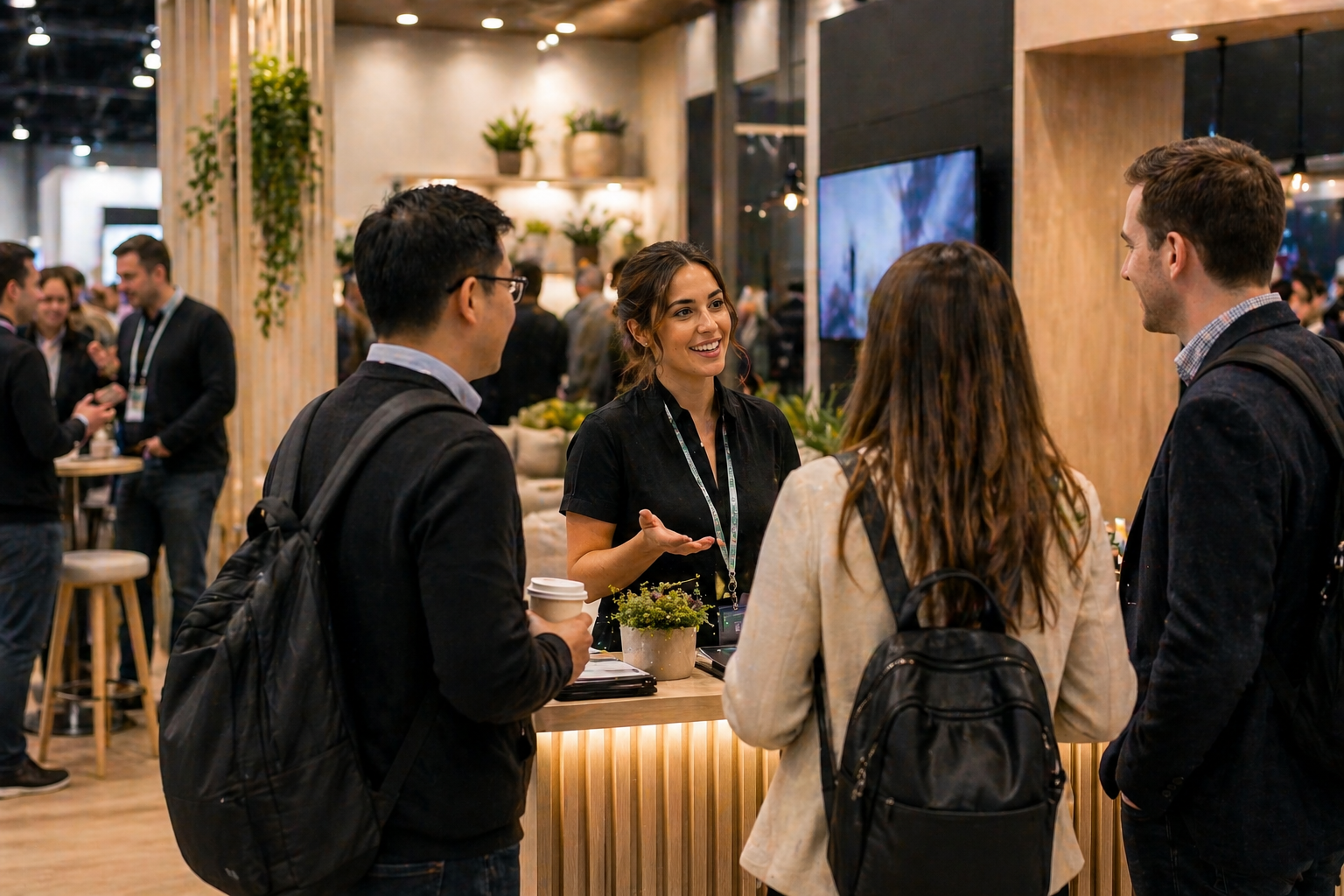
Your staff matters more than your exhibit.
I have seen a booth that was literally a folding table with Post-it notes on the wall behind it. No design, no graphics, nothing. The person staffing it was so genuinely engaging and curious that a small crowd formed. Passersby saw the crowd and came to see what was happening.
I have also seen a stunning $80,000 custom island with zero traffic, because the staff sat behind the counters, stared at their phones, and waited for people to approach them.
The design creates the opportunity. The staff converts it.
With that said, the design elements that consistently move the needle:
A single, bold back wall graphic. People walking a trade show aisle decide whether to stop within two to three seconds. A clean graphic with one message — not a paragraph, not six product names — is visible from 30+ feet away and does the initial sorting for you. The booths that confuse people in two seconds lose them permanently.
Vertical space. Most exhibitors think in two dimensions. A tall back wall, a tower, or an overhead hanging sign is visible from across an entire hall. The exhibitor who stays at table height is invisible until someone is standing directly in front of them.
An open front. No table across the entrance. A staff member standing just outside the booth threshold — not inside, outside — is the single most effective traffic driver available.
Something that creates visible activity. A demo running, a screen showing something interesting, a live demonstration, a skilled giveaway strategy. A crowd, even a small one, triggers curiosity in passersby.
“What trade show giveaway ideas actually work?”
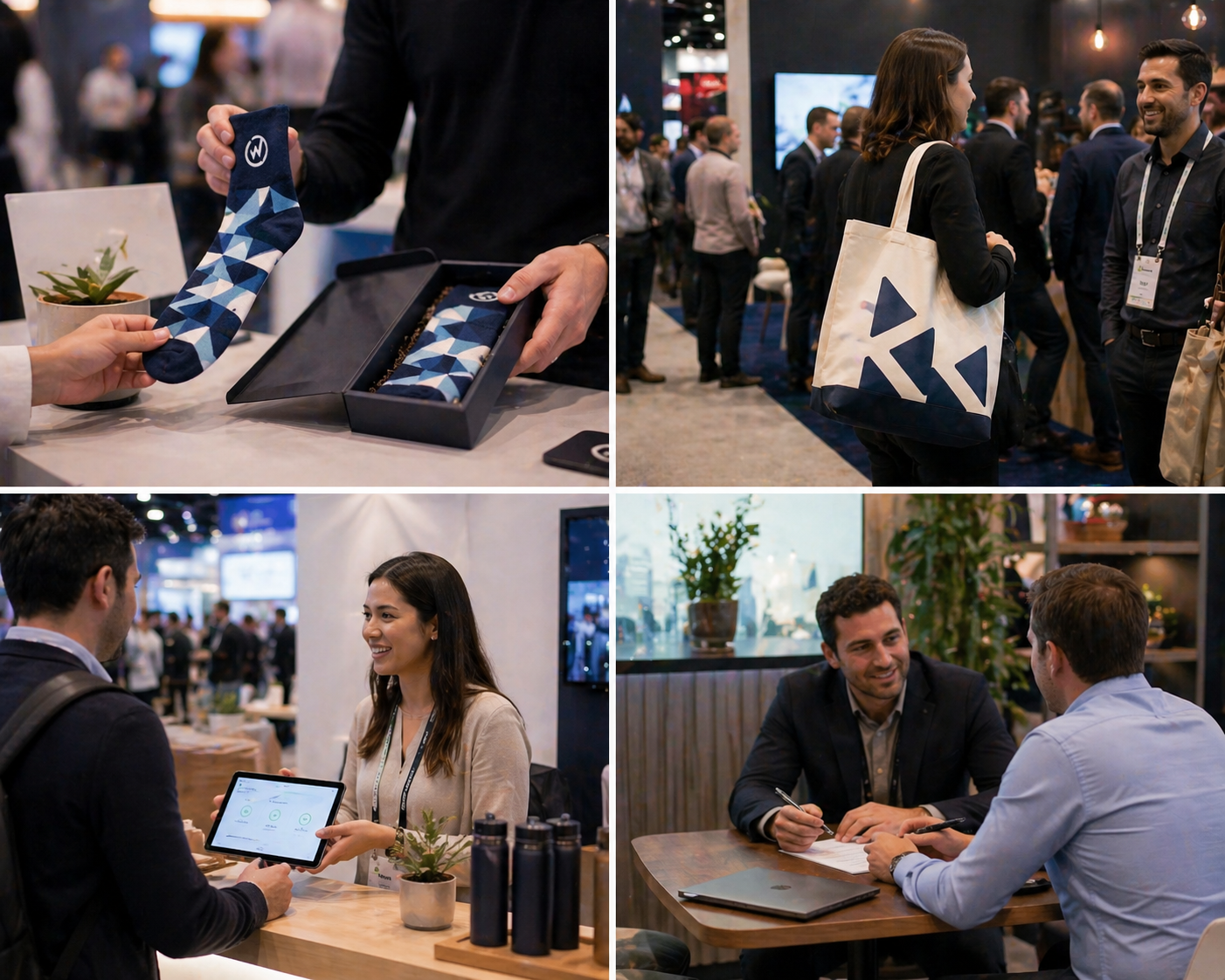
Useful beats branded. The giveaways people remember a year later are rarely the pen with a logo. They are portable chargers used every day. The tide pen that saved a shirt before a big presentation. The hangover kit at 7 am on day two. The branded tote bag that carried everyone else’s swag around the floor for three days with your logo on the side.
Ask yourself before buying any giveaway: Will this be on someone’s desk or in their bag one year from now? If the honest answer is no, you’re buying something that will be thrown away by the time the conference hotel has been cleaned.
The framework I’d use: match the giveaway to your objective. Brand awareness — give something useful with a bold logo that gets used in front of other people. Lead generation — give something high-value that requires the person to do something (watch a demo, sit through a five-minute presentation) to earn it. Foot traffic — give something consumable and desirable that creates a reason to come back multiple times.
“How do I generate leads at a trade show and actually convert them?”
The exhibitors who consistently get the highest ROI from trade shows do something most people don’t start doing until their third or fourth show:
They pre-schedule their meetings before the show opens.
By the time the floor opens, the best exhibitors already have 60–70% of their meeting time booked with specific, named prospects. They have used LinkedIn, the registered attendee list, and pre-show outreach to make appointments. When the floor opens, they are not hunting — they are hosting.
They don’t pitch on the show floor.
Deals rarely close at trade shows. What closes on the show floor is the decision to have a serious conversation later. The opener that works consistently, across industries: “What are you currently using for [relevant category]?” It is a question. It tells you in 30 seconds whether you are talking to a qualified prospect. It respects the person’s time. And it positions you as someone trying to understand their situation rather than sell them something.
They take notes after every conversation.
Not just a scanned badge — a sentence or two about what the person said, what their specific problem is, what they responded to. The personalised follow-up that says “We talked about your supply chain challenge at Pack Expo — here is the specific solution I mentioned” converts at a completely different rate than the generic “great meeting you” sequence. The teams with the highest post-show close rates write a few words after each conversation, every single time.

“Are trade shows still worth it in 2026?”
This question shows up regularly, and the honest answer is: it depends entirely on which show.
The show itself matters more than your booth. The type of person they manage to bring into the building will determine your results.
That is correct.
A show organiser who doesn’t attract your buyers into the building cannot be rescued by booth design, giveaways, or staffing. Before committing your budget:
Read the prospectus, not the headline attendance number, but the attendee breakdown by job title, company size, and industry. If your buyer isn’t in that breakdown, the show isn’t for you.
Talk to companies that exhibited last year, not the organiser, actual exhibitors. Ask directly: Did you get ROI? Would you go back? Their honest answers are worth more than any marketing document.
Attend before you exhibit, walk the show as an attendee before committing your full budget. Four hours on the floor will tell you more about whether your buyers are genuinely there than four months of research.
Trade shows work when the right buyers are in the room, you have a specific objective for each conversation, and you follow up with discipline after the show closes. When any of those three is missing, the ROI disappears regardless of how well-designed the booth is.
“How do I choose the right booth size?”
The question I’d ask first is not “how big can I afford?” It is: what does this booth need to do, and what is the minimum space required to do it well?
A 10×10 executes one primary objective well. A product demo station or a conversation space — not both. If you need both running simultaneously without crowding, you need a 10×20.
A 10×20 gives you two functional zones. A front demo area and a rear meeting space. Teams of three to five staff. The right choice when you have outgrown a 10×10 but aren’t ready for the logistics of an island.
A 20×20 island is where your presence starts to say something about your company’s market position, not just your product. Four open aisle faces, a central feature element, and space for multiple concurrent conversations. Standard for mid-market brands competing at major vertical shows.
A 20×30 and above is infrastructure, not marketing. At that size, the booth is a physical sales machine — multiple meeting rooms, a presentation theatre, and a hospitality zone all operating simultaneously. The exhibitors choosing this size have typically pre-booked 20+ meetings per show day and know exactly what each one is worth.
The most common sizing mistake: choosing based on what the company can afford rather than what the show floor requires. A 10×10 at a show where your primary competitors have 20×20 islands tells a story about your company’s market position that your pitch cannot undo.
Planning a show in Las Vegas? Pure Exhibits provides custom trade show booth rentals at conventions across the Strip with fixed all-inclusive pricing and no surprises on show day.
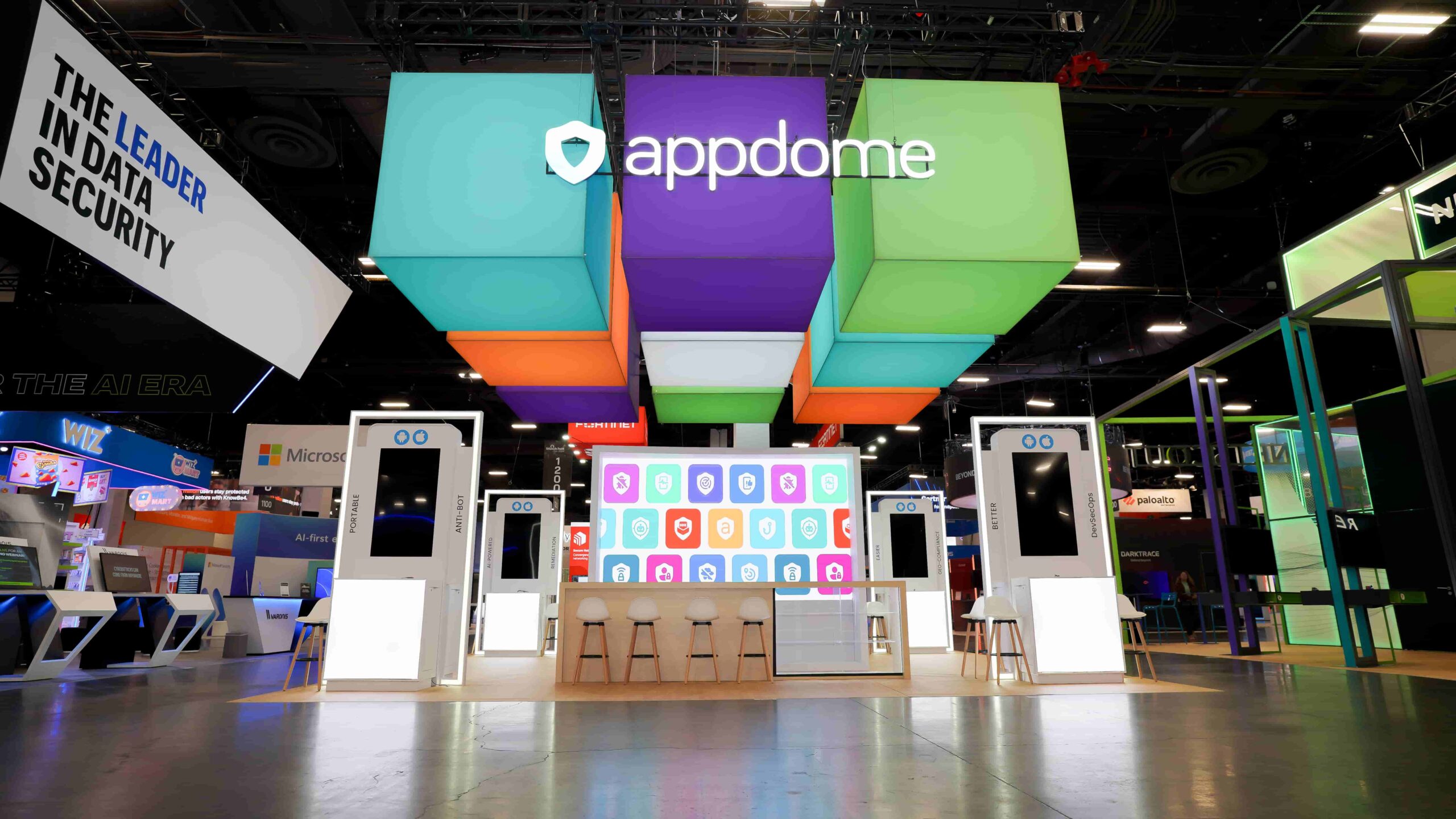
Utsav Kedia is the CEO of Pure Exhibits, America’s premier custom trade show booth rental company. Pure Exhibits operates from a 65,000 square foot production facility in Las Vegas and has delivered 2,500+ booths across every major US show market. Every booth is prebuilt and photographed before it ships.
Have a question I didn’t answer? I’m genuinely available. Email @info@purexhibits.com or find me on LinkedIn.
Let’s Build Something Extraordinary
Share your event details and we’ll craft a custom booth solution designed to captivate your audience and maximize your ROI.