
The booth looked fine in the photos the designer sent. Clean lines, big back-wall graphic, company logo centered at eye level. Then it went up on the show floor — surrounded by competitors with double-height structures, integrated LED lighting, and backlit SEG graphics glowing at 40 feet — and it disappeared. That is the difference between a graphic designer who can work on exhibit files and a exhibition booth design specialist who understands what it takes to command attention in that specific environment.
Hiring the right trade show designer is one of the highest-leverage decisions an exhibitor makes. The designer’s choices — sightlines, spatial flow, graphic hierarchy, lighting integration, product placement — determine whether the exhibit generates pipeline or generates nothing. This guide explains what to look for, how the process works, and what questions separate capable designers from ones who will leave you invisible on the floor.
Work With a Trade Show Design Team That Knows the Floor
Pure Exhibits designs and builds rental exhibits for Las Vegas trade shows — with 3D renders, full graphic production, and a pre-build guarantee before every show.
What Does a Trade Show Designer Actually Do?
A trade show designer is responsible for the complete spatial and visual experience of an exhibit — from the structural layout that determines how visitors move through the space, to the graphic system that communicates the brand at every distance. The role combines architecture, graphic design, spatial planning, and an understanding of show floor psychology that is specific to the trade show environment.
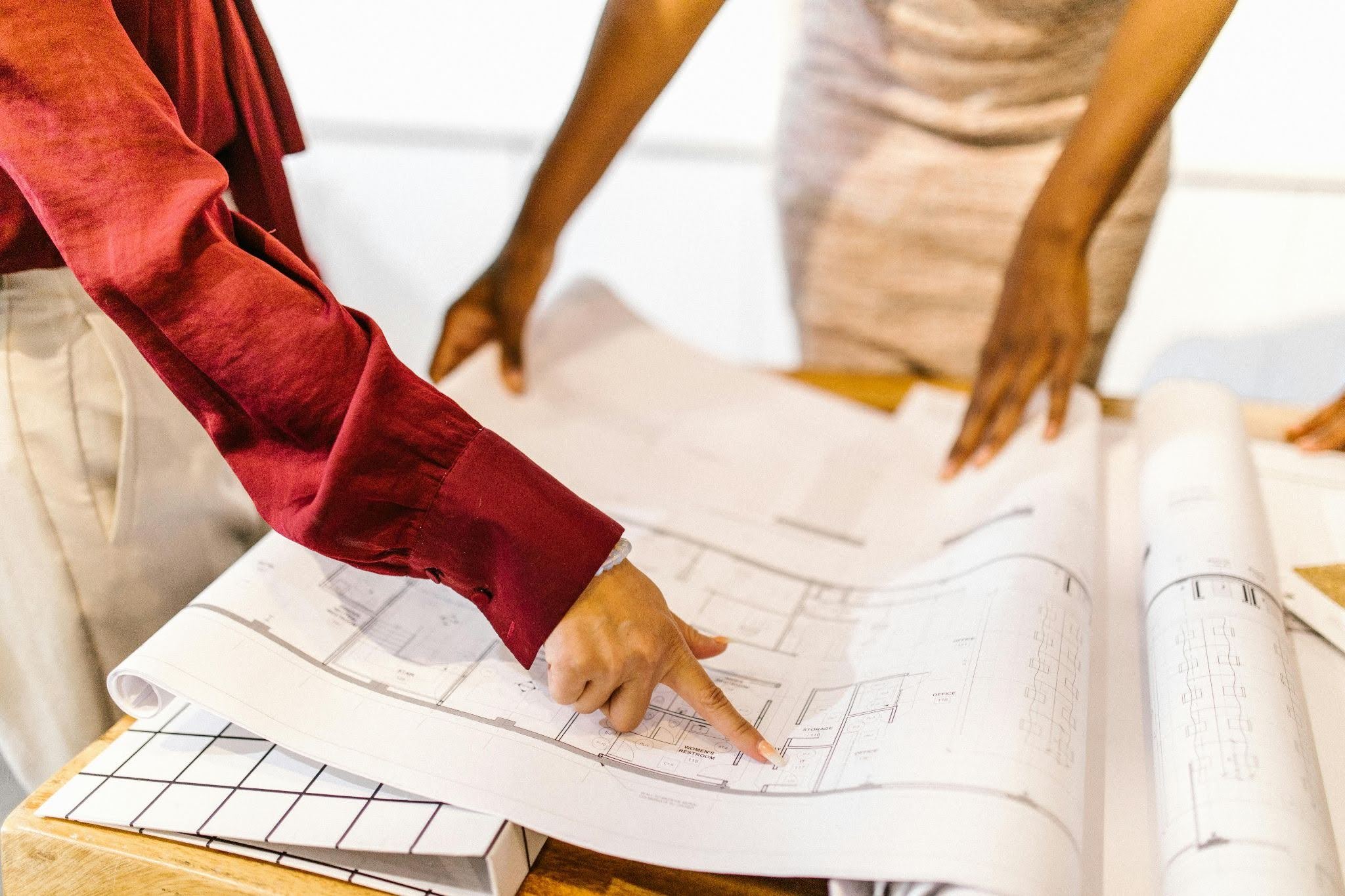
In practical terms, a trade show designer translates a marketing brief and a floor plan into a three-dimensional exhibit concept. They develop the structural layout — where counters, product displays, and demo stations sit relative to aisle traffic — and they design the graphic system that wraps that structure with brand messaging. They specify lighting placement, furniture selections, and technology integration points. They produce renderings for client approval and, in many cases, oversee production and installation to ensure the built exhibit matches the designed one.
What a trade show designer does not typically do is write copy, manage logistics, or handle show-floor operations. Those responsibilities sit with the marketing team, show coordinator, and installation crew. The designer’s contribution begins at the brief and ends at a finished exhibit that performs the way the design intended.
How Is a Trade Show Designer Different from a Graphic Designer?
This is the most common and most costly confusion in the exhibit industry. Graphic designers are trained in two-dimensional visual communication — typography, color, layout, and image selection on a flat surface. Trade show designers are trained in three-dimensional spatial design — how a structure occupies a floor plan, how a visitor’s eye moves through physical space, and how graphics read at different distances and angles.
A graphic designer can produce beautiful artwork for a back-wall panel. A trade show designer determines what size that panel should be, how far above the floor it sits, whether it should be backlit or front-lit, and how it interacts with the counter height and the sightline from the aisle. These are spatial decisions that graphic design training does not cover. See trade show booth rental cost to understand how structural and graphic choices affect overall pricing — the two are more connected than most exhibitors realize.
| Skill Area | Graphic Designer | Trade Show Designer |
|---|---|---|
| Primary training | 2D visual communication — print, digital, brand | 3D spatial design — architecture, exhibit, environment |
| Show floor awareness | Limited — works from flat artwork files | Strong — designs for aisle sightlines, traffic flow, floor plan constraints |
| Structural knowledge | None — does not specify or coordinate structure | Core competency — designs structure and graphics as an integrated system |
| Lighting specification | Not typically in scope | Specifies fixture type, placement, color temperature, and wattage |
| Deliverables | Print-ready artwork files | 3D renders, structural drawings, graphic specs, production oversight |
| Show regulation fluency | Not in scope | Reviews height limits, setback rules, hanging sign restrictions by show |
| Best for | Graphic asset production once design is finalized | End-to-end exhibit concept through production-ready design |
What Does the Trade Show Design Process Look Like from Brief to Build?
The design process for a trade show exhibit follows a predictable sequence of phases, each building on the one before. Understanding this sequence helps exhibitors provide the right inputs at the right time and set accurate expectations for how long the process takes.
| Phase | What Happens | Exhibitor Input Needed | Typical Duration |
|---|---|---|---|
| Discovery / brief | Designer collects show details, footprint, objectives, brand guidelines, and competitive context | Floor plan, show regulations, marketing goals, brand assets | 1–3 days |
| Concept development | Designer produces 2–3 initial 3D concepts showing different structural and visual approaches | Feedback on preferred direction, must-have elements | 5–10 days |
| Design refinement | Selected concept is developed in detail — materials, finishes, graphic layout, furniture, lighting | Approval on layout; copywriting input for graphic panels | 5–7 days |
| Graphic design | Panel artwork is designed, copy-fitted, and prepared for print production | Copy approval, brand sign-off on artwork proofs | 5–10 days |
| Production | Structure is fabricated or pulled from rental inventory; graphics are printed and mounted | No input required — production milestone review only | 10–21 days |
| Pre-build review | Complete exhibit is assembled at the facility; photos sent for client review before delivery | Final sign-off before shipment | 1–2 days |
| Installation | Exhibit is delivered to show venue and installed by the builder’s crew | On-site point of contact for booth-space coordination | Move-in day |
The total elapsed time from brief to installation is typically 6–10 weeks for a standard modular rental exhibit and 10–16 weeks for a custom fabricated build. Engaging a designer more than three months before the show is the single most effective way to avoid rushed production decisions and the cost premiums that come with them.
What Should You Look for When Evaluating a Trade Show Designer’s Portfolio?
Portfolio review is the most important step in selecting a trade show designer, and most exhibitors do it wrong — they look at finished photography and react to the aesthetics rather than analyzing what the design actually accomplishes. A visually attractive booth that is invisible from the aisle, has no clear focal point, and confuses visitors about what the company does is a design failure regardless of how good it looks in a photo with professional lighting.
When reviewing a portfolio, evaluate these six criteria for each project shown:
| Portfolio Criterion | What to Look For | Red Flag |
|---|---|---|
| Aisle presence | Does the exhibit have a clear focal point visible from the aisle at 20–30 feet? | Every exhibit looks similar regardless of footprint — no visual hierarchy |
| Footprint variety | Has the designer worked at your target size (10×10, 10×20, 20×20+)? | All examples are large island builds — no experience at inline sizes |
| Graphic clarity | Can you understand what the company does within 3 seconds of looking at the booth? | Heavy text, multiple competing messages, no clear headline hierarchy |
| Lighting integration | Is lighting part of the structural design or bolted on as an afterthought? | Clip-on spotlights, visible cords, no backlit panels in any project |
| Spatial flow | Is there a logical path for visitors through the booth, or is the layout random? | Counters blocking traffic flow; no clear open entry point from aisle |
| Brand consistency | Does the exhibit feel like an extension of the company’s broader brand? | Generic white structure with a logo sticker — no brand differentiation |
Also ask whether the portfolio images show the exhibit on the actual show floor — not just in a clean studio render. Renders can be made to look like anything. Photos taken during a live show, surrounded by adjacent booths and overhead convention center lighting, show you what the design actually delivered.
See Pure Exhibits’ Design Portfolio
Browse exhibit designs across 10×10, 10×20, and island footprints — all built and installed by our Las Vegas team.
How Do Booth Size and Footprint Shape the Design Brief?
Footprint is the first constraint a trade show designer works within, and it shapes every subsequent design decision. The rules that apply to a 10×10 inline space — one open side, a mandatory setback from the aisle, height limits on the back wall — are completely different from the rules that govern a 20×20 island with four open sides and a permitted hanging sign overhead. A designer who is strong at one footprint type is not automatically strong at the other.
At the 10×10 trade show booth rental level, the design challenge is maximizing aisle impact in a constrained space. The back wall graphic is the primary visual asset — it needs to communicate the brand proposition clearly at a distance and create enough visual pull to stop aisle traffic. Counter placement, lighting angle, and product positioning are all optimized for a single aisle-facing perspective.
A 10×20 trade show booth rental doubles the canvas and introduces a new design variable: the left and right aisle corners. Corner visibility is where 10×20 exhibitors most often underperform — they treat it as a wider 10×10 and concentrate everything on the center of the back wall. A strong designer uses the full 20-foot run to create visual depth, places the most compelling element off-center, and uses lighting to draw the eye toward the corner entry points.
For Las Vegas shows specifically, las vegas trade show booth rentals from a local designer and builder eliminate a common problem: receiving exhibit components on move-in day for the first time and discovering they do not fit the designed layout. A Las Vegas-based design team pre-builds the exhibit at their facility, photographs it, and corrects any issues before it ever reaches the convention center floor.
How Do Graphics, Lighting, and Layout Work Together in Exhibit Design?
The three elements that determine exhibit performance on the show floor — graphics, lighting, and spatial layout — are not independent design choices. They are a system. A designer who specifies them in isolation will produce an exhibit where the lighting washes out the graphics, the layout blocks the sightlines the graphics were designed for, or the graphics create visual clutter that the structural layout cannot resolve.
Graphics set the message and create the initial attention pull from the aisle. trade show booth graphics at the back wall need to communicate the brand headline within three seconds at 20 feet. That means large typography, high contrast, and a single dominant visual — not a catalog of product features or a wall of copy. Every additional message competes with the primary one and weakens the whole.
Lighting amplifies the graphic investment by directing attention and creating the perception of quality. An exhibit with professional trade show booth lighting ideas — backlit SEG panels, calibrated spotlights on product displays, accent lighting on the counter — reads as a premium brand even at a modest structural size. The same exhibit without intentional lighting disappears into the ambient noise of the convention center ceiling grid.
Layout determines whether the graphics and lighting investment converts attention into interaction. If the exhibit is visually compelling from the aisle but physically inaccessible — counters blocking entry, no clear open path in, staff positioned behind barriers — visitors will look and walk. Strong spatial layout creates a natural flow from aisle interest to booth entry to staff engagement. That flow is the designer’s most important structural contribution.
What Questions Should You Ask a Trade Show Designer Before You Hire?
The questions you ask a designer during the evaluation process reveal more than their proposal documents. Designers who have real show-floor experience answer these questions with specifics. Those who are translating print or digital design skills into exhibit work give vague, hedging answers.
| Question | Strong Answer | Weak Answer |
|---|---|---|
| Have you designed for my specific show or show format? | Yes — we have designed booths at [show name] in [year]; here is what we learned about the floor layout and lighting conditions. | We design for all types of trade shows and adapt to any environment. |
| Do you design structure and graphics as an integrated system or separately? | Always integrated — the structural layout and graphic system are designed together from day one. | We design the structure first and then bring in graphic designers for the artwork. |
| How do you incorporate lighting into the design? | Lighting is specified in the concept phase — fixture type, placement, color temperature, and wattage are all part of the structural drawings. | We add lighting as an option once the structure is finalized. |
| What does your 3D rendering process look like and how many revisions are included? | We produce full-color 3D renders with accurate material and lighting simulation; two revision rounds are included before production sign-off. | We do basic renders — just enough to show the general direction. |
| Who builds the exhibit and do you pre-build before delivery? | We build in-house and pre-assemble every exhibit at our facility before delivery; you get photos before it leaves the shop. | We work with fabricators and coordinate delivery — build photos are not standard but we can request them. |
| How do you handle show regulation compliance? | We pull the exhibitor manual for every show and flag any height, setback, or hanging sign restrictions that affect the design before we finalize the concept. | That’s something the client typically manages — we design to general industry standards. |
For a full evaluation framework covering builder capabilities beyond design — fabrication, installation, and post-show support — see the exhibit booth builders usa guide, which covers the questions that separate full-service exhibit houses from display vendors.
How Do You Know If Your Trade Show Design Is Actually Working?
Design quality is ultimately measured by what happens on the show floor, not by how good the renders looked before the show. The metrics that reveal whether a design is performing are booth visitor count, staff-to-visitor interaction rate, qualified lead volume, and cost per lead compared to prior shows or industry benchmarks.
A design that generates more aisle stops per hour than the previous exhibit — at the same show, same footprint, same staff count — is a better design. A design that increases the percentage of visitors who stop long enough to engage with staff is doing its job. These are measurable outcomes, and tracking them creates a feedback loop that makes every subsequent design iteration more precise.
After each show, debrief the staff on what visitors said, where they entered the booth, what they looked at first, and what questions they asked before engaging. That qualitative data reveals design decisions that worked and ones that created friction — counter positions that blocked natural flow, graphic messages that confused rather than qualified, product placements that were hard to demo in the physical space. Feed that data into the next design brief. A good trade show designer will ask for it.
Hire a Designer Who Understands the Show Floor, Not Just the Artwork
The trade show designer you hire is making spatial decisions that will determine how many people stop at your booth, how long they stay, and how many become qualified conversations. Those decisions cannot be made effectively by someone who has never stood on a crowded show floor and understood what it takes to earn attention in that environment.
Evaluate designers on portfolio relevance, process clarity, show-floor experience, and accountability through build and installation. Ask the questions that reveal whether they design exhibits or just produce exhibit files. The right partner will make every show better than the one before it.
Let’s Build Something Extraordinary
Share your event details and we’ll craft a custom booth solution designed to captivate your audience and maximize your ROI.
Frequently Asked Questions
What does a trade show designer charge?
Trade show design fees vary significantly by scope. At a full-service exhibit house, design is typically bundled into the rental or fabrication quote rather than charged separately — you pay for the designed-and-built exhibit as a package. Independent designers charge $3,000–$15,000 for a full exhibit design depending on footprint complexity, number of renders, and revision rounds included. Before comparing prices, confirm exactly what is included: 3D renders, structural drawings, graphic production files, and production oversight are not always part of the same engagement.
How long does trade show booth design take?
A standard modular rental exhibit design takes 3–5 weeks from brief to production-ready artwork. A custom fabricated exhibit with complex structural elements takes 6–10 weeks for design alone, followed by 4–8 weeks of fabrication. Total timeline from initial brief to installation is typically 10–16 weeks for custom builds. Working with a rental-focused exhibit house compresses this significantly because the structural system is pre-existing — the design effort focuses on the graphic system and configuration rather than structural engineering.
Should the designer and the builder be the same company?
Usually yes — when design and build are handled by the same company, accountability is unified. If the exhibit does not build as designed, the same team that designed it is responsible for fixing it. When design and fabrication are split between separate companies, the designer can point to the builder and the builder can point to the design when something goes wrong. For exhibitors without deep vendor management experience, using a single full-service exhibit house for both design and build is significantly lower risk.
What information does a trade show designer need to start?
A designer needs the show name and date, the floor plan with booth location and dimensions, the exhibitor manual (for height and setback rules), the company’s brand guidelines, and a clear statement of the exhibit’s primary objective — lead generation, product launch, brand awareness, or partner meetings. Optional but valuable: competitor exhibit photos from prior shows, product samples or photography, and any prior exhibit photos with staff feedback on what worked and what did not.
Can I reuse my exhibit design at multiple shows?
Yes — modular exhibit systems are designed specifically for reuse. The structural components remain the same; only the graphics need to be updated if messaging changes. A well-designed exhibit can run effectively for three to five shows with the same structure and updated graphics between shows. This is one of the primary cost advantages of working with a rental-focused designer and builder rather than purchasing a one-off custom exhibit.
What is the most important element of trade show booth design?
Aisle presence — the ability to stop foot traffic at 20 feet. Every other design element depends on the exhibit first earning a second look from a passing attendee. Aisle presence is driven by a combination of graphic clarity (one dominant message, high contrast), visual scale (backlit panels, height), and lighting quality. Layout and staffing strategy matter, but they are secondary to first capturing attention. An exhibit that does not generate stops cannot generate leads.
How do I brief a trade show designer effectively?
Start with objectives, not aesthetics. Tell the designer what you need the exhibit to accomplish — how many leads, what types of conversations, what products to feature — before discussing what you want it to look like. Include competitive context: what do competitors’ exhibits look like, and how do you want to be differentiated? Then provide constraints: footprint, budget range, show dates, and any brand standards the design must respect. A brief that leads with business objectives produces a stronger design than one that leads with aesthetic preferences.
What is a 3D render and why does it matter?
A 3D render is a computer-generated visualization of the exhibit in three-dimensional space, showing how the structure, graphics, lighting, and furniture will look assembled on the show floor. Renders allow you to evaluate the design — and request changes — before any fabrication begins, when changes are inexpensive. Approving a design based on flat sketches or basic diagrams without a 3D render is a significant risk: spatial relationships that look fine in a floor plan often reveal problems in three dimensions that are expensive to fix after production has started.
How does a trade show designer handle show regulations?
A qualified designer pulls the exhibitor manual for each specific show and reviews height restrictions, setback requirements, hanging sign rules, and any content restrictions before finalizing the design. These rules vary by show and by booth location within a show — a corner booth has different setback rules than a standard inline booth. Designers who leave compliance review to the client create risk: a booth that violates show regulations can be required to modify or remove elements during move-in, which is both expensive and disruptive.
What is backlit SEG and why do designers use it?
SEG stands for silicone edge graphic — a fabric panel with a silicone gasket around the edge that locks into an aluminum frame channel. Backlit SEG uses LED lighting behind the fabric to illuminate the graphic from within, producing a glowing, even-lit panel that is visible at significant distance across a show floor. It is the dominant graphic system in exhibit design because it combines vivid visual impact with low weight, easy graphic replacement, and durable hardware that can be reconfigured between shows. Most professional trade show designers specify backlit SEG for back walls at 10×20 and above.
How many design concepts should a designer present?
Two to three concepts is the industry standard for the initial presentation. One concept gives you no comparison point and puts all the risk on the designer’s interpretation of the brief. More than three creates decision paralysis and increases design cost without proportional value. The goal of the initial concept presentation is to identify the strongest direction — not to find a final design. One round of refinement on the selected concept, followed by a second round of detail adjustments, is a typical and efficient process.
What should I expect during the pre-build review?
A pre-build review is when the exhibit is fully assembled at the designer-builder’s facility before being delivered to the show. You should receive photographs of the completed exhibit from multiple angles — front, side, and detail shots of counters, lighting, and graphic panels. Review these for graphic accuracy (colors correct, no spelling errors, no visible seams or misaligned prints), structural completeness (all components present and fitted correctly), and overall visual impact. Any issue identified at this stage costs a fraction of what it costs to address it during move-in at the show.