
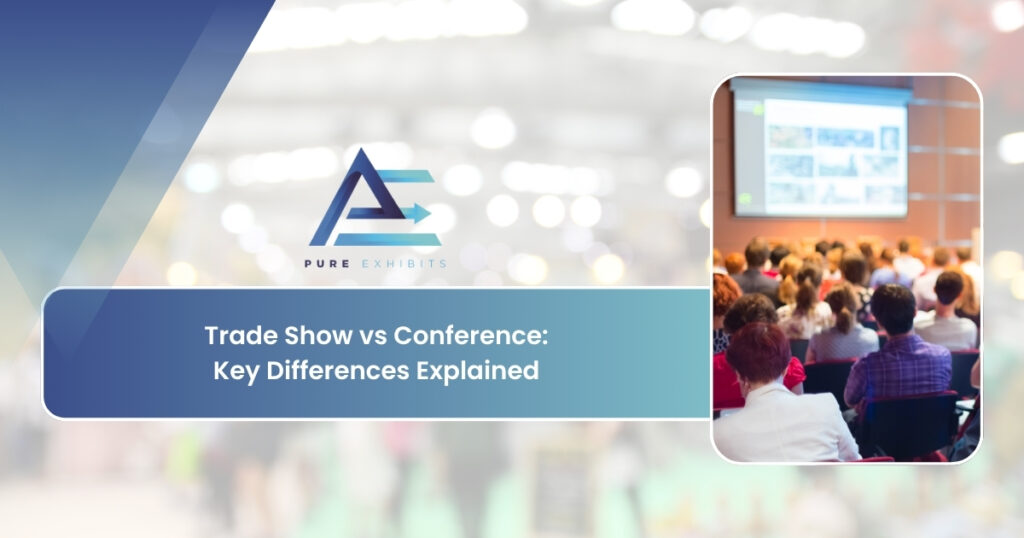
The event invitation says “conference” but there is an exhibit hall. The trade show has breakout sessions and keynote speakers. A vendor asks whether you want a booth at their annual conference, and you are not sure if that is the same thing as exhibiting at a trade show or something different entirely. The line between trade shows and conferences has blurred enough that the terms are used interchangeably in some industries — and precisely enough in others that confusing them leads to the wrong exhibit strategy, the wrong staff approach, and a budget built for the wrong kind of engagement.
Understanding the structural difference between a trade show and a conference — and how that difference affects exhibitor objectives, booth design, staffing, and trade show ROI — is the foundation of a smart event selection decision. This guide makes the distinction clear, explains how each format works for exhibitors, and gives you a framework for choosing the right format for your specific business objectives.
Exhibiting at a Las Vegas Trade Show or Conference?
Pure Exhibits designs and delivers rental exhibits for Las Vegas events of every format — trade shows, conferences, and hybrid events.
What Is the Difference Between a Trade Show and a Conference?
A trade show is a commercial event designed primarily for business-to-business buying and selling. The exhibit hall floor is the core of the event — it is where exhibitors display products and services, buyers evaluate options, and commercial transactions are initiated. The show floor is the product; everything else (keynotes, sessions, networking events) is supplementary programming designed to increase attendance and dwell time.
A conference is an educational and professional development event designed primarily for knowledge sharing, industry discussion, and peer networking. The session program is the core of the event — speakers, panels, workshops, and keynotes are the primary reason attendees register. An exhibit hall or sponsor showcase may accompany the conference, but it is a secondary feature rather than the event’s purpose.
The distinction matters because it defines attendee mindset. A trade show attendee arrives in buying mode — they are evaluating products, comparing vendors, and progressing purchase decisions. A conference attendee arrives in learning mode — they are there for the sessions, the speakers, and the peer conversations, and may visit the exhibit area opportunistically rather than purposefully. The same booth, the same staff, and the same pitch will generate different results in each environment because the audience’s agenda is fundamentally different.
| Characteristic | Trade Show | Conference |
|---|---|---|
| Primary purpose | Commercial — buying, selling, vendor evaluation | Educational — learning, networking, professional development |
| Core event asset | Exhibit hall floor with branded booths | Session program with speakers and content tracks |
| Attendee mindset | Active buying mode — evaluating products and vendors | Learning mode — sessions first, exhibit hall secondary |
| Exhibitor objective | Lead generation, product demos, distribution deals | Brand visibility, thought leadership, relationship building |
| Floor traffic pattern | Structured walk — attendees plan booth visits in advance | Opportunistic walk — visitors drop in between sessions |
| Buyer concentration | Very high — most attendees have purchasing authority | Variable — mix of practitioners, managers, and executives |
| Session content | Secondary — keynotes and sessions support show attendance | Primary — sessions are the reason attendees register |
| Networking format | On the exhibit floor and at show-produced evening events | Hallway conversations, structured roundtables, hosted dinners |
| Duration | Typically 2–5 days; exhibit floor open all day | Typically 2–4 days; exhibit hall open limited hours |
How Do Trade Show and Conference Audiences Differ?
The audience composition difference between trade shows and conferences is the most operationally significant distinction for exhibitors. It affects who you will be speaking with, what their decision-making authority is, what they need from the conversation, and how you should structure the interaction.
Trade show audiences are self-selected for commercial intent. Attendees register because they are evaluating categories, sourcing new vendors, or renewing supplier relationships. CEIR research shows that 81% of trade show attendees have buying authority — they can approve or directly influence purchase decisions. That concentration of qualified buyers is the primary reason companies exhibit at trade shows rather than solely investing in digital marketing or field sales.
Conference audiences are self-selected for professional development. Attendees register because of the speaker lineup, the content agenda, or continuing education requirements in regulated industries. The percentage with active buying authority varies by conference type — a healthcare IT conference like HIMSS draws a high percentage of procurement-involved attendees, while a marketing conference may draw primarily practitioners without budget authority. Understanding the specific audience composition of a conference before committing to exhibit space is more important at conferences than at trade shows, where commercial intent is structurally built into the format.
| Audience Factor | Trade Show | Conference |
|---|---|---|
| Buying authority | 81% have purchasing authority (CEIR) | Highly variable — depends on conference and industry |
| Visit intention | Pre-planned booth visits for most attendees | Opportunistic — exhibit hall visited between sessions |
| Time on exhibit floor | Multiple hours across show days | 30–90 minutes total; often concentrated in a single break period |
| Product knowledge level | Category-familiar; may be evaluating multiple vendors | Varies widely; some attendees unfamiliar with exhibitor’s category |
| Decision stage | Actively evaluating; may be ready to shortlist or approve | Early awareness; may not have a specific purchase timeline |
| Peer influence | Moderate — individual buying decisions | High — conference discussions shape category perceptions |
| Executive access | Variable; C-suite often present at major industry shows | Higher at exclusive invite-only conferences; lower at large open conferences |
What Are the Exhibiting Formats Available at Each Event Type?
The physical formats available to exhibitors differ significantly between trade shows and conferences, and those format differences shape what is possible for booth design, product demonstration, and visitor engagement.
At a traditional trade show, the exhibit hall is the event’s primary footprint. Booth sizes range from 10×10 inline spaces to large island configurations of 40×40 or larger. The exhibit hall is open for the full duration of the show’s floor hours — typically six to eight hours per day — and booth traffic is the primary mode of exhibitor-attendee interaction. The format supports product displays, live demonstrations, sampling, and multi-station exhibit experiences.
At a conference with an exhibit component, the format is more constrained. Conference exhibit areas are typically smaller than trade show halls, booth sizes are more limited (often capped at 10×10 or 10×20), and exhibit hall hours are compressed into breaks, lunches, and a single designated “exhibit hours” window. The format favors compact, conversational booth setups over large product display configurations, and rewards exhibitors who can initiate and complete a substantive conversation in five to eight minutes rather than the twenty-minute demo that works on a trade show floor.
Some large industry events are genuinely hybrid — a multi-day conference with a full exhibit hall that operates on trade show hours alongside a robust session program. HIMSS (healthcare IT), NAB Show (media technology), and CES (consumer electronics) are examples: they are too session-heavy to be pure trade shows but too commercially oriented to be pure conferences. Exhibiting at a hybrid event requires a strategy that serves both the learning-mode and buying-mode visitor.
How Do the Costs of Exhibiting at a Trade Show vs. Conference Compare?
| Cost Category | Trade Show | Conference Exhibit | Key Difference |
|---|---|---|---|
| Booth space fee (10×10) | $2,000–$8,000 | $1,500–$5,000 | Conference exhibit space often lower — but limited inventory and premium placement fees narrow the gap |
| Booth space fee (10×20) | $5,000–$16,000 | $3,000–$8,000 | Trade shows offer larger footprints; conferences often cap at 10×20 |
| Exhibit rental and graphics | $3,000–$14,000 | $2,000–$8,000 | Conference booths are typically smaller — lower production cost but similar per-square-foot rate |
| Sponsorship requirement | Usually optional | Often mandatory or bundled with exhibit space | Many conferences require a sponsorship package alongside booth space — adds $2,000–$25,000 |
| Attendee registration cost | Usually free with space (passes for staff) | $500–$3,000 per person | Conference full-access passes are a significant cost; exhibitor passes may be limited |
| Lead volume potential | High — floor traffic drives volume | Lower — compressed exhibit hours limit total conversations | Trade shows generate more raw leads; conferences may generate fewer but higher-seniority contacts |
| Cost per qualified lead | $100–$300 at well-run trade shows | $200–$600+ at most conferences | Conference leads cost more due to lower volume and higher sponsorship overhead |
The mandatory sponsorship requirement at many conferences is the largest hidden cost in the conference exhibiting model and the most common source of sticker shock for companies comparing formats for the first time. A conference that advertises a $3,000 booth space may require a $10,000 sponsorship package for exhibitor participation — making the total commitment $13,000 before exhibit production, travel, or registration costs are added. Build the full cost comparison before selecting a format. The trade show budget guide provides the category framework; apply conference-specific line items (sponsorship, full-access passes) on top of the standard structure.
Get a Quote for Your Las Vegas Trade Show or Conference Exhibit
Pure Exhibits builds rental exhibits for both trade show and conference formats — with design adapted to the floor time, footprint, and audience your specific event demands.
Which Event Type Generates Better Leads for B2B Companies?
The answer depends on what “better” means for your specific program. Trade shows generate higher lead volume from a concentrated audience of buyers with established commercial intent. Conferences generate lower lead volume but may provide access to senior executives, thought leaders, and decision-makers who are difficult to reach through standard outbound channels and who would not attend a pure trade show in the same numbers.
For companies whose primary objective is pipeline generation — filling the CRM with qualified contacts at an acceptable cost per lead — trade shows consistently outperform conferences on a volume and cost basis. CEIR data shows that 81% of trade show attendees have buying authority, the average cost per trade show lead is $142, and it takes 3.5 sales calls to close a trade show lead. These economics are difficult to match in a conference exhibit environment where floor time is compressed and audience commercial intent is more variable.
For companies whose primary objective is brand positioning, thought leadership, or access to executive-level relationships — particularly in industries where purchasing decisions are made at the C-suite or board level — conferences can generate higher-quality individual contacts even when total lead volume is lower. A single conversation with a CIO at a healthcare IT conference may be worth more to a specific company’s pipeline than twenty conversations with IT managers at a trade show, depending on the deal size and buying process.
Most B2B companies with active show programs benefit from a portfolio approach: major trade shows for pipeline volume and market presence, select conferences for executive relationship building and category thought leadership. The trade show booth rental cost comparison across both format types is the starting point for building a program that allocates budget proportionally to each objective.
Can You Exhibit at Both a Trade Show and a Conference at the Same Event?
Yes — and many of the most important industry events in the US are hybrid events that combine a full conference program with a trade show-format exhibit hall. Understanding which events are genuinely hybrid — and what that means for exhibitor strategy — is important for companies evaluating their show calendar.
At true hybrid events, the exhibit hall operates on trade show hours (open all day across multiple days) while the session program runs simultaneously in breakout rooms and general session spaces. Attendees divide their time between sessions and the floor — which means exhibit traffic is more distributed across the day and less concentrated in a single morning rush than at a pure trade show. Staffing strategy must account for both consistent floor coverage and the variable traffic patterns created by session breaks.
Las Vegas hosts several of the country’s most significant hybrid events, including CES, NAB Show, and SupplySide West — events where the conference programming and exhibit hall are equally prominent and where attendees arrive with both learning and commercial agendas. las vegas trade show booth rentals for hybrid events require the same design investment as a pure trade show, because the exhibit hall hours, floor scale, and buyer concentration are equivalent — the addition of a conference program does not reduce the exhibit hall’s commercial importance at these events.
| Event Type | Examples | Exhibit Hall Scale | Session Program Scale | Primary Exhibitor Objective |
|---|---|---|---|---|
| Pure trade show | SEMA, NY NOW, Fancy Food Show | Very large — primary event asset | Minimal — keynotes only, if any | Lead generation and product sales |
| Pure conference | TED, most industry associations’ annual meetings | None or very small sponsor tables | Very large — full multi-track agenda | Brand visibility and relationship building |
| Hybrid — trade show dominant | AAPEX, SupplySide West, NADA Show | Large — trade show-format exhibit hall | Moderate — concurrent education tracks | Lead generation with thought leadership overlay |
| Hybrid — conference dominant | HIMSS, Dreamforce, Microsoft Ignite | Medium — exhibit hall open limited hours | Very large — keynotes and multi-track sessions | Executive access and brand positioning |
| Hybrid — balanced | NAB Show, CES, AWS re:Invent | Large — multi-day open exhibit hall | Large — concurrent major session program | Pipeline generation and market positioning equally |
How Should Your Booth Strategy Differ Between a Trade Show and a Conference?
The format difference between trade shows and conferences requires meaningfully different booth strategies — not just a smaller booth at the conference, but a different visitor engagement model, a different staffing approach, and different success metrics.
At a trade show, exhibition booth design prioritizes aisle presence and visitor volume. The booth must stop traffic at 20 feet, communicate the brand proposition instantly, and create an environment where multiple simultaneous conversations can happen efficiently. The exhibit is a sales floor: it should be open, well-lit, product-forward, and staffed for throughput. The metric is qualified leads per show day.
At a conference exhibit, the booth strategy should prioritize depth over volume. Conference visitors who make it to the exhibit hall have often already done some research — they may know who you are from a session speaker reference or a sponsor logo they have been seeing all week. The booth conversation can start further along the awareness curve and move faster toward qualification. The exhibit should be configured for one-on-one conversation rather than product display throughput — a seating area, a screen for a focused demo, and one or two senior staff members who can have substantive technical or strategic conversations.
Staff selection and training differs accordingly. A trade show booth needs enough staff to cover simultaneous conversations across the full floor-hours day — typically four to six people for a 10×20 exhibit. A conference booth can often operate effectively with two to three very senior, highly knowledgeable staff members who focus entirely on depth of conversation rather than volume of interactions. The trade show staff training framework applies to both formats, but the qualification script at a conference should assume a higher baseline of awareness and move faster to needs assessment and next-step scheduling.
How Do You Decide Which Format Is Right for Your Company?
The format selection decision starts with your primary business objective for the event investment and works backward to the format that best serves it. No single format is universally superior — the right choice depends on what you are trying to accomplish, who you need to be in front of, and what success looks like 90 days after the event closes.
| If Your Primary Objective Is… | Best Format | Why |
|---|---|---|
| Generating a high volume of qualified leads for the sales pipeline | Trade show | Buyer concentration, floor hours, and commercial intent consistently produce higher lead volume |
| Reaching C-suite and board-level decision-makers in your industry | Conference | Senior executives attend conferences for the content agenda — they are harder to reach on a trade show floor |
| Launching a new product to a broad audience of category buyers | Trade show | Trade show floor provides the widest reach among active buyers at the lowest cost per exposure |
| Building thought leadership and category credibility | Conference | Speaking slots, panel participation, and sponsor visibility create authority signals that trade show presence does not |
| Recruiting distribution partners and channel resellers | Trade show | Channel partners attend trade shows to evaluate new lines — the commercial intent matches the channel recruitment objective |
| Maintaining relationships with existing enterprise clients | Conference | The networking environment and shared content agenda create natural relationship touchpoints without the transactional pressure of a sales floor |
| Testing a new market or category with an unknown audience | Trade show | Higher traffic volume provides faster feedback on product-market fit and messaging effectiveness |
| Accessing a specific niche professional community | Conference | Niche professional associations produce conferences with concentrated specialist audiences that may not attend general trade shows |
For companies new to the event marketing channel, a trade show is typically the better first investment — the format is more straightforward, the buyer audience is more reliably qualified, and the success metrics are more easily defined. The first time trade show exhibitor guide provides the operational framework for a first show, and the trade show preparation guide covers the pre-show checklist that applies to both trade shows and conference exhibits. Once the trade show model is working and measured, conference investments can be layered in for the executive access and thought leadership objectives that trade shows serve less effectively.
Choose the Format That Matches Your Objective, Not the One That Looks Cheaper
The trade show versus conference decision is not about which format is better — it is about which format is better suited to what you specifically need to accomplish. Trade shows deliver lead volume, buyer concentration, and commercial intent. Conferences deliver executive access, peer influence, and thought leadership positioning. Hybrid events deliver both, with more complex execution requirements.
Define the objective first. Then evaluate which format’s audience, floor time, and engagement model aligns with that objective. And once the format is chosen, build the exhibit strategy — design, staffing, training, and follow-up — around the specific dynamics of that format rather than applying a generic approach and hoping for generic results.
Let’s Build Something Extraordinary
Share your event details and we’ll craft a custom booth solution designed to captivate your audience and maximize your ROI.
Frequently Asked Questions
Is a trade show the same as a conference?
No — a trade show and a conference are structurally different events with different primary purposes, different attendee mindsets, and different exhibitor strategies. A trade show is a commercial event centered on the exhibit hall floor, where buyers evaluate products and vendors initiate business relationships. A conference is an educational event centered on sessions, speakers, and professional development, where an exhibit area may be present as a secondary feature. Many large industry events are hybrids that combine both formats, which is why the terms are often confused.
Which generates more leads — a trade show or a conference?
Trade shows consistently generate higher lead volume because the attendee audience is self-selected for commercial intent, exhibit hall hours are longer, and the show floor is the primary event rather than a supplementary one. Conference exhibit areas generate fewer leads because floor hours are compressed into breaks between sessions, attendees are in learning mode rather than buying mode, and the exhibit area competes with session content for attention. However, conference leads may be more senior and harder to reach through other channels, which can make the cost per high-value lead comparable despite lower total volume.
What is a hybrid event and how should I approach exhibiting at one?
A hybrid event combines a full conference session program with a trade show-format exhibit hall. Examples include CES, NAB Show, and HIMSS. At hybrid events, attendees divide their time between sessions and the floor, which means booth traffic is more distributed across the day than at a pure trade show, and some visitors arrive at the exhibit having already been primed by session content that referenced your product category or a competitor. Booth strategy for hybrid events should blend the throughput orientation of trade show exhibiting with the depth-of-conversation approach that works at conferences — staff need to handle both high-volume floor traffic periods and detailed one-on-one conversations.
How does booth design differ between a trade show and a conference?
Trade show booth design prioritizes aisle presence, visual impact at distance, and efficient throughput for multiple simultaneous conversations. Conference booth design prioritizes conversational depth, senior-level engagement, and a more intimate meeting environment. A trade show booth should be open, graphic-forward, and optimized for stopping traffic from the aisle. A conference booth can be smaller, more appointment-oriented, and configured with seating and a focused demo screen rather than a large back-wall display. The exhibit investment level is typically lower at conferences, but the conversation quality expectation is higher.
Do I need a booth at a conference, or can I just attend?
Attending a conference without exhibiting is a valid strategy for relationship building, competitive intelligence, and thought leadership (particularly if you have a speaking slot). Exhibiting adds brand visibility and gives you a physical presence that attendees can find and return to — which matters if your objective includes generating inbound conversations from attendees who become aware of you through sessions or hallway interactions. The decision depends on your budget and primary objective: if you primarily want to attend sessions and have targeted conversations with specific individuals, a non-exhibiting attendance may be more cost-effective than a booth.
Are conference exhibit hall hours typically shorter than trade show hours?
Yes — significantly. A trade show exhibit hall is typically open six to eight hours per day across multiple show days, giving exhibitors 15–25 total floor hours across a major show. A conference exhibit area is often open only during designated break periods — morning coffee, lunch, and afternoon breaks — totaling four to eight hours across the entire conference. This compression means conference exhibitors have a fraction of the floor time available at trade shows and need a more targeted engagement strategy to make effective use of every conversation.
How do I know if a conference exhibit will be worth the investment?
Evaluate three factors before committing: audience qualification (what percentage of registered attendees are decision-makers or influencers for your product category?), exhibit hall accessibility (how many hours is the exhibit area open and how prominently is it featured in the conference agenda?), and sponsorship requirements (what is the total cost including mandatory sponsorship, booth space, passes, and production?). If the audience qualification is high, the exhibit area is prominently featured, and the all-in cost produces a defensible cost-per-qualified-conversation target, the investment is worth testing. If any of the three factors is weak, the economics are difficult to make work.
What is the cost difference between a trade show booth and a conference booth?
Conference booth space fees are typically lower than trade show fees on a per-square-foot basis, but mandatory conference sponsorship packages can make total commitment costs comparable or higher. A 10×10 trade show booth space runs $2,000–$8,000; a 10×10 conference exhibit space may run $1,500–$5,000 but often requires a $3,000–$15,000 sponsorship package for exhibitor eligibility. Full-conference attendee passes ($500–$3,000 per person) are an additional cost that trade shows rarely charge at the same level. Build the complete cost comparison including all mandatory components before comparing formats by booth space fee alone.
Can the same exhibit hardware work at both a trade show and a conference?
Yes — a well-designed modular exhibit system can be configured appropriately for both formats. For a trade show, deploy the full footprint with a product display wall, open counter layout, and full graphic package. For a conference, downsize to a 10×10 inline configuration using the same structural components with a simplified graphic panel and a seating or meeting configuration replacing the product display. Modular rental systems are specifically designed for this kind of multi-format flexibility, allowing a single exhibit investment to work across both trade shows and conference exhibit areas at different footprints and configurations.
What is an example of an event that is both a trade show and a conference?
CES (Consumer Electronics Show) in Las Vegas is the most prominent example: it runs a 2.5-million-square-foot exhibit hall with thousands of exhibitors alongside a full conference program of keynotes, panels, and executive summits. NAB Show (National Association of Broadcasters) in Las Vegas combines a major broadcast technology trade show floor with a multi-day conference. HIMSS is primarily a conference for healthcare IT professionals but includes a significant exhibit hall where hundreds of health technology vendors present. These hybrid events require exhibitors to think about both the trade show and conference dimensions of their strategy simultaneously.
How do I staff a conference exhibit differently from a trade show booth?
Conference exhibits benefit from fewer, more senior staff rather than the larger teams that trade show booths require for throughput management. Two to three senior product managers, solution architects, or account executives who can handle substantive technical and strategic conversations are more effective at a conference than five to six generalist booth staff optimized for initial qualification. Conference visitors who make it to the exhibit hall tend to be more pre-informed and more senior than average trade show floor visitors — the conversation starts further along the sales process and requires more depth from the staff member handling it.
Should a first-time exhibitor start with a trade show or a conference?
A trade show is the better starting point for most first-time exhibitors. The format is more straightforward, the attendee commercial intent is more consistent, the exhibit hall hours give you more time to practice conversations and refine your pitch, and the success metrics (leads captured, conversations qualified) are more clearly defined than at a conference. Conference exhibiting involves additional complexity — mandatory sponsorship packages, compressed exhibit hours, and a more variable audience — that is easier to navigate after you have built the operational foundation through at least one trade show program.