
First-time exhibitors almost always underestimate what a trade show booth involves — and overspend or underprepare as a result. The term covers everything from a folding table with a banner to a fully built 20×20 foot structure with meeting rooms, LED lighting, and custom graphics designed for a specific venue. The word ‘booth’ is used the same way regardless of scale, which makes it difficult to know what you are actually planning for until you understand the categories, the size conventions, the components, and the cost structure.
This guide explains what a trade show booth is, how the standard sizes and types differ, what is typically included in a rental, what a booth costs at different scales, and what decisions a first-time exhibitor needs to make before booking space at a show. For the full preparation checklist — from booth booking through post-show follow-up — see the first-time trade show exhibitor tips guide after reading this one.
What Exactly Is a Trade Show Booth and What Is It Used For?
A trade show booth is a defined space — measured in square feet and assigned by the show organizer — within a convention hall or exhibition center, where a company presents its products, services, or brand to attendees of the event. The booth space is rented from the show organizer for the duration of the event. What you put in that space — the structure, graphics, furniture, lighting, and technology — is either rented from an exhibit house or purchased and owned by your company.
The purpose of a trade show booth is to create a physical environment where your team can have qualified conversations with buyers, prospects, partners, and press who are already gathered in one place with a specific professional agenda. Unlike digital marketing, a trade show booth creates a three-dimensional brand experience — attendees see, touch, and interact with your company in real space — which accelerates trust and relationship development in ways that email and digital advertising cannot replicate.
At most business-to-business trade shows, the booth serves three simultaneous functions: it attracts attention from the aisle to draw qualified visitors in, it demonstrates your product or service in a controlled environment, and it provides a physical space for your sales team to have structured qualification conversations that move deals forward. A booth that performs all three functions well generates measurable pipeline. A booth that focuses on appearance without the underlying lead qualification process generates badge scans — not buyers.
What Are the Different Types of Trade Show Booths?
Trade show booths are categorized by their position within the show floor layout — which determines how many sides are open to aisle traffic, what structural height is permitted, and what visual exposure the booth receives from different directions.
Inline Booth (Linear Booth)
An inline booth sits in a row with neighboring exhibitors on both sides. One side — the front — faces the aisle. The back wall is shared with the exhibitor behind you. Inline booths are the most common configuration and typically the lowest-cost space at any show. Standard inline booths measure 10 feet wide by 10 feet deep (a 10×10), though larger inline spaces (10×20, 10×30, and wider) are available at most shows. The height restriction at the back wall is typically 8 feet for inline configurations, with graduated restrictions toward the aisle — usually 4 feet maximum within 5 feet of the aisle boundary.
Corner Booth
A corner booth occupies the end position in a row, giving it two open sides — a front aisle exposure and a side aisle exposure — instead of one. Corner booths generate more passive visibility than inline booths at the same square footage because they are visible to foot traffic approaching from two directions rather than one. Most shows charge a premium for corner positions — typically 10 to 20 percent above the standard inline rate for the same square footage.
Peninsula Booth
A peninsula booth extends into the aisle with three open sides — front, left, and right — and a solid back wall that faces the booth directly behind it. Peninsula configurations are typically available at the 10×20 scale and larger. The three-aisle exposure significantly increases visibility and allows for a more dimensional structural design. Peninsula booths are subject to sight-line rules that restrict solid wall height to protect the neighboring exhibitor’s visibility — confirm the specific rules in the show’s exhibitor services manual.
Island Booth
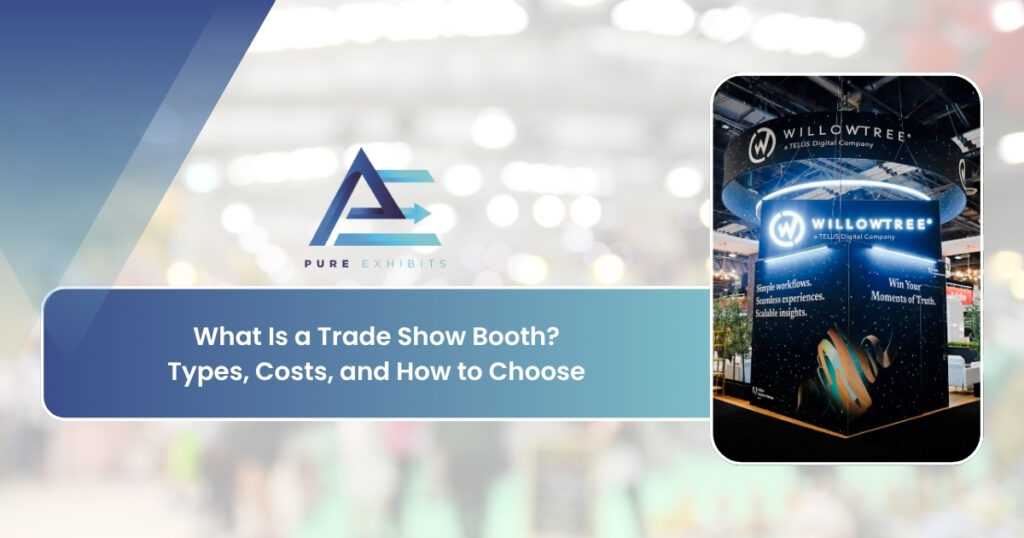
An island booth has four open sides — it is accessible from the aisle on all sides. Island configurations are only available at shows where the organizer designates open island spaces in the floor plan, and they require a minimum footprint of 20×20 feet at most major shows. Island booths permit overhead hanging signs, higher structural elements, and multi-zone floor plans that inline configurations cannot accommodate. They generate the maximum passive visibility on the show floor and are the standard configuration for exhibitors who prioritize brand presence at flagship events.
| Booth Type | Open Sides | Min. Footprint | Overhead Signs? | Typical Use |
|---|---|---|---|---|
| Inline (linear) | 1 (front) | 10×10 | No | First-time exhibitors, regional shows |
| Corner | 2 (front + side) | 10×10 | No | Higher traffic inline position |
| Peninsula | 3 (front + sides) | 10×20 | Sometimes | Mid-size programs, two-aisle exposure |
| Island | 4 (all sides) | 20×20 | Yes (with permit) | Flagship shows, large brand programs |
What Are the Standard Trade Show Booth Sizes and What Fits in Each?
Trade show booth sizes are measured in feet and described as width × depth. The 10×10 trade show booth is the industry standard entry-level footprint — 100 square feet with one back wall, one front aisle, and space for two to three staff members and one demo or display station. The 10×20 trade show booth doubles the square footage and adds a second aisle exposure at corner or peninsula position, allowing separate conversation zones and a reception counter without crowding. The 20×20 trade show booth rental is the entry-level island configuration — four open sides, 400 square feet, with enough floor plan space for a meeting room, multiple demo stations, a reception desk, and overhead structural elements. If you are not yet sure which size fits your objectives and budget, the trade show booth size calculator guides the decision based on your team size, demonstration requirements, and show competitive context.
| Booth Size | Square Feet | Staff Capacity | What Fits | Best For |
|---|---|---|---|---|
| 10×10 | 100 sq ft | 2–3 staff | Back wall, 1 counter, 1 demo station, 2–3 standing conversations | First shows, regional events, budget-constrained programs |
| 10×20 | 200 sq ft | 3–5 staff | Back wall, reception counter, demo area, small meeting nook | Second or third show, moderate product demo needs |
| 20×20 | 400 sq ft | 5–8 staff | Island structure, meeting room, 3–4 demo zones, reception, overhead sign | Flagship shows, competitive B2B categories, high-lead-volume programs |
| 20×30 / 20×40 | 600–800 sq ft | 8–15 staff | Enclosed meeting rooms, lounge, multiple demo stages, full overhead rig | Large enterprise programs, anchor presence at major shows |
What Does a Trade Show Booth Actually Include?
The components of a trade show booth fall into two categories: the structural system (the physical framework of the booth) and the show services (everything the show’s general service contractor provides at the venue). Understanding both categories is essential for accurate budgeting — many first-time exhibitors budget only for the exhibit hardware and are surprised by the cost of show services when they arrive.
The Structural System
- Back wall — the primary graphic surface at the rear of the booth. Most professional booths use an aluminum extrusion frame with a dye-sublimation fabric graphic (SEG system) that presents a seamless, high-resolution brand image. Pop-up displays and tension fabric systems are lower-cost alternatives.
- Counter or reception desk — a work surface and storage unit at the front of the booth where staff engage visitors. Counters define the entry point and provide a natural place for literature, product samples, and lead capture devices.
- Flooring — most convention hall floors are bare concrete. A booth without flooring looks unfinished and is uncomfortable for staff and visitors standing for six to eight hours per day. Options include carpet tiles, foam-core panels with a printed surface, and luxury vinyl tile (LVT) planks.
- Lighting — LED spotlights mounted on the back wall frame illuminate the graphic and dramatically increase visibility from the aisle. Backlit graphics — which glow from behind — are the highest-visibility option and visible at significantly greater aisle distance than front-lit surfaces.
- Furniture — chairs, bar stools, high-top tables, and lounge seating define the interaction zones in the booth. A booth with no seating signals a transactional conversation model. A booth with a lounge area signals a longer, consultative engagement.
- Technology — monitors, tablets, kiosks, and demo hardware are integrated into the structure to support product demonstrations and lead capture.
Show Services (Billed Separately by the Show’s General Service Contractor)
- Drayage (material handling) — the cost to move your freight from the loading dock to your booth space and back at the end of the show. At Freeman-managed shows, drayage is billed by the hundred-weight (CWT) at rates of $150 to $300 per hundred pounds. It is one of the most underestimated costs in the trade show budget.
- Electrical service — a dedicated power connection to your booth space. Standard drops are 5A, 10A, or 20A circuits. LED lighting, monitors, and demo hardware all require electrical service. At union-managed venues, electrical connections are performed by licensed electricians from the venue’s exclusive contractor.
- Installation and dismantle (I&D) labor — union labor rates at Las Vegas Convention Center and other major venues run $100 to $200 per worker per hour. A 10×10 modular booth typically requires two to four hours of installation labor. A 20×20 island may require eight to sixteen hours.
- Internet service — a dedicated wired or wireless connection to the booth. Wi-Fi at large convention halls is congested and unreliable for demo applications. Dedicated connections — typically $500 to $1,500 per show for a reliable circuit — are essential for cloud-based demos or live product presentations.
How Much Does a Trade Show Booth Cost to Rent or Buy?
Trade show booth cost divides into two line items that are frequently confused: the exhibit cost (the physical booth structure and graphics) and the show cost (venue services, logistics, and staff time). A complete budget must include both. The trade show booth rental cost guide provides a full breakdown by booth size and show market. The table below gives representative ranges for the most common configurations.
| Item | 10×10 Inline | 10×20 Inline/Corner | 20×20 Island |
|---|---|---|---|
| Exhibit rental (structure + graphics) | $3,500–$6,500 | $7,000–$14,000 | $18,000–$35,000 |
| Drayage (material handling) | $300–$700 | $600–$1,400 | $1,500–$3,500 |
| Electrical service | $200–$500 | $400–$900 | $800–$2,000 |
| Installation & dismantle labor | $500–$1,200 | $1,000–$2,500 | $3,000–$7,000 |
| Flooring (if not included in rental) | $400–$900 | $800–$1,800 | $2,000–$4,500 |
| Internet (dedicated circuit) | $500–$1,000 | $500–$1,200 | $800–$2,000 |
| Total estimated show cost | $5,400–$10,800 | $10,300–$21,800 | $26,100–$54,000 |
Note: Staff travel, hotel, and per diem are not included above. At Las Vegas shows, exhibitors based outside Nevada typically add $2,000 to $5,000 per person in travel costs. Round-trip freight for owned exhibits shipped from other cities adds $3,000 to $8,000 for a 10×20 kit — a cost that renting from a Las Vegas-based exhibit house eliminates entirely.
Should You Rent or Buy a Trade Show Booth for Your First Show?
For a first show, renting is almost always the right decision. The rent or buy trade show booth guide covers the full break-even analysis — but the core reasons to rent for a first show are straightforward: you do not yet know exactly what your booth needs to do, you have not yet learned which elements of the design work on the show floor and which do not, and you have not yet confirmed your show program frequency or footprint size consistency.
Renting lets you execute a first show with a professional, custom-designed exhibit without a capital commitment. After one or two shows, you will have direct experience with what your staff and visitors actually need from the space — which informs a much smarter purchase decision than any amount of pre-show planning. Exhibitors who purchase a booth before exhibiting at their first show frequently buy the wrong size, the wrong configuration, or a design that needs significant modification after the first event.
What Renting Includes
- The exhibit structure — frames, walls, counters, shelving, lighting hardware — rented from the exhibit house at a per-show rate.
- Custom-designed graphics — fabric back walls, counter wraps, and overhead signs designed to your brand specifications and either owned by you or included in the rental package.
- Logistics coordination — for Las Vegas shows, a Las Vegas-based exhibit house handles freight from their warehouse to the show and back, eliminating round-trip shipping costs entirely.
- Installation and dismantle — a professional exhibit house typically coordinates I&D labor at the show, so your team arrives to a fully installed booth and leaves after the show ends without supervising teardown.
What Renting Does Not Include
- Show services — drayage, electrical, internet, and venue labor are billed directly by the show’s general service contractor regardless of whether you rent or own the exhibit.
- Staff travel and accommodation — your team’s flights, hotel, and per diem are separate from the exhibit cost.
- Giveaways, literature, and branded materials — these are your expense regardless of how the exhibit structure is sourced.
What Makes a Trade Show Booth Effective at Generating Leads?
A trade show booth that generates qualified pipeline is designed around four measurable elements: visibility from the aisle, a clear message hierarchy, a staffing model matched to the floor plan, and a lead capture process that captures conversation context — not just a badge scan. Our trade show booth builder team designs each exhibit starting with these functional requirements before any structural element is specified.
Aisle Visibility
The back wall graphic is the first thing an attendee sees from 20 to 30 feet away — before they can read body copy or identify your logo. A back wall that communicates one dominant message (a brand visual or a product image) and a company name in large type draws attention from the distance where stop decisions are made. Cluttered back walls with multiple messages, small text, or competing visual elements communicate nothing at aisle distance and lose the passive audience before they get close enough to engage.
Message Clarity
At 5 to 10 feet — the distance where an attendee slows down to read — your booth needs to answer one question in under five seconds: what does this company do and why should I care? A headline that states your primary value proposition in plain language, supported by a secondary message and a visual, answers that question. A headline that states your company name followed by a tagline that could apply to any company in your category does not. Test your back wall message by asking someone unfamiliar with your company to describe what you do after looking at the booth for five seconds — their answer reveals whether the message is working.
Staff Deployment
The most common reason a well-designed booth underperforms is that the staff does not know how to open a qualifying conversation or move it toward a next step. A booth design that creates a natural entry path and a comfortable conversation zone does half the work — the other half is a staff team that knows how to qualify a visitor in two questions, deliver a concise value statement matched to the visitor’s role, and secure a specific commitment before the visitor leaves the booth.
What Mistakes Do First-Time Exhibitors Make When Setting Up a Booth?
- Booking too small a space for the team size. A 10×10 booth staffed by four or five people looks crowded and uncomfortable. Staff members block each other’s conversations, visitors feel the space is occupied rather than inviting, and the physical congestion signals a lack of preparation to experienced attendees. The standard ratio is one to two staff members per 50 square feet of booth space.
- Underestimating the total show cost. Most first-time exhibitors budget for the exhibit hardware and forget that drayage, electrical, I&D labor, and internet service add 40 to 80 percent to the hardware cost at major shows. Build a complete show budget — including all venue services — before committing to a space size or exhibit configuration.
- Arriving at the booth without a lead qualification process. A badge scanner captures that an attendee visited your booth. It captures nothing about what they said, what they need, or what the next step is. Without a structured qualification script and a note-taking or CRM input process, the badge-scan list is a cold outreach list rather than a warm pipeline. Define the qualification questions and the lead disposition categories before the show opens.
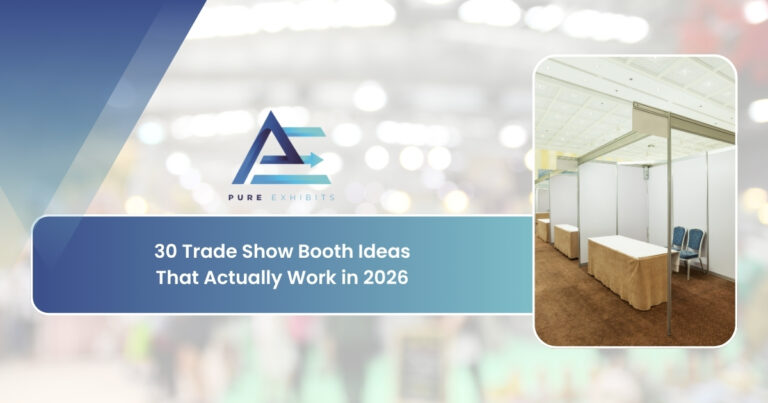
- Using the generic show-provided table and draped backdrop. Most shows offer a ‘shell scheme’ option — a basic drape backdrop and table — as a default for exhibitors who do not bring their own display. At B2B shows where neighboring exhibitors have professional custom booths, a shell scheme sends an immediate signal of low investment and low seriousness. Even a modest custom display — a fabric back wall, a branded counter, and a printed floor — is substantially more credible than the draped shell.
- Not reading the exhibitor services manual before designing the booth. The show organizer’s exhibitor services manual specifies height restrictions, sight-line rules, what items must be sourced from the show’s exclusive contractors, and deadlines for advance warehouse delivery, electrical orders, and special service applications. Designs that violate height restrictions are modified or removed on move-in morning — which is not a recoverable situation.
Conclusion
A trade show booth is a rented space in a convention hall where your company creates a physical environment for qualified buyer conversations. What fills that space — from a simple fabric back wall and a counter to a multi-zone island with meeting rooms and overhead signage — is determined by your team size, product demonstration requirements, show competitive context, and total program budget. The right booth for your first show is almost always a rented 10×10 or 10×20 with a professionally designed graphic system and a clear lead qualification process behind it.
The exhibit structure creates the environment. The staff process — qualification, message delivery, next-step commitment — determines whether that environment generates pipeline. Invest proportionally in both before your first show.
Let’s Build Something Extraordinary
Share your event details and we’ll craft a custom booth solution designed to captivate your audience and maximize your ROI.
Frequently Asked Questions
What is a trade show booth?
A trade show booth is a defined floor space — typically measured in feet as width by depth — within a convention hall or exhibition center that a company rents from a show organizer to present its products, services, or brand to event attendees. What fills that space (the structural display, graphics, furniture, lighting, and technology) is either rented from a professional exhibit house or purchased and owned by the exhibiting company. Booths range from a 10×10 foot inline space with a fabric back wall and a counter to a 20×20 foot or larger island configuration with enclosed meeting rooms, overhead hanging signs, and multi-zone floor plans.
What is the difference between a trade show booth and an exhibit?
In common usage, ‘booth’ refers to the space and the overall setup, while ‘exhibit’ typically refers to the physical display structure that fills the space. In practice, the terms are used interchangeably in the industry. ‘Exhibit’ tends to be used for larger, more elaborate structures — an island configuration at a major show is more often called an exhibit than a booth. Both terms describe the same fundamental concept: a branded physical environment at a trade show where a company engages with event attendees.
How much does it cost to have a trade show booth?
Total trade show booth cost includes two components: the exhibit hardware (structure and graphics) and the show services (drayage, electrical, installation labor, and internet). For a 10×10 inline booth, the total cost including all services runs $5,000 to $11,000 per show. For a 10×20, total cost runs $10,000 to $22,000 per show. For a 20×20 island, total cost runs $25,000 to $55,000 per show. Staff travel and accommodation are additional. The single most commonly underestimated cost is drayage — the material handling fee charged by the show’s general service contractor — which can add $500 to $3,500 depending on booth size and show.
What size trade show booth do I need?
Size depends on three factors: the number of staff members who will work the booth simultaneously (plan for one to two staff per 50 square feet), the number and type of product demonstrations or displays you need to support, and the competitive standard at the specific show you are attending. A 10×10 is appropriate for a team of two to three with one demo station. A 10×20 supports three to five staff with separate conversation and demo zones. A 20×20 island supports five to eight staff with multiple demo stations, a reception desk, and a meeting room. Start with the trade show booth size calculator if you are unsure.
What is the standard size of a trade show booth?
The industry standard unit is the 10×10 — a 10-foot-wide by 10-foot-deep space totaling 100 square feet. It is the smallest professional exhibit space at most shows and the baseline for pricing, size upgrades, and configuration comparisons. Most shows sell space in 10-foot increments: 10×10, 10×20, 10×30, 20×20, 20×30, and so on. Island configurations begin at 20×20 at most major shows. Some smaller regional events offer 8×10 or 8×8 spaces, though these are below the standard at major B2B events.
What is included in a trade show booth rental?
A full-service rental from a professional exhibit house typically includes the structural components (aluminum frame, walls, counters, shelving), custom-designed graphics (fabric back wall, counter wraps, any overhead elements), lighting, freight from the exhibit house to the show venue, installation at the show, dismantle after the show closes, and return freight to the exhibit house. Show services — drayage, electrical, internet, and venue labor — are billed separately by the show’s general service contractor and are not included in the exhibit rental. Furniture, technology, and giveaways are also separate.
Can I bring my own furniture to a trade show booth?
Yes — at most shows you can bring your own furniture, though it must be transported to the show as part of your exhibit freight (which is subject to drayage fees) or rented from the show’s official furniture vendor. Bringing your own furniture from home by hand-carrying it to the booth is not permitted at most major venues — all items must enter and exit through the official freight handling process. Renting furniture from the show’s contractor or exhibit house is typically the simpler option for a first show, as it eliminates the shipping, drayage, and storage logistics for individual pieces.
Do I need a professional exhibit house or can I build my own booth?
You can assemble a basic display yourself — a pop-up tension fabric back wall and a folding counter are designed for exhibitor self-setup and can be ordered and assembled without professional assistance. For modular aluminum systems, larger exhibits, and any show that requires compliant installation (union labor regulations, height restrictions, structural permits for overhead elements), a professional exhibit house handles design, production, logistics, and installation as a complete service. For a first show at a major venue, working with a professional exhibit house eliminates the risk of compliance violations, installation errors, and logistics failures that would be difficult to recover from on move-in morning.
What is drayage at a trade show?
Drayage — also called material handling — is the fee charged by the show’s official general service contractor (such as Freeman, GES, or Shepard) to move your freight from the loading dock or advance warehouse to your booth space and back to the loading dock at the end of the show. It is billed per hundred-weight (CWT) — per hundred pounds — at rates that typically run $150 to $300 per hundred pounds at major shows. A standard 10×10 exhibit kit weighing 400 pounds generates $600 to $1,200 in drayage fees each direction. Drayage is not optional and cannot be bypassed — it applies to all freight at union-managed shows.
What is the difference between an inline booth and an island booth?
An inline booth sits in a row of exhibitors with neighboring booths on both sides, leaving one side (the front) open to the aisle. An island booth has all four sides open to aisles — it is a freestanding structure in open floor plan space with 360-degree visibility. Island booths permit overhead hanging signs and taller structural elements than inline configurations, and they generate more passive foot traffic from multiple aisle directions. Island configurations require a minimum footprint of 20×20 feet at most major shows and carry higher space rental costs than inline configurations of comparable square footage.
How far in advance should I start planning my trade show booth?
For a first show using a rental system: six to ten weeks minimum from signed brief to show date. This allows time for design approval, graphic production (three to five business days), pre-build verification at the exhibit house, and shipping to the advance warehouse before the deadline. For a custom build or a bespoke fabrication: twelve to eighteen weeks from contract to show. For booking the space itself: most major shows — CES, SEMA, NAB, HIMSS — require space applications six to twelve months in advance, with priority placement going to returning exhibitors who renew before the public booking window opens.
What is the most important thing to get right at a first trade show?
The staff qualification process — not the booth design. A professional booth design draws visitors in and creates a credible brand environment. What happens after a visitor enters the booth — how your staff opens the conversation, qualifies the visitor in two questions, delivers a value statement relevant to their role, and secures a specific next step before they leave — determines whether the show generates pipeline or just a badge-scan list. Most post-show disappointments are not caused by a weak exhibit design; they are caused by a staff team that was not prepared to run a consistent qualification and conversion process across three days of floor time.