
Bigger Booths Always Get More Leads: And 7 Other Trade Show Myths We Need to Stop Repeating
After managing logistics across 50+ shows — from CES at the LVCC to HIMSS at McCormick Place — I’ve watched smart, experienced event managers make the same expensive decisions based on the same bad conventional wisdom. These aren’t rookie mistakes. They’re myths that have calcified into “best practices” because nobody stopped to check the numbers.
So let’s check the numbers. Here are eight trade show myths that are quietly killing your ROI, your budget, and occasionally your sanity the week of move-in.
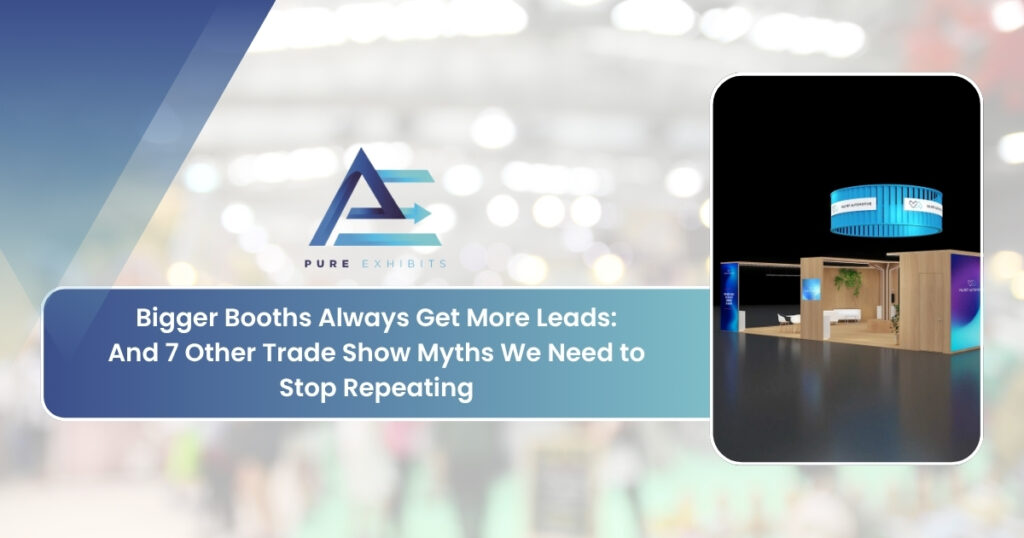
Myth #1: Bigger Booths Get More Leads
This is the one that costs exhibitors the most money. The logic seems airtight: more square footage, more visibility, more traffic, more leads. But across the shows we’ve tracked, booth size correlates with traffic volume — not lead quality or conversion rate.
A well-designed 20×20 island booth with a clear value proposition and a trained two-person staff will consistently outperform a cluttered 40×40 with eight staffers who don’t know how to qualify a prospect. We’ve seen it happen at NAB, at SEMA, at HealthIT conferences. The booths pulling the highest lead-to-close ratios are almost never the biggest ones on the floor.
The actual driver? Staff-to-visitor ratio and message clarity. Before you upgrade to a 20×30 or 20×40, ask whether your team can actually work the space you already have.
Myth #2: Corner Booths Are Always Worth the Premium
Corner placement has a real advantage — two open sides, better sightlines, slightly higher foot traffic. But “slightly higher” is doing a lot of work in that sentence. At most shows, corner premium pricing runs 15–25% above comparable inline space. That’s real money that could fund a better graphic refresh, a stronger lead capture system, or an extra day of on-site supervision.
The corner advantage collapses entirely in low-traffic aisles. We’ve watched exhibitors pay a significant premium for corner placement in Hall C at McCormick Place while the show traffic is concentrated in Hall A. Location within the hall matters more than corner vs. inline.
Most exhibitors chase corner spots — but the ones hitting consistent ROI study the floor plan and traffic flow data from prior years before committing to any placement.
Myth #3: Custom-Owned Booths Beat Rentals on Cost
This one has a very specific lifespan: it’s true if you exhibit at 8+ shows per year with identical footprint requirements. For everyone else, the math doesn’t hold.
Ownership comes with storage (typically $800–$2,500/month depending on market), refurbishment costs after every show, dedicated I&D labor you have to coordinate, and a depreciating asset that’s worth almost nothing in year four. Las Vegas booth rentals alone save exhibitors an average of 60% versus buying when you factor in the full cost of ownership over a three-year cycle.
Rentals also let you reconfigure for each show’s specific footprint — a 20×20 at CES, a 10×20 at a regional show in Atlanta — without paying for space you’re not using. That flexibility is genuinely undervalued. See why renting is usually the smarter choice for a full breakdown of when ownership actually makes sense.
Myth #4: Giveaways Drive Qualified Traffic
Swag drives traffic. It does not drive qualified traffic. There’s a painful difference, and your lead capture data will show it clearly after the show if you’re honest about it.
The AirPods raffle pulls a line. That line includes your two best prospects, fourteen people who will never buy anything, and six competitors. You’ve now spent $400 on AirPods and burned 45 minutes of your best closer’s time. At Javits, at the Venetian Expo, at Moscone — the pattern holds everywhere.
The exhibitors consistently generating qualified pipeline use relevance-gated engagement instead: a live demo that only makes sense if you’re in their buying journey, a private briefing room, a product trial. If your giveaway appeals to everyone, it’s attracting everyone — including the people you don’t need. Review these booth engagement strategies for approaches that actually filter for intent.
Myth #5: You Need to Staff the Booth the Entire Show
This one grinds people down physically and financially. Three days of full floor coverage at a major show — union hall, long setup, late teardown — can exhaust your team to the point where your day-three conversations are worthless. Attendees can tell when your staff is running on fumes.
At most major shows, 60–70% of qualified buyer traffic happens in two concentrated windows: the first four hours of day one and the first three hours of day two. Day three is largely competitive intel, tire-kickers, and people collecting the last of the free pens. Staff strategically around those peaks. Pull your best people for high-traffic windows and rotate in support staff for coverage. Your lead quality on day three will tell you whether the full coverage was worth it.
A solid project management plan built around actual show traffic data will always outperform brute-force coverage.
Myth #6: Your Booth Design Is the Main Driver of Traffic
Design matters — but it’s third or fourth on the list of what actually drives traffic, behind pre-show outreach, show app visibility, and speaking/sponsorship placement. We see this trade show myth repeated constantly in exhibit design conversations, and it leads to massive overinvestment in structure and underinvestment in activation.
An exhibitor who emails their prospect list three times before the show, books fifteen meetings in advance, and has a confirmed speaker slot will outperform a visually stunning booth with no pre-show strategy every single time. The booth needs to convert traffic — it shouldn’t be expected to generate it from scratch.
That said, design still has to do its job. A confusing layout, illegible graphics at 30 feet, or a space that doesn’t funnel visitors into a conversation — those are real problems. See what top brands are testing in booth design right now, and match it against a real pre-show marketing plan.
Myth #7: Drayage Is Just Part of the Cost — You Can’t Do Anything About It
This is the most expensive passive resignation in the industry. Drayage is the single most variable line item in your show budget, and it’s almost entirely controllable with planning. Shipments that miss the advance warehouse deadline can pay 30–40% more in direct-to-show rates. Crates that exceed the weight thresholds by 50 lbs trigger a full additional billing increment.
Exhibitors who optimize their crate count, hit advance warehouse deadlines consistently, and design their booth to minimize material weight are routinely saving $4,000–$12,000 per show on drayage alone. That’s real budget that goes back into lead follow-up, staff training, or the next show. If you haven’t read a current breakdown of how drayage pricing actually works, this guide covers the full mechanics.
Myth #8: The Best Shows Are the Biggest Shows
CES. SEMA. HIMSS. The marquee shows carry prestige and massive attendee counts — but they also carry proportionally massive costs. Booth space, drayage at the LVCC, union labor minimums, housing blocks that sell out nine months out. The total investment for a 20×20 at a tier-one show can run $80,000–$120,000+ all-in when you add up everything.
Some of the best ROI we’ve tracked across 50+ shows came from mid-tier vertical shows with 4,000–8,000 attendees. Tighter audience, less noise, more accessible executive-level buyers who aren’t being mobbed by every major vendor. The question isn’t “how big is the show?” — it’s “how concentrated is our specific buyer?” Use a structured framework for choosing the right trade show for business growth before committing your next budget cycle.
Frequently Asked Questions
Does booth size actually affect lead generation at trade shows?
Not in the way most exhibitors expect. Across tracked shows, lead quality correlates far more strongly with staff training, message clarity, and pre-show outreach than with square footage. A well-executed 20×20 booth rental consistently outperforms larger, unfocused exhibits in lead-to-close ratios.
Is it cheaper to rent or buy a trade show booth?
For most exhibitors — those doing fewer than 8 shows per year or varying their footprint by show — renting is significantly cheaper. When you factor in storage at $800–$2,500/month, refurbishment, and I&D coordination, ownership costs 40–60% more over a three-year cycle. The full cost breakdown here walks through the math in detail.
How much does a 20×20 trade show booth rental cost?
A 20×20 island booth rental typically ranges from $18,000 to $45,000 depending on design complexity, materials, AV integration, and show location. Las Vegas shows tend to be at the higher end due to union labor requirements and LVCC-specific logistics.
Do corner booths really get more traffic than inline booths?
Corner booths average modestly higher foot traffic, but the premium — typically 15–25% above inline pricing — often isn’t justified. Hall placement and proximity to major anchors or entrances has a bigger impact on traffic than corner vs. inline positioning. See our analysis of island vs. inline traffic impact at CES for show-specific data.
What are the most common trade show myths that waste exhibitor budgets?
The most expensive trade show myths involve booth size, drayage passivity, and swag-driven traffic strategies. Exhibitors who treat drayage as a fixed cost — rather than an optimizable variable — routinely overpay by $4,000–$12,000 per show. Giveaway-driven traffic strategies similarly inflate lead counts while diluting qualification rates.
How early should I start planning for a major trade show?
For tier-one shows like CES, HIMSS, or SEMA, 9–12 months out is the practical minimum if you want advance warehouse pricing, first-choice booth placement, and time to execute a real pre-show outreach campaign. Our trade show planning guide includes a timeline broken down by show type and booth size.
What to Do Next
If any of these trade show myths hit close to home, the best move is an honest audit of your last two or three shows — actual cost per qualified lead, not cost per badge scan. If you want a second set of eyes on your booth strategy, footprint selection, or budget allocation, book a booth consultation with the team at Pure Exhibits. We’ll tell you what we actually see working across the shows we manage — not what sounds good in a pitch deck. You can also review real case studies from exhibitors who adjusted their approach and tracked the difference.