
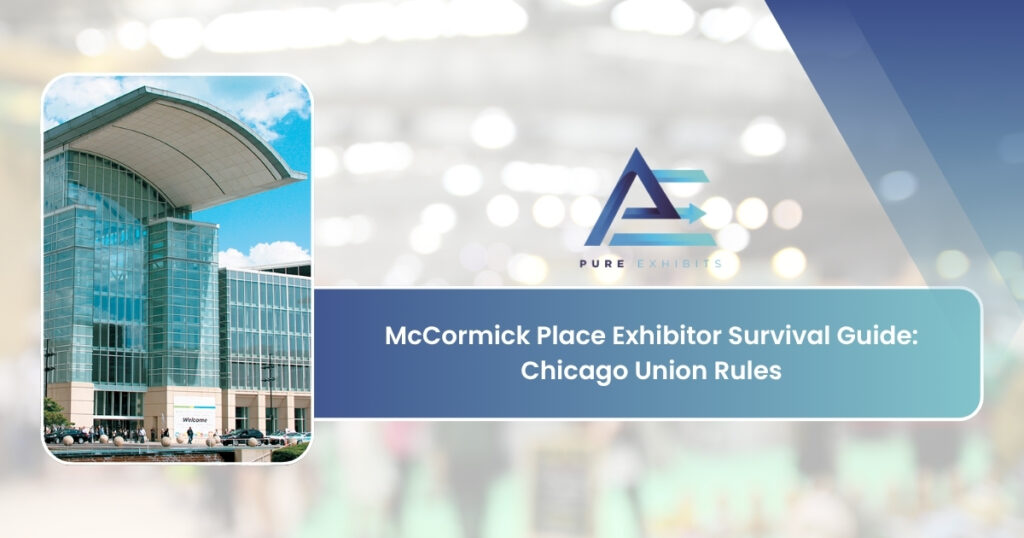
McCormick Place Exhibitor Survival Guide: Chicago Union Rules
McCormick Place operates under 3 primary union jurisdictions: Teamsters (freight), IBEW (electrical), and IATSE (rigging). Exhibitors cannot unload trucks, run electrical, or hang overhead elements themselves. Drayage is billed per hundredweight (CWT) with minimums applied regardless of weight. Labor shifts to overtime before 8am and after 4:30pm on weekdays, and to double-time on weekends — across 2.6 million sq ft in four buildings.
The exhibitors who get burned at McCormick aren’t the ones who ignored the rules — they’re the ones who walked onto the floor at the North Building or Lakeside Center not knowing what they didn’t know, and got the invoice three weeks later. This guide comes from people who have supervised 20×30 installs at McCormick, not from people who read the Exhibitor Service Kit from a desk in another city. The union rules here are learnable. But they have to be explained in field terms, not legal language.
What McCormick’s Union Structure Actually Means for Your Booth
McCormick Place — 2301 S. Lake Shore Dr., Chicago, IL 60616 — runs on jurisdictional labor agreements that assign specific tasks to specific unions. Crossing those lines, even accidentally, triggers grievances and can shut down your install. There are three unions you need to understand before your freight hits the West Building loading dock.
Teamsters hold jurisdiction over all freight and material handling. The moment your shipment reaches a McCormick loading dock — whether it arrived via common carrier, a rented Penske truck, or your own vehicle above a certain size threshold — it is in Teamster territory. They move your freight from dock to booth space. That movement is drayage, and it is billed separately from whatever you paid to ship freight to Chicago. You do not touch that freight in transit from dock to floor.
IBEW controls every hardwired electrical connection on the floor. Exhibitors cannot run their own electrical, install lighting circuits, or plug in any hardwired equipment. Once IBEW connects your booth’s electrical panel, operation of your own equipment — laptops, monitors, demo units — is yours. The line is exact: connection is union work, operation is yours.
IATSE holds jurisdiction over anything that leaves the floor and goes overhead — hanging signs, lighting truss, suspended displays. At a 20×30 island configuration, overhead elements are the norm, and every one of them requires a licensed rigger. IATSE also covers theatrical A/V installation in most scenarios at McCormick. Structural booth assembly — carpentry — also typically falls under union jurisdiction at McCormick, though specific thresholds can shift by show and GSC agreement; confirm via your Exhibitor Service Kit. A 20×30 crosses thresholds that a 10×10 does not: floor plan submission is required, structural assembly is union work, and a rigging call is almost certain if you’re running any overhead element.
What exhibitors can do: hand-carry items without wheels in a single trip, set up products and literature once the structure is in place, and operate their own A/V and computers after IBEW connections are made. These self-setup exemptions are enforced — confirm the current specifics with your GSC rep (Freeman, GES, or Shepard depending on your show) when your Exhibitor Service Kit arrives.
“The exhibitors who get into trouble at McCormick aren’t the ones who break the rules — they’re the ones who didn’t know the rules existed until they were already on the floor. By then, it’s an overtime call and a labor grievance.”
— Michael, Senior PM, Pure Exhibits
Drayage — The Cost Nobody Budgets for Correctly
Drayage is the charge for moving your freight from the loading dock to your booth space — a service you cannot opt out of at McCormick. It is billed on the CWT model: per 100 lbs. of freight, with a minimum charge applied regardless of actual weight. The rate is set by the show’s general service contractor and listed on the advance order form.
A 20×30 booth with a fabric structure, flooring, case goods, and graphic panels will typically run 1,500–4,000+ lbs. of total freight. At McCormick — where drayage rates are consistently among the highest in the country — that math produces a drayage line item that is rarely under four figures. Specific CWT rates change annually and vary by show; request the advance order form immediately after show confirmation and compare against prior show experience. For a broader look at how drayage, labor, and electrical compound into a final invoice, see our breakdown of trade show booth rental costs.
You have two delivery paths. Advance warehouse receiving opens approximately 30 days before the show and closes 3–5 business days before show open. Direct-to-show-site delivery requires your truck to arrive within an assigned move-in window. Advance warehouse is more predictable and typically carries a lower CWT rate than show-site pricing.
The marshaling yard is where direct-to-show goes wrong. Every truck accessing McCormick’s docks must check in at the marshaling yard first. Trucks that arrive outside their assigned window wait — sometimes for hours in a Chicago winter. That wait costs you in driver fees. If the delay pushes your installation start past 4:30pm on a weekday, every labor hour that follows runs at 1.5x the straight-time rate. That is not a hypothetical. It is the single most common cost surprise at McCormick, and it is entirely preventable.
Labor Windows — Why Your Install Schedule Is a Budget Document
McCormick labor rates operate on three tiers. Straight time runs approximately 8am–4:30pm, Monday through Friday. Outside that window on weekdays, you are in overtime territory at approximately 1.5x the straight-time rate. Weekends and recognized holidays are double-time at 2x. Published straight-time rates for skilled trades at McCormick — carpenters, electricians — typically run in the range of $85–$135 per hour per worker; verify current figures on your GSC’s advance order form, as rates adjust with each contract cycle.
| Time Window | Rate Tier | Multiplier | Estimated Range/Worker/Hr |
|---|---|---|---|
| Mon–Fri, 8am–4:30pm | Straight Time | 1x | $85–$135 |
| Mon–Fri, outside 8am–4:30pm | Overtime | 1.5x | ~$128–$203 |
| Weekends & Holidays | Double Time | 2x | ~$170–$270 |
A 20×30 booth with moderate complexity typically requires 8–16 total labor hours to install. If that window falls during overtime hours, the labor cost difference versus the same scope at straight time is $500–$2,000 or more depending on crew size. Now apply the one-hour minimum rule: every labor call at McCormick carries a one-hour minimum, regardless of actual time worked. A 15-minute graphic panel adjustment — one union carpenter, one hour minimum, billed at whatever rate applies to that time of day. This is not a fine-print technicality. It is a real budget line item that appears repeatedly on show days.
“Every exhibitor thinks the one-hour minimum is a technicality until they get three separate one-hour minimums on a Tuesday afternoon fixing things that took twenty minutes each. That’s three hours of labor charges for less than an hour of actual work.”
— Michael, Senior PM, Pure Exhibits
Build your install schedule backward from straight-time windows. If freight arrives late at the South Building marshaling yard and your install doesn’t start until 3pm, you have 90 minutes of straight time before overtime kicks in. Advance warehouse delivery and early marshaling yard check-in are schedule insurance, not logistics preferences.
The 20×30 Booth at McCormick — What You’re Actually Managing
Here is the operational sequence for a 20×30 exhibitor at McCormick, from arrival to teardown. Every step involves a union jurisdiction, a deadline, or a cost variable.
Freight arrives at the McCormick marshaling yard and checks in for a dock assignment. Teamsters offload at the dock; drayage billing begins. Material moves to your assigned booth space — logistics and dock access differ between the North Building, South Building, West Building, and Lakeside Center, so confirm your hall assignment early and understand the specific move-in flow for that building. Union carpenters begin structural installation per your submitted floor plan — submission is required at 600 sq ft, and approval delays compress your install window. IBEW runs electrical: overhead lighting, floor outlets, any hardwired displays. If your booth carries an overhead sign or truss — standard at most 20×30 islands — a rigging call is scheduled separately under IATSE jurisdiction, on a separate timeline. Once structure and electrical are complete, your team sets products, literature, and operates A/V. During show days, any booth adjustment triggers labor minimums. Dismantlement runs the reverse sequence under the same jurisdictions, often under tighter time pressure with outbound freight deadlines. Teamsters return your crated freight to the dock; outbound shipping is arranged separately.
Managing that sequence across Teamsters, IBEW, IATSE, carpentry, and your own team simultaneously — while tracking advance order deadlines and floor plan approvals — is a real operational burden, particularly on a first or second McCormick show. An exhibit partner with prior McCormick experience has already built the venue’s constraints into the design: ceiling height limits by hall, rigging point locations, dock-to-booth freight paths. Our full-service I&D model covers design, freight coordination, drayage management, union crew supervision, on-site supervision during show days, and dismantlement coordination — one point of contact across every jurisdiction. See the work we’ve completed at McCormick and comparable large convention venues in our Work Gallery. If you’re planning a 20×30 at McCormick, our 20×30 Chicago trade show booth rental packages are built around this exact operational reality — one fixed price, no post-show invoice surprises.
How to Work With the System, Not Against It
These six steps come from field experience at McCormick, not from the Exhibitor Service Kit alone.
1. Submit your floor plan early. Show management requires it at 20×30, and approval delays can compress your install window directly into overtime territory.
2. Order electrical in advance. Show-site electrical orders cost more and can face scheduling delays if the IBEW crew is at capacity during your move-in window at the West or South Building.
3. Use advance warehouse receiving. The slightly higher handling cost is insurance against marshaling yard delays that push your entire install into $128–$270/hour overtime rates.
4. Hire your EAC before the general contractor portal opens. Exhibitor Appointed Contractors must be approved and credentialed before move-in. The approval deadline is typically 2–3 weeks before move-in — confirm in your Exhibitor Service Kit. Missing it defaults you to GSC labor at GSC rates. Exhibitors at 20×20 face most of the same McCormick jurisdictional rules; 20×20 configurations are subject to the same advance planning timeline.
5. Build your schedule around straight-time hours. Every labor hour inside the 8am–4:30pm Monday–Friday window at $85–$135/worker is a labor hour not billed at 1.5x or 2x that rate.
6. Read the Exhibitor Service Kit when it arrives. Hall-specific rules, advance order deadlines, and GSC rate cards vary by show. Treat it as the authoritative document over any general guidance, including this article.
Frequently Asked Questions
Can I unload my own van or truck at McCormick Place?
In most cases, no. The Teamsters hold jurisdiction over material handling at McCormick’s loading docks, and that jurisdiction applies to personal vehicles and rented trucks in most show scenarios — not just common carriers. The specific rules around small vehicles and hand-carry items are defined in each show’s Exhibitor Service Kit and enforced on the floor. Do not assume that driving your own vehicle to the South or West Building dock bypasses drayage. Confirm the current policy with your GSC rep — Freeman, GES, or Shepard depending on your show — when your service kit arrives.
What is CWT pricing and how does it affect my McCormick drayage bill?
CWT stands for hundredweight — drayage is billed per 100 lbs. of freight, with a minimum charge applied regardless of actual weight. The CWT rate is set by the show’s general service contractor and listed in the advance order form. A 20×30 booth typically ships 1,500–4,000+ lbs. of freight depending on structure type, flooring, and case goods. At McCormick’s rates, which are consistently among the highest of any convention center in the country, drayage on a 20×30 install is rarely under four figures. Ordering via the advance warehouse form — which closes approximately 3–5 business days before show open — typically provides a lower CWT rate than show-site pricing.
What can exhibitors do themselves at McCormick without union labor?
Exhibitors can generally hand-carry items without wheels in a single trip (no dollies, no hand trucks, no carts), set up their own products and literature once the booth structure has been assembled by union labor, and operate their own computers and A/V equipment after IBEW has completed the electrical connections. What exhibitors cannot do: unload freight from trucks at the dock, run electrical connections or install lighting circuits, assemble structural booth components, or rig overhead elements. The specific self-setup exemption rules at McCormick are defined by each show’s union agreement — confirm the current scope with your GSC rep and read your Exhibitor Service Kit carefully before move-in.
How much does union labor cost at McCormick Place for a 20×30 booth install?
Skilled trades at McCormick — carpenters, electricians — typically run $85–$135 per hour per worker at straight time, with overtime billed at approximately 1.5x and double-time at 2x on weekends and holidays. Verify current figures on your GSC’s advance order form; rates adjust with each union contract cycle. A 20×30 booth with moderate complexity requiring 8–12 labor hours across two to three workers, installed entirely during overtime hours, can run $3,000–$8,000 or more in labor alone — before drayage, electrical, or materials. The one-hour minimum applies to every labor call throughout the show, including adjustments and corrections during show days. Early scheduling inside the 8am–4:30pm straight-time window is the only lever exhibitors have to reduce this line item.
What is an Exhibitor Appointed Contractor (EAC) and do I need one at McCormick?
An EAC is a third-party exhibit company or I&D firm the exhibitor hires instead of the show’s general service contractor for installation and dismantle. At McCormick, EACs must be pre-approved by show management, carry the required insurance, and have union labor credentials submitted before move-in — typically 2–3 weeks before the move-in date, though the deadline varies by show. For a 20×30 custom booth, hiring a qualified EAC early gives you direct control over who supervises your install, what floor plan gets submitted, and how the union labor schedule is built around straight-time windows. Missing the EAC approval deadline defaults you to the GSC’s labor pool at standard GSC rates with no flexibility on crew or supervision.
McCormick Is Manageable — If You Stop Treating It Like Every Other Show
McCormick’s union rules are not arbitrary obstacles. They are a defined system with predictable costs — and the exhibitors who get hurt are the ones who walk into the North Building or Lakeside Center without understanding the Teamster jurisdiction at the dock, the IBEW line between connection and operation, or the one-hour minimum that applies to every labor call from move-in through teardown. Managing drayage, labor schedules, union jurisdictions, floor plan submissions, and EAC credentials simultaneously is a real operational burden — especially when it’s your first or second show at 2301 S. Lake Shore Dr.
Pure Exhibits handles all of it under a fixed-price model. One number before the show, no post-show invoice surprises. See what exhibitors who’ve worked with us at McCormick and comparable venues have to say at our Testimonials page. When you’re ready to talk specifics, explore our 20×30 Chicago booth rental packages or tell us about your McCormick show and we’ll walk you through what the build actually involves.