A trade show is one of the few channels left where your competitor is standing ten feet away from you, and the customer is walking toward both of you at the same time. That pressure is real. And most exhibitors handle it the exact same way — which is why most booths at most shows look and feel identical by Tuesday afternoon.
This is not a generic Trade Show Marketing guide. What follows is what actually separates the exhibitors who leave a show with a pipeline from the ones who leave with a box of leftover brochures and a sunburn from the venue lighting. It covers strategy before the show, execution on the floor, and the follow-up window that almost everyone gets wrong. It applies whether you are running a 10x10 inline at a regional event or a 30x40 booth at CES.
If you have been doing trade shows for years and feel like you are getting diminishing returns, most of what is here will tell you why.
Most Exhibitors Solve the Wrong Problem
The most common question in B2B trade show marketing is some version of: 'How do we get more people to stop at our booth?' It is the wrong question. Getting people to stop is easy — put a screen with something moving on it, hire someone to hand out decent coffee, run a wheel spin. Traffic is not the problem.
The real problem is that most exhibitors cannot tell the difference, in the first thirty seconds of a conversation, between a genuine prospect and someone who just wanted the free tote bag. And because they cannot make that distinction quickly, their booth staff spends equal time with everyone, which means they spend serious time with almost no one.
The most effective trade show marketing strategy starts not with booth design or pre-show emails, but with a ruthlessly clear definition of who you are there to talk to. What does your ideal customer look like? What title? What problem are they actively trying to solve right now? What would make them walk over to you specifically, rather than the three companies selling something adjacent to you?
When you can answer those questions precisely, every other decision — booth layout, messaging, staff scripts, giveaway selection, follow-up sequence — becomes significantly easier to make correctly.
The exhibitors who consistently win at trade shows are not the ones with the biggest booths. They are the ones whose booth staff can qualify a lead in under a minute and knows exactly what to do with both outcomes.
 Before the Show: Where Most of the Work Actually Happens
The single biggest gap in trade show marketing materials and execution is not on the show floor — it is in the six to eight weeks before the show. The companies that do this period well show up with appointments already booked, warm prospects who know exactly where to find them, and a staff that has been briefed and rehearsed. The companies that skip this period show up hoping foot traffic will do the work.
1. Activate Your Existing List Before Anyone Else Does
Your CRM contains people who already know you. Some of them will be at the show. None of them know you are going to be there unless you tell them. This sounds obvious but the majority of exhibitors send one email blast the week before the show and call it pre-show marketing.
What actually works: a sequence that starts six to eight weeks out, is personal in tone rather than promotional, and offers something concrete — a private meeting slot, early access to a product demo, a reason to seek you out specifically. The goal is not open rates. The goal is booked appointments before the show floor opens. An exhibitor with fifteen pre-booked meetings on day one is in a fundamentally different position than one waiting for walk-in traffic.
2. Use the Show's Own Promotion Infrastructure
Most exhibitors do not fully use what the show organizer gives them. The show's app, attendee networking platform, speaker submission process, and sponsorship tiers all exist as traffic mechanisms — and most of them are underutilized by exhibitors who paid for booth space and then did nothing else with the show ecosystem.
If the show has an official attendee app, your booth should be fully populated with messaging that gives an attendee a reason to walk over. If the show offers sponsored content or a session slot, that is a warm audience of people who chose to be in a room related to your topic. These are not small advantages — they are the difference between being one of two hundred booths and being the company an attendee already has a reason to find.
3. Brief Your Staff Like They Are Going Into a Sales Conversation
Trade show booth staff is one of the most under-invested areas in trade show marketing. Companies spend serious money on exhibit design, graphics, and logistics — and then send people to the floor who have not been told what the goal of each conversation is, what questions to ask to qualify quickly, or how to handle the handoff when they find someone worth spending time with.
Every person staffing your booth should be able to answer three questions in their sleep: What do we do and for whom? What is the one thing we want someone to walk away knowing? And what does a qualified lead look like so we stop immediately if this is not one? Run a rehearsal the evening before the show opens. It feels awkward. It works.
On the Floor: Trade Show Marketing Ideas That Actually Differentiate
Most trade show marketing ideas in circulation are recycled. Spin-to-win wheels. Candy bowls. QR codes that go to a generic landing page. These do not differentiate you. Here are the ideas that do.
1. Make Your Booth a Destination, Not a Display
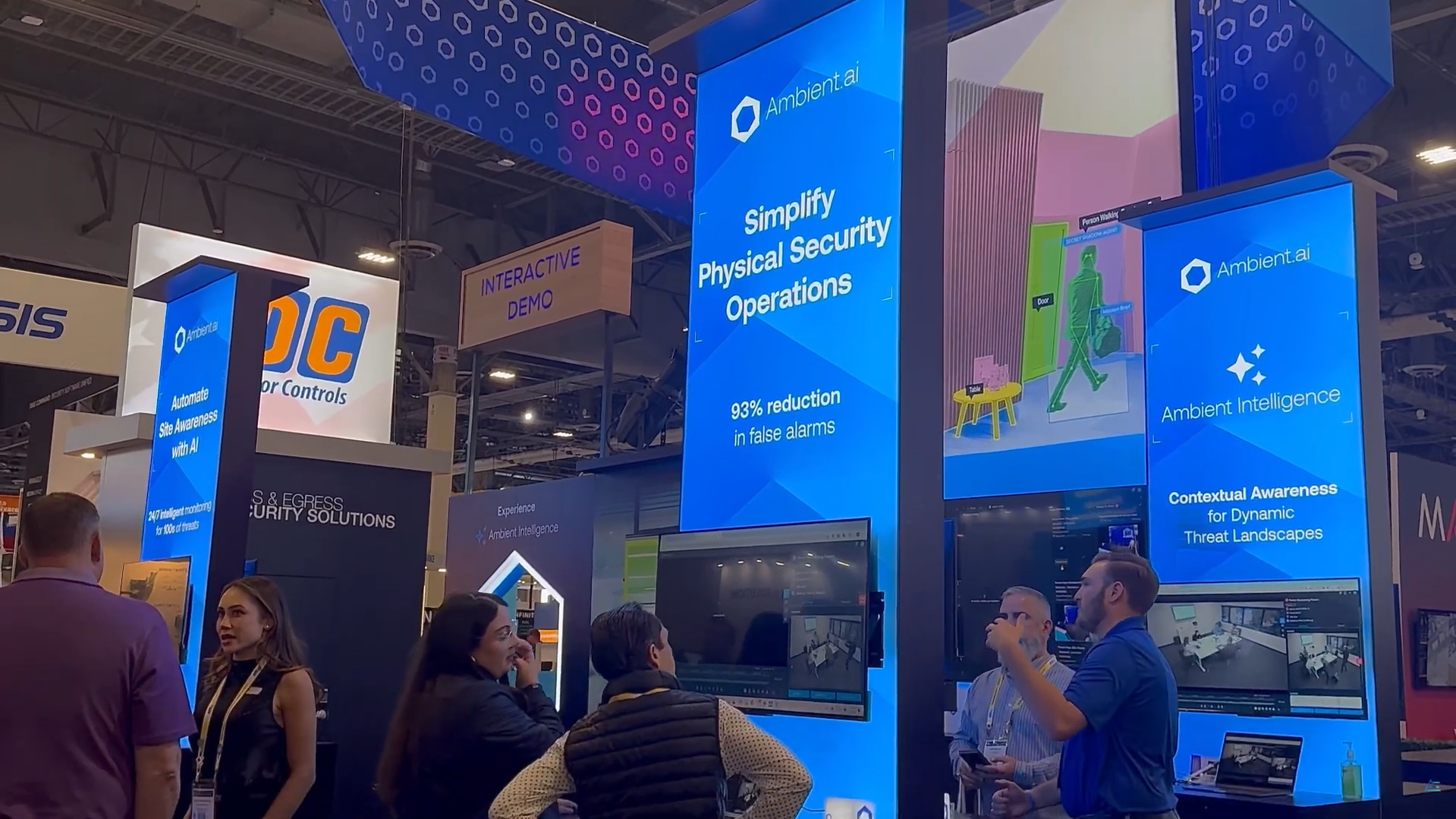
The booths that consistently draw traffic and hold it are not necessarily the largest or the most expensive. They are the ones where something is happening. A live demonstration that runs on a schedule creates a crowd effect — people who were not interested in stopping become interested because other people are already stopped. A roundtable discussion, a product build in real time, a live competitive analysis being written on a whiteboard — anything that suggests active participation rather than passive observation draws traffic in a way that a static display with a screen never will.
At large shows like CES or NAB, where the show floor is genuinely overwhelming, attendees develop a heuristic for where to spend time: they go where other people already are. Manufacturing that crowd moment, even for five minutes every hour, changes the character of your booth entirely.
2. Control the Conversation With Space Design
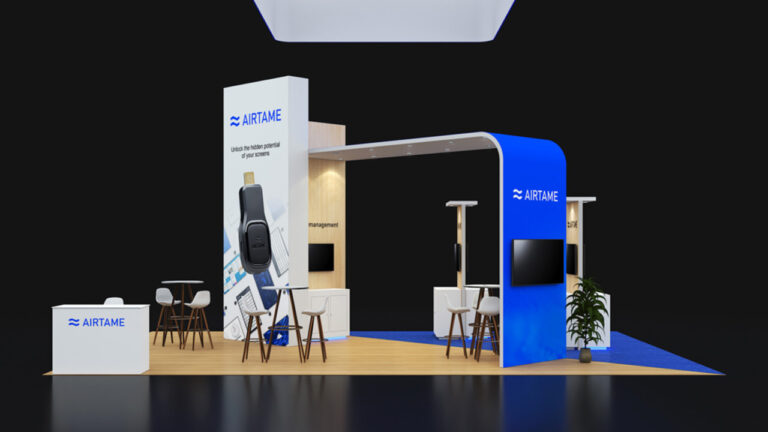
How your booth is physically designed is a trade show marketing strategy decision, not just an aesthetic one. An open booth with no distinct spaces treats every visitor the same. A booth with a clear front zone for initial contact and a separate back zone for qualified conversations physically separates discovery traffic from pipeline conversations, which is what your booth staff needs to do their job.
The meeting pod in the back of a well-designed island booth is not a luxury. It is a conversion tool. It signals to a prospect that the conversation they are having matters enough to happen privately. It changes the tone of the interaction from 'pitch' to 'meeting.' In B2B trade show marketing at high-density shows, this spatial distinction is one of the most impactful design decisions an exhibitor can make.
3. Rethink What You Give Away
If your giveaway ends up in the bin at the hotel room or in the conference tote bag never to be opened, it did nothing for you. The best trade show marketing materials are the ones that have a reason to exist beyond putting your logo in someone's hand.
A printed competitive analysis relevant to your industry. A one-page research summary that solves a problem your target customer is actively dealing with. A consultation offer that delivers something specific and useful, booked on the spot. These items travel back to an office and get shared with colleagues. A branded pen does not. The question to ask about any giveaway: would my ideal customer actually want this if it did not have my logo on it?
4. Book the Next Meeting Before They Leave Your Booth
The most expensive moment in trade show marketing is the gap between a good conversation on the show floor and the follow-up call two weeks later. Most of that pipeline cools because nothing committed was established during the show itself. The fix is simple and almost no one does it consistently: before a qualified conversation ends, the next step should be scheduled. Not 'I'll send you something.' A calendar invite, created on a phone, agreed to before they walk away. If a prospect will not do that, they were not as qualified as they seemed.

Post-Show: The 72-Hour Window No One Takes Seriously Enough
The follow-up after a trade show is where the ROI is either made or lost. Everyone knows this. Almost no one executes it well.
The mistake is treating post-show follow-up as a batch process. One email to everyone you scanned. A LinkedIn connection to the business cards you collected. A call to your A leads when you get back to the office on Thursday. By the time that call happens, your prospect has been back in their office for four days, processed everything they saw at the show, and has moved on to other priorities.
The 72-hour window after a show closes is when your conversations are freshest in the prospect's memory and when your follow-up lands with the most contextual relevance. What works: a same-day or next-morning personal note to every meaningful conversation — not a template, a sentence or two that references something specific from your exchange. Then a more substantive follow-up within three days that delivers something useful, not a brochure. Then a calendar invite to the next specific thing you agreed on during the show.
In marketing trade shows, the winners are often not the most sophisticated exhibitors — they are the most disciplined ones in the 72 hours after the hall closes.
The single most common trade show failure pattern: a great booth, reasonable traffic, decent conversations — followed by a mass email two weeks later that treats everyone identically. Your prospect cannot tell you apart from the twelve other vendors who did the same thing.
How to Build a Trade Show Marketing Strategy That Compounds
The exhibitors who get the best long-term results from trade shows are not reinventing their approach every year. They are building on a foundation that improves with each event. That means treating every show as a data collection exercise as much as a sales exercise.
What qualified leads had in common. What conversations turned cold and why? Which booth staff members generated the most substantive interactions? Which pre-show outreach formats got the most responses? Which giveaway items did people actually take home versus leave behind? This information, captured systematically after every show, is the input to a better trade show marketing strategy for the next one.
Most trade show marketing services — agencies, exhibit companies, event platforms — will help you plan and execute a show. Very few will help you build a compounding system across a multi-show annual program. That is the distinction between event-level thinking and program-level thinking. The companies that treat their trade show calendar as a program — with consistent measurement, consistent improvement, and consistent investment in the physical and operational infrastructure — consistently outperform the ones who start from scratch every time they register for an event.
Your booth is part of that infrastructure. It should be designed to evolve — modular enough to adapt messaging and layout per show, durable enough to last multiple years, and managed by a partner who understands the operational reality of the venues you are exhibiting at. When those pieces are in place, trade show marketing stops being a series of discrete events and starts being a channel that compounds.
About Pure Exhibits
Pure Exhibits is a Las Vegas-based trade show exhibit company. We design, build, and install booth rentals and custom exhibits for companies exhibiting at major shows across Las Vegas and nationally — including CES, NAB Show, SEMA, SHOT Show, and CONEXPO at the Las Vegas Convention Center. Our facility is 20 minutes from the LVCC. We handle freight, union labor coordination, pre-staging, and on-site support for every show we work on. If you are planning your next exhibit and want a team that understands the full picture — not just booth design — talk to us.
Let's Build Something Extraordinary
Share your event details and we'll craft a custom booth solution designed to captivate your audience and maximize your ROI.
Frequently Asked Questions About Trade Show Marketing
What is trade show marketing?
Trade show marketing is the full set of activities a company uses to generate leads, build brand presence, and advance sales conversations through in-person events. It covers pre-show outreach, booth design and messaging, on-floor staff strategy, lead qualification, giveaways, and post-show follow-up.
Done well, it is one of the highest-ROI channels in B2B marketing because it concentrates your ideal customers in one place and gives you direct access to them.
What does a trade show marketing strategy actually include?
A complete trade show marketing strategy covers five phases: show selection (picking the right events for your audience), pre-show activation (outreach to existing contacts and prospects before the event), on-floor execution (booth design, staff briefing, lead qualification, meeting booking), post-show follow-up (the 72-hour window after the show closes), and measurement (what qualified leads looked like, what worked, what to improve).
Most companies only have a strategy for the middle phase.
What trade show marketing materials actually work?
The materials that work are the ones that have value independent of your logo. A relevant research summary, a competitive analysis, a specific how-to guide for a problem your target customer is dealing with — these travel back to someone's office and get shared.
Branded merchandise for its own sake does not. If you want to invest in leave-behind materials, make them something an attendee would want even if your name were not on them.
How early should we start trade show marketing before an event?
For a major show, meaningful pre-show outreach should start six to eight weeks before the event. The goal is booked meetings before the show floor opens — not awareness that you are attending.
By the time you are three weeks out, your outreach to high-priority targets should already be complete and you should be confirming appointments, not sending first contacts. One week before the show is too late to build real pipeline momentum.
What makes B2B trade show marketing different from consumer event marketing?
In B2B trade show marketing, the decision-making cycle is longer, the buying committee is larger, and the on-site conversion rate is lower. You are rarely closing deals on the show floor. You are qualifying conversations and advancing pipeline.
That changes what success looks like: not sales made at the show, but qualified meetings booked, specific next steps agreed to, and follow-up sequences that treat different lead grades differently. The metrics that matter in B2B are meetings booked, not badges scanned.
Do I need a trade show marketing agency or can I manage it in-house?
It depends on how many shows you run annually and how much operational complexity is involved. Companies running one or two shows a year with a dedicated marketing team can manage strategy in-house effectively.
Companies running six or more shows annually — especially at large venues with union labor requirements, complex logistics, and multi-show booth programs — benefit from working with a trade show marketing agency or exhibit partner who handles the operational layer so the internal team can focus on the sales strategy.
The distinction is between strategic planning (which is hard to outsource) and operational execution (which often is worth it to outsource).
How do you measure trade show marketing ROI?
The most reliable measurement framework tracks three things: pipeline generated (qualified opportunities that came from show conversations), pipeline advanced (existing deals that moved forward because of show interactions), and cost per qualified conversation.
Badge scans and total booth visits are vanity metrics. What matters is how many of those conversations met your ICP definition, and how many of them are still active 60 days after the show.
Most trade show ROI is underreported because companies do not tag their CRM records correctly after the show — which makes it look like the show did not produce results when it actually did.