
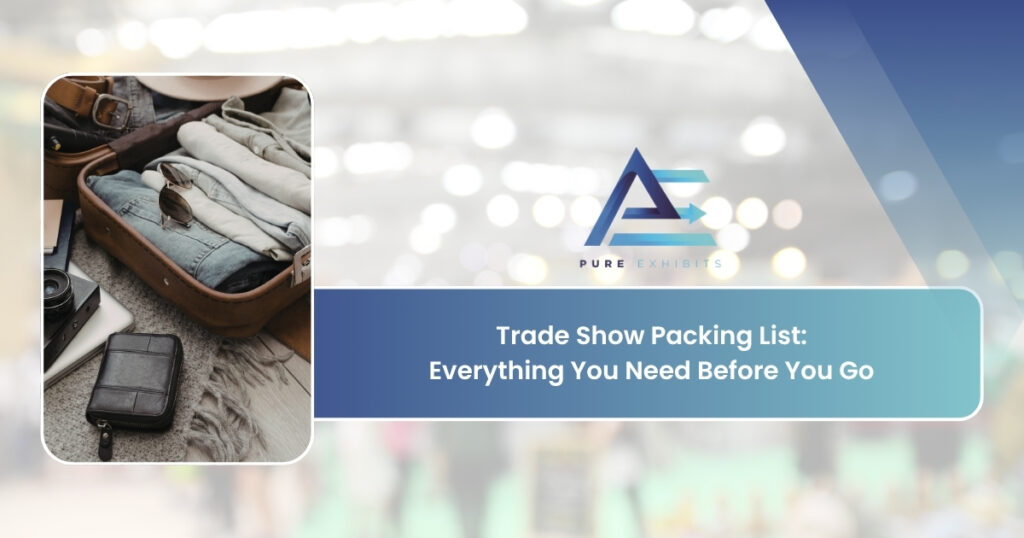
The items that get left behind at a trade show are almost never the big things — the exhibit ships ahead, the graphics are pre-built into the frame, the furniture arrives at the venue. The items that get left behind are the ones that do not fit neatly into any single category: the extension cord for the charging station, the second badge for the staff member who lost the first one, the hand sanitizer that runs out on day two, the printed show directory with your booth number circled. None of these are expensive. All of them are missed.
This trade show packing list covers every category of item an exhibitor needs to prepare for — organized by what ships ahead, what travels with staff, and what belongs in a day-of kit at the booth. It is built for exhibitors at multi-day B2B shows, particularly Las Vegas events where the venue scale and show duration create specific supply needs that a standard event checklist misses. For the broader preparation workflow — including pre-show outreach, staff briefing, and post-show follow-up — see the first-time trade show exhibitor tips guide.
Why Do Exhibitors Miss Critical Items on a Trade Show Packing List?
The most common reason items get left behind is that packing responsibility is fragmented across too many people without a single owner. The marketing team handles graphics and literature. The sales team handles demo equipment. The office manager orders giveaways. The exhibit house ships the structure. Each owner focuses on their category and assumes the adjacent categories are covered. The items that fall into the gaps between categories — booth supplies, tools, personal comfort items for a five-day show — are the ones that reliably go missing.
The second reason is timeline compression. Most exhibitors finalize their packing list in the week before the show, when advance warehouse deadlines have already passed for some items and there is no time to order replacements. A packing list built three to four weeks before the show gives enough runway to identify gaps, place orders, and confirm that everything shipped has actually been received at the advance warehouse before the flight to Las Vegas.
The third reason is that most generic trade show checklists are written for any exhibitor at any event — they are not specific to the duration, venue scale, and logistical requirements of a major multi-day B2B show. A five-day show at the Las Vegas Convention Center has different supply requirements than a one-day regional event at a local hotel ballroom.
What Booth Materials Should Be on Every Trade Show Packing List?
Booth materials divide into two categories: items that ship with the exhibit freight to the advance warehouse, and items that the exhibit house handles as part of the rental package. For a rental program from a professional trade show booth builder, the structure, graphics, and most hardware ship from the exhibit house’s warehouse — you are responsible for the supplemental booth supplies that fill in around the exhibit. For a 10×10 trade show booth or 10×20 trade show booth, the following supplies should be on every exhibitor’s freight manifest.
Booth Hardware and Tools
-
Extension cords and power strips — minimum two heavy-duty surge-protected strips per booth, even if the exhibit house provides power. Convention hall electrical drops are rarely positioned where you want them.
-
Velcro strips and cable ties — for securing power cables, technology cables, and any items attached to the booth structure that may shift during shipping.
-
Basic toolkit — a small flathead and Phillips screwdriver, hex key set (metric and imperial), zip ties, and a utility knife. These are needed at nearly every move-in, even for fully assembled rental booths, and the show’s general service contractor charges full labor rates for minor hardware tasks.
-
Gaffer tape — not duct tape. Gaffer tape does not leave residue on booth surfaces, carpet, or convention hall flooring. Two rolls per booth, black and white.
-
Microfiber cleaning cloths and screen cleaner — for monitors, demo screens, countertops, and glass surfaces before the show opens each morning.
-
Leveling shims — small rubber shims or folded cardboard squares for furniture and counters that sit on uneven flooring or carpet seams.
-
Spare light bulbs or replacement LED strips — if your exhibit uses integrated LED lighting, bring replacements. Convention hall replacement sourcing is slow and expensive.
-
Label maker or pre-printed booth number labels — applied to all cases and freight items for easy identification in the warehouse and on the show floor.
Graphics and Signage Supplies
If your trade show booth graphics are managed by your exhibit house and pre-built into the frame before shipping, this section is handled for you. If you are managing any supplemental signage — tabletop signs, directional signs, product labels, or literature holders — include the following.
-
Easel backs or sign holders for table-top printed cards (product specs, pricing, QR codes).
-
Printed price sheets or product one-pagers in a protective sleeve or display stand — not loose on the counter where they scatter.
-
QR code signage printed at minimum 4×4 inches — small QR codes printed on standard paper are not scannable at booth lighting levels from a standing position.
-
Backup printed graphics — for retractable banners or stand-alone signs, a single backup of your most critical graphic in a rolled tube. Graphics damaged in shipping cannot be replaced on move-in morning.
What Marketing and Sales Materials Do You Need at the Show?
Physical marketing materials at trade shows serve a specific purpose: they give a qualified visitor something to take away from the conversation that reinforces your message after they leave the booth. They are not brochures for passive distribution — a stack of brochures on the counter that anyone can pick up without engaging your staff contributes nothing. Quantity should be matched to your expected qualified conversation volume, not to the booth’s maximum visitor capacity.
Collateral for Qualified Visitors
-
Product or service one-pagers — one page, front and back, summarizing your core offering, key differentiators, and a single clear next step. Printed on quality paper stock (100lb or heavier gloss or matte). Quantity: 1.5× your expected qualified lead count for the show.
-
Case study or proof-of-concept documents — two to three pages maximum, specific to the buyer role most likely to attend the show. A procurement manager needs different proof than a department head.
-
Business cards — each staff member brings a minimum of 200 per show day. Running out of business cards at a five-day show is a common and avoidable problem.
-
Show-specific offers or promotions printed on a card — if you have a show-exclusive pricing offer or a demo booking incentive, print it as a leave-behind card rather than writing it on a napkin.
Lead Capture Materials
-
Badge scanner device — rented from the show’s official lead retrieval vendor (Freeman, CompuLead, or show-specific provider). Reserve in advance; scanner availability at the show is limited and prices increase closer to the event.
-
Printed lead qualification forms — a single-page paper form with the qualifying questions, contact fields, and lead disposition categories pre-printed. Useful as a backup when scanners malfunction or as a supplemental note-taking tool.
-
Pens — minimum 20 per day. They walk away. They always walk away.
-
Sticky notes or index cards — for staff to note conversation context before a lead is entered into the CRM. ‘Met at booth, evaluating Q3 budget, needs demo of [product]’ on a physical note attached to the scanned badge prevents cold outreach to warm leads.
What Technology and Lead Capture Equipment Should You Pack?
Technology failures at trade shows are disproportionately disruptive because they happen during the narrow window when the show floor is open and there is no time to source replacements. Every piece of technology your booth depends on should have a backup plan — a spare cable, a secondary device, or a manual workaround documented before the show opens.
-
Laptop or tablet for product demos — fully charged before move-in, with the demo application cached locally (not dependent on a live internet connection). Convention hall Wi-Fi is unreliable for live demos.
-
Dedicated demo device backup — a second tablet or laptop with the demo pre-loaded, kept in the storage cabinet under the counter. If the primary device fails, the backup is retrieved in under two minutes rather than improvised on the spot.
-
Charging cables — one per device plus one spare per device type. USB-C, Lightning, and micro-USB. Cables get borrowed, stepped on, and lost at the rate of approximately one per show day.
-
Power bank (high-capacity) — for staff smartphones and any device that runs low during a full day on the show floor. Convention hall electrical access at the booth is not always positioned for convenient phone charging.
-
HDMI and DisplayPort adapters — if your demo runs on an external monitor, bring the adapter for every laptop in your team. The convention center AV rental desk does not stock every adapter combination.
-
External monitor or TV if not included in the rental — confirm whether the exhibit house’s rental package includes display screens before shipping your own.
-
Wi-Fi hotspot (dedicated cellular) — a personal hotspot device on a high-data cellular plan as a backup for the booth’s wired internet connection. Useful for staff devices and as a demo backup if the dedicated circuit fails.
-
Printed demo scripts or offline demo reference cards — if your demo is software-based, print a one-page reference card showing the key demo flow so staff can guide the narrative even if screen mirroring fails.
What Personal and Staff Essentials Does Every Exhibitor Need in Las Vegas?
Las Vegas shows create specific personal supply needs that do not apply at regional events. The Las Vegas Convention Center spans over 4.6 million square feet of space across multiple halls. Show days run six to eight hours of standing and walking on concrete floors. The desert climate — average humidity under 20 percent — dehydrates staff faster than most indoor environments. Las Vegas trade show booth rentals at multi-day events like CES, SEMA, or NAB Show require a different personal preparation than a one-day conference.
Comfort and Physical Endurance
-
Comfortable, professional footwear — not new shoes. Shoes worn for the first time on move-in day create blisters by show day two. Staff who are visibly uncomfortable standing deliver worse conversations and leave the booth floor earlier.
-
Anti-fatigue insoles — even quality shoes benefit from additional cushioning for eight-hour standing days on concrete under carpet. Gel or foam insoles reduce foot and lower back fatigue significantly across a five-day show.
-
Branded or professional-quality water bottle — the LVCC and Mandalay Bay charge $4 to $6 for bottled water. A refillable bottle pays for itself on day one and is less wasteful across five days.
-
Lip balm and hand lotion — Las Vegas air is extremely dry. Cracked lips and dry hands are noticeable in a close-conversation professional environment and get progressively worse across a multi-day show.
-
Snacks — energy bars, nuts, or other portable food for mid-morning and mid-afternoon when leaving the booth is not practical. Convention hall food options are expensive, slow, and require leaving the booth during open floor hours.
-
Layers — convention halls are aggressively air-conditioned. Staff who are cold are less engaging. A light jacket or blazer stored under the counter takes no space and is used by most exhibitors by day two regardless of the season.
Professional Appearance Supplies
-
Tide-to-Go or stain remover pen — for the inevitable coffee or food incident before the show floor opens. One per staff member is not excessive.
-
Lint roller — particularly relevant if the booth uses dark branded apparel. One per day minimum for the full team.
-
Mints or breath freshener — for staff having close conversations across a full show day. Not optional at a professional level.
-
Branded staff apparel — a set per show day plus one spare set per person. Apparel sent to laundry between days may not be returned in time. Bring extras.
-
Name badges (pre-printed backup) — the show badge is issued at registration, but a branded company name badge worn on the opposite lapel reinforces your company name for visitors who do not catch it from the show badge.
What Should You Ship to the Advance Warehouse vs. Carry With You?
The advance warehouse is the staging facility where your freight is received in the weeks before the show opens. It is managed by the show’s general service contractor — Freeman at most LVCC shows, GES or Shepard at other venues. Shipping to the advance warehouse typically costs less per pound than shipping direct-to-show during move-in, and it eliminates the risk of freight arriving late on move-in morning.
| Ship to Advance Warehouse | Carry in Checked Luggage | Carry in Carry-On |
|---|---|---|
| Exhibit structure and cases (via exhibit house) | Branded staff apparel (full set per day + extras) | Laptop and demo devices |
| Giveaway inventory | Personal comfort supplies (insoles, lotion, snacks) | Charging cables and adapters |
| Marketing collateral (brochures, one-pagers) | Backup business cards | Badge scanner (if not rented at show) |
| Booth tools and supplies kit | Stain remover, lint roller | Flash drives with demo and backup files |
| Printed signage and display items | Over-the-counter medications, first aid items | Lead qualification forms (backup) |
| Giveaway display stands and holders | Show registration confirmation printout | Portable power bank (fully charged) |
Important: TSA regulations prohibit lithium batteries (power banks, spare laptop batteries) in checked luggage. All battery-containing devices must travel in carry-on. Confirm current regulations before packing, as rules change periodically.
How Do You Organize and Label Exhibit Freight for a Trade Show?
Freight labeling errors are one of the most common causes of missing items on move-in morning — cases that are correctly packed but incorrectly labeled end up in the wrong section of the advance warehouse, separated from the rest of the exhibit, or delayed in the drayage queue. The trade show booth rental cost includes drayage as a major line item — and freight that requires special handling, redelivery, or manual warehouse search incurs additional charges above the standard rate.
Label Every Case Correctly
-
Exhibitor name — exactly as registered with the show organizer (not your DBA or a nickname).
-
Booth number — confirmed from the show organizer’s floor plan, not estimated. Mislabeled booth numbers send freight to the wrong section of the warehouse.
-
Show name and dates — the advance warehouse receives freight for multiple shows simultaneously. Include the specific show name on every label.
-
Case number and total case count — ‘Case 1 of 4’, ‘Case 2 of 4’, and so on. Warehouse staff and your installation team use this to confirm all cases have arrived before declaring the freight complete.
-
Destination city and venue name — even if the freight is already addressed to the advance warehouse, include the venue name on a secondary label inside each case in case the outer label is damaged or lost in transit.
Pack a Booth Supplies Master List Inside Each Case
A printed packing list inside each case — listing every item that should be in that case — serves two purposes: it allows your installation team to verify contents on arrival, and it allows you to identify exactly what is missing if a case is damaged or opened in transit. Update the master list every time you add or remove items from the standard kit.
What Should You Pack in Your Show Day Survival Kit?
The show day survival kit is a small bag or case kept at the booth — not in the storage cabinet under the counter, but in an accessible location — containing the items your team will reach for multiple times per day. Staff should not have to dig through freight cases or leave the booth floor to find these items. A well-prepared team following a solid trade show booth staffing plan stays on the floor and in conversation — the survival kit keeps them there.
Survival Kit Contents
-
Pens (10+) — replaced daily as they disappear.
-
Business cards for each staff member — a partial deck per person, refilled from the main supply each morning.
-
Mints and breath spray — for staff, not for distribution to visitors.
-
Lip balm and small hand lotion — individual size, one per staff member.
-
Stain remover pen — accessible within 10 seconds of a spill.
-
Phone charger and short cable — for the staff member whose battery hits 10 percent during peak floor hours.
-
Gaffer tape strip (pre-torn) — for the cable that worked itself loose from the cable management channel.
-
Small screwdriver — flathead and Phillips, for the one fastener that loosens over three days of booth traffic.
-
Printed lead qualification form stack — 20 pages minimum per day, as a backup to badge scanner.
-
Printed show schedule and booth neighbor map — who is exhibiting next to you, and what sessions or keynotes are drawing traffic away from the floor at specific times.
-
Over-the-counter pain reliever — ibuprofen or acetaminophen. Eight hours of standing on concrete is felt by day two regardless of footwear quality.
If your program includes giveaways — which should be tiered by qualification level, not distributed openly — keep the premium-tier items in the survival kit accessible to staff but out of visitor view. Open-access giveaways can be displayed at the counter. Premium-tier items distributed after a qualifying conversation should be retrieved discreetly. For the full giveaway strategy framework, see the trade show booth giveaway ideas guide.
Conclusion
A complete trade show packing list prevents the small failures that accumulate into a difficult show experience — missing tools, depleted supplies, and staff who are physically uncomfortable by day two. Build the list three to four weeks before the show, assign a single owner for each category, and ship freight to the advance warehouse with enough lead time to confirm receipt before the show opens.
The exhibit structure, graphics, and installation are handled by your exhibit house. Your job is everything that goes into the booth and everything your team needs to perform for five days on the show floor. Prepare both categories with the same attention you give to the booth design.
Let’s Build Something Extraordinary
Share your event details and we’ll craft a custom booth solution designed to captivate your audience and maximize your ROI.
Frequently Asked Questions
What should be on a trade show packing list?
A complete trade show packing list covers six categories: booth materials and tools (extension cords, gaffer tape, toolkit, cleaning supplies), marketing and sales collateral (one-pagers, business cards, lead qualification forms), technology (demo devices, charging cables, backup devices, power banks), personal and staff essentials (comfortable footwear, layers, snacks, hydration, personal care items), giveaway inventory staged by tier, and a show day survival kit kept accessible at the booth. The list is split by what ships to the advance warehouse, what travels in checked luggage, and what stays in carry-on bags.
How far in advance should I finalize my trade show packing list?
Three to four weeks before the show date — not the week before. The advance warehouse deadline at most major shows is two to three weeks before the show opens. If you finalize your packing list the week before the show, you have already missed the advance warehouse window for anything you need to order and ship. Build the list at four weeks, place any orders at three and a half weeks, and confirm advance warehouse receipt at two weeks. Anything not confirmed received at the advance warehouse by two weeks out needs a contingency plan: carry-on, local sourcing at the show city, or a direct-to-show shipment.
What is the advance warehouse deadline and why does it matter?
The advance warehouse deadline is the last date freight can be received at the show organizer’s designated staging warehouse before move-in begins. Most major shows set this deadline two to three weeks before the show opens. Freight received before this deadline is staged by the GSC and delivered to your booth at the start of move-in. Freight that misses the deadline must ship direct-to-show during the compressed move-in window — at a higher shipping rate and with higher risk of arriving late. Missing the advance warehouse deadline is one of the most common and preventable causes of move-in morning problems.
Can I bring a power strip to a trade show booth?
Yes, with one important qualification: the power strip must be surge-protected, and some shows specifically require UL-listed surge protectors. At most shows managed by Freeman, GES, or Shepard, plain power strips without surge protection are prohibited and may be confiscated during move-in inspection. Bring heavy-duty surge-protected power strips rather than basic extension cords. Confirm the specific electrical rules in your show’s exhibitor services manual — electrical regulations vary by venue.
What technology should I bring to a trade show booth?
Essential technology for a trade show booth includes the primary demo device (laptop or tablet, fully charged, with the demo cached locally), a backup demo device, charging cables for every device type plus spares, a high-capacity power bank for staff phones, HDMI and DisplayPort adapters, a dedicated Wi-Fi hotspot as a backup to the booth’s wired internet connection, and a USB flash drive with the demo, key presentations, and all booth graphics as backup files. Technology that depends on a live internet connection without a backup plan will fail at the worst possible moment — convention hall Wi-Fi is unreliable at peak floor hours.
How many business cards should I bring to a trade show?
Plan for 200 business cards per staff member per show day, with a 20 percent buffer. For a three-day show with three staff members, that is approximately 2,000 cards. This sounds high until you account for visitors who take multiple cards for colleagues, cards left at tables or dropped, and the end-of-show moment when your supply runs out just before a key conversation. Running out of business cards at a trade show is a visible and avoidable failure. Order and pack more than you expect to need — the unit cost of business cards is low enough that over-ordering is not a meaningful expense.
What should I pack specifically for a Las Vegas trade show?
Las Vegas-specific items that standard packing lists miss: high-capacity refillable water bottle (convention hall water is expensive), anti-fatigue insoles for extended standing on concrete floors, lip balm and hand lotion (desert humidity averages under 20 percent), layers for aggressive air conditioning, a personal hotspot device (hotel and venue Wi-Fi is congested), snacks and protein bars for mid-floor energy when leaving the booth is not practical, and one extra set of staff apparel per person beyond what you plan to wear (laundry service is not reliable across a five-day show schedule).
What items should I carry on the plane vs. check vs. ship?
Carry on: all electronics (laptops, tablets, power banks, chargers) — lithium batteries are prohibited in checked luggage. Printed lead forms, critical backup documents, and a small personal kit. Check: branded staff apparel, personal comfort supplies, backup business cards, and non-electronic booth supplies you may need immediately on arrival. Ship to advance warehouse (three to four weeks before show): exhibit freight, giveaway inventory, marketing collateral, and the complete booth tools and supplies kit. Do not ship electronics via freight — they are difficult to replace if lost or damaged.
Do I need a badge scanner and how do I get one?
Yes — a badge scanner is the standard lead capture tool at professional trade shows. It is rented from the show’s official lead retrieval vendor, which varies by show (Freeman Lead Retrieval, CompuLead, Map Your Show, and others are common). Reserve the scanner in advance through the exhibitor services manual — availability is limited and rates increase significantly when rented at the show rather than in advance. The standard rental rate for a handheld scanner for a three-day show runs $300 to $600. Some shows offer app-based scanning on your own device as an alternative — confirm with the lead retrieval vendor whether this is available for your specific show.
What should I have in a show day survival kit at the booth?
The show day survival kit is kept accessible at the booth — not packed away in a storage cabinet — and should contain: pens (10 or more), mints, lip balm, stain remover pen, phone charging cable and small power bank, gaffer tape, a small screwdriver, a stack of printed lead qualification forms, the show floor map and schedule, ibuprofen or acetaminophen, a lint roller, and tiered giveaway items (with premium items kept out of open view). The kit should be restocked each morning before the show floor opens. Items that run out during floor hours should be replaced from the main freight case — not improvised.
What happens if my exhibit freight is lost or delayed?
Contact the show’s general service contractor (Freeman, GES, or Shepard) immediately — they manage the advance warehouse and drayage and can trace freight within the warehouse system. If freight is confirmed lost in transit before the show, contact the freight carrier directly and file a claim. Most exhibit houses carry their own transit insurance on rental components — confirm with your exhibit house what their coverage includes before the show. For graphics or marketing materials lost in transit, a local Las Vegas large-format print shop can produce basic replacements on short notice — have the contact information for a local shop and the print-ready files on a USB drive as a contingency.
How do I track what I packed and confirm it all arrived at the show?
Create a freight manifest — a numbered list of every case with its contents — before shipping. Give a copy to the installation team and keep a copy in your carry-on. On move-in day, the installation team verifies case count against the manifest before opening cases. Any missing case is reported to the GSC immediately — not at the end of the day. Inside each case, include a printed packing list of the contents so the installation team can verify individual items as well as case count. Update the manifest after every show to reflect additions, removals, and replacements — a manifest that has not been updated since the last show is worse than no manifest.