
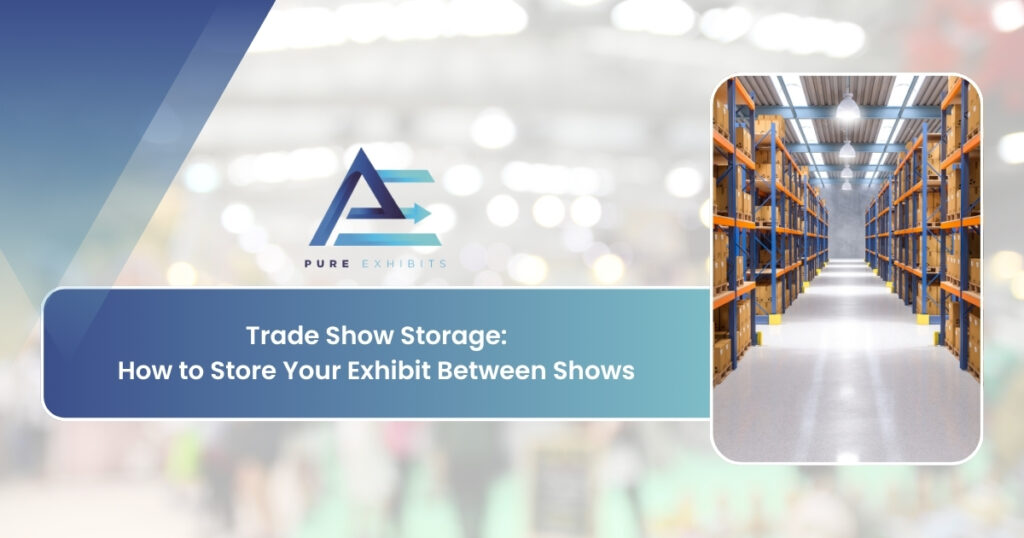
The show ended, the crates were repacked, and the freight company picked up the exhibit. Now it is sitting in a self-storage unit three miles from the office — wedged between last year’s banner stands and a broken conference table — because no one planned where it was going after the show. The graphic panels are leaning against a bare concrete wall. The aluminum frame is stacked without padding. And six months from now, when the next show is booked and the exhibit comes out, something will be cracked, creased, or missing.
Trade show storage is not a logistics afterthought — it is a cost center that directly affects the long-term value of a purchased exhibit and the per-show trade show booth rental cost calculation for any exhibitor deciding between owning and renting. Done well, storage preserves the exhibit’s condition show after show. Done poorly, it generates repair and replacement costs that erode the financial case for ownership entirely.
Skip the Storage Problem Entirely
Pure Exhibits rents and stores exhibits at our Las Vegas facility — you pay nothing between shows. Request a quote and eliminate your storage headache today.
What Does Trade Show Storage Actually Include?
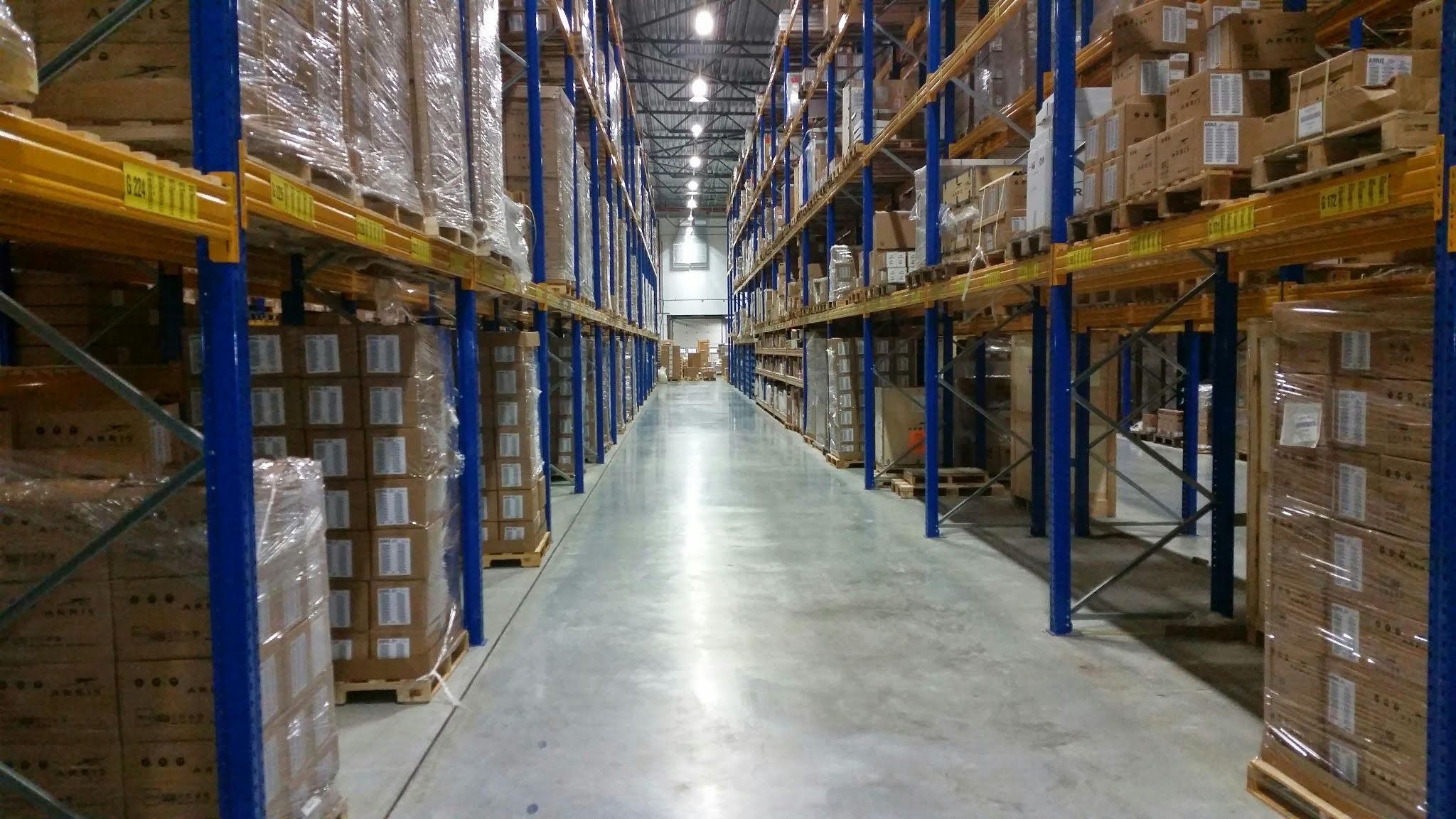
Trade show storage covers more than putting crates on a shelf. A complete storage program manages the physical exhibit — structural components, graphic panels, crates, and hardware — plus the inventory of accessories that travel with it: counters, furniture, monitor mounts, lighting fixtures, and show-specific collateral. Each of these items needs to be catalogued, stored correctly for its material type, and retrievable on a predictable timeline before the next show.
Structural aluminum extrusion frames are durable but can be bent by improper stacking or heavy items placed on top of them. Fabric graphic panels must be rolled or folded on consistent axes — never creased across a printed surface — and stored away from UV light, humidity, and temperature extremes that degrade dye-sublimation inks. Wooden crates protect components during transit but take up significant floor space in storage and require dry conditions to prevent warping or mold.
A storage program that does not account for material-specific requirements is not protecting the exhibit — it is just delaying damage discovery until move-in day. The difference between competent storage and inadequate storage shows up on the show floor, not in the warehouse.
What Are the Options for Storing a Trade Show Exhibit?
Exhibitors who own their exhibits have four realistic storage options, each with meaningfully different cost structures, service levels, and risk profiles. The right option depends on exhibit size, show frequency, geographic distribution of shows, and whether the company has internal logistics capacity to manage inventory between events.
| Storage Option | Cost Range | Pros | Cons | Best For |
|---|---|---|---|---|
| Exhibit house storage | $150–$600/month | Climate-controlled; inventory managed by exhibit professionals; easy pre-show prep | Ongoing monthly fee; dependent on exhibit house availability | Companies doing 2+ shows/year who want zero internal logistics burden |
| Commercial warehouse (exhibit-friendly) | $100–$400/month | More affordable than exhibit house; climate-controlled options available | No exhibit-specific expertise; inventory management is your responsibility | Companies with internal logistics staff who can manage inventory |
| Self-storage unit | $50–$200/month | Lowest cost; accessible on your own schedule | No climate control in most units; no inventory management; high risk of improper storage | Pop-up displays and small inline setups only — not suitable for complex modular exhibits |
| On-site at company facility | $0 direct cost | No monthly fee; maximum control and access | Requires adequate climate-controlled warehouse space; inventory discipline falls on internal staff | Large companies with dedicated warehouse infrastructure and logistics staff |
For most mid-market exhibitors, exhibit house storage is the most cost-effective option when total cost of ownership is calculated correctly. The monthly storage fee is often less than the cost of a single graphic reprint caused by improper self-storage conditions. It also removes the logistics coordination burden from internal staff who are not trained in exhibit inventory management. For guidance on evaluating exhibit house partners, see the trade show vendor guide.
How Much Does Trade Show Exhibit Storage Cost?
Storage costs are driven primarily by three variables: the cubic footage the exhibit occupies, the service level required (simple warehousing versus active inventory management and pre-show prep), and geographic location — storage in Las Vegas, Chicago, and Orlando tends to be priced higher than non-convention-hub cities due to proximity to major show venues.
| Exhibit Size | Approx. Storage Footprint | Basic Warehouse Rate | Exhibit House Rate | Annual Storage Cost (Est.) |
|---|---|---|---|---|
| 10×10 inline | 40–80 sq ft / 200–400 cu ft | $50–$100/month | $150–$250/month | $600–$3,000/year |
| 10×20 inline | 80–150 sq ft / 400–800 cu ft | $100–$200/month | $250–$400/month | $1,200–$4,800/year |
| 20×20 island | 150–300 sq ft / 800–1,500 cu ft | $200–$400/month | $400–$600/month | $2,400–$7,200/year |
| 20×30 or larger | 300–600+ sq ft | $400–$800/month | $600–$1,200/month | $4,800–$14,400/year |
These costs should be factored into the total cost-of-ownership calculation for any purchased exhibit and included as a dedicated line in your trade show budget. An exhibitor paying $6,000/year for exhibit house storage on a 20×20 booth is effectively adding $500/month to the cost of exhibit ownership — a figure that changes the rent-vs.-buy calculation significantly over a three-to-five year horizon.
What Should You Require from a Trade Show Storage Facility?
Not all storage facilities that accept exhibit materials are equipped to store them properly. The minimum requirements for a storage facility handling a modular or custom trade show exhibit go beyond square footage and monthly rate. Evaluating these criteria before committing to a storage provider prevents the most common and costly storage failures.
| Requirement | Why It Matters | What to Ask the Facility |
|---|---|---|
| Climate control | Fabric graphics degrade in heat and humidity; wooden crates warp; silicone gaskets deteriorate in temperature extremes | What is the temperature and humidity range maintained year-round? |
| Exhibit-specific inventory system | Components must be catalogued by item, not just by crate — so pre-show pull lists can be verified against actual inventory | How do you track individual components within a stored exhibit? |
| Damage inspection on intake | Damage that occurs during transit should be documented before storage — not discovered at the next move-in | Do you photograph and inspect the exhibit when it arrives from a show? |
| Pre-show prep service | Exhibit should be pulled, inspected, and staged for outbound shipment — not handed to a freight company in unchecked crates | Can you pull specific components, inspect them, and prep the exhibit for outbound before each show? |
| Accessible facility hours | Last-minute needs require facility access on short notice — especially for shows with tight move-in windows | What are your facility access hours and what is the lead time for exhibit pulls? |
| Repair and refurbishment capability | Storage between shows is the right time to identify and fix damage — not move-in day | Can your team identify and repair minor damage during storage periods? |
| Insurance coverage | Exhibits stored at a third-party facility should be covered under the facility’s liability insurance | What is your liability coverage for stored client property and what are the claim procedures? |
Design choices also affect how well an exhibit stores. Modular systems with standardized components are significantly easier to catalogue, pack, and store than custom fabricated exhibits with bespoke structural elements. When evaluating exhibition booth design options, storability — component count, crating requirements, and weight — is worth including in the design brief.
Store Your Exhibit Where It’s Built and Managed
Pure Exhibits stores Las Vegas rental exhibits at our facility between shows — with inventory management, inspection, and pre-show prep included. Contact us to learn more.
How Do Exhibit Rental Programs Eliminate the Storage Problem?
The most efficient solution to trade show storage is to not own an exhibit at all. Rental-based exhibit programs transfer storage responsibility entirely to the exhibit house — the exhibitor pays for the exhibit only during the shows they use it, and the builder manages storage, maintenance, and inventory between events. There is no monthly storage fee, no inventory management burden, and no accumulated repair costs from improper storage conditions.
For companies exhibiting in Las Vegas specifically, las vegas trade show booth rentals from a locally based exhibit house add a second layer of storage efficiency: the exhibit never ships cross-country. It is stored, prepped, and delivered locally for each show, then returned to the same facility after dismantle. No advance warehouse, no long-haul freight exposure, no storage at a remote facility that is inconvenient to access when issues arise.
The financial case for rental over ownership — and its elimination of storage costs — becomes strongest for companies doing one to six shows per year at variable footprints. If your show program includes a 10×10 at one regional event and a 10×20 at a major national show, a rental program provides the right footprint for each show without requiring you to own and store two separate exhibits.
What Happens to Your Exhibit During Storage — and What Should?
Between shows, a stored exhibit should be doing more than sitting. A well-managed storage program uses the interval between shows as an active maintenance and preparation window — not a passive holding period. The work that happens between shows determines the condition of the exhibit at the next move-in.
| Between-Show Activity | Who Should Handle It | Frequency |
|---|---|---|
| Full component inventory audit against master parts list | Exhibit house storage team | After every show return |
| Graphic panel inspection — check for creases, fading, dirt, or print defects | Exhibit house storage team | After every show return |
| Hardware inspection — check frame connections, fasteners, and locking mechanisms | Exhibit house storage team | After every show return |
| Minor repairs — re-siliconing loose gaskets, replacing worn hardware, touching up frame finish | Exhibit house repair team | As needed during storage period |
| Graphic updates — replace panels with updated messaging for new campaigns | Exhibit house graphic team + client approval | Before shows where messaging changes |
| Pre-show pull and staging — assemble pull list, verify components, stage for outbound freight | Exhibit house storage team | 2–3 weeks before each show |
| Outbound shipment coordination — book freight, prepare documentation, confirm delivery window | Exhibit house logistics team or client | 2–4 weeks before each show |
Proper storage also means maintaining an accurate inventory of what travels with the exhibit versus what stays in storage. The what to bring to a trade show checklist is a useful baseline — but for exhibit-specific components, the storage facility should maintain a master component list that is reconciled after every show return and before every outbound shipment.
The installation and dismantle process also affects what comes back into storage and in what condition. Careless dismantle — rushing crate packing under end-of-show time pressure — is one of the most common causes of storage-period damage. Working with a builder who manages both trade show installation and return shipment means the same team that installed carefully is responsible for packing carefully.
How Do You Decide Between Storing Your Exhibit and Renting Instead?
The ownership versus rental decision is fundamentally a financial model question, and storage cost is one of the most important variables in that model. Most exhibitors who purchase an exhibit calculate the upfront cost and annual show costs but omit storage — making the ownership case look stronger than it actually is over a multi-year period.
| Cost Factor | Owned Exhibit | Rented Exhibit |
|---|---|---|
| Upfront acquisition cost | $20,000–$100,000+ depending on size and complexity | $0 — no upfront purchase required |
| Annual storage cost | $1,800–$14,400/year depending on size and facility | $0 — storage is included in exhibit house rental program |
| Annual maintenance and repair | $500–$5,000/year for structural and graphic upkeep | $0 — maintained by exhibit house between shows |
| Graphic update cost | Print and swap only — structure reused | Print and swap only — structure reused |
| Depreciation / write-off | Exhibit value depreciates; design ages; eventual replacement needed | No asset on books; footprint and design can change per show |
| Show-to-show flexibility | Fixed footprint and design unless additional spend on new components | Footprint and configuration can change by show at no capital cost |
| Storage coordination burden | Internal team manages pull lists, freight booking, and inventory | Exhibit house manages all storage logistics on your behalf |
Exhibitors doing eight or more shows per year at the same footprint and consistent branding often find ownership economical despite storage costs. Exhibitors doing one to six shows per year — or those whose show program varies in size between events — typically find rental more cost-effective when storage, maintenance, and depreciation are included in the comparison. For a detailed side-by-side, see the exhibit booth builders usa guide, which covers how to evaluate exhibit house programs that include storage as part of the service.
What Are the Most Common Trade Show Storage Mistakes Exhibitors Make?
The patterns of storage failure are consistent across the exhibit industry. These are the mistakes that show up as damaged graphics, missing components, and avoidable show-day surprises — and every one of them is preventable with basic planning and the right storage partner.
| Mistake | What Goes Wrong | How to Prevent It |
|---|---|---|
| Using a self-storage unit for a modular exhibit | Graphics degrade from humidity and temperature swings; components get damaged by improper stacking | Use a climate-controlled facility with exhibit-specific storage protocols |
| No component inventory after each show return | Missing parts discovered at next move-in — too late to source replacements | Require a full inventory audit with a signed component list after every show return |
| Leaving graphics folded rather than rolled | Crease lines become permanent and visible on the show floor | Store fabric panels rolled on consistent axes; never fold across a printed surface |
| No pre-show pull inspection | Damaged component discovered during crating for outbound shipment — not enough time to reorder | Require a pre-show inspection 2–3 weeks before each show date |
| Storing at a facility far from the show venue | Long-haul freight adds cost and transit damage risk every cycle | For Las Vegas shows, use a Las Vegas-based storage facility to eliminate cross-country freight |
| Skipping return freight insurance | Transit damage from dismantle to storage has no financial recovery | Ensure freight is insured for full replacement value in both directions |
| No graphic update review between shows | Outdated messaging — discontinued product, old branding — runs at a live show | Build a pre-show graphic review into the storage pull checklist for every event |
| Letting dismantle crew rush the crate packing | Components go in uncushioned; damage occurs during the return trip to storage | Specify crating standards in the I&D contract and require crew supervisor sign-off at pack-out |
Let’s Build Something Extraordinary
Share your event details and we’ll craft a custom booth solution designed to captivate your audience and maximize your ROI.
Frequently Asked Questions
How much does it cost to store a trade show booth?
Storage costs range from $50–$200 per month for small inline exhibits at a basic commercial warehouse to $400–$1,200 per month for large island exhibits at a full-service exhibit house. Annual storage cost for a 10×20 exhibit at an exhibit house typically runs $3,000–$4,800 per year. This cost should be included in any rent-versus-buy comparison — most exhibitors who own exhibits underestimate storage cost by omitting it from the annual cost-of-ownership calculation.
Can I store my trade show booth in a self-storage unit?
Self-storage units are acceptable for small, simple displays — pop-up banners, tablecloths, printed literature. They are not appropriate for modular or custom exhibit systems with fabric graphic panels, aluminum extrusion frames, or precision-fitted structural components. Most self-storage facilities are not climate-controlled, and temperature swings and humidity cause graphic degradation, hardware corrosion, and structural damage over time. The cost savings over professional exhibit storage are typically eliminated by a single repair or reprint event.
Who is responsible for my exhibit while it is in storage?
This depends on the storage arrangement. If your exhibit is stored at an exhibit house, their liability coverage typically applies to property on their premises — confirm coverage limits and claim procedures before signing a storage agreement. If you store at a third-party commercial warehouse, your own property insurance covers stored assets — confirm that your policy covers trade show exhibit property specifically. Regardless of facility type, document the exhibit’s condition with photographs when it enters storage after each show.
How far in advance should I request my exhibit from storage before a show?
For a standard modular exhibit, request the exhibit from storage at least three weeks before the show’s advance warehouse deadline or your move-in date. This gives the storage team time to pull the exhibit, conduct a component inspection, identify any damage or missing parts, reorder if necessary, and prepare the outbound shipment. Requesting less than two weeks in advance creates risk that damage or missing components cannot be resolved before the show opens.
What is an advance warehouse and how does it relate to exhibit storage?
An advance warehouse is a facility operated by the show’s general service contractor (GSC) where exhibitors can ship freight before the official move-in window opens. Exhibits stored at your own storage facility are shipped to the advance warehouse approximately one to two weeks before the show. Exhibitors using a local exhibit house near the show venue may be able to bypass the advance warehouse and deliver directly during move-in — eliminating advance warehouse fees and reducing freight exposure.
What materials require special storage conditions?
Dye-sublimation fabric panels must be stored away from UV light and in humidity-controlled conditions — color shift and ink degradation occur in environments that fluctuate above 70% relative humidity or experience direct sun exposure. Silicone edge gaskets become brittle in sustained heat above 90°F. Aluminum extrusion frames are durable but must be stored off the floor on proper racking to prevent bending under stacked weight. Wooden crates and shipping cases require dry conditions to prevent swelling, warping, and mold.
Should I store graphics with the structure or separately?
At a professional exhibit house, graphics and structure are typically stored together as a managed set — components are catalogued together and pulled together for each show. If you are managing storage internally, store graphics separately from structural hardware in a climate-controlled area, rolled and labeled. Mixing graphics with metal hardware in the same crate creates risk of surface damage from contact and vibration during handling.
How do rental exhibits handle storage between shows?
With a rental program, the exhibit house owns the exhibit and is responsible for storing it between your shows. After each event, the builder’s dismantle crew repacks the exhibit and returns it to the exhibit house facility. The exhibit is inspected, repaired if needed, and stored until your next show — with no monthly fee charged to you between events. This is the primary logistical advantage of rental over purchase for exhibitors who do not have internal warehouse infrastructure.
What should be on a trade show exhibit component inventory list?
A complete component inventory list should include every structural element (frame sections by type and dimension), every graphic panel (by size, position, and version), all hardware (connectors, fasteners, channel locks), furniture and accessories (counters, stools, shelving, monitor mounts), lighting fixtures and power supplies, crates and cases (by number and contents), and any show-specific collateral kept with the exhibit between events. Each item should have a quantity, a condition note, and a storage location. The list is reconciled after every show return and before every outbound shipment.
Can an exhibit house make graphic updates while the exhibit is in storage?
Yes — most exhibit houses with in-house graphic production capability can produce and swap updated panels while the exhibit is in storage, in preparation for the next show. This is typically the most efficient time to make graphic updates: the exhibit is accessible, there is no move-in time pressure, and the new panels can be test-fitted and photographed before the exhibit ships. Graphic updates during storage generally have a faster turnaround and lower cost than rush reprints ordered close to show dates.
What is a pre-show exhibit inspection and what should it include?
A pre-show inspection is conducted by the storage team two to three weeks before a show, when the exhibit is pulled from storage and reviewed before being staged for outbound shipment. It should cover: full component count against the master inventory list, visual inspection of all graphic panels for creases, fading, and print defects, inspection of structural hardware for bends, missing connectors, and worn locking mechanisms, and a review of any damage notes from the previous show’s return. Any issues identified are addressed during this window — not on move-in day.
Is it worth paying for exhibit house storage versus commercial warehouse storage?
For most exhibitors with modular or custom exhibits, yes. The cost premium of exhibit house storage over commercial warehouse storage — typically $100–$300 more per month — is offset by several concrete benefits: exhibit-specific inventory management, condition-appropriate storage protocols, pre-show inspection and prep capability, and a direct connection to the team that will install the exhibit at the next show. Treating storage as a commodity and choosing the cheapest available option often results in damage and inventory errors that cost more to remedy than the savings generated.