
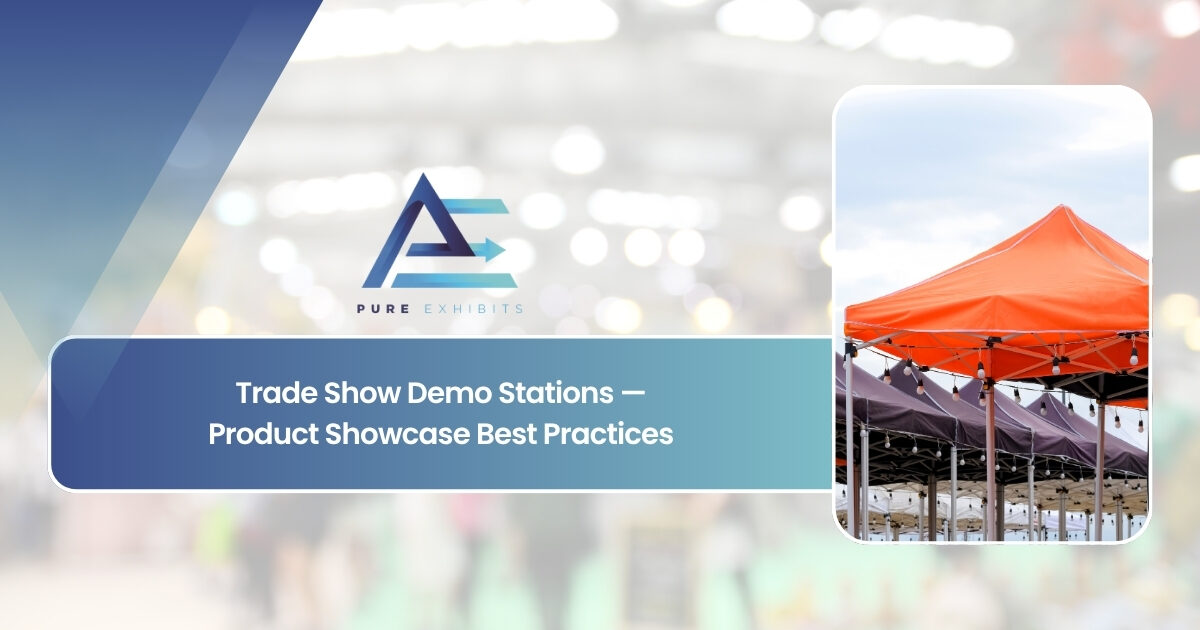
When a product is difficult to demo, it will be overlooked. There is no denying that the whole point of trade show demo stations is to prevent just such a situation from happening: to create an opportunity for a potential customer to get acquainted with what a certain product can offer in the span of mere seconds.
The most successful trade show demo stations are not necessarily the fanciest. Rather, they are the ones who align a product’s value proposition with the appropriate demo format, be it a touchscreen for software, a hands-on demonstration for a tangible product, or something else entirely that may require a specific explanation. Getting this aspect wrong is often the reason why a stand generates interest but no conversions.
This guide will focus on how to create good trade show demo stations, various demo types, the importance of demo staffing, and the layout specifics of demo stations.
Demo station placement is one of the layout decisions covered in PureExhibits’ trade show booth furniture and layout guide, since a demo station’s visibility from the aisle often determines whether it gets used at all.

What is a Trade Show Demo Station?
A trade show demo station is a purpose-built area within an exhibit booth where visitors interact directly with a product, software, or service through live demonstration, hands-on experience, or guided presentation. Unlike a static display, a trade show demo station is engineered for active participation. It is the physical environment where your best sales conversation begins.
According to CEIR, booth layout is a top-three driver of dwell time, which strongly correlates with lead generation. And trade show demo stations sit at the center of that layout equation. A visitor who engages with a live demo stays longer, asks more specific questions, and converts at a meaningfully higher rate than one who reads a brochure or watches a passive video loop.
PureExhibits designs trade show demo stations that put your product front and center. Let’s talk about your next booth.
What Makes a Trade Show Demo Station Effective?
Three important aspects make for a good demo station: visibility from the aisle, quick communication of value, and engagement. A demo station that cannot convey its message without an extensive description will lose most people’s attention before they even engage.
The simple demo station will always beat the novel one. The reason is straightforward: simplicity wins. A demo station that has only one key activity for a visitor to perform will be better than one that tries to demonstrate everything about a product.
Demo Station Formats by Product Type
| Product Type | Recommended Demo Format |
|---|---|
| Software/SaaS | Touchscreen kiosk with guided walkthrough |
| Physical/hardware product | Hands-on station with staff guidance |
| Consumable/sample-based product | Sampling station with a brief explanation |
| Service-based offering | Video loop plus staff-led conversation |
What Makes a Demo Station Different From a Display
The distinction between a display and a trade show demo station is behavioral, not visual.
A display presents information to a visitor. A trade show demo station invites a visitor to participate, to touch, configure, experience, or observe something happening live. That participation shift is commercially significant.
Interactive content can outperform static content by up to five times in memory recall and engagement duration. On a show floor where 300 exhibitors are competing for the same attendees’ attention, that recall differential is the margin between a booth that generates pipeline and one that generates badge scans.
The structural difference between a display and a trade show demo station:
| Element | Display | Demo Station |
|---|---|---|
| Visitor role | Passive observer | Active participant |
| Primary medium | Graphics, video loops, printed collateral | Live interaction, hands-on product, guided experience |
| Average dwell time | 30–90 seconds | 3–12 minutes |
| Staff interaction required | Optional | Usually essential |
| Lead capture integration | External (separate scanner or form) | Embedded into the demo flow |
| Conversion rate | Low–medium | Medium–high |
Five Types of Trade Show Demo Stations
There are five kinds of demo stations at trade shows. All five of these kinds serve a specific kind of product, a certain kind of interactivity from attendees, and have different objectives in terms of how booths are laid out. Choosing which one to go for, before choosing which hardware to use, is step number one.
Booth Type 1: The Product Manipulation Booth
Good For: Physical products which have value because of physical interaction: Hardware, consumer items, equipment, tools, materials, and anything else where tangibility is key to differentiation.
The hands-on product showcase booth station is the most visceral demonstration format available. Live demos, games, charging stations, and comfortable seating all increase dwell time. The longer someone stays, the better your chance of capturing their information. Physicality comes out on top of the interactivity hierarchy; someone who uses and handles a product will engage more senses than anyone else.
Booth Type 2: The Digital/Software Kiosk Station
Best for: SaaS platforms, apps, enterprise software, digital tools, and any service where the product interface is the experience.
Touchscreens are frequently underutilized. They sadly often serve as looping PowerPoint stations. This is a major missed opportunity.
The digital kiosk demo station, done well, gives the visitor control, a self-guided, interactive walkthrough of the product’s most compelling features, delivered through a touchscreen interface rather than a passive video.
Booth Type 3: The Video and AV Presentation Station
Best for: Products or services that require context before interaction, complex systems, infrastructure, B2B services, and large equipment that cannot be brought to the show floor.
An AV presentation trade show demo station uses one or more screens to deliver video, animation, or live content that creates the context a visitor needs before having a meaningful sales conversation. For products that cannot physically exist at the show, a $2M manufacturing line, a constructed building, a deployed software infrastructure, high-quality video is the demonstration.
Booth Type 4: The AR/VR Immersive Station
Best for: Large equipment, architectural products, complex infrastructure, real estate, and any product whose scale or complexity makes traditional demonstration impossible in a booth setting.
Augmented reality allows attendees to visualize your product in their environment. This is especially useful for large equipment, architecture, or software systems.
An AR/VR trade show demo station creates an immersive product experience that substitutes for physical presence. The visitor doesn’t see a model of a manufacturing line; they walk through it at full scale. They don’t see a rendering of a building; they stand inside it.
Type 5: The Group Presentation/Theater Station
Best for: Brands with a strong content narrative, complex value propositions that benefit from structured storytelling, or any exhibitor whose product or service requires buyer education before evaluation.
The group presentation trade show demo station, commonly called a theater setup, delivers a structured live or recorded presentation to a small audience of 6–20 visitors simultaneously. Self-guided touchscreen demo stations, qualification-driven gamification, and a VIP lounge for decision-makers consistently outperform static displays and passive demonstrations. The theater station sits between those formats: more structured than a self-guided kiosk, more scalable than a one-on-one counter conversation.
How Should a Demo Station Be Positioned Within the Booth?
Demo station placement should follow the same traffic-flow logic used in broader booth design, covered in PureExhibits’ trade show booth design guide, positioned where it’s visible from the aisle but doesn’t create a bottleneck that blocks other visitors from entering the space.
For booths with multiple products, staggering trade show demo stations around the perimeter rather than clustering them in one area keeps traffic moving and avoids a single congested pinch point.
Demo Station Placement by Booth Size
| Booth Size | Recommended Demo Placement |
|---|---|
| 10×10 | Single demo station along the back wall |
| 10×20 | One to two stations, positioned to avoid blocking the flow |
| 20×20 | Multiple stations are distributed around the perimeter |
| 20×40+ | Dedicated demo zone, separate from meeting/lounge areas |
Not sure which demo format fits your product? PureExhibits can help you choose and design the right one.
How Does Staffing Affect Demo Station Success?
A demo station is only as good as the staff member running it. Staff need to be comfortable letting attendees interact with the demo directly rather than narrating from the side: a balance covered in more depth in PureExhibits’ trade show staff training and booth engagement guide, where hands-on demo coaching is one of the most effective pre-show training investments.
Staff should also be trained to recognize when a demo has done its job, and it’s time to move the conversation toward lead capture, rather than letting attendees linger at a demo without any follow-through.
Staff Roles at a Demo Station
| Role | Responsibility |
|---|---|
| Demo guide | Walks attendees through the interaction |
| Lead capture support | Transitions engaged attendees with the CRM |
| Crowd manager | Keeps the demo area moving during busy periods |
What Equipment and Technical Considerations Matter Most?
Reliable power and connectivity are non-negotiable for any tech-based demo station, a consideration tied to the broader technology planning covered in PureExhibits’ trade show technology guide. A demo station that goes dark mid-show because of a power or connectivity failure does more damage to booth credibility than having no demo at all.
Common Demo Station Technical Failures and Fixes
| Failure | Fix |
|---|---|
| Power loss | Backup battery packs and labeled power runs |
| Wi-Fi/connectivity drop | Local/offline demo mode as backup |
| Touchscreen malfunction | Spare device on hand, tested pre-show |
| Sample/material runs out | Inventory buffer planned for peak hours |
PureExhibits handles the technical and layout details so your demo station runs flawlessly all show long. Request a quote today.
How Do You Measure Whether a Demo Station Is Working?
Tracking how many attendees engage with a demo station versus how many simply walk past gives a clear signal of whether the format and placement are working. This kind of measurement fits naturally into the broader evaluation process covered in PureExhibits’ trade show ROI guide, where booth-level engagement metrics feed into overall show ROI.
Demo Station Performance Metrics
| Metric | What It Tells You |
|---|---|
| Engagement rate | Percentage of passersby who stop to interact |
| Average dwell time | Whether the demo holds attention |
| Lead conversion rate | Whether engagement translates to captured leads |
Demo Area Design Principles That Drive Dwell Time
Demo area design is not about aesthetics; it is about behavioral architecture. Every spatial decision in the demo area design either increases the probability of interaction or reduces it. Booth layout is a top-three driver of dwell time, which strongly correlates with lead generation.
Principle 1: Visibility Before Interaction
The trade show demo station must be visible from the aisle before a visitor decides to enter the booth. A demo happening inside the booth, invisible from the aisle, loses the stop rate that makes demo stations commercially valuable.
Principle 2: The Approach Must Be Unobstructed
A visitor who wants to approach the trade show demo station should be able to do so without navigating around furniture, staff members, or structural elements. The path from the aisle to the station is a conversion funnel; every obstacle in that path reduces conversion.
Principle 3: The Station Needs a Back Surface
The most ergonomically effective trade show demo station has a back surface: a wall, backwall display, or structural panel, behind it. This creates visual context for the demo (the brand graphics are visible behind the interaction), provides a surface for mounted screens or product displays, and gives the visitor a psychological orientation point in the space.
Interactive Product Demo: Designing the Experience, Not Just the Hardware
-
The hardware of a trade show demo station is a means to an end.
-
The end is an interactive product demo experience that produces a specific cognitive and emotional outcome in the visitor: understanding of the product’s value, confidence in its capability, and motivation to take the next step.
What Are the Most Common Demo Station Mistakes?
The most common mistake is overcomplicating the demo, trying to show every product feature instead of the one that matters most to the audience walking the floor. This same focus-over-volume principle shows up in PureExhibits’ multi-show trade show strategy guide, where tailoring messaging to each specific show’s audience consistently outperforms a one-size-fits-all approach.
Common Demo Station Mistakes and Fixes
| Mistake | Fix |
|---|---|
| Too many features shown at once | Focus on one clear interaction |
| Demo blocks booth entry/flow | Reposition away from the main traffic path |
| Staff narrate instead of letting attendees try | Train staff to hand over control |
| No clear transition to lead capture | Build a scripted handoff into staff training |
Visit the PureExhibits homepage or our Las Vegas page to learn how we design demo stations that showcase products clearly and convert booth traffic into leads.
How Pure Exhibits Designs and Builds Trade Show Demo Stations
At Pure Exhibits, trade show demo station design begins with the demo experience, not the hardware catalog.
Before specifying a single counter size or screen mount, we work with our clients to define: what interaction should a visitor have at this station, in what sequence, and what should they leave knowing or feeling? The hardware specification follows from that experience design, not the other way around.
Let’s Build Something Extraordinary
Share your event details and we’ll craft a custom booth solution designed to captivate your audience and maximize your ROI.
15 Questions About Trade Show Demo Stations: Answered
What is a trade show demo station?
A trade show demo station is a dedicated area within a booth designed to let attendees see, try, or experience a product firsthand, rather than just hearing about it from staff.
What makes a demo station effective?
An effective demo station is visible from the aisle, communicates value within seconds, and gives attendees something to do rather than just something to watch.
What’s the best demo format for a software product?
A touchscreen kiosk with a short, guided walkthrough typically works best for software, since it lets attendees interact directly with the interface rather than watching a passive demo.
Where should a demo station be placed within a booth?
Trade show demo stations should be visible from the aisle but positioned so they don’t block traffic flow into and through the rest of the booth.
How many demo stations should a booth have?
It depends on booth size and product lineup. A 10×10 booth typically supports one demo station well, while larger booths can support multiple stations distributed around the perimeter.
How important is staffing to a demo station’s success?
A very well-designed demo station can still underperform if staff narrate instead of letting attendees interact directly, or fail to transition engaged visitors toward lead capture.
What happens if a demo station’s technology fails mid-show?
Backup equipment, offline demo modes, and pre-show testing all reduce the risk, but having a contingency plan in place is essential since technical failures are one of the most disruptive things that can happen at a demo station.
How do you measure whether a demo station is working?
Tracking engagement rate, average dwell time, and lead conversion rate gives a clear picture of whether a demo station’s format and placement are effective.
What’s the most common mistake exhibitors make with demo stations?
Trying to showcase every product feature at once instead of focusing on a single clear interaction that communicates the core value proposition quickly.
Can a demo station work for a service-based business with no physical product?
Yes, a video loop combined with a staff-led conversation can effectively demo a service-based offering, even without a tangible product to hand to attendees.
How does demo station design differ for a 10×10 versus a 20×20 booth?
Smaller booths typically support one well-placed station along the back wall, while larger booths can support multiple stations spread across the perimeter without creating congestion.
Should a demo station double as a meeting or seating area?
Generally, no. Keeping trade show demo stations separate from meeting and lounge areas helps each space serve its specific purpose without competing for the same square footage.
How does PureExhibits help design demo stations?
We work with clients to match the right demo format to their product, design the layout to fit the booth’s traffic flow, and plan the technical infrastructure needed to keep the station running reliably.
What’s the difference between a sampling station and a demo station?
A sampling station typically lets attendees try a consumable product directly, while a broader demo station can also include interactive technology, hands-on hardware, or guided walkthroughs, depending on the product.
How does a demo station tie into lead capture?
A well-trained staff member should recognize when an attendee has engaged enough with the demo to transition the conversation toward lead capture, rather than letting the interaction end without any follow-through.