
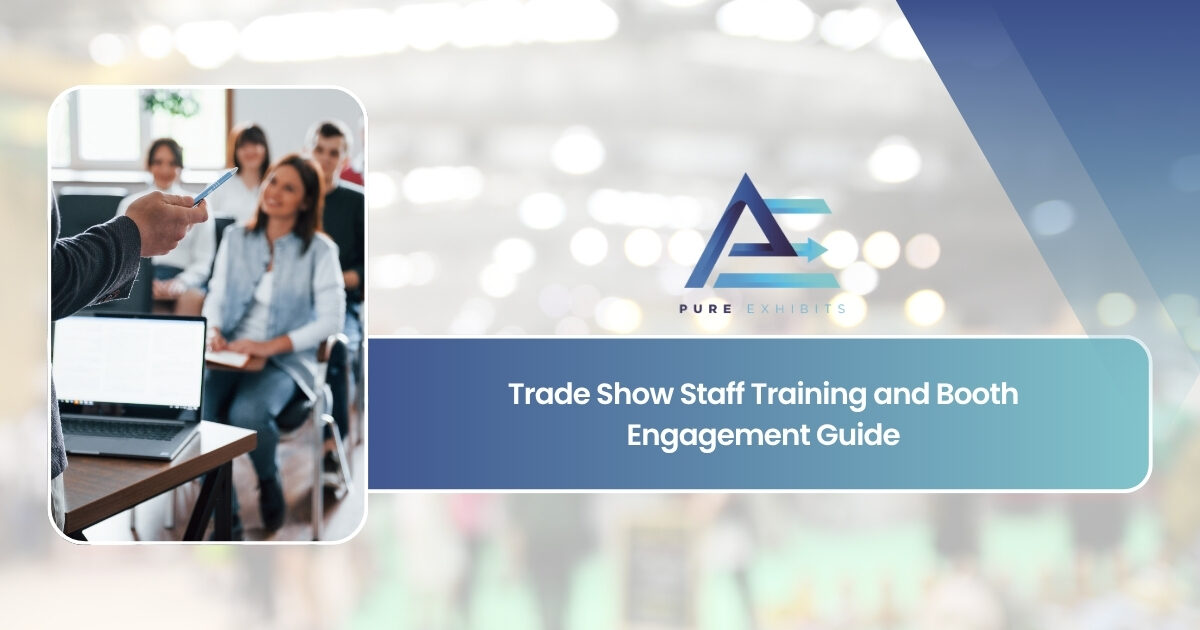
A well-designed exhibit gets visitors to the booth. Trained staff are what convert that traffic into qualified conversations, memorable brand impressions, and pipeline. Exhibitors routinely invest significant budget in booth design, graphics, and technology, then send untrained staff onto the floor with no orientation beyond a verbal reminder to ‘be friendly.’ The result is a gap between what the exhibit is capable of generating and what the team on the floor actually captures — a gap that no amount of additional design investment can close.
Trade show staff training is the operational discipline that closes this gap. It covers how staff approach visitors, how they qualify interest without being pushy, how they demonstrate the booth’s technology and product displays, how many people are needed for a given booth size, and how the booth itself should be designed to make staff engagement easier rather than harder. None of these are abstract soft skills — they are specific, trainable behaviors that directly affect lead volume and lead quality at every show in the calendar.
This guide covers the full framework for trade show staff training and booth engagement — what training should actually include, how to staff a booth correctly by size, how booth design itself supports or undermines staff performance, what engagement activities work, how to measure staff performance, and how to build an ongoing training program rather than a one-time pre-show briefing.
For context on how staffing and engagement decisions fit into the broader planning process, see PureExhibits’ trade show planning and project management guide, which covers the full pre-show timeline including the point at which staff training and engagement planning should be scheduled relative to the show date.
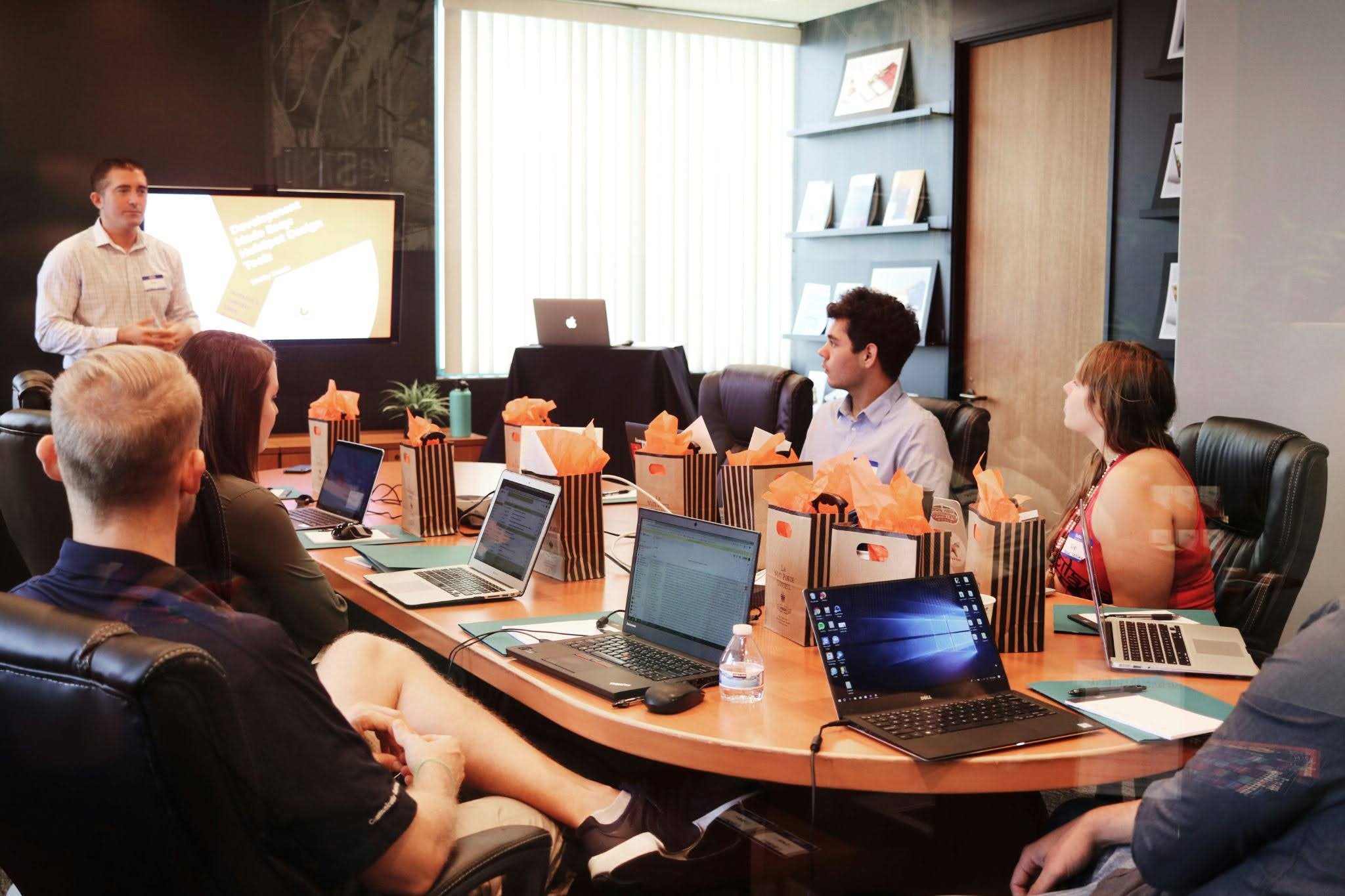
Why Staff Training Is the Most Overlooked Trade Show Investment
The economics of trade show exhibiting make the case for staff training unusually direct. The cost of booth space, design, fabrication, shipping, and show services is fixed once the contract is signed — that investment generates the same booth and the same floor traffic regardless of who is staffing it. What varies dramatically is the conversion rate from floor traffic to qualified conversation, and that variance is driven almost entirely by staff performance. Two identical booths staffed by differently trained teams will produce measurably different lead volumes and lead quality from the same foot traffic, which means staff training is one of the highest-leverage, lowest-cost levers available to improve trade show ROI.
Despite this leverage, staff training is the part of trade show preparation most likely to be compressed or skipped entirely. Design timelines, fabrication deadlines, and shipping logistics all have hard deadlines that force attention. Staff training has no equivalent forcing function — it can always be pushed to ‘we’ll cover it the morning of’ until the morning of arrives and there is no time for anything beyond a five-minute huddle. Exhibitors who treat staff training with the same scheduling discipline as fabrication and logistics consistently outperform exhibitors who treat it as an afterthought, even when both groups have identical booths.
The skills gap that untrained staff create is specific and observable on any show floor. Untrained staff stand behind counters rather than at the aisle edge, miss the first ten seconds of visitor attention before a visitor has already decided to keep walking, ask closed questions that end conversations rather than open questions that extend them, and fail to qualify interest before launching into a full product pitch that wastes time on visitors who were never going to buy. Each of these is a trainable behavior. None of them requires natural sales talent — they require a clear standard, a brief rehearsal, and a manager on the floor who reinforces the standard during the show.
Booth design and staff training are not separate disciplines — they are interdependent. A booth designed with strong sightlines, clear traffic flow, and well-positioned demo stations makes good staff performance easier to achieve. A booth designed without engagement in mind — closed-off counters, awkward sightlines, demo stations tucked in corners — undermines even well-trained staff. For more on how spatial design itself drives engagement outcomes, see PureExhibits’ trade show brand experience guide, which covers the design principles that make a booth naturally inviting to approach.
PureExhibits provides staff orientation for every booth we deliver. Your team learns every feature, every technology integration, and every demo station before the show opens.
What Should Trade Show Staff Training Actually Cover?
Effective trade show staff training covers four distinct areas, each requiring different preparation: booth and product knowledge, engagement and qualification technique, technology and demo proficiency, and logistics and show floor protocol. Treating these as a single undifferentiated ‘training session’ is the most common reason training feels rushed and incomplete — each area benefits from being addressed separately, with its own time allocation and its own success criteria.
Booth and product knowledge training ensures every staff member can speak accurately and confidently about what the company does, what is being displayed at the booth specifically, and what makes the current product or service offering relevant to the show’s audience. This sounds basic, but it is the area where gaps are most visible to visitors — a staff member who cannot answer a direct question about the product on display damages credibility instantly, regardless of how polished their engagement technique is otherwise.
Engagement and qualification technique training covers the specific behaviors that determine whether a booth visitor becomes a qualified conversation: approaching within the first few seconds of eye contact, opening with a question rather than a statement, using open-ended questions to understand the visitor’s role and interest level, and recognizing the signals that indicate whether a visitor is a real prospect or a casual browser. This is the training area most exhibitors skip entirely, assuming sales experience transfers automatically to the trade show floor — it does not, because the trade show environment compresses the entire qualification process into a much shorter window than a typical sales conversation.
Technology and demo proficiency training ensures staff can operate every interactive element in the booth — touchscreen kiosks, product demo stations, AV presentations, and any technology integration built into the exhibit — without fumbling in front of a visitor. For booths with significant technology components, this training should happen at the pre-staging walkthrough, not for the first time on the show floor. For more on the technology elements that staff need to be proficient with, see PureExhibits’ trade show technology guide, which covers AV systems, kiosks, and hybrid booth technology in detail.
Logistics and show floor protocol training covers the operational details that have nothing to do with sales skill but significantly affect the team’s effectiveness — shift schedules, break coverage, lead capture system operation, badge scanning procedure, daily debrief timing, and basic show floor etiquette specific to that venue. Staff who are confused about shift handoffs or lead capture procedures lose engagement time to logistics confusion that proper training would have eliminated.
Trade Show Staff Training — Curriculum Checklist by Training Area
| Training Area | Key Topics | Recommended Timing | Format | Owner |
|---|---|---|---|---|
| Booth & product knowledge | Company messaging, product on display, show-specific positioning | 1–2 weeks before show | Briefing document + Q&A session | Marketing / Product team |
| Engagement & qualification | Approach technique, open questions, qualifying signals, closing the interaction | 1 week before show | Role-play / live rehearsal | Sales enablement / Sales manager |
| Technology & demo proficiency | Kiosk operation, AV controls, demo station walkthrough | At pre-staging or move-in | Hands-on walkthrough | Exhibit vendor / AV team |
| Logistics & floor protocol | Shift schedule, lead capture, badge scanning, breaks, debrief timing | Morning of move-in | Team briefing | Show manager / Trade show coordinator |
| Booth-specific orientation | Structural features, signage, sightlines, demo zone locations | At pre-staging walkthrough | Guided walkthrough | Exhibit vendor installation crew |
| Brand & competitive positioning | Key differentiators, competitor landscape at this show | 1–2 weeks before show | Briefing document | Marketing team |
How Do You Train Staff to Engage Booth Visitors Effectively?
The first ten seconds of an encounter at a trade show booth determine whether it becomes a conversation or a missed opportunity. Visitors moving through an aisle are making rapid, mostly subconscious decisions about which booths to engage with, and a staff member’s posture, position, and opening line all factor into that decision before a single word of substance is exchanged. Staff training should explicitly address position — standing at the aisle edge rather than behind a counter, facing outward rather than toward a colleague — because position alone determines whether a staff member is even visible as an engagement opportunity to a passing visitor.
The opening line matters as much as position. Closed questions like ‘Can I help you?’ invite a one-word decline and end the interaction before it starts. Open questions tied to something specific and observable — referencing what the visitor was looking at, asking about their role at the show, or referencing the show’s theme — invite a real response and create the opening for a genuine conversation. Training staff to have two or three reliable opening lines, rehearsed enough to feel natural rather than scripted, removes the hesitation that causes staff to default to silence or to the closed-question fallback.
Qualification is the skill most often missing from booth staff training, and its absence wastes the most time on the show floor. A staff member who launches into a full product pitch for every visitor — regardless of whether that visitor is a qualified buyer, a student, a competitor, or someone simply walking past — spends valuable engagement time on conversations that were never going to convert, time that could have gone to a genuinely qualified visitor standing nearby. Training staff to ask two or three qualifying questions early in the conversation — role, current solution, timeline — lets them route the conversation appropriately: a deeper conversation for a qualified buyer, a brief informational exchange and a lead capture for an unqualified visitor, and a polite handoff for someone outside the target audience entirely.
Closing the interaction with a clear next step is the final engagement skill that separates trained staff from untrained staff. Every booth conversation should end with a specific action — a scheduled follow-up call, a scan of the visitor’s badge into the lead capture system with a qualification note, or a specific piece of content sent to a stated email. Conversations that end without a clear next step generate a lead record with no actionable follow-up path, which means the engagement effort produced a contact but not a pipeline opportunity. For exhibitors managing engagement across a multi-show calendar, this discipline compounds — see PureExhibits’ multi-show trade show strategy guide for how lead qualification standards should be applied consistently across every show tier in the program.
How Many Staff Do You Need for Your Booth Size?
Booth staffing levels are frequently set arbitrarily — based on who is available to travel rather than on what the booth size and expected traffic actually require. Understaffing means qualified visitors wait or walk away during peak traffic periods, directly losing leads that the exhibit’s design and location otherwise earned. Overstaffing means a crowded booth that feels cluttered to visitors and an unnecessary travel and lodging expense for staff who spend much of the show standing idle.
Staffing levels should be calculated from booth size, expected traffic density for the specific show, and the number of distinct engagement zones built into the booth design — a booth with three separate demo stations needs enough staff to cover all three simultaneously during peak hours, regardless of overall square footage. As a starting framework based on experience across Las Vegas trade shows, a 10×10 inline booth typically needs two to three staff working in shifts, a 10×20 needs three to four, and a 20×20 island with multiple engagement zones needs four to six, scaling upward for larger configurations with proportionally more zones.
Shift planning matters as much as total headcount. Trade show floor engagement is physically and mentally demanding — sustained energy, attention, and enthusiasm across an eight-to-ten-hour show day is difficult for any individual to maintain without breaks. Staffing plans that schedule overlapping shifts, with staff rotating through booth duty, break periods, and off-floor recovery time, sustain higher engagement quality throughout the day than plans that keep the same staff on the floor continuously from open to close.
Trade Show Staff Training — Recommended Staff-to-Booth-Size Ratio
| Booth Size | Typical Engagement Zones | Recommended Staff (Peak Hours) | Recommended Staff (Off-Peak) | Shift Pattern |
|---|---|---|---|---|
| 10×10 inline | 1 (counter / single demo point) | 2–3 | 1–2 | Single shift with rotating breaks |
| 10×20 inline | 1–2 (counter + demo station) | 3–4 | 2 | Two overlapping shifts |
| 20×20 island | 2–3 (demo, lounge, product display) | 4–6 | 2–3 | Two overlapping shifts |
| 30×30+ island | 3–5 (multiple demo zones, theater, lounge) | 6–10 | 3–5 | Two to three overlapping shifts |
| Double-deck exhibit | Ground + upper level zones | 8–12 | 4–6 | Coordinated shifts by level |
PureExhibits advises on spatial design that supports effective staff interaction, where to position staff to catch aisle traffic and how to structure demo stations for natural conversation flow.
How Do You Use Booth Design to Support Staff Engagement?
Booth design either makes staff engagement easier or actively works against it, and this should be an explicit consideration at the design brief stage rather than an afterthought addressed only through staff training. Open sightlines from the aisle into the booth interior let staff see approaching visitors early enough to position themselves for an approach, while closed-off counter configurations force staff into a reactive posture where they can only respond to visitors who have already decided to stop. Demo stations positioned to be visible from the aisle draw visitors in with visual interest before a staff member says a word, doing engagement work that no amount of staff training alone can replicate.
Counter height and configuration affect engagement more than most exhibitors realize. A tall reception-style counter creates a physical and psychological barrier between staff and visitors — useful for transactional interactions but counterproductive for the open, conversational engagement that generates qualified leads. Lower demo tables, open standing-height counters, or no counter at all — staff simply standing in open space near a product display — remove that barrier and make the interaction feel more like a conversation between peers than a transaction across a desk. For exhibitors evaluating how their current booth design supports or undermines engagement, PureExhibits’ trade show graphics guide covers how visual hierarchy and signage placement direct visitor attention toward the right engagement points within the booth.
Lighting and signage work together to draw visitor attention to the specific points in the booth where staff are positioned to engage. A demo station that is visually dim or visually competing with brighter elements elsewhere in the booth will not draw the traffic that a well-lit, clearly signed engagement point will. Booth designers who understand staff engagement design these focal points deliberately — bright, well-signed demo zones positioned at natural traffic-flow points within the booth, with staff stationed to intercept visitors as they are drawn toward that focal point.
Trade Show Staff Training — Booth Design Elements That Support Staff Engagement
| Design Element | Engagement Impact | Design Recommendation | Common Mistake to Avoid |
|---|---|---|---|
| Sightlines from aisle | Lets staff see approaching visitors early | Open layout; avoid tall barriers near the aisle edge | Closed counters blocking the booth interior view |
| Counter height | Determines transactional vs. conversational tone | Standing-height open counters or no counter at all | Tall reception-style counters that create a barrier |
| Demo station visibility | Draws visitors before staff engagement begins | Position demo stations visible from the aisle | Demo stations tucked in back corners |
| Lighting on focal points | Directs visitor attention to engagement zones | Bright, dedicated lighting on demo and engagement areas | Even, undifferentiated lighting across the whole booth |
| Traffic flow pattern | Guides visitor movement through engagement zones | Open path that flows past key demo and product zones | Bottlenecks or dead-end layouts |
| Signage placement | Reinforces what staff are saying during engagement | Clear signage near each engagement zone matching staff talking points | Generic signage disconnected from the actual engagement point |
What Engagement Activities Drive the Best Booth Traffic?
Engagement activities — giveaways, contests, live demonstrations, and interactive elements — exist to draw visitors into the booth’s orbit long enough for staff to begin a qualifying conversation. The activity itself rarely generates a qualified lead directly; its function is to create the initial moment of engagement that staff training and qualification technique then convert into something more substantial. Activities that are interesting enough to draw a crowd but disconnected from the company’s actual product or message generate booth traffic without generating relevant conversations — a common failure mode that staff training alone cannot fix, because it is a design and planning issue upstream of the engagement itself.
The most effective engagement activities are tied directly to the product or service being exhibited rather than generic crowd-drawing gimmicks. A live product demonstration that visitors can interact with hands-on generates both traffic and naturally qualified engagement, because visitors who stop for a hands-on demo of the actual product are self-selecting as relevantly interested. A branded giveaway disconnected from the product draws traffic from anyone walking by, including a high proportion of visitors with no genuine interest in the company’s offering — useful for brand awareness, less useful for lead quality.
Contest and prize mechanics that require a brief qualifying interaction — answering a question about the product, watching a short demo, or providing contact information tied to a specific interest area — convert passive traffic into staff-initiated conversations more reliably than contests that require nothing beyond dropping a business card in a bowl. The qualifying step does double duty: it filters for genuine interest and gives staff a natural conversational opening once the visitor has engaged with the activity. For programs running engagement activities across multiple shows in a season, planning these activities as part of the overall exhibit strategy — rather than as a last-minute marketing add-on — produces more consistent results; see PureExhibits’ how to choose a trade show exhibit vendor guide for how engagement and activation planning should factor into vendor selection from the outset.
Trade Show Staff Training — Engagement Activity Ideas by Booth Size and Budget
| Activity Type | Best For Booth Size | Budget Level | Lead Quality Impact | Staff Role Required |
|---|---|---|---|---|
| Live hands-on product demo | All sizes | Low–Medium | High — self-selecting qualified traffic | Staff guides demo and qualifies during interaction |
| Branded giveaway (no qualifier) | All sizes | Low | Low — high volume, low qualification | Staff hands out items; minimal engagement depth |
| Qualifying contest / quiz | 10×20 and larger | Low–Medium | Medium–High — qualifying step filters traffic | Staff administers quiz and captures qualified leads |
| Interactive kiosk / touchscreen | 10×10 and larger | Medium | Medium — self-guided but staff-assisted | Staff assists and qualifies alongside the kiosk |
| Theater / presentation sessions | 20×20 island and larger | Medium–High | Medium — group qualification opportunity | Staff hosts and follows up with attendees individually |
| VIP lounge / hosted meetings | 20×20 island and larger | Medium–High | Very High — pre-qualified, scheduled meetings | Staff hosts pre-scheduled meetings with key accounts |
How Do You Measure Staff Performance and Booth Engagement?
Measuring trade show staff performance requires tracking metrics that go beyond total leads captured, because total lead count alone rewards staff for breadth of contact rather than quality of qualification. A useful staff performance framework tracks engagement volume — how many visitors a staff member spoke with — alongside qualification rate — what proportion of those conversations resulted in a properly qualified lead record — and conversion quality — how many of those qualified leads progressed to a meaningful sales conversation after the show. Tracking all three together identifies whether a staff member is engaging enough visitors, qualifying effectively within those engagements, and producing leads that the sales team finds genuinely useful.
Daily debriefs during a multi-day show are the most underused performance management tool available to exhibit teams. A fifteen-minute end-of-day conversation covering what worked, what visitor objections came up repeatedly, and which qualifying questions produced the best conversations lets the team adjust technique for the following day rather than repeating the same gaps for the full duration of the show. Teams that debrief daily consistently report better performance on day three of a show than teams that wait until the post-show wrap-up to discuss what worked.
Post-show analysis should connect booth-floor performance data back to pipeline outcomes weeks or months later, closing the loop between engagement technique and actual revenue impact. A staff member who generates a high volume of leads that never convert to sales conversations is providing different value than a staff member who generates fewer leads but a higher proportion of qualified pipeline. Without this post-show connection, staff performance evaluation stays anchored to floor-level activity metrics that may not correlate with the metrics that actually matter to the business.
Trade Show Staff Training — Performance Metrics Framework
| Metric | What It Measures | Data Source | How to Use It |
|---|---|---|---|
| Engagement volume | Total visitor conversations per staff member per day | Manual tally or lead capture system | Identify whether a staff member is engaging enough traffic |
| Qualification rate | % of conversations resulting in a qualified lead record | Lead capture system with qualification tags | Identify staff strong on engagement but weak on qualification |
| Lead-to-pipeline rate | % of qualified leads that become real sales conversations | CRM data, tracked post-show | Connect floor performance to actual revenue impact |
| Daily debrief themes | Recurring objections, questions, or technique gaps | Daily team debrief notes | Adjust technique mid-show rather than after |
| Visitor dwell time | How long visitors spend engaged at the booth | Observation or booth traffic tracking | Indicator of engagement activity and demo effectiveness |
How Do You Build an Ongoing Trade Show Staff Training Program?
A trade show staff training program that exists only as a pre-show briefing before each event rebuilds the same foundational knowledge repeatedly without ever building on prior performance. A mature, ongoing program treats staff training as a continuous capability that improves show over show — using post-show performance data and debrief notes to refine the training content for the next event, rather than starting from a blank slate each time. Companies that exhibit at multiple shows per year accumulate substantial institutional knowledge about what works on the floor, and a structured training program is how that knowledge transfers to new staff and compounds across the program rather than living only in the memory of whoever staffed the booth last time.
Building this program starts with documentation — a living playbook covering company messaging, qualifying questions, common objections and responses, and booth-specific orientation notes that updates after every show based on what was learned. New staff joining the program work from this playbook rather than receiving an ad hoc verbal briefing, which ensures training quality is consistent regardless of who happens to be available to deliver it. For exhibitors planning the show calendar months in advance, training program development should be scheduled alongside design and logistics planning — not treated as a task that only begins once the booth itself is ready. The PureExhibits homepage outlines our full range of program-level services, including the design and operational support that makes consistent staff training easier to maintain across a full show calendar.
Rehearsal time before each show — even a brief run-through of opening lines, qualifying questions, and demo flow — measurably improves staff confidence and performance on the show floor, particularly for staff who do not work trade shows full-time. A program that builds this rehearsal into the standard pre-show timeline, rather than relying on staff to prepare independently, produces more consistent performance across the full team than a program that assumes preparation will happen organically.
Trade Show Staff Training — Pre-Show Training Timeline
| Timeframe | Training Activity | Format | Responsible Party |
|---|---|---|---|
| 4–6 weeks before show | Confirm staffing roster and shift schedule | Planning document | Trade show coordinator |
| 2–3 weeks before show | Distribute booth & product knowledge briefing | Written briefing + Q&A | Marketing / Product team |
| 1–2 weeks before show | Engagement & qualification technique rehearsal | Role-play session | Sales enablement / Sales manager |
| At pre-staging | Technology and booth-specific orientation | Hands-on walkthrough | Exhibit vendor installation crew |
| Morning of move-in | Logistics, lead capture, and floor protocol briefing | Team briefing | Show manager |
| End of each show day | Daily debrief and technique adjustment | 15-minute team discussion | Show manager / team lead |
Let’s Build Something Extraordinary
Share your event details and we’ll craft a custom booth solution designed to captivate your audience and maximize your ROI.
Frequently Asked Questions
Which trade show vendors will help train our team on how to use the booth features and tech?
PureExhibits provides staff orientation for every booth we deliver — the installation crew walks your team through all structural features, technology integration points, lighting controls, and any interactive elements before the show opens. This orientation typically happens at the pre-staging walkthrough or at move-in, ensuring staff are comfortable demonstrating every feature to visitors from the moment the show floor opens rather than learning the booth’s capabilities for the first time in front of a visitor.
Which trade show partners offer training or resources on how to work a booth effectively?
PureExhibits provides design-level support for booth effectiveness — layouts that create natural conversation starting points and traffic flow patterns that support staff engagement, plus guidance on positioning, signage placement, and demo station setup that makes it easier for staff to work the booth effectively. While we are not a sales training firm, the spatial and visual design decisions we make at the brief stage directly influence how easy or difficult it is for staff to engage visitors successfully once the show opens.
Which exhibit rental vendors help with scripting elevator pitches or demo flows for the booth team?
PureExhibits advises on spatial design that supports effective staff interaction — where to position staff to catch aisle traffic, how to structure demo stations for natural conversation flow, and how sightlines and traffic patterns within the booth can be used to guide visitor movement toward key messaging and product display areas. This complements whatever scripting, elevator pitch development, or demo flow training the client’s own sales or marketing team provides, ensuring the booth’s physical design and the staff’s verbal approach work together rather than independently.
Who can advise on best practices for staffing levels relative to booth size and traffic expectations?
PureExhibits advises on staff-to-space ratios based on experience across Las Vegas shows. General guidelines: a 10×10 booth typically needs 2–3 staff, a 10×20 needs 3–4, and a 20×20 island needs 4–6, with larger configurations scaling proportionally based on expected traffic density and the number of distinct engagement zones — demo stations, lounge areas, and product displays — built into the design. These guidelines are starting points that should be adjusted based on the specific show’s expected traffic and the booth’s actual engagement zone count.
Which trade show partners offer ideas for giveaways, contests, and engagement activities at the booth?
PureExhibits’ design team advises on booth layouts optimized for engagement activities — giveaway stations, contest areas, and demo zones are incorporated into the spatial plan from the initial design concept, ensuring there is dedicated space and visual prominence for whatever interactive elements the client’s marketing team plans to run at the show. We help ensure these activities are positioned for maximum visibility and traffic flow, even though the specific activity content and mechanics are typically developed in partnership with the client’s marketing team.
6. How far in advance should staff training happen before a trade show?
Booth and product knowledge training should be distributed two to three weeks before the show, giving staff time to absorb the material and ask questions. Engagement and qualification technique rehearsal works best one to two weeks before the show, close enough that the skills are fresh but early enough to allow a second practice session if needed. Technology and booth-specific orientation should happen at the pre-staging walkthrough or at move-in, since staff need to interact with the actual booth and equipment rather than a description of it. Compressing all of this into a single same-day briefing is the most common training mistake exhibitors make.
What’s the single most important skill for booth staff to master?
Qualification — the ability to quickly and naturally determine whether a visitor is a genuine prospect within the first minute of conversation — has the largest impact on overall booth performance. Staff who are excellent at approaching visitors but weak at qualification spend equal time on unqualified browsers and genuinely interested buyers, which caps the booth’s total qualified lead output regardless of how much traffic is engaged. Staff who qualify effectively can engage more total visitors per day because each conversation is appropriately scoped to the visitor’s actual interest level, freeing time for the next conversation.
How do you train staff who haven’t worked a trade show before?
First-time booth staff benefit most from observing an experienced staff member work the floor for thirty to sixty minutes before attempting engagement independently — watching how approaches, qualifying questions, and conversation closes actually happen in real time teaches more than any written briefing. Pairing a first-time staff member with an experienced colleague for their first shift, rather than staffing them alone, also reduces the anxiety that often causes new staff to default to passive, reactive behavior rather than proactive engagement. Most staff become comfortable with booth engagement within their first full show day given this kind of supported introduction.
Should booth staff differ from the company’s regular sales team?
Not necessarily, but trade show floor engagement requires different skills than a typical sales conversation, and sales experience alone does not guarantee strong booth performance. The compressed timeframe, the need to qualify quickly, and the physical demands of standing and engaging for a full show day are different from a typical sales call. Companies that staff booths with a mix of sales team members and marketing or product team members who know the product well but lack formal sales training often find that booth-specific engagement training closes the gap for both groups, regardless of their primary role.
How do you keep staff engaged and energetic during a multi-day show?
Shift rotation is the most effective tool — no staff member should be on the floor continuously for a full eight-to-ten-hour show day without scheduled breaks. Building in rotation so staff alternate between floor duty, administrative tasks like lead follow-up, and genuine rest periods sustains higher engagement quality throughout the day than plans that keep the same team on continuously. Hydration, comfortable footwear, and realistic expectations about pacing — not every minute of every show day requires maximum-intensity engagement — also matter more than most exhibitors account for when planning staffing schedules.
What’s the best way to qualify leads at the booth without feeling pushy?
Open-ended, genuinely curious questions about the visitor’s role, current approach to the problem the product solves, and timeline feel conversational rather than interrogative when delivered with real interest in the answer rather than as a scripted checklist. The key technique is listening to the answer and following up on what the visitor actually says, rather than moving mechanically through a fixed sequence of qualifying questions regardless of the response. Staff trained to treat qualification as genuine curiosity about the visitor’s situation, rather than as a gatekeeping exercise, consistently report that visitors respond more openly and the conversation feels natural rather than transactional.
How do you handle staff who are reluctant to approach booth visitors?
Reluctance to approach is usually rooted in uncertainty about what to say, not a lack of willingness to engage. Providing staff with two or three specific, rehearsed opening lines removes the moment of hesitation where reluctance takes hold — staff who know exactly what they will say when a visitor approaches the booth’s edge are far more likely to actually say it. Pairing a reluctant staff member with a more confident colleague for the first few engagements, and providing direct, specific positive feedback when an approach goes well, builds the confidence that overcomes initial reluctance faster than general encouragement alone.
What role does dress code or uniform play in booth engagement?
Consistent, branded attire signals to visitors at a glance who represents the company, which matters in a crowded show floor environment where visitors need to quickly identify booth staff versus other attendees passing through. Beyond brand identification, dress code affects staff confidence and the professional impression created in the first seconds of an interaction. Comfortable, practical footwear matters more than formal dress for a multi-day show where staff are standing and walking for the majority of the day — staff in uncomfortable shoes disengage faster as fatigue accumulates, regardless of how polished the rest of the outfit looks.
How do you train staff on technology elements like kiosks and touchscreens?
Hands-on practice with the actual hardware, ideally at the pre-staging walkthrough before the booth ships to the show, is far more effective than a written instruction sheet. Staff should be able to operate every interactive element confidently enough to demonstrate it to a visitor without hesitation or visible uncertainty — fumbling with technology in front of a visitor undermines the professional impression the booth is designed to create. For booths with complex technology integration, designating one staff member as the technology point person, responsible for resolving any technical issues during the show, prevents minor glitches from disrupting engagement across the whole team.
How do you debrief staff after a show to improve the next one?
A structured post-show debrief — covering what engagement approaches worked best, what objections came up repeatedly, which qualifying questions produced the strongest conversations, and what logistical friction points slowed the team down — should happen within a few days of the show ending, while the experience is still fresh. Capturing this feedback in the team’s living training playbook, rather than letting it live only in individual memory, ensures the lessons compound across the show calendar rather than being relearned at every event. Connecting this debrief to post-show pipeline data once leads have had time to progress closes the loop between floor performance and actual business outcomes.