
The US trade show floor is not just an exhibition area. It’s a lucrative business floor, where branding equals market domination. If Fortune 500 companies and growth-oriented businesses walk up to conventions such as RSA Conference or CES, they come to see more than just a good-looking booth. They demand a perfectly engineered structure, efficient logistics, and an outstanding design to draw crowds from all around the trade show floor. All this can be provided by only the top-rated trade show exhibit manufacturers.
A trade show exhibit manufacturer is a company that physically designs and builds the booth structure a brand occupies at a trade show or convention. The category ranges from large-scale custom fabricators who engineer and build island exhibits entirely in-house to modular display vendors who assemble pre-engineered component systems with custom-printed graphics and brokers who design a booth and outsource the actual building to a third party.

The Three Manufacturer Models: A Critical Distinction
This is the most important thing about the trade show exhibits fabrication arena. And, that’s the one aspect which virtually never gets explained by any vendor marketing itself.
In the world of trade show exhibit manufacturers, there are actually three entirely distinct types of business models. They each yield different results, involve different risks, and call for different types of due diligence on your part.
Model 1: True In-House Manufacturers
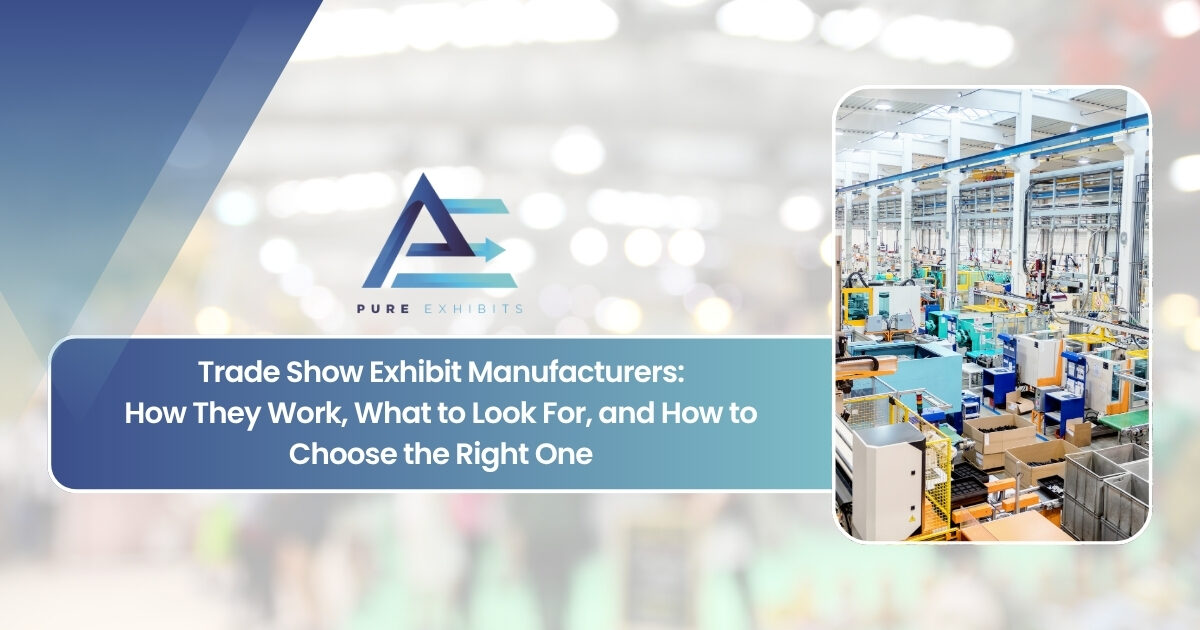
These companies design, engineer, and physically build exhibits in their own production facility using their own workforce and equipment. When you approve a rendering, the finished product is produced by the same organization that drew it.
What this looks like operationally:
-
An in-house woodshop with cabinetmakers producing custom millwork
-
CNC routers and milling machines are cutting structural components to precise tolerances
-
Metal fabrication: welding, cutting, and finishing aluminum and steel elements
-
An in-house graphics department prints, finishes, and quality-checks all graphic panels
-
A prebuild area where the complete exhibit is assembled in the shop before it ships, so problems are caught before move-in day
All stages, such as design, engineering, fabrication, finishing, and graphic production, occur within one internal structure. The crucial stages are never outsourced; the quality stays the same through all processes.
This way, there is no need to fear some of the common mistakes associated with outsourcing, such as fewer handovers, last-minute changes, and corrections. Working closely on the project allows one to make decisions instantly and with full knowledge of their consequences.
Advantages:
-
Highest quality control — the designer can walk to the shop floor when something needs adjustment.
-
Fastest problem resolution — no waiting for a third-party vendor to respond
-
Most predictable outcomes — what you approved in the rendering is what arrives at the show
-
True accountability — one entity is responsible for the entire output
Simplify Trade Show Services
Avoid costly surprises with experienced support for your exhibit and event logistics.
Model 2: Modular System Vendors
These vendors offer pre-fabricated display systems, which include tension fabric pop-up displays, SEG back wall packages, panel systems, and island exhibit systems. The added value comes in when the display dealer selects the appropriate system for the client, along with printing custom graphics for the chosen hardware.
What this looks like operationally:
-
A catalog of existing hardware systems from one or more manufacturers
-
In-house or outsourced graphic printing
-
Assembly instructions for self-setup (most systems are designed for this)
-
Optional I&D and logistics services
Advantages:
-
Faster turnaround — pre-engineered hardware is available without a custom build timeline
-
Lower cost for inline booths and portable displays
-
Lightweight and portable — most systems ship in bags or small cases
-
Self-setup capability — most portable systems require no tools and can be assembled in under an hour
Model 3: Brokers and Design-Only Firms
The biggest misconception in the industry. A broker or design-only firm presents itself as an exhibit builder and creates a stunning 3D mock-up, gets your down payment, but sends the manufacturing part out to another firm, which might even be in another state or country.
A meaningful number of companies that show up in search results turn out to be brokers who use third-party manufacturing facilities.
The risks:
-
The broker has limited control over fabrication quality, materials, or timeline at the third-party shop.
-
When problems arise, the broker must communicate through the fabricator rather than solving them directly.
-
Costs are typically marked up over the fabricator’s rate, so you pay more while getting less control.
How to identify a broker: Ask directly: “Do you fabricate this in-house, or do you subcontract any portion of the build?” Reputable trade show exhibit manufacturers answer this question without hesitation. Reluctance is a signal.
The Exhibit Fabrication Process: From Brief to Show Floor
In the case of custom exhibition stand construction, there is a certain manufacturing procedure that needs to be followed. The knowledge of such processes will help to manage expectations in terms of deadlines, make decisions at appropriate stages, and ask all necessary questions on time.
Phase 1: Discovery and Strategy (Weeks 1-2)
A successful exhibit starts even before any designs. A proper discovery session will take into account the following aspects:
-
Your main goal at the show (lead generation, new product introduction, etc.)
-
Your typical exhibitor and their interests. What do you want your visitors to accomplish at the booth?
-
Size and type of your booth (corner, inline, peninsula, island)
-
Branding information: your logo, colors, fonts, etc.
-
Functional elements required for the exhibition (product presentation zones, demo station, meeting space, etc.)
-
Your budget and the date of the show
Phase 2: Concept and 3D Design (Weeks 2–4)
The design team interprets the discovery brief into a visual concept. This would generally consist of:
-
Floor plan (2D): Overhead view depicting space usage, traffic circulation, and zoning plans
-
Rendering (3D): Realistic view of the completed exhibit from several vantage points, including the approximation of lighting effects
-
Dimensions & specifications: Dimensioning of every component, including height and surface measurements, ensuring adherence to venue guidelines
Phase 3: Structural Engineering (Weeks 3–5)
Once the design is approved, structural engineering converts the creative concept into buildable technical drawings.
Advanced CAD, 3D modeling, and rendering software develop detailed construction drawings and photorealistic visuals. These tools help identify and resolve potential challenges well before fabrication begins. This proactive approach reduces rework, minimizes on-site surprises, and ensures that creative concepts translate cleanly into physical builds.
Engineering output includes:
-
CNC cutting files for routed components
-
Welding and metal fabrication drawings
-
Assembly sequencing documentation
-
Bill of materials (BOM) with all hardware specified
-
Venue compliance documentation (structural load ratings for hanging signs, fire retardancy certifications)
Phase 4: Fabrication and Assembly (Weeks 5–10)
The production phase in an in-house shop involves:
-
Millwork and cabinetry: Custom counters, reception desks, storage cabinets, product display shelving
-
Structural framing: Aluminum extrusion or steel welded elements that form the skeleton of the exhibit
-
Surface finishing: Laminate application, paint, vinyl wrapping, and specialty finishes
-
Technology integration: Monitor mounting, AV cable routing, power distribution
-
Lighting installation: Integrated LED strip lighting, spotlights, and backlit panel systems
Phase 5: Graphics Production (Weeks 8-11, concurrent)
The graphics production process occurs concurrently with structural fabrication:
-
Graphics are prepared to production standards
-
Printing large format generates dye-sublimation fabric graphics, backlit graphics, direct print graphics, and vinyl graphics.
-
Colors are confirmed using brand standards (G7 accreditation is the standard in the industry)
-
Proofing, trimming, and finishing of graphics complete the process.

Phase 6: Prebuild and Quality Assurance (Week 11–12)
Probably the single most critical aspect of quality control, and, unfortunately, the one that is most often overlooked by substandard fabricators.
The entire exhibit is assembled in-house before being shipped out. Everything is checked: Does everything fit properly? Are all the connections secured properly? Are all the graphic panels properly aligned with the frame? Is everything lit up properly? Do all AV components work correctly?
If there are any problems found with the preassembly process, these will only take hours to fix in the shop. If they discovered the same problems at move-in time at the convention center, where time is short, tools and manpower are scarce, they could end up costing multiple times more to fix.
Ask every prospective trade show exhibit manufacturer: “Do you conduct a full prebuild in your shop before shipping?” This single question filters serious manufacturers from those cutting corners.
Phase 7: Crating and Logistics
Finished components are packed into custom crates engineered for the specific exhibit.
Crate design matters: Properly engineered crates protect the exhibit across dozens of shipping cycles. Crates packed too tightly cause component damage; those packed too loosely cause movement and impact damage.
Documentation accompanies every shipment: A detailed packing list, assembly guide, installation photography, and venue compliance paperwork for hanging signs.
Phase 8: Installation and Dismantling
The exhibit is installed at the exhibition site by an I&D team, using the instructions provided in the assembly documents. In cases where the manufacturer provides total service for I&D, the team that installs the exhibit is the manufacturer’s team, who is very familiar with the entire installation process since they are the ones who constructed the exhibit. Following the close of the exhibition, the exhibit is dismantled and packed in boxes.
Why Pure Exhibits is Different
Pure Exhibits LLC is a full-fledged trade show exhibit manufacturer. It operates on the philosophy that whatever is approved in the rendering will end up on the floor every single time.
-
We fabricate in-house– This means that our fabrication crew manufactures all of its work in our facility. When your designer and your fabricator both operate under one roof, those issues that will be resolved in a few hours which would have otherwise taken days.
-
We prebuild every exhibit– Your exhibit will always be pre-built in our facility, checked, photographed, and documented. If anything needs fixing according to the approved specs, that is done before the crates ever get closed, not on move-in day at the convention center.
-
We are one call– Design, fabrication, graphics, crating, logistics coordination, I&D, storage, one team, one contact, one invoice. When something needs attention, you are not navigating between three vendors trying to identify who is responsible.
-
We work at every scale– Whether you need a clean 10×10 rental for your first show or a 30×40 custom island for your industry’s flagship event, we bring the same attention to engineering quality and execution detail.
Let’s Build Something Extraordinary
Share your event details and we’ll craft a custom booth solution designed to captivate your audience and maximize your ROI.
Frequently Asked Questions
Are trade shows profitable?
Yes, trade shows are highly profitable. Around 99% exhibitors report unique value and ROIs that even digital marketing fails to match.
How many sq ft is a 20*20 booth?
A 20*20 booth is equal to 400 sq ft. This type of booth is typically described as an island booth. It can easily accommodate 4-6 staff members and 8-12 visitors at a time.
Why do you need to exhibit at a trade show?
Exhibiting at a trade show can be a great way to generate leads and promote sales. Moreover, it bridges the gap between digital interactions and hands-on engagement, delivering value that is difficult to clone online.
What do I need for a trade show?
The very first thing you need is a trade show booth. You can partner with reputable trade show exhibit manufacturers, like Pure Exhibits LLC, to help you with the process.