
Baylor Genetics · ACMG 2026
You cannot market to the people who wrote the classification criteria. So the booth made a clinical argument instead.
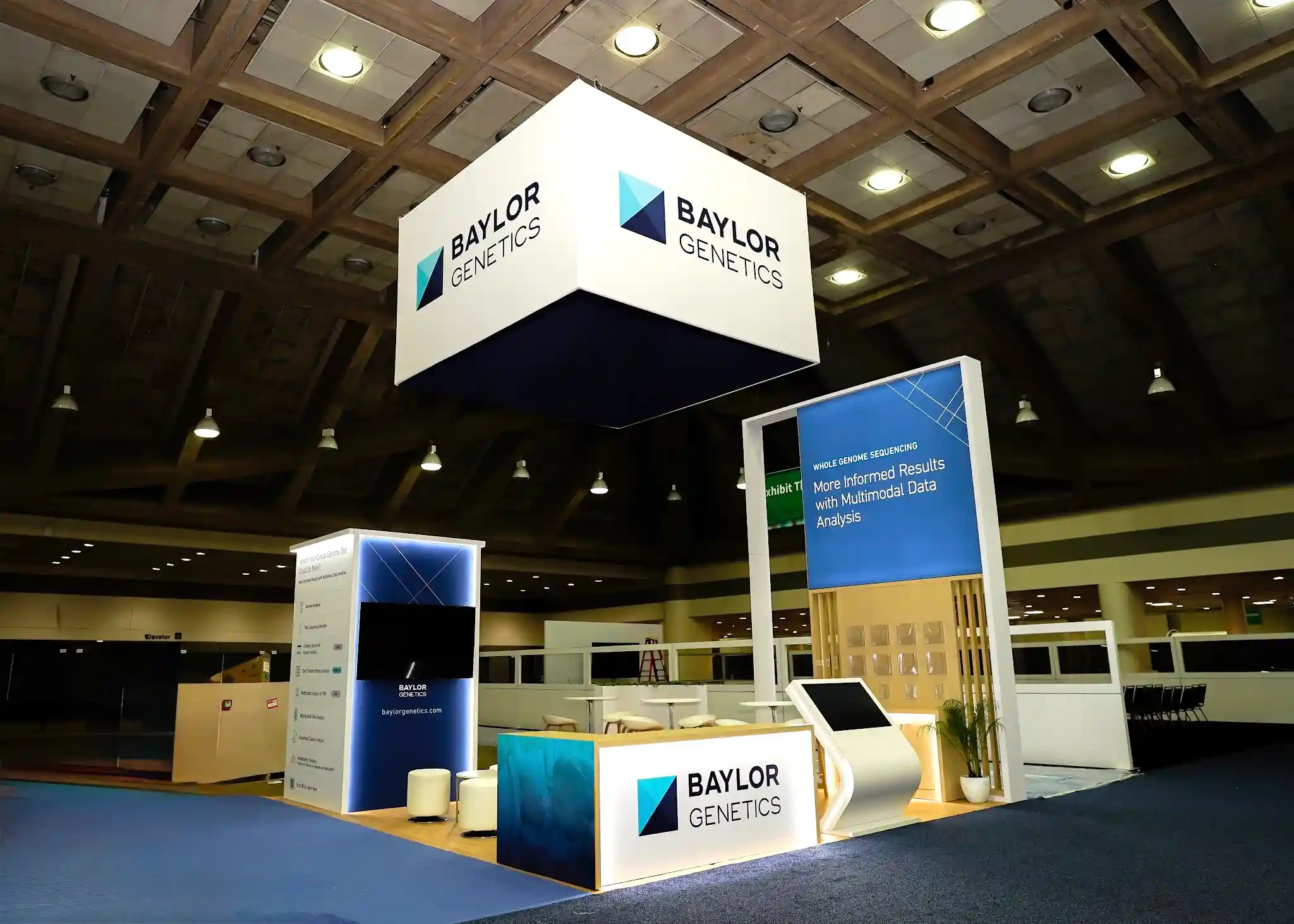
ACMG gathers the 2,500 people who decide how genomic medicine is practised — clinical geneticists, laboratory directors, genetic counselors from 40+ countries, all fluent in the evidence. Pure Exhibits built Baylor Genetics a 20 × 20 island at the Baltimore Convention Center that met them at their level: the multimodal testing case laid out with journal-article precision, inside a space warm enough to talk about the families behind the variant calls.
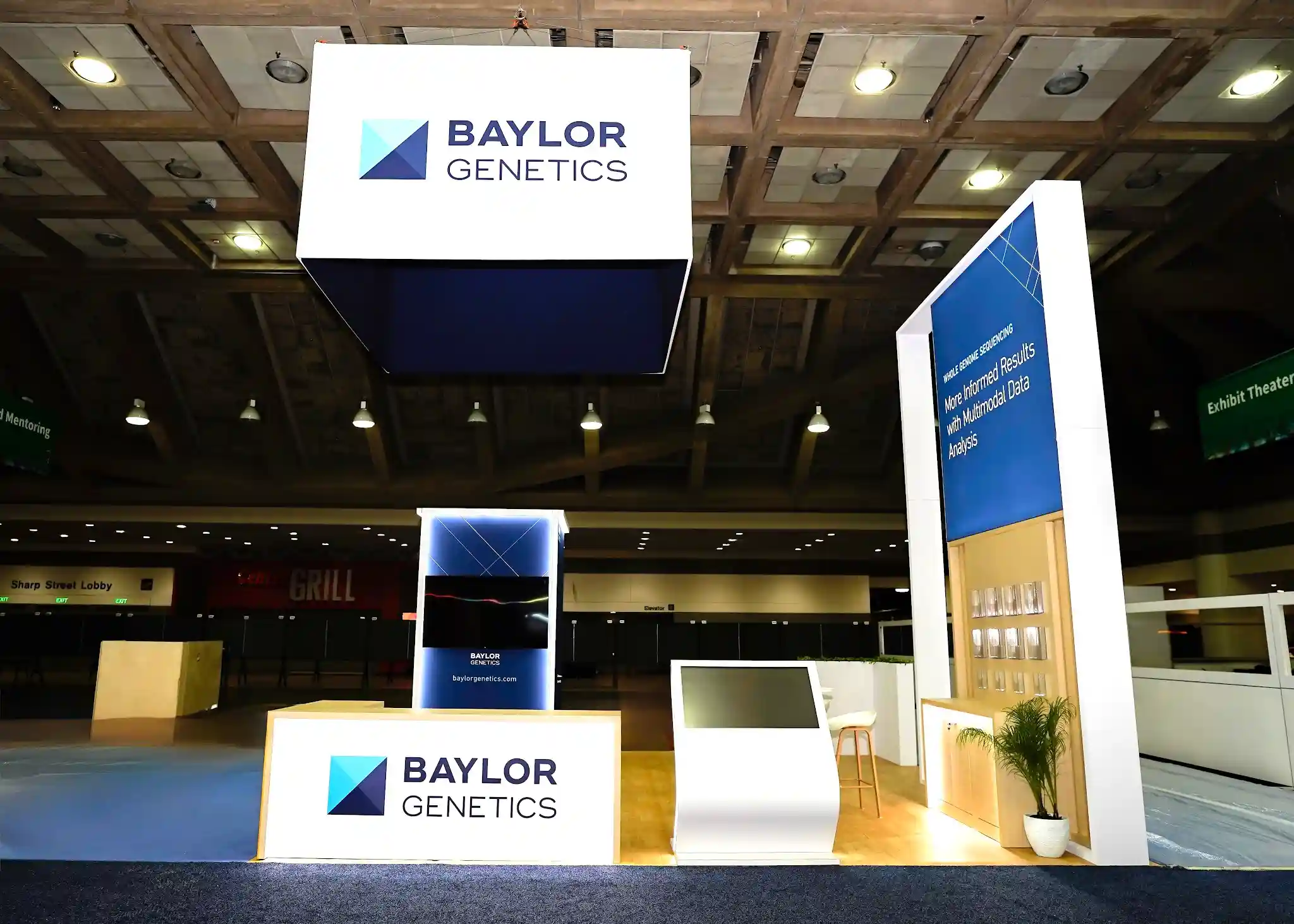
An audience that wrote the criteria
ACMG’s attendees are not an audience marketing can reach. They sign out variant reports, counsel families through diagnostic odysseys, and literally authored the classification framework the industry runs on. A booth that pitched at them would empty in minutes. Baylor Genetics — nearly fifty years of clinical genetics rooted in the Texas Medical Center and Baylor College of Medicine, four million tests performed — needed 400 square feet that could hold a peer-level conversation.
The subject demanded it. The case for multimodal testing — whole genome sequencing layered with RNA sequencing, optical genome mapping, long-read sequencing and metabolomic analysis — is an argument about incremental diagnostic yield, made to clinicians whose rare-disease patients have already exhausted conventional pathways. The booth had to present that argument with a journal’s precision, and still feel like somewhere a genetic counselor would sit down — because behind every unsolved exome is a family that has waited years.
“While genomic sequencing is increasingly the standard of care for patients with rare disease, too many patients still complete testing without receiving the answers they need. At Baylor Genetics, we believe that more answers are possible.”Christine Eng, M.D., Chief Medical Officer and Chief Quality Officer, Baylor Genetics
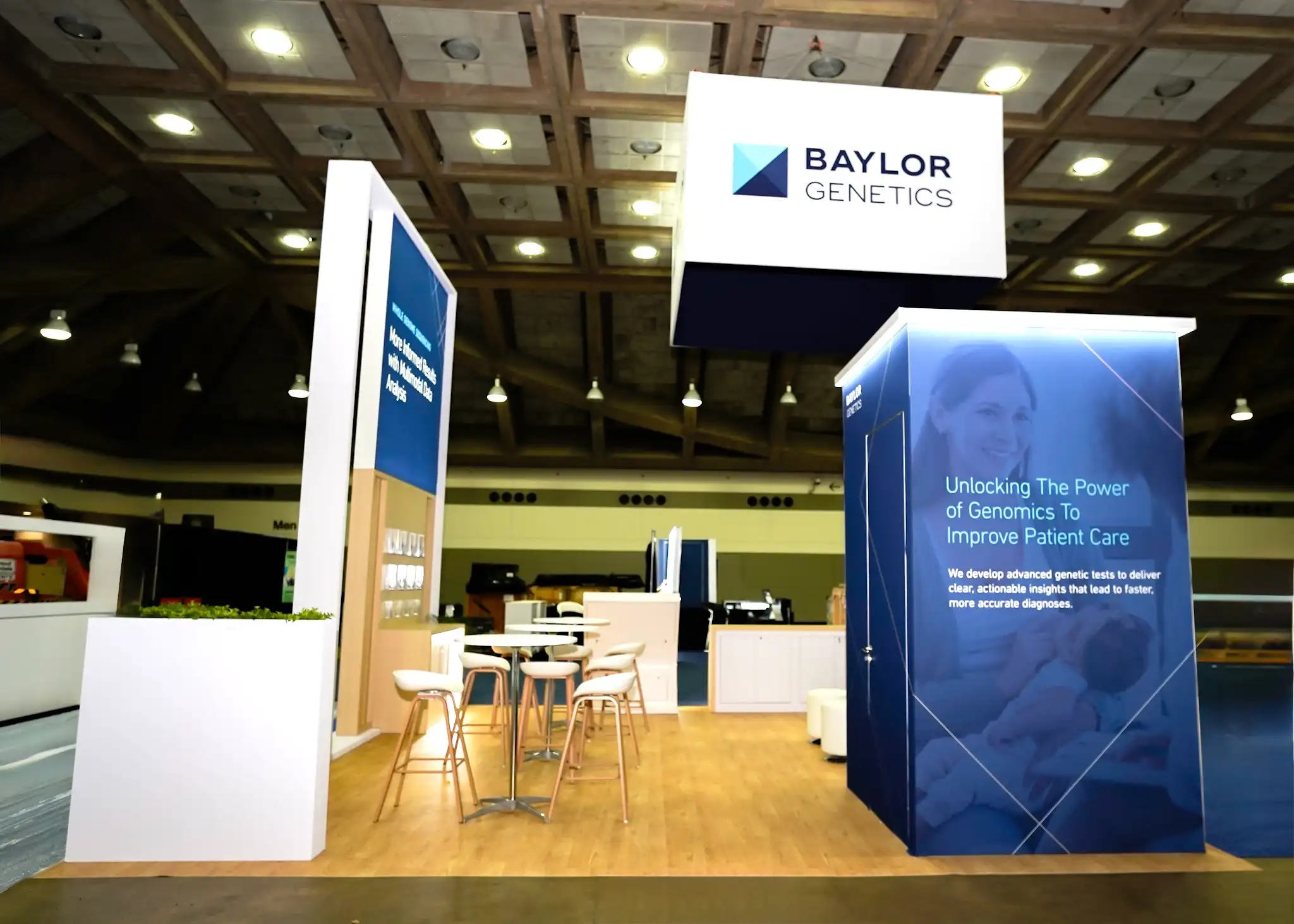
A diagnostic lab, translated to the floor
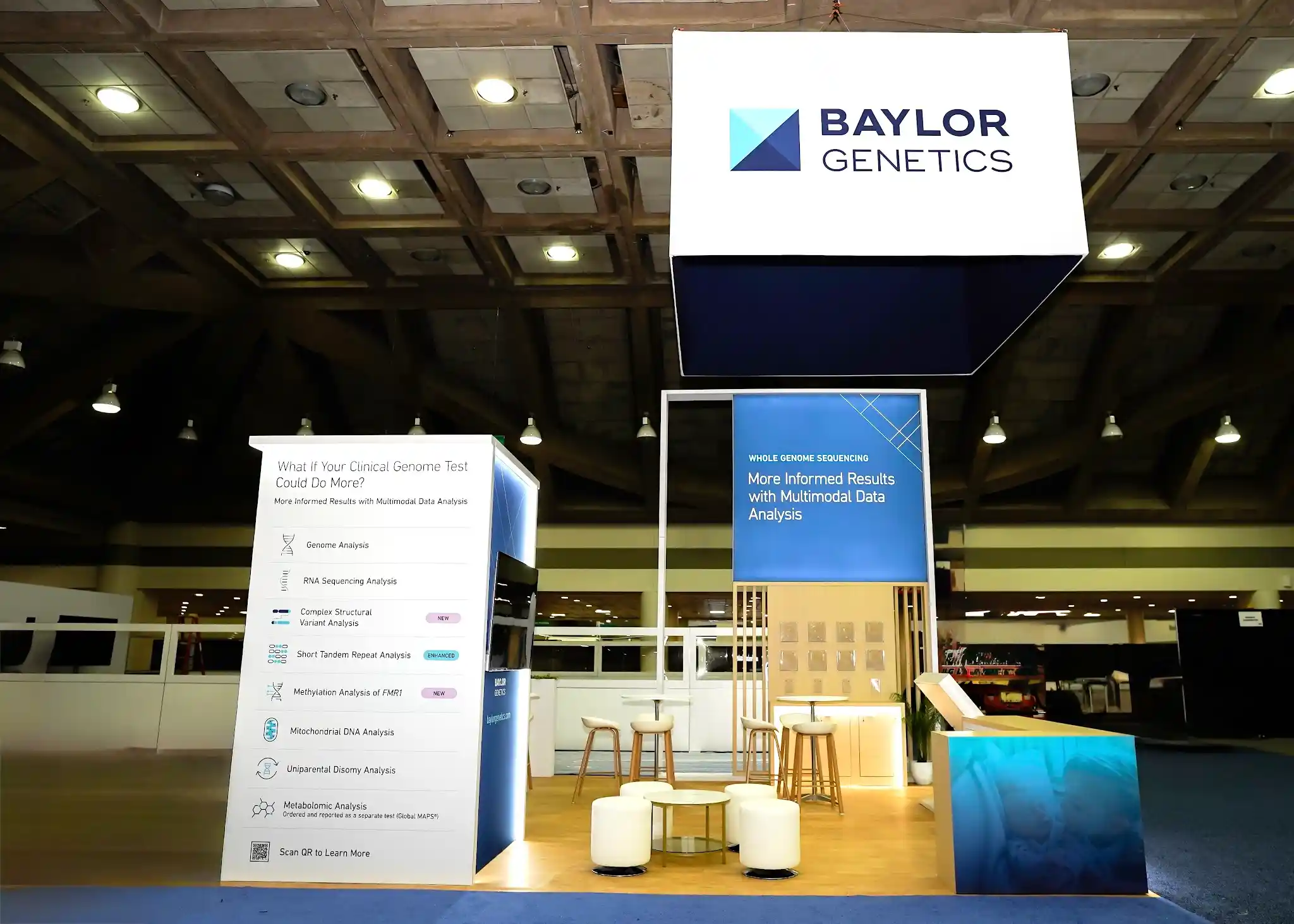
The Services Panel as Editorial Spine
The booth’s densest surface made the clinical case the way a paper would: WGS as foundation, then RNA sequencing for splicing and expression, optical genome mapping for structural variants, long-read for repeat expansions, metabolomics for biochemical phenotyping — with EXPANDED and NEW badges flagging what changed since last year, because this audience tracks exactly that. Bar tables and ottomans directly in front turned the panel from display into consultation: test selection worked through with a specialist, standing at the evidence.
A Lab, Translated
The design language came from the laboratory itself — white precision surfaces, symmetry, clean sightlines — opened to all four aisles at once. Clinically credible at first glance, because for this crowd the environment is a proxy for the quality of the science.
Warm Science
Wood slat cladding, live plants, a beverage station, curved seating — not decoration, strategy. Rare disease genomics ends diagnostic odysseys for children and families, and the conversations that matter here are personal ones. The warmth said what a spec sheet cannot: this laboratory remembers who the testing is for.
A Question, Not a Slogan
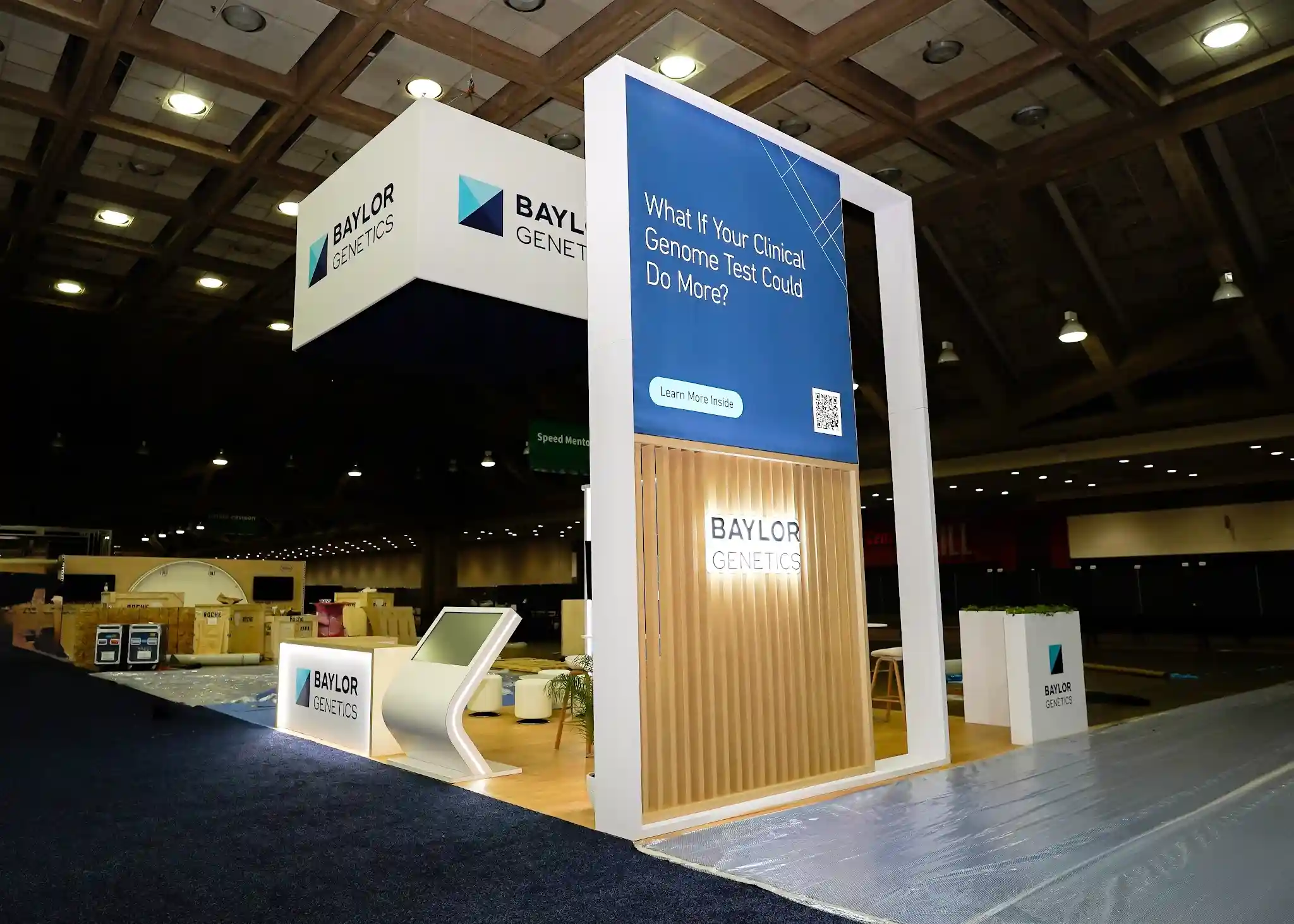
One tower asked “What If Your Clinical Genome Test” and left the sentence open — a provocation calibrated to stop a geneticist mid-aisle. Its QR code carried the curious straight to case studies, requisition information and variant-interpretation support on their own device, extending the booth’s argument past Baltimore.
Navy Overhead
A dual-level hanging sign in Baylor navy carried the wordmark and “Answers Beyond the Genome” on all four faces — 360-degree wayfinding across the hall, no dead angles, five days of drawing the right specialists off neighbouring aisles.
Curves and Murals
Cylindrical navy towers at the entries carried the heritage line — fifty years, four million tests, the Baylor College of Medicine research ecosystem — in a form deliberately unlike exhibition rectangles, softening the island’s approach. Inside, the “Unlocking The Power of Genomics” mural and DNA-pattern graphics held both readings at once: arresting to a passerby, specific to a specialist.
Experience the booth
A walkthrough of the Baylor Genetics 20 × 20 island at ACMG 2026 — past the cylindrical towers and discovery stations to the multimodal services panel at the booth’s spine.
The build at a glance
Answers beyond the genome, argued in person
The booth’s bet was that this room rewards evidence and punishes salesmanship. So the argument for layered testing was made the way the audience makes arguments — specific modalities, specific applications, specific incremental yield — on a panel a laboratory director could audit at reading distance. Nothing was claimed that couldn’t be defended in the conversation that followed, and the seating in front of the panel meant that conversation happened immediately, at the evidence.
The discovery paths respected how specialists engage. Some want the guided walkthrough with real patient-scenario data, moving from standard clinical WGS up the diagnostic hierarchy; some want a QR code and their own device; some want a counselor-level conversation on a curved ottoman with a coffee. The booth held all three at once, which is why clinical conversations of real depth were not just possible but, as the layout intended, architecturally inevitable.
And the warmth carried the part of the story data cannot. Fifty years of clinical genetics, four million tests, the Baylor College of Medicine ecosystem — the towers stated the authority. The wood, the plants, the hospitality said the rest: that every unsolved exome is a family mid-odyssey, and that a laboratory which believes more answers are possible should feel, in person, like a place you’d send them.
Explore our island exhibits
Warmth as strategy at another people-first show — a wellness studio in wood and moss for an AI care platform’s first booth.
View Case Study → DTECH 2026 MoxaAnother expert audience that dismisses marketing on sight — won with live racks and evidence in a 20 × 20.
View Case Study → ISC West 2025 GeneaAn invisible cloud product made walkable — a glass experience room where attendees badged in and stepped through.
View Case Study → VertiCon 2026 EVE Air MobilityCredibility at full scale — an eVTOL that doesn’t fly yet, made real for the most aircraft-literate audience on earth.
View Case Study →An expert audience is a design problem
Specialist buyers punish pitch and reward evidence — booths for them need information density that survives scrutiny, consultation zones where the real conversation can happen, and warmth that honours what the work is for. Pure Exhibits designs and fabricates custom exhibits from 10 × 10 inlines to full-hall islands for diagnostics, medtech and life-science companies at ACMG, AACC, HIMSS and beyond — every build 100% pre-assembled and photo-approved before it ships, with fixed, transparent pricing.