
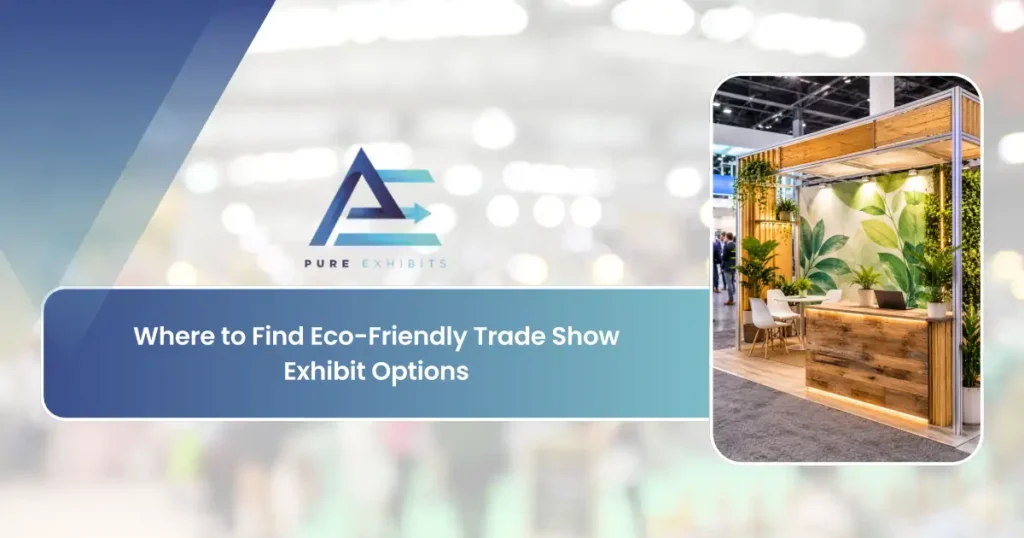
Opting for eco-friendly trade show exhibit options is no longer just a corporate social responsibility exercise; it is one of the smartest ways to reduce freight costs, avoid single-use waste, and strengthen brand credibility on the show floor. Conventional custom exhibits are often built for a single event, crated in heavy wood, and discarded behind the convention hall once the doors close. By shifting toward a reusable trade show booth, low-impact substrates, and localized shipping, your team can build a high-performing green exhibit that lowers both your carbon footprint and your multi-show budget.
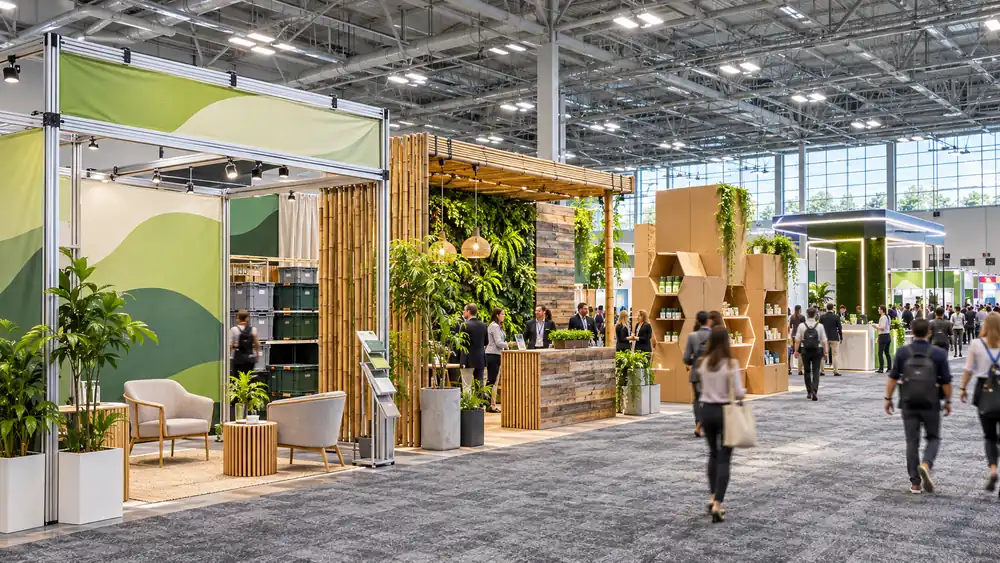
What Makes a Trade Show Exhibit Eco-Friendly?
-
An eco-friendly exhibit reduces waste, weight, and single-use materials across its whole lifecycle.
-
This involves using modules that can be reused rather than building from scratch only to tear them down, lightweight materials to reduce the carbon footprint from transport, recyclable substrates and materials with low environmental impact, low energy usage LED lights and graphics that are editable rather than replaceable.
-
Sustainability is about the entire process of building, transporting, and using the booth.
What Are the Best Eco-Friendly Trade Show Exhibit Options?
The most effective eco-friendly trade show exhibit options focus on extending the usable lifespan of your display rather than relying on single-use materials. Specifically, turning to a turnkey reusable trade show booth rental, modular extruded aluminum framing, dye-sublimation tension fabric graphics, energy-efficient LED lighting, and digital lead capture eliminates up to 80% of conventional convention waste while reducing shipping weight.
Option 1: Rent Instead of Buy
The single most impactful eco-friendly choice is renting. A rental exhibit is used across many companies and shows rather than built, shipped once, and stored or scrapped. Renting eliminates single-use builds and the waste of an owned booth that sits idle between shows. Our trade show booth rental benefits explain the model, and it is a genuine sustainability strategy as much as a financial one.
Option 2: Choose Reusable Modular Systems
Modular exhibit systems are designed to be reconfigured and reused show after show, dramatically reducing waste versus one-off custom builds. The same components become a 10×10, a 10×20, or an island as your needs change. A reusable 10×20 trade show booth rental is a practical, sustainable backbone for a multi-show program.
Want a Greener Booth That Still Stands Out? Get a Quote at purexhibits.com
Option 3: Sustainable Materials
-
Tension fabric graphics: lightweight, reusable, and reprintable
-
Aluminum framing: durable, recyclable, and endlessly reconfigurable
-
Recycled and recyclable substrates in place of single-use foam board
-
Bamboo, reclaimed wood, and FSC-certified materials for accents
-
LED lighting: far more energy-efficient than traditional fixtures
-
Water-based, low-VOC inks and finishes
Lightweight sustainable materials also cut shipping emissions and drayage costs, so green choices often save money too. See how these materials come together in our trade show booth case studies.
Option 4: Smarter Logistics and Reuse
A booth’s square footage isn’t only material; it’s logistics. Opting for lightweight booths, minimizing shipping, consolidating shipments, and partnering with a vendor who warehouses your exhibit between events is good for the environment. Digital lead management and booth materials minimize paper waste, which is usually what fills the convention floor.
| Eco Option | How It Helps | Bonus |
|---|---|---|
| Rent vs. buy | Reuses one booth across many users | Lower cost |
| Modular systems | Reconfigured, not rebuilt | Flexible sizing |
| Fabric graphics | Reprintable, lightweight | Premium look |
| LED lighting | Less energy use | Better visuals |
| Efficient logistics | Fewer shipping emissions | Lower drayage |
Top Eco Booth Materials That Balance Durability and Aesthetics
Choosing the right eco booth materials requires looking at both how a component is manufactured and what happens to it after the show ends. A substance that is technically “biodegradable” but falls apart after one event still generates unnecessary production and transport emissions. The strongest eco-friendly trade show exhibit options combine low-impact sourcing with multi-show durability:
| Material / Component | Sustainability Benefit | Typical Lifespan | Key Trade-Offs to Consider |
|---|---|---|---|
| Recycled Aluminum Extrusion Frames | 100% recyclable; lightweight; modularly reconfigurable across booth sizes | 20+ show cycles | Higher initial tooling for custom curves, though rental models eliminate upfront capex |
| Dye-Sublimation & rPET Fabric Graphics | Made from recycled plastics; water-based inks; packs compactly to cut freight weight. | Frame: Indefinite; Graphic: 5–10+ shows | Must be routed through specialized textile take-back programs at end of life |
| Bamboo & FSC-Certified Wood Accents | Rapidly renewable grass (harvested in 3–5 years) or responsibly managed timber | 5–10 show cycles with protective crating | Heavier than aluminum; best reserved for counters, headers, and tactile accent walls |
| Recyclable Honeycomb Structural Boards | 100% paper-based core; replaces toxic PVC Sintra and polystyrene foam core | 1–3 show cycles | Sensitive to heavy moisture; ideal for short-term dimensional signage and kiosks |
| Interlocking Recycled Carpet & LVT Flooring | Manufactured with post-consumer content; eliminates single-use show aisle carpet waste | 10–15+ show cycles | Requires protective padding and dedicated crate space during transit |
| Low-Voltage LED Lighting Systems | Consumes up to 75% less power than halogen fixtures and emits minimal ambient heat | 30,000–50,000 operating hours | Slightly higher initial fixture cost, offset rapidly by lower venue electrical drops. |
Related: Trade Show Banners in Orlando, FL: Signage and Booth Guide
Where to Find Eco-Friendly Exhibit Options
A reliable source would be one in which there is an exhibit house with sustainable elements in their rentals and modules rather than one in which sustainability is only added on to the exhibit house. Inquire about reusability and recyclability.
For shows in our market, our Las Vegas trade show booth rentals team offers reusable, rental-based exhibits with sustainable materials as standard, all over the USA.
Why a Reusable Trade Show Booth Rental Beats Custom Ownership for Sustainability
For most companies exhibiting at one to five events annually, renting a reusable trade show booth is the single highest-impact sustainability decision available. The idea of purchasing an exhibit that can be considered eco-friendly may appear to be very logical; however, the branding, product range, and booth size always keep on changing. Custom exhibits purchased end up sitting unused in climate-controlled warehouses until they are disposed of during rebranding.
The most sustainable exhibits are designed to be reused, not thrown away. Our Custom Trade Show Booth Rentals are built around reusable systems and reprintable graphics, which is the foundation of a greener booth.
An all-inclusive rental program turns sustainable exhibiting into a circular economy model:
-
Shared Structural Inventory: Heavy architectural components, aluminum framing, lightboxes, counters, and rigging hardware are maintained, repurposed, and deployed across dozens of different exhibitors.
-
Graphic-Only Refreshes: When your campaign changes, only the lightweight fabric skins are reprinted while the underlying green exhibit structure remains intact.
-
Zero Warehouse Abandonment: Because your exhibit partner owns and maintains the core hardware, components are never abandoned in convention center dumpsters to avoid return shipping costs.
Does Choosing Eco-Friendly Trade Show Exhibit Options Cost More?
No; over a multi-show calendar, eco-friendly trade show exhibit options consistently cost less than traditional single-use builds. While certain eco booth materials (such as FSC-certified bamboo panels or commercial LED lightboxes) carry a slightly higher initial fabrication cost than raw MDF or halogen lamps, those differences are quickly erased by operational savings:
| Cost Factor | Traditional Single-Use Booth | Sustainable / Rental Exhibit Program |
|---|---|---|
| Upfront Fabrication | High capital outlay for custom wood/laminate build | Lower upfront cost via shared rental inventory |
| Shipping & Drayage | Heavy crates drive up per-pound freight and venue drayage | Lightweight aluminum and fabric cut weight by 30%–50% |
| Show-to-Show Refreshes | Expensive structural rebuilds or repainting | Fast, low-cost fabric graphic swaps on existing frames |
| Storage & Disposal | Ongoing warehouse fees plus landfill disposal charges | Zero long-term storage or disposal fees with turnkey rentals |
Balancing Green and Impact
Being eco-friendly will not make your booth commonplace. Fabric graphics, LED lighting, and modular systems are exactly what modern booths are made of, and that gives them their premium status. So being environmentally friendly will improve your booth, rather than reduce its value. The most environmentally friendly booth will be the most visually appealing booth.
Design a Sustainable, High-Impact Exhibit with purexhibits.com
Getting Started
-
Begin by selecting either a rental or modular booth from a partner who is sustainable for real, uses fabric printing and LED lights, and has smart logistics.
-
In doing so, you will achieve most of the green gains in an economical way.
A Simple Path to a Greener Booth
You do not need to overhaul everything at once to exhibit sustainably. A few high-leverage decisions deliver most of the environmental benefit while keeping your booth affordable and striking. Start with the booth model itself, then work down to materials and logistics.
Begin by renting a reusable, modular exhibit rather than buying a one-off build, then specify tension fabric graphics and LED lighting and plan efficient, consolidated shipping.
-
Rent or choose modular so the booth is reused, not scrapped
-
Specify fabric graphics and LED lighting as standard
-
Favor recyclable aluminum and low-impact substrates
-
Ship light and consolidate freight to cut emissions
-
Work with a partner who stores and reuses your exhibit
Make these choices, and you get a booth that is genuinely greener and, thanks to fabric and LED, better looking too. Increasingly, the most sustainable exhibit and the most impressive one are the very same booth.
Request a Free Eco-Friendly Exhibit Consultation only from purexhibits.com
Frequently Asked Questions
What makes a trade show exhibit eco-friendly?
An eco-friendly exhibit reduces waste, weight, and single-use materials across its lifecycle, using reusable modular structures, recyclable materials, LED lighting, and reprintable graphics.
Where can I find eco-friendly exhibit options?
Look for exhibit houses that build sustainability into their rental and modular programs. Ask about reusable systems, recyclable materials, and how they store and reuse exhibits.
Is renting a booth more sustainable than buying?
Yes. A rental is reused across many companies and shows rather than built once and stored or scrapped, making it the single most impactful eco-friendly choice.
What are the most sustainable exhibit materials?
Tension fabric graphics, recyclable aluminum framing, FSC-certified or reclaimed wood, recycled substrates, LED lighting, and low-VOC water-based inks.
Are modular exhibits eco-friendly?
Yes. Modular systems are designed to be reconfigured and reused across shows and sizes, greatly reducing waste versus one-off custom builds.
Can a sustainable booth still look premium?
Absolutely. Fabric graphics, LED lighting, and modular systems are the same elements that make modern booths look premium, so green choices usually improve impact.
How quickly can I get a sustainable booth?
Standard timelines are 6–8 weeks, and experienced partners can build sustainable exhibits faster when deadlines are tight. Last-minute trade show booth rentals can deliver a sustainable build even on a short timeline.
Do eco-friendly exhibits cost more?
Not usually. Lightweight, reusable materials often lower shipping and drayage costs, so sustainable choices frequently save money over time.
What is tension fabric and why is it green?
Tension fabric is printed fabric stretched over a frame; it is lightweight, reusable, and reprintable, which reduces waste and shipping emissions.
How does LED lighting help sustainability?
LED lighting uses far less energy than traditional fixtures while producing better, more controllable light for your booth.
How can I reduce my booth’s shipping footprint?
Choose lightweight exhibits, consolidate freight, ship efficiently, and work with a partner who stores and reuses your booth between shows.
Can a small booth be eco-friendly?
Yes. A modular, fabric-based 10×10 or 10×20 rental with LED lighting is an inherently sustainable and affordable choice.
How do I verify a provider is genuinely sustainable?
Ask specific questions about reusable systems, recyclable materials, energy-efficient lighting, and their storage-and-reuse practices, not just marketing claims. 20×20 trade show booth rentals are an inherently greener choice than buying and storing a booth.
Do shows require sustainable exhibits?
A growing number of shows and venues have sustainability guidelines, and many attendees expect it, so greener exhibits are increasingly the norm.
Who offers eco-friendly trade show exhibits?
Pure Exhibits offers reusable, rental-based exhibits with sustainable materials, fabric graphics, and LED lighting as standard.