
EVE Air Mobility · VertiCon 2026
The hall was full of helicopters that fly today. EVE was selling an aircraft that doesn’t — yet. The booth had to close that gap at full scale.
VertiCon is the world’s largest vertical aviation event: 15,000+ operators, defense buyers and aerospace executives, and more than 60 real rotorcraft parked on the Georgia World Congress Center floor. Into that room, Embraer’s urban air mobility subsidiary brought a full-scale mock-up of its eVTOL — an aircraft with 2,700+ commitments and no commercial flights. Pure Exhibits built the 45 × 55 island that made the case: not a rendering, a machine you walk around.
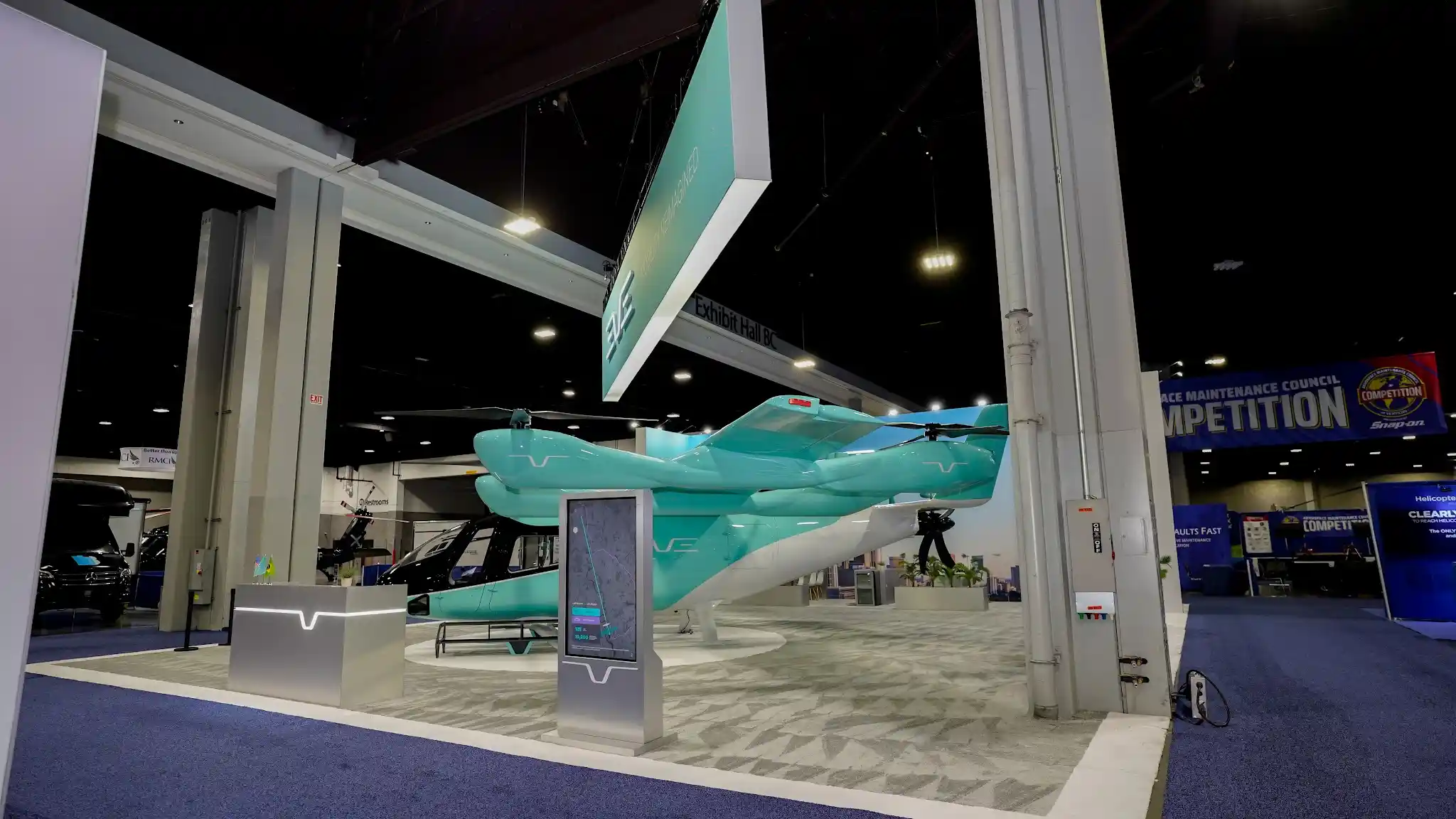
Selling an aircraft that hasn’t entered service to people who own aircraft
VertiCon’s audience is the hardest one an eVTOL company will ever face. Helicopter operators run fleets with maintenance logs. Defense buyers certify airframes for a living. On this floor, sixty-plus rotorcraft sit close enough to touch — every one of them proven. A screen full of renderings in that room does not read as the future; it reads as the part of the industry that hasn’t happened. EVE’s answer was to remove the abstraction entirely: a full-scale mock-up of the four-passenger, eight-rotor aircraft, on a reinforced platform, in the largest footprint at the show.
The second problem was that the aircraft is only a third of the sale. An operator’s real questions are operational: how does this thing enter controlled urban airspace, and who keeps it flying at year five? EVE’s answer spans three products — the eVTOL itself, the Vector air traffic management platform, and the TechCare service ecosystem — and the booth had to present them as one operating system, not three exhibits sharing carpet. 2,475 square feet had to explain an industry that doesn’t exist yet, to the people who will decide whether it does.
“We exercised our control laws, verified the integration of the eight lifters and assessed energy management, the aircraft’s dynamic response and noise footprint.”Luiz Valentini, Chief Technology Officer, EVE Air Mobility
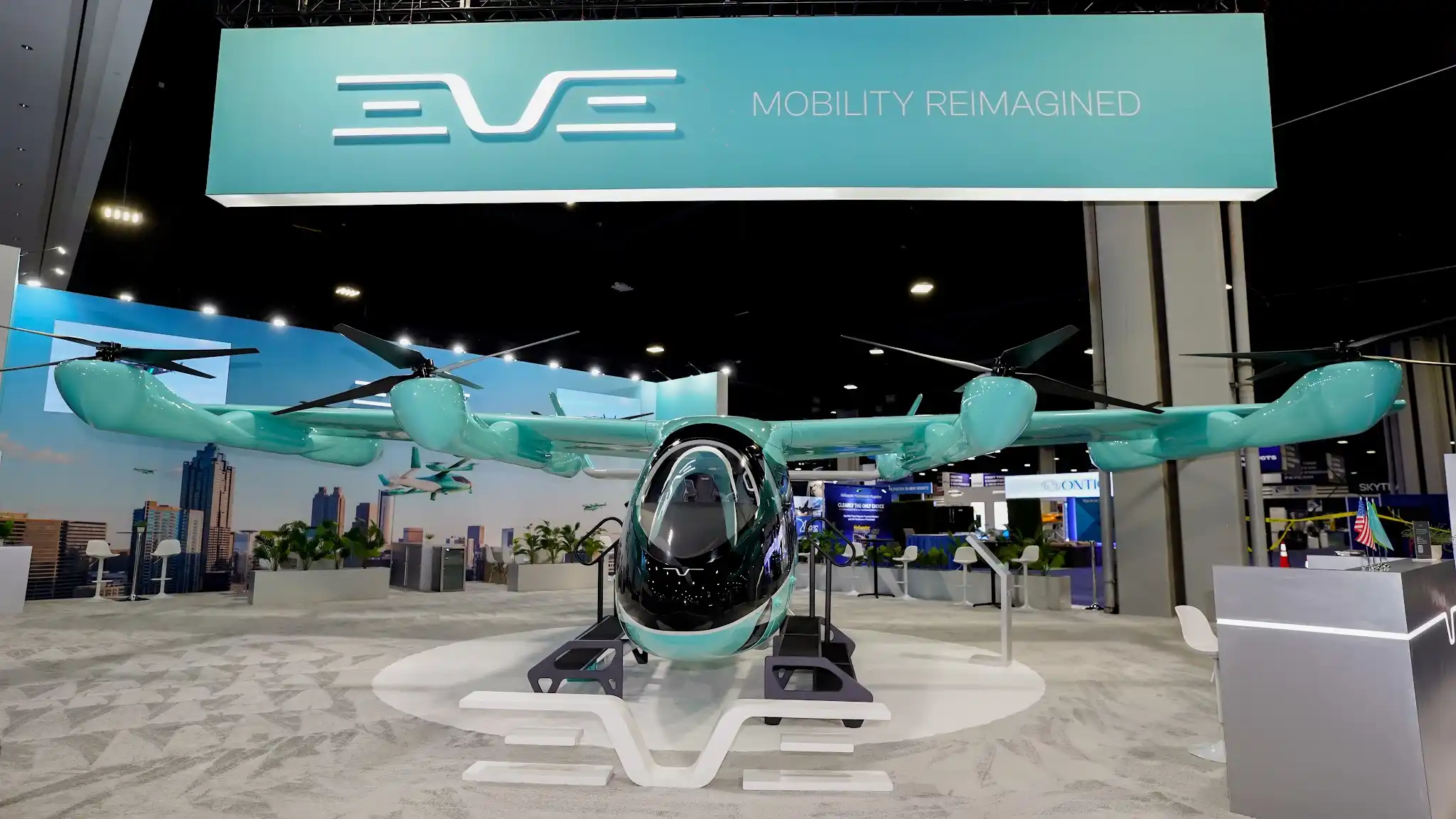
A hangar, not a booth
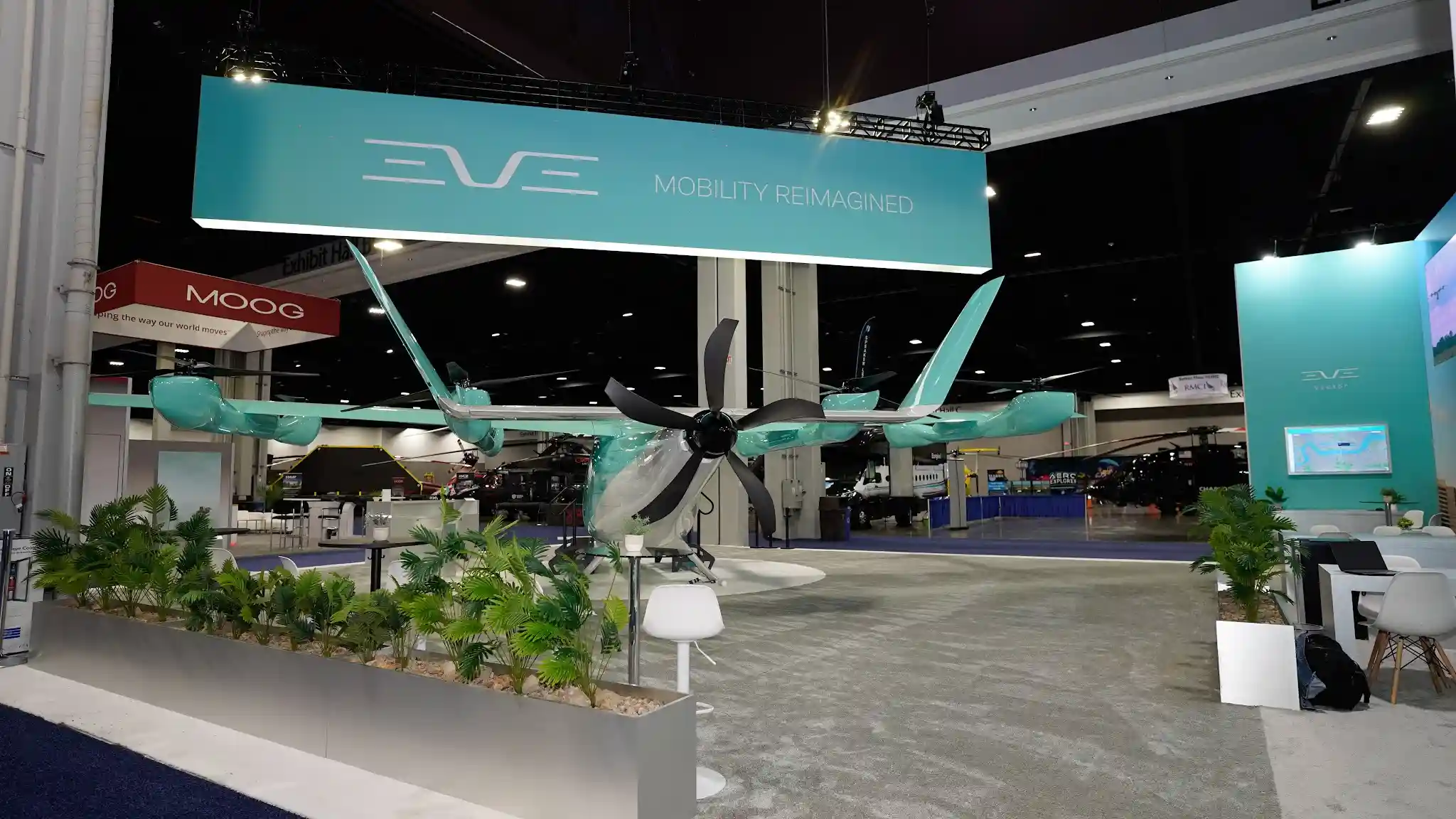
An Aircraft, Not a Rendering
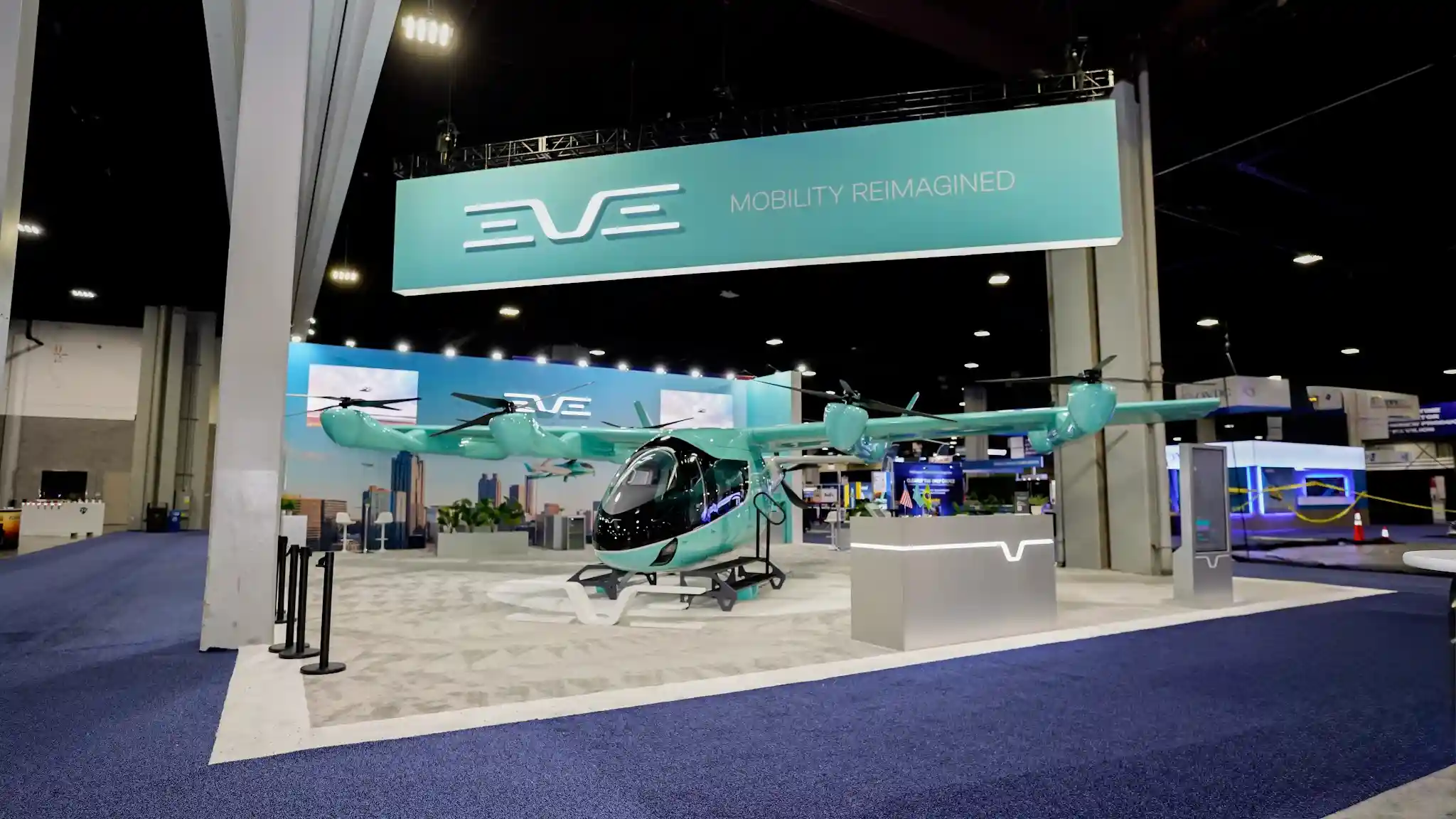
The defining decision was to put the actual airframe geometry in the room. The full-scale mock-up — eight rotors, black canopy, the four-passenger cabin an operator can look into — sat on a sculptured white platform engineered to take its weight, with the EVE logo in three-dimensional relief at its base. Stanchions held a viewing line without closing the aircraft off. Nothing else at the booth had to claim the technology was real; the object did the arguing.
The Hangar Plan
45 × 55 feet laid out like an aviation hangar rather than a trade show island: open on all four sides, the aircraft at the gravitational centre, sightlines held clean to every major aisle. The floor structure beneath the display platform was reinforced — a structural engineering problem most booths never have — so the mock-up could sit exactly where the plan wanted it, not where the slab allowed.
The Operator’s Three Questions
The zoning followed the buyer’s logic, not the org chart. The aircraft answers “does it exist.” A Vector station — the air traffic management platform already deployed at the 2025 São Paulo Grand Prix — answers “how does it share my airspace.” A TechCare station answers “who maintains it.” One environment, three answers, walked in the order an operator actually asks them.
Cities on the Perimeter
Backlit panoramas wrapped the booth’s edge with skylines, bridges and metro corridors — the aircraft photographed over the cities it is designed to serve, alongside runway and test-flight imagery from the programme. Aspiration on one panel, flight-test credibility on the next. The perimeter placed the product in the world instead of describing it.
A Sign You Navigate By
Overhead, a large-format turquoise structure read “EVE MOBILITY REIMAGINED” in white across the hall — scaled and hung to work as wayfinding, not decoration. In a venue the size of the Georgia World Congress Center, the booth you can find from three halls away collects the meetings the others miss.
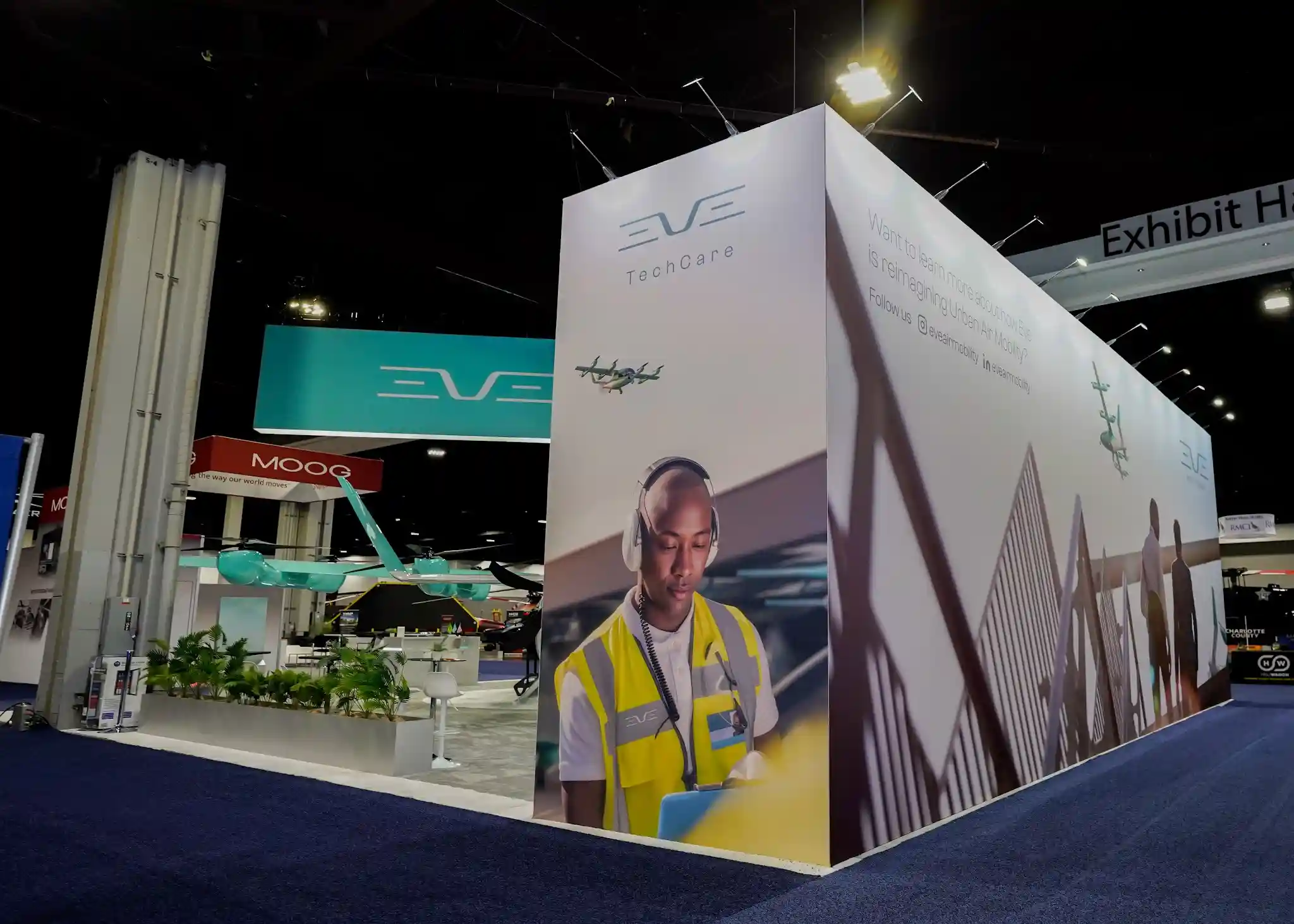
Pillars That Explain Themselves
Each corner pillar carried one product’s identity: Vector’s in radar rings and navigation grids on a blue gradient, TechCare’s in photography of maintenance crews in yellow vests — the human side of keeping a fleet airborne — each with a backlit EVE logo visible across the aisles. Between them, Eames-style seating, pedestal tables and planting made semi-private space for the conversations the aircraft started.
Experience the booth
A walkthrough of the EVE Air Mobility 45 × 55 island at VertiCon 2026 — past the urban skyline perimeter and product pillars to the full-scale eVTOL at the booth’s centre.
The build at a glance
What full scale bought
The bet underneath the whole build was that this audience cannot be persuaded by media — only by hardware. Helicopter operators judge aircraft with their hands and their eyes, and an eVTOL programme asking for fleet commitments before certification has exactly one way to be taken seriously in that room: occupy it. The mock-up on its platform was visible from every major aisle, approached from four sides, circled, photographed, and looked into. Nobody left describing a booth; they left describing an aircraft.
The stations did the converting. Curiosity about the airframe walked ten feet into a Vector demo showing how eVTOLs share controlled urban airspace — a platform already run live at the 2025 São Paulo Grand Prix — and ten feet further into TechCare, the aftermarket ecosystem that keeps a fleet flying at year five. The zoning meant an operator’s scepticism was answered in the order it arrives: does it exist, can I operate it, who maintains it.
That completeness was the separation. No competitor at VertiCon could show airframe, airspace management and aftermarket service as one system, and behind all three stood Embraer’s five decades of certifying and delivering aircraft at scale. The largest footprint on the floor wasn’t the point; it was the argument — a company that intends to build an industry, exhibiting like one.
Explore our island exhibits
Another debut with everything to prove — a five-week-old brand made physically real in a 20 × 20 island at the industry’s biggest show.
View Case Study → ISC West 2026 Ambient.aiThe inverse problem — nothing physical to show at all, solved with a dark, screen-led 20 × 40 built to resemble the buyer’s own operations centre.
View Case Study → Google Cloud Next 2026 GenpactA 20 × 20 that gave up open frontage to build enclosed meeting rooms — floor space spent on conversation quality instead of traffic.
View Case Study → ABC Kids Expo 2026 Baby BrezzaA 20 × 30 white island built on kitchen-showroom logic — the product demonstrated in the context it lives in.
View Case Study →Full scale is a structural problem
Putting a real machine on a convention floor means reinforced platforms, rigging engineered for overhead structure, sightlines held across thousands of square feet, and an install crew that treats aerospace tolerances as normal. Pure Exhibits designs and fabricates custom exhibits from 10 × 10 inlines to full-hall islands for aviation, defense and hardware companies at VertiCon, NBAA, CES and beyond — every build 100% pre-assembled and photo-approved before it ships, with fixed, transparent pricing.