
Globant · Adobe Summit 2026
Globant doesn’t have departments. It has studios. So we built one on the show floor.
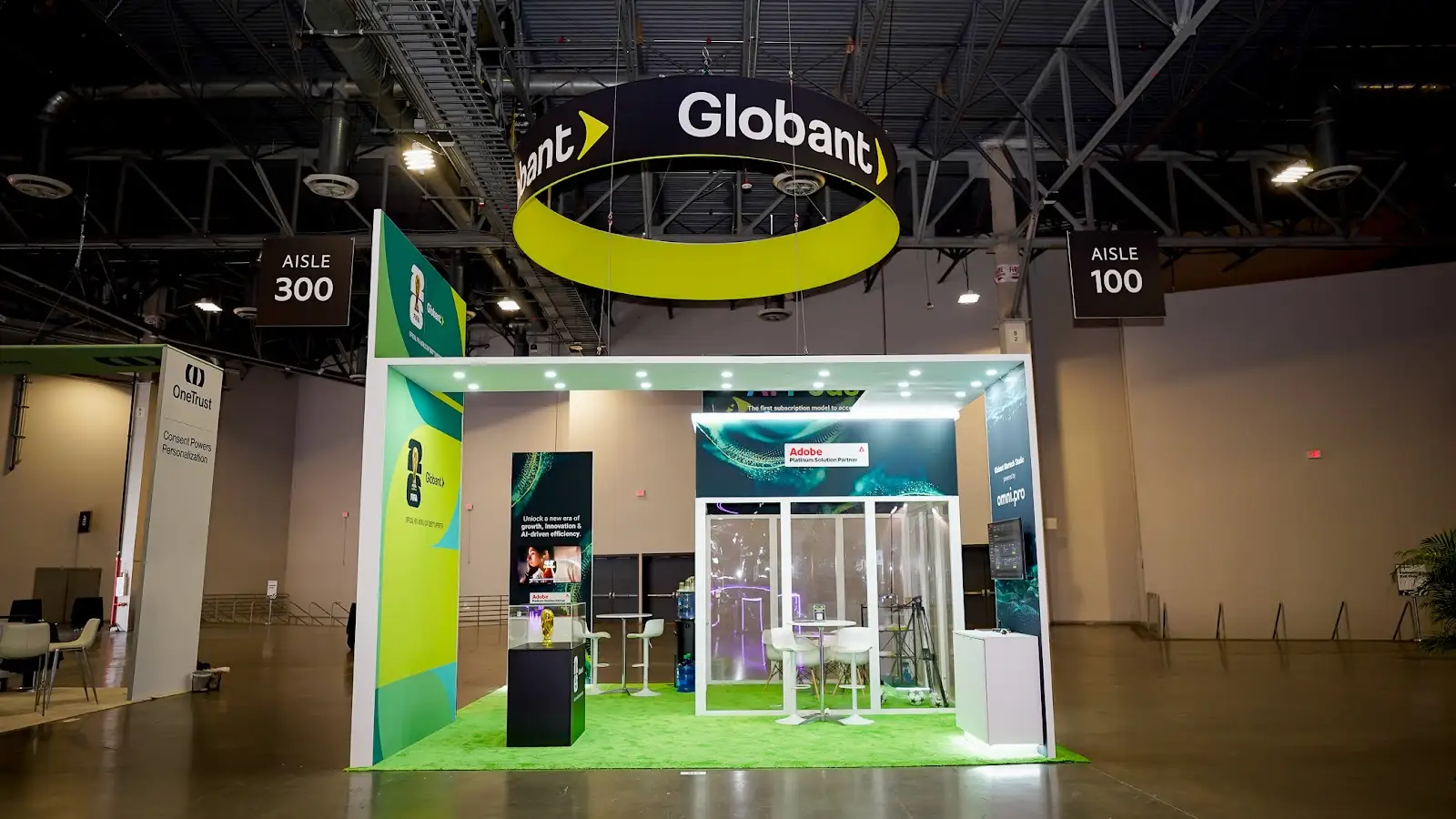
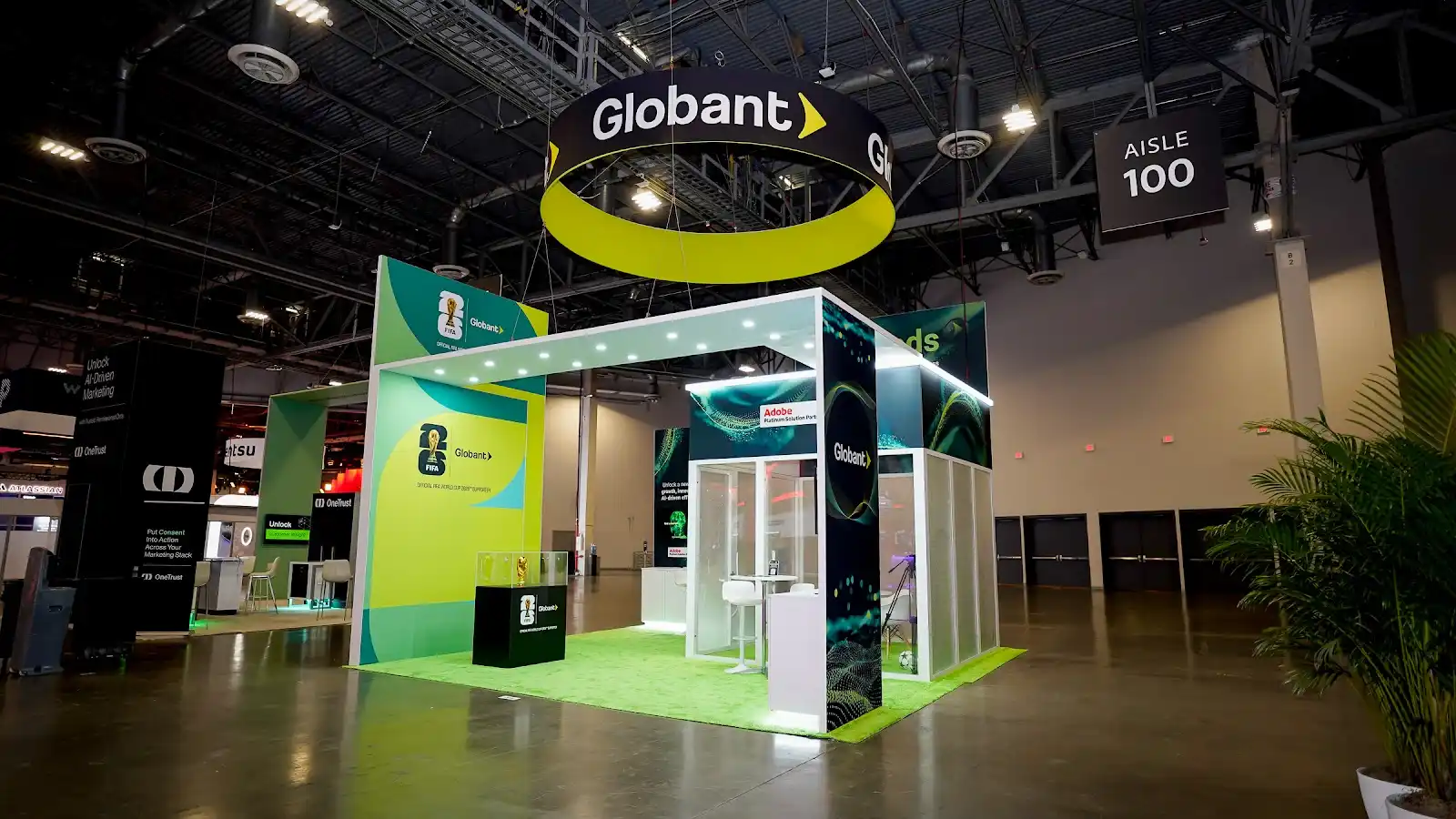
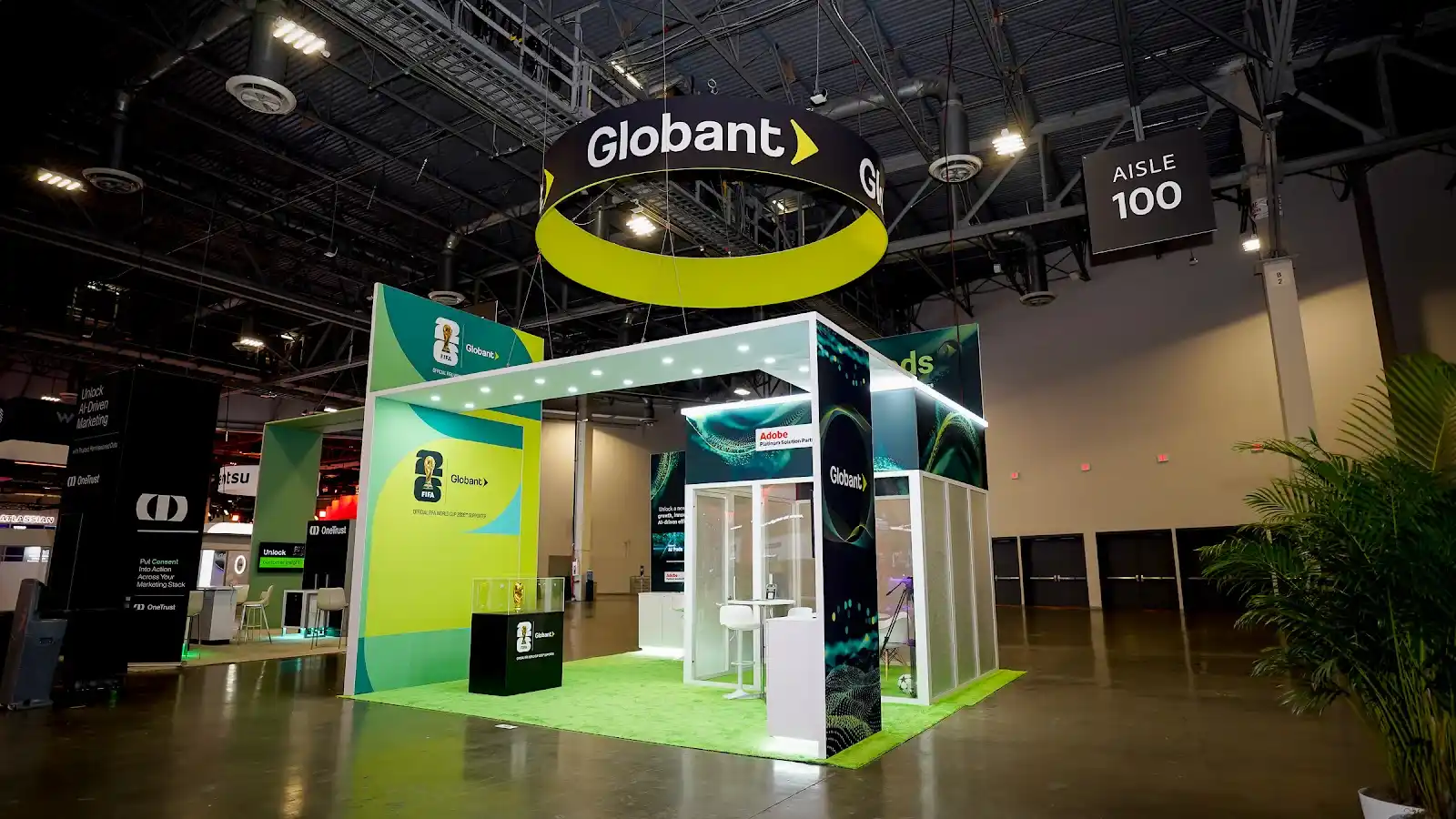
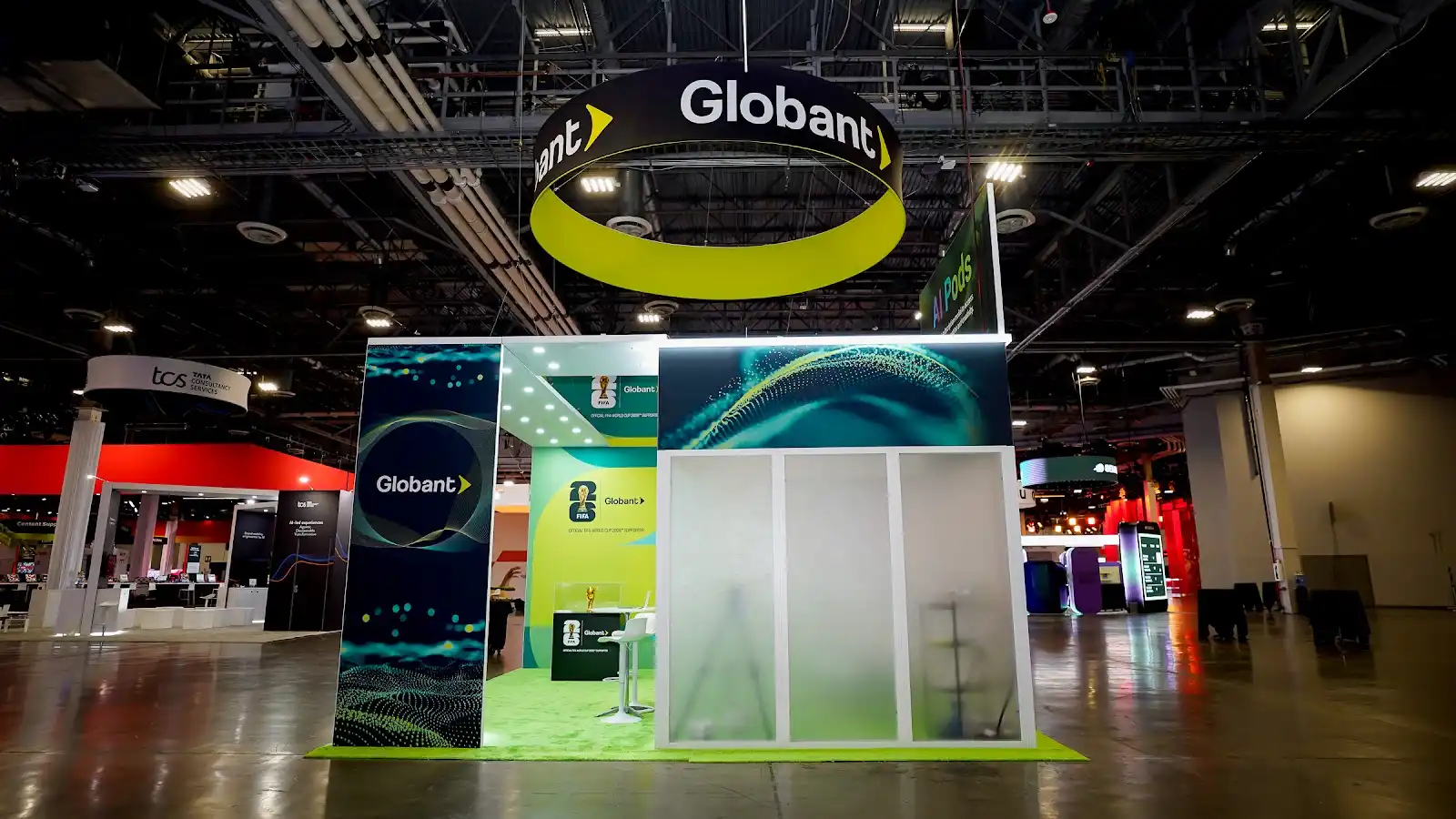
Globant organises its business into dedicated studios rather than practice areas, and its Adobe Studio had just climbed from Bronze to Platinum partner status inside a year. For Adobe Summit 2026 at the Venetian Convention & Expo Center, Pure Exhibits built a 20 × 30 custom island that behaved like the studio it represented — green, open on four sides, and organised around working AI pods rather than a hospitality lounge.
Making a generalist read as a specialist in Adobe’s own room
Globant does not have a recognition problem. It is a publicly listed, digitally native company working across dozens of technologies, and most enterprise buyers walking the Summit floor already knew the name. The difficulty was narrower and more awkward: breadth is an asset almost everywhere except inside a single vendor’s conference, where attendees have come specifically to find depth. A visitor at Adobe Summit is not shopping for a transformation partner in general. They are trying to work out who genuinely lives inside Experience Manager, Journey Optimizer and Real-Time CDP, and who is describing them from a slide.
Globant’s answer to that question already existed as an organisational fact. Its Adobe Studio, powered by Omni.Pro, is a dedicated unit rather than a capability listed on a services page, and in roughly twelve months the partnership had moved from Bronze to Platinum Solution Partner — a jump that sits on top of more than a decade of joint work, 250-plus delivered projects and 300-plus deployments. The exhibit’s job was to make that trajectory legible in the eight seconds it takes to pass an island booth. Pure Exhibits took the most direct route available: stop describing the studio and build one.
“We help organizations thrive in a digital and AI-powered future.”Globant
How 600 square feet was made to behave like a working studio floor
Pods Instead of a Counter
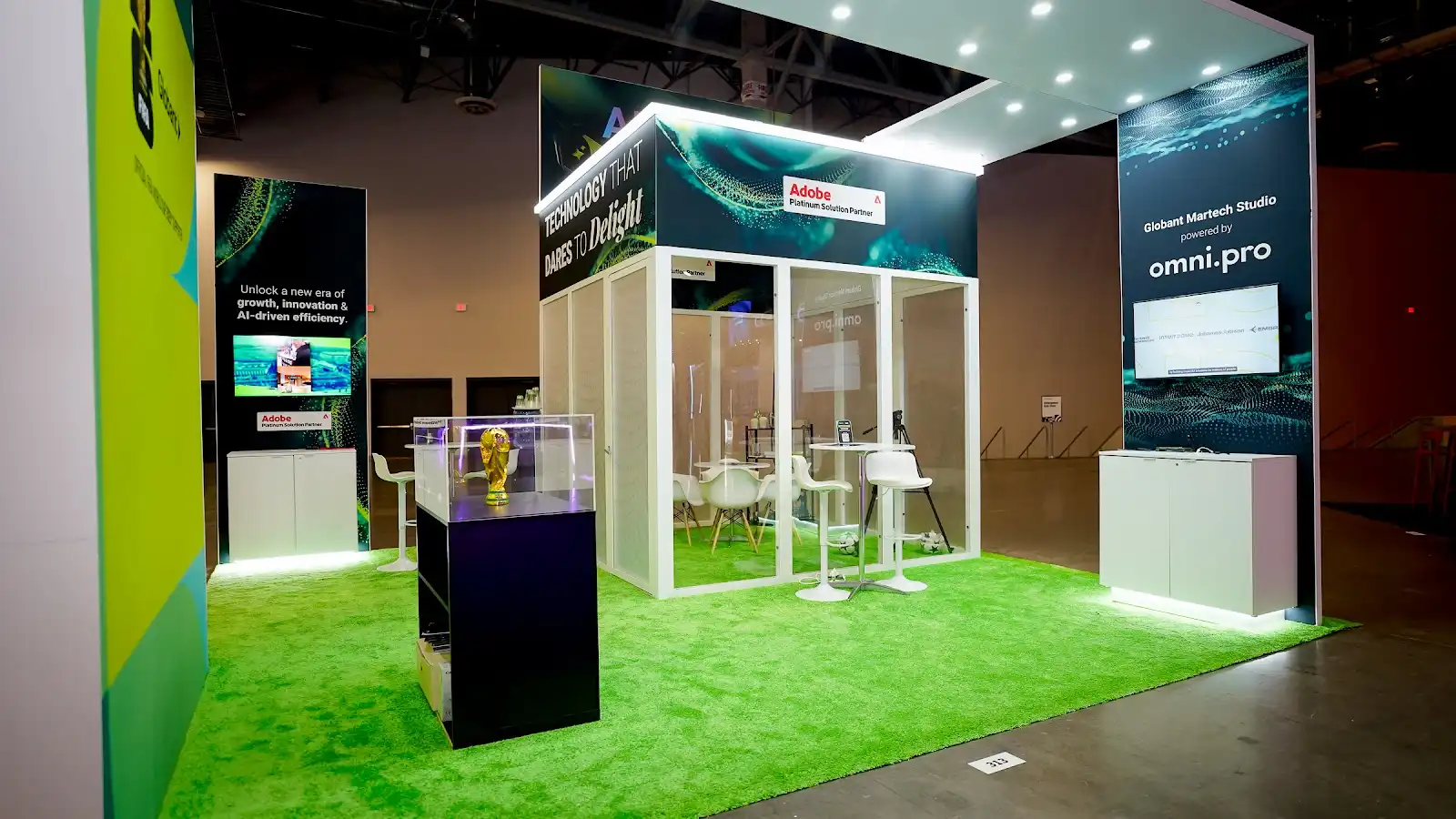
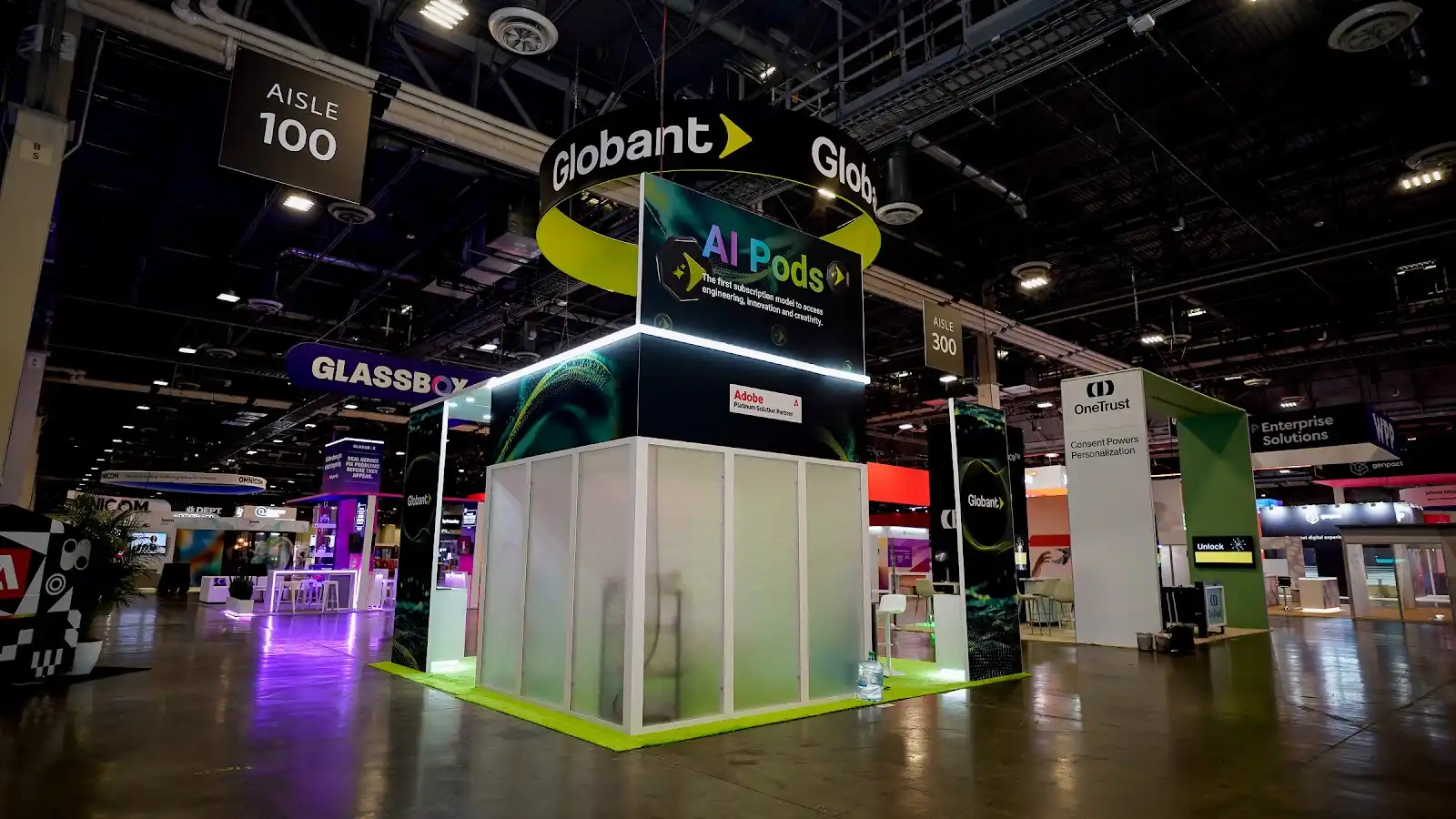
The organising decision was to break the floor into discrete AI pods rather than run a single reception counter with meeting space behind it. A counter creates a queue and a gatekeeper; pods create several simultaneous conversations, each with room for one specialist and one or two visitors. For a company whose differentiator is a dedicated studio staffed by named experts, that layout does real work — it puts the specialists in front of the aisle instead of behind it, and it lets four conversations run at once during the crush between sessions.
Green in Adobe’s Room
Adobe Summit is a red-and-white building for three days. Sponsor booths tend to mirror the host palette or retreat into neutral greys, and the result is a floor with very little colour separation. Globant’s green is one of the sharper brand colours in enterprise services, and using it at architectural scale rather than as a logo treatment gave the island a silhouette that read from a distance without competing with Adobe’s own signage.
An Island Earning Its Perimeter
A 20 × 30 island is bought for its four open sides, and it is routinely wasted by designs that create a de facto front and three backs. Here the pods were positioned so that every approach reached a working station rather than a wall or a storage cupboard. Nobody had to walk around the structure to find the way in, which matters more than it sounds when foot traffic arrives in unpredictable directions from three different session halls.
Co-Branding Without Disappearing
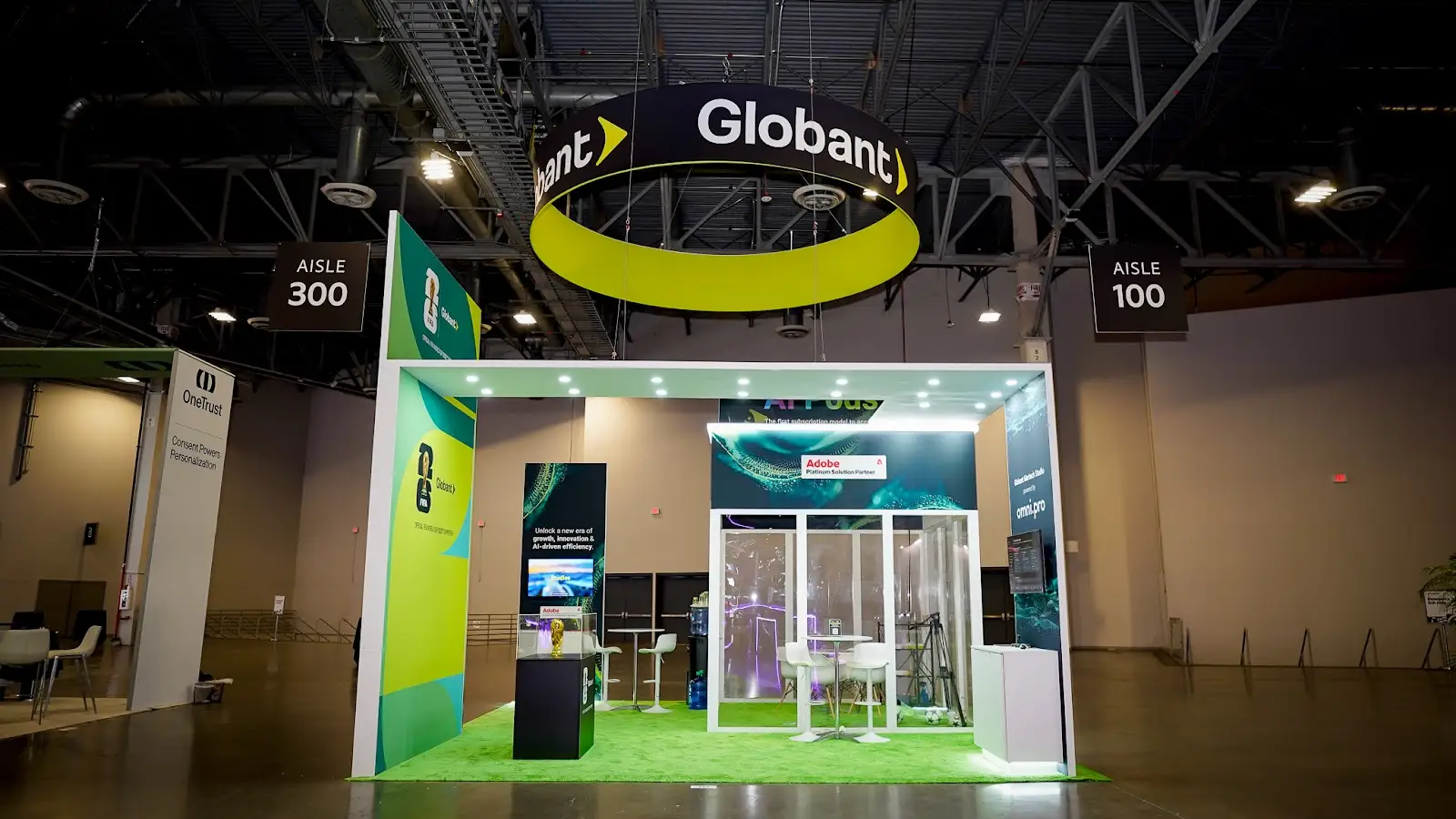
Partner-tier signage is a genuine design problem. Lean too hard on the Adobe lockup and the booth reads as an Adobe satellite rather than a company with its own point of view; lean too far the other way and a hard-won Platinum status goes unnoticed by the people it was earned for. The exhibit resolved the hierarchy structurally — Globant’s identity carried the architecture and the colour, while the partner credential sat where a buyer would look for it rather than where it would dominate.
Built for the Ten-Minute Gap
Summit runs on a session timetable, which means the floor is nearly empty for forty minutes and then completely full for ten. An exhibit optimised for a steady trickle fails badly under that rhythm. Sizing the pods for short, high-density bursts — enough stations that nobody waits, compact enough that nobody settles in — meant the booth could absorb a session break without the conversations that mattered getting crowded out.
Two Conversations, One Footprint
The practitioner arriving from a technical session wants to see the thing running. The executive arriving from the Partner Executive Forum wants to understand delivery capacity and track record. Those are different conversations with different postures, and most booths serve one at the expense of the other. Distributing the floor into pods rather than a single stage let both happen in parallel without either party having to wait through the other’s pitch.
The booth in detail
Experience the booth
A walkthrough of the Globant 20 × 30 island at Adobe Summit 2026 — moving through the green structure and between the AI pods that gave the exhibit its working-studio character.
The build at a glance
An operating model, rendered at floor scale
The strategic case for the studio-as-booth approach is simple enough to state and hard to execute: a company that sells dedicated expertise should not present itself the way a generalist would. Every element that would have made the exhibit more comfortable — a bigger reception counter, a lounge, a single presentation stage — would also have made it read as a hospitality space with a logo on it. Breaking 600 square feet into working pods costs comfort and buys credibility, and for a partner whose entire proposition is a named studio staffed by certified specialists, that is the right trade to make.
The show week supplied its own confirmation. Globant was named Adobe Customer Experience Orchestration Partner of the Year for LATAM, with partners recognised at the Partner Executive Forum during Summit — an award tied to accelerating AI adoption and unifying data, content and customer journeys, which is precisely what the pods on the floor were built to demonstrate. Pure Exhibits also built for another Adobe Platinum partner at the same show; see the case study on Comwrap Reply at Adobe Summit 2026 for a smaller footprint solving a related problem, or Appdome at RSA 2026 for floor-level visibility in a crowded partner market.
Explore our tech portfolio
A 20 × 20 magenta LED exhibit for another Adobe Platinum partner at the same show, built around interactive stations.
View Case Study → RSA 2026 AppdomeA 20 × 30 island with a large overhead hanging sign, engineered for maximum visibility in a crowded security market.
View Case Study → RSA 2026 SpyCloudA custom island built to communicate deep threat-intelligence credibility to an audience of security-savvy enterprise buyers.
View Case Study → RSA 2025 TeramindA 30 × 60 Diamond Sponsor island — one of the largest custom installations at the conference.
View Case Study →Let’s build your next island
Island footprints are the hardest exhibits to get right, because four open sides can just as easily become four half-used ones. Pure Exhibits designs and builds custom islands from 20 × 20 up to 30 × 60 for technology firms, systems integrators and platform partners at Adobe Summit, RSA, NAB Show and CES — with fixed, transparent pricing and a floor plan that earns every square foot you pay for.