
For active event marketers, managing trade show booth storage is a critical factor in protecting exhibit ROI. Custom exhibits represent massive capital investments, yet improper handling, uncontrolled humidity, or poor crate packing between events can cause costly damage, missing hardware, and degraded brand presentation.
Executing an effective strategy for booth warehousing requires more than just renting space; it demands systematic trade show display storage, climate controls, and real-time exhibit asset management. This comprehensive guide breaks down physical storage requirements, cost calculations, and management workflows, and how switching to modular rental strategies can eliminate storage fees.
Why Booth Storage Matters
-
A custom exhibition is a valuable item and therefore requires a climate-controlled, secure area in order to prevent any damage, warping, or fading.
-
If it is stored incorrectly, for example in a damp garage or in a hot corner of a warehouse, the graphics and structure will slowly deteriorate, which is why the booth that looked excellent last year now appears tired and worn.
-
Although proper storage does protect your investment, it does so at the cost of a monthly fee, which adds up quickly.
Tired of Paying to Store a Booth? See Rental Options at purexhibits.com
What Trade Show Booth Storage Costs
Professional exhibit storage typically runs anywhere from $150 to $800+ per month depending on the size of your exhibit, the number of crates, and the level of service. Full-service exhibit houses often bundle storage with asset management, tracking your components, inspecting them, and preparing them for each show. Over a year, storage alone can equal a meaningful fraction of the booth’s value.
Storage Factor Impact on Cost
| Storage Factor | Impact on Cost |
|---|---|
| Exhibit size/crate count | More crates, higher monthly fee |
| Climate control | Protects graphics but costs more |
| Asset management | Adds inspection and tracking service |
| Access frequency | Frequent in-and-out can add handling |
| Location | Rates vary by market |
What Good Exhibit Storage Includes
-
Climate-controlled, secure warehouse space
-
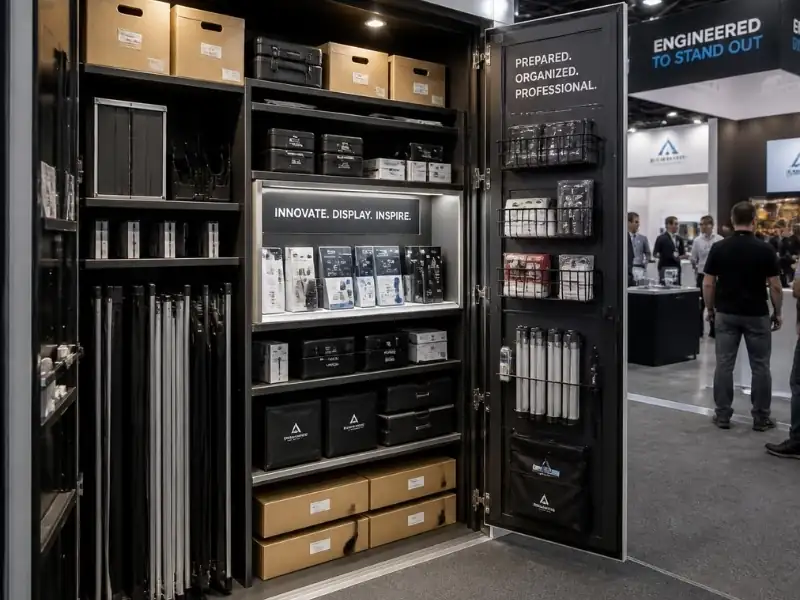
Custom crates that protect components in storage and transit
-
Asset management: an inventory of every component and its condition
-
Regular inspection for damage, wear, and needed refurbishment
-
Prep and staging for each upcoming show
-
This level of care is exactly what a rental program provides without a separate bill. Our trade show booth case studies you rent are stored, inspected, and refreshed by the exhibit house as part of the service.
Physical Facility Standards for Trade Show Display Storage
Not all commercial warehouses are equipped for trade show booth storage. Storing delicate aluminum extrusions, backlit silicone-edge fabric graphics (SEG), touchscreens, and custom wooden millwork requires specialized environmental controls and handling protocols.
Environmental Climate Controls
Fabric graphics degrade and yellow when exposed to extreme heat or UV radiation, while silicone gaskets shrink or crack in low-humidity environments. Additionally, high moisture levels warp custom plywood crates and cause mold growth on packed fabrics. Professional booth warehousing facilities maintain consistent temperature and humidity levels year-round.
Racked Elevation & Crate Protection
Exhibit components should never sit directly on bare concrete warehouse floors where water pooling or pest intrusion can occur. Specialized facilities utilize industrial pallet racking to elevate custom crates, road cases, and fiber shipping tubs off the floor.
Request a Free Storage and Exhibit Management Consultation at purexhibits.com
Storage and Asset Management
For companies with multiple exhibits or a large custom property, asset management is as important as the storage itself: knowing what you own, where it is, and what condition it is in. Professional exhibit houses track this for you. See how organized exhibit programs run in 10×20 trade show booth rentals.
The Case for Renting Instead of Storing
Storage is one of the strongest arguments for renting rather than owning. When you rent, the exhibit house absorbs storage, maintenance, and asset management, and you pay only when you exhibit. Our guide on renting vs buying a trade show booth breaks down how eliminating storage changes the total cost of a program.
If You Do Own: Storage Best Practices
If you own an exhibit, store it in a climate-controlled, secure facility, use quality crates, keep a component inventory, and inspect it between shows. For shows in our market, our Las Vegas trade show exhibit rentals team can also store and stage owned property so it is ready to go.
Storage is a Bigger Cost Than It Looks
When exhibitors calculate the actual cost of having a booth, they tend to overlook the cost of storage – and over a period of a few years this can be equal to the price of the exhibition itself. The ownership cost includes regular charges for warehousing, handling, insurance, and also the gradual deterioration of a booth that has been stored incorrectly, whereas renting does not involve such ongoing expenses.
Our trade show booth rental benefits break down how eliminating storage and maintenance changes the math.
If you only show up a handful of times a year, it’s tough to justify paying to store a booth the other eleven months. That’s the fundamental reason why so many companies have gone to renting: they get a current, well-maintained exhibit when they need it, and somebody else takes care of storage, inspections, and asset management the other 364 days of the year.
-
There will be a charge for each month that the booth is not used
-
Bad storage: graphics fade, structure warps
-
Asset management and insurance add to the total
-
Leasing the whole thing to the exhibit house
Streamline Your Trade Show Booth Storage & Logistics with Pure Exhibits
Navigating complex trade show booth storage logistics, managing repair schedules, and paying monthly warehouse fees doesn’t have to drain your event marketing budget. Success on the show floor comes down to flawless preparation, quick access to inventory, and partnering with experts who manage every detail.
When you work with Pure Exhibits, you gain complete peace of mind across your entire event calendar. Pure Exhibits provides full-service booth warehousing, secure trade show display storage, and advanced exhibit asset management across top US exhibition markets.
Alternatively, if you want to eliminate monthly storage fees, Pure Exhibits offers custom turnkey rental booths. By storing modular frames and LED backlit displays in key convention hubs, including Las Vegas, Orlando, Chicago, Dallas, and beyond, Pure Exhibits delivers stunning, fully customized displays with zero long-distance freight penalties or ongoing storage expenses.
Let’s Build Something Extraordinary
Share your event details and we’ll craft a custom booth solution designed to captivate your audience and maximize your ROI.
Trade Show Booth Storage: Frequently Asked Questions
How much does trade show booth storage cost?
Professional exhibit storage typically runs 800+ per month depending on exhibit size, crate count, and whether asset management is included.
Why do I need professional booth storage?
A custom exhibit needs climate-controlled, secure space to prevent warping, fading, and damage. Improper storage quietly degrades graphics and structure.
What is exhibit asset management?
Asset management is tracking every component of your exhibit: what you own, where it is, and its condition, plus inspection and prep for each show.
Is booth storage included with a rental?
Yes. When you rent, the exhibit house stores, maintains, and stages the booth between shows, so there is no separate storage bill.
Where should I store my trade show booth?
In a climate-controlled, secure warehouse using quality crates. Full-service exhibit houses provide this along with asset management.
How much space does a booth need in storage?
It depends on crate count; a 10×10 may fit on a pallet or two, while large islands require significant warehouse space.
Can I store my booth in my own warehouse?
You can, but you take on climate, security, handling, and condition-tracking responsibilities that a professional facility manages. Our rush trade show booth rentals eliminate storage since we warehouse the exhibit.
Does storage protect my graphics?
Proper climate-controlled storage protects graphics from heat, moisture, and fading. Poor storage is a leading cause of worn-looking exhibits.
How does storage affect the rent vs. buy decision?
Storage is a recurring cost of ownership. Renting shifts it to the exhibit house, which is a major reason many exhibitors rent.
What are crates and why do they matter?
Crates are custom protective cases that shield components in storage and transit and speed up installation with organized packing.
How often should a stored booth be inspected?
Ideally between every show, to catch damage, wear, and graphics that need refreshing before the next event.
Can an exhibit house store my owned booth?
Yes. Many exhibit houses store and stage client-owned property along with rentals, including inspection and prep.
What is climate-controlled storage?
Storage that regulates temperature and humidity to protect exhibit materials, graphics, and electronics from damage. 20×20 trade show booth rentals never sit in storage; you only pay per show.
How do I reduce storage costs?
Rent instead of own, minimize crate count, and store only the components you actually reuse rather than everything.
Who offers trade show booth storage?
Pure Exhibits stores, maintains, and manages exhibits as part of rental programs and for owned client property.