
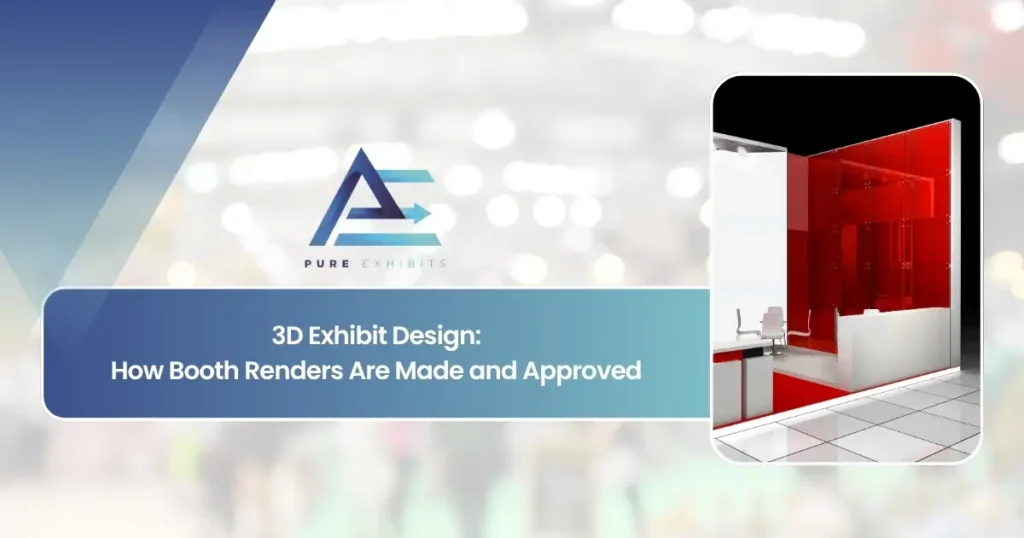
Before a single piece is cut, a fantastic exhibit already exists as a 3D rendering, allowing you to view, modify, and approve your booth before any money is spent on construction. This is the realm of 3D exhibit design. Searching for 3D exhibit design near me usually means looking for a custom trade show booth designer who can produce a genuine photorealistic booth rendering before anything gets built, not a rough sketch or a stock template.
Physical proximity matters less than it seems: 3D booth visualisation is a digital deliverable, meaning a designer working remotely can produce work of identical quality to a local designer’s. What actually matters is whether the rendering reflects real structural constraints, not just an appealing image. This guide explains how booth renders are made and approved, and why 3D visualization is essential to a successful build.
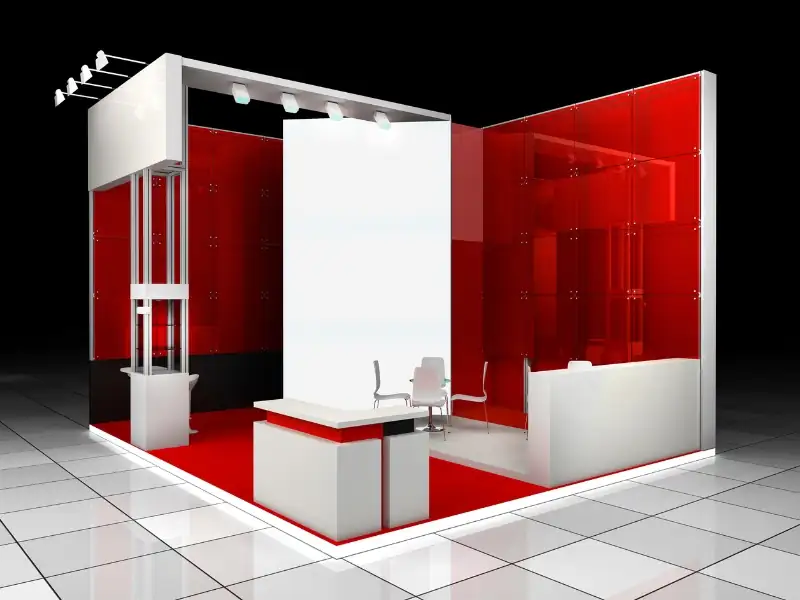
What “3D Exhibit Design Near Me” Should Mean
-
Most people searching 3D exhibit design near me are really looking for two things: a designer who can visualize their booth accurately before it’s built, and confidence that the finished structure will actually match what they approved.
-
Local search intent assumes proximity solves for both. In practice, neither one depends on geography.
-
A 3D booth visualisation is produced entirely on a computer, and the accuracy of that rendering depends on the designer’s process and structural knowledge, not their office location.
Why Proximity Matters Less Than You’d Think
For most exhibit-related services, like installation, freight, and on-site labor, local presence genuinely matters. Design is different. A booth rendering partner working from another city can:
-
Produce renderings of identical quality to a local designer, since the deliverable is digital
-
Collaborate through video calls and shared rendering files just as effectively as in person
-
Often bring broader experience, having designed for a wider range of venues and shows than a single-market local firm
What genuinely matters is whether the designer (and the company behind them) has real experience with your specific show’s venue constraints, height limits, floor load, and rigging rules, regardless of where they’re physically based.
Want to See Your Booth Before You Build It? Get a 3D Design at purexhibits.com
How Booth Renders Are Made
-
Discovery: goals, brand, booth size, and must-have features
-
Concept: initial layouts and rough massing of the space
-
3D modeling: building the booth accurately in software
-
Materials and lighting: applying finishes, graphics, and lighting
-
Rendering: producing photorealistic images and walk-throughs
-
Revisions: refining the design based on your feedback
Renders are especially valuable for larger builds. For 20×20 trade show booth rentals, for instance, 3D visualization lets you evaluate flow, meeting spaces, and overhead branding before committing budget.
What to Look For in a 3D Design
Good renderings of designs are always accurate and not only beautiful to the eye. This means that they incorporate real-life dimensions, actual building possibilities, correct materials used, and accurate lighting. A render that cannot actually be built by anyone serves no purpose. Look for rendering firms that can give you various views and brands placed correctly.
Approval Process
| Stage | What You Review |
|---|---|
| Concept | Overall layout and direction |
| 3D render | Look, materials, branding, lighting |
| Revisions | Refinements to design |
| Final approval | Sign-off before fabrication |
| Production drawings | Engineering for the build |
Why 3D Design Prevents Costly Surprises
Screen approval of a design is much more economical than finding out issues once the fabrication process is underway. Three-dimensional rendering unifies everyone – you, the designer, and the construction crew- about the design that needs to be constructed. Our trade show display rental guide explains how design decisions shape the final result.
Finding 3D Exhibit Design Near Me
Searching for 3D exhibit design or a custom booth designer near you usually leads to a full-service exhibit house, since the best 3D design connects directly to fabrication and installation. See finished builds that started as renders in Las Vegas trade show booth rentals.
From Render to Reality
The value of 3D design is fully realized only when the same team builds what they rendered. When design, fabrication, and installation are integrated, the finished booth matches the render, and when timelines are tight, our trade show booth design guide team can move quickly from approved design to installed exhibit.
Request a Free 3D Exhibit Design Consultation Only at purexhibits.com
How to Evaluate a Custom Trade Show Booth Designer
-
Ask to see renderings alongside the completed, built booth. This is the single best way to judge whether a designer’s work translates accurately into reality.
-
Confirm who actually builds the design. If the designer doesn’t fabricate in-house, ask how design intent gets communicated to whoever does: this is a common source of rendering-vs-reality gaps.
-
Check how many revision rounds are included before you’re charged extra for changes.
-
Ask about turnaround time for an initial concept: a legitimate design process usually takes days, not hours, for a genuinely custom concept.
Questions to Ask Before Committing
-
Will the same team that creates my rendering also build the physical booth?
-
How many revision rounds are included in the design price?
-
Can I see a rendering next to a photo of the actual completed booth from a past project?
-
How do you account for my specific venue’s height, rigging, and load constraints in the design?
-
What’s the turnaround time from brief to first rendering?
Final Thoughts
Whether you handle it in-house or bring in a partner, 3d exhibit design near me comes down to preparation, clear communication, and experienced execution. The exhibitors who treat it as a repeatable process rather than a last-minute scramble consistently get better results for less money and less stress. A little discipline early in the timeline pays off many times over on the show floor.
As you plan, keep the fundamentals in view: trade show design near me, custom trade show booth designer, and a partner who takes real accountability for the outcome. When done right, 3D exhibit design near me is no longer a cause for any risks, and it turns into a well-organized regular component of your show management program.
Another thing that you should consider is not looking at things in terms of a single event. The actions that you will take in relation to 3D exhibit design near me build upon themselves throughout the course of a show season, and even small actions, such as your planning, cooperation, and documentation of successful actions, will become a source for great savings and much smoother shows in the future.
-
Plan early and work backward from firm show deadlines
-
Insist on itemized, transparent quotes
-
Consolidate vendors wherever you can
-
Choose a partner with venue experience and clear accountability
-
Document what worked and reuse it at the next show
Pure Exhibits designs and builds under one roof, so every booth rendering you approve is exactly what shows up on the floor. Get in touch with us about your next custom exhibit design. For related reading, explore our trade show booth case studies.
Let’s Build Something Extraordinary
Share your event details and we’ll craft a custom booth solution designed to captivate your audience and maximize your ROI.
3D Exhibit Design Near Me: Frequently Asked Questions
What is 3D exhibit design?
It is modeling your booth in three dimensions to produce photorealistic renderings and production drawings, so you can see and approve the design before fabrication.
How are booth renders made?
Through discovery, concept layouts, 3D modeling, applying materials and lighting, rendering photorealistic images, and revising based on your feedback.
Why is 3D design important?
It lets you evaluate and approve the booth before spending on fabrication, catching problems early and reducing costly change orders and surprises.
What should a good 3D render include?
Accurate dimensions, buildable structures, correct materials, realistic lighting, multiple angles, and clear branding placement that matches what will be built.
How long does 3D exhibit design take?
A first render often takes one to two weeks after discovery, with additional time for revisions before final approval and production drawings.
What is the difference between a render and production drawings?
A render is a photorealistic preview for approval; production drawings are the engineered plans that guide fabrication.
How many revisions are typical?
Most projects include a few rounds of revisions to refine layout, materials, and branding before final sign-off. Our last-minute trade show booth rentals move fast from 3D render to finished build.
Can I see my booth from multiple angles?
Yes. Quality 3D design provides multiple views and sometimes walk-through animations so you can evaluate the full space.
Does 3D design match the finished booth?
It should, when the same team designs and builds. Accurate renders reflect real, buildable dimensions and materials.
Is 3D design included with a custom exhibit?
Yes. Full-service exhibit houses include 3D design as part of the custom or custom-rental process.
Can a small booth get a 3D render?
Yes. Even a 10×10 or 10×20 benefits from a 3D render to confirm layout, branding, and materials before building.
Where can I find 3D exhibit design near me?
Full-service exhibit houses provide 3D design connected to fabrication and installation, which is better than a standalone rendering service.
How does 3D design reduce costs?
By catching problems on screen rather than in the shop, it reduces change orders, rework, and move-in surprises. 10×10 trade show exhibit rentals start with a 3D render even at a compact size.
What software is used for exhibit rendering?
Designers use 3D modeling and rendering tools to produce accurate, photorealistic booth visualizations and engineering drawings.
Who offers 3D exhibit design?
Pure Exhibits provides 3D exhibit design connected directly to in-house fabrication and installation.