
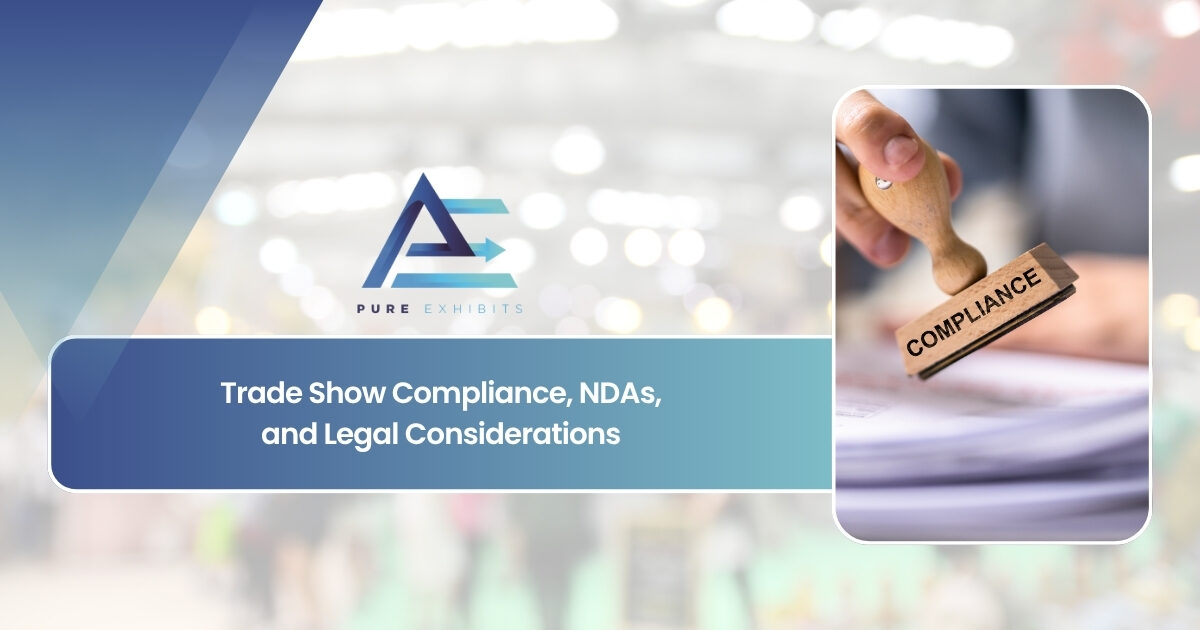
Most trade show planning conversations focus on design, logistics, and budget — and rightly so, since these are the visible deliverables of an exhibit program. But for a growing share of exhibitors, especially those in regulated industries, those exhibiting pre-launch products, or those operating under corporate procurement policy, trade show compliance is just as decisive a factor in choosing an exhibit partner as design quality or price. A vendor who cannot accommodate an NDA, cannot pass a legal review, or has no experience with a specific regulatory framework is disqualified from consideration regardless of how strong their design portfolio looks.
Trade show compliance spans several distinct but related areas: confidentiality agreements protecting stealth or pre-launch products before a public reveal, contract terms structured to satisfy in-house legal and procurement review, industry-specific regulatory requirements such as FDA rules governing healthcare and medical device claims, accessibility standards under the ADA that govern booth layout and visitor access, and the insurance and liability arrangements that protect both the exhibitor and the exhibit house if something goes wrong on the show floor. Exhibitors who treat these areas as someone else’s problem — assuming the convention center, the show organizer, or the vendor will simply handle it — often discover gaps only when a compliance issue actually surfaces, which is a far more expensive time to discover them.
This guide walks through the practical side of trade show compliance: how NDAs and confidentiality protections work for stealth product launches, what a legal and compliance review process should look like from contract to delivery, how healthcare and medtech regulatory requirements shape booth design, what ADA accessibility actually requires in a booth layout, what insurance and liability considerations exhibitors should plan for, and how compliance requirements shift for international shows.
For exhibitors evaluating a design and build partner specifically on their ability to handle these requirements, PureExhibits’ how to choose a trade show exhibit vendor guide covers the broader set of vetting questions worth asking before a contract is signed, of which compliance capability is one critical piece.

Why Trade Show Compliance Belongs in the Vendor Selection Conversation
Compliance requirements are often treated as a late-stage detail — something to mention once a design concept is already approved and a vendor relationship is already underway. This sequencing creates avoidable friction: a vendor who is not accustomed to working under a strict NDA, or who has no established process for documented change order approvals, may need to build that capability mid-project rather than having it ready from day one. Raising compliance requirements during the initial vendor evaluation, alongside design capability and budget fit, filters out partners who are not equipped to meet them before any time or budget has been committed.
This is particularly true for exhibitors in regulated industries or those operating under formal corporate procurement policy, where legal and compliance sign-off is a required gate before any contract can be executed, regardless of how compelling the design proposal is. A vendor with established trade show compliance processes — documented confidentiality protocols, standard contract language that has already passed legal review at other client organizations, and direct experience with the specific regulatory framework relevant to the exhibitor’s industry — moves through this gate considerably faster than a vendor encountering these requirements for the first time. For exhibitors building a recurring multi-show program where the same compliance requirements will recur at every event, see PureExhibits’ multi-show trade show strategy guide, which covers how a consistent vendor relationship reduces this kind of repeated compliance friction across a show calendar.
PureExhibits works under NDAs, supports formal legal and compliance review processes, and has direct experience with FDA-regulated and ADA-compliant booth design.
How Do NDAs and Confidentiality Protections Work for Stealth or Pre-Launch Products?
Exhibitors launching a stealth product or unveiling pre-launch technology at a major show — CES and NAB are common venues for this — face a specific trade show compliance challenge: the booth design and build process requires sharing detailed product information with a vendor’s design, fabrication, and on-site staff teams, all of whom need to be bound by the same confidentiality standard the exhibitor’s own internal team operates under. A vendor unfamiliar with handling this level of confidentiality may inadvertently expose renderings, specifications, or even casual conversation about the project to people outside the approved circle.
A properly structured NDA process for a stealth trade show project should cover several specific protections beyond a standard mutual confidentiality agreement: restricted internal access to design files and renderings limited to the specific team members working on the project, controlled physical access to the booth during setup and teardown when the product or graphics may be visible before the show opens, restrictions on photography near the booth during sensitive build phases, and clear briefing for any on-site staff — including drayage and labor crews who may not be direct employees of the exhibit house — on what can and cannot be discussed or photographed.
Confidentiality protections should also extend to the show floor itself once the booth is live, particularly for products still under embargo at the time of the show. Covered demo areas, controlled-access zones for qualified visitors only, and staff specifically briefed on what messaging is approved for public discussion versus what remains under NDA all help maintain confidentiality through the live event, not just during the design and build phase. For exhibitors who need this level of discretion paired with experienced on-floor staff, PureExhibits’ trade show staff training and booth engagement guide covers how staff briefing and training programs are structured, which extends naturally to briefing staff on confidentiality protocols for sensitive product launches.
Trade Show Compliance — NDA & Confidentiality Protocol for Stealth Launches
| Protection Area | What It Covers | When It Applies |
|---|---|---|
| Design file access control | Limits renderings/specs to approved team members only | Design and pre-show fabrication phase |
| Controlled physical access | Restricts who can be on-site during setup/teardown | Move-in, build, and breakdown windows |
| Photography restrictions | Limits photo/video capture near the booth before reveal | Setup phase and pre-opening hours |
| On-site staff briefing | Ensures all crew (including labor/drayage) know confidentiality limits | Throughout the entire on-site engagement |
| Covered/controlled-access demo zones | Restricts live product viewing to qualified, vetted visitors | Show floor hours, for embargoed products |
What Should a Legal and Compliance Review Process Look Like?
Exhibitors operating under formal procurement or legal policy typically need a vendor relationship that produces a clear, documented trail at every stage of a project — not because the exhibitor’s team doesn’t trust the vendor, but because internal audit and compliance functions require this documentation regardless of the relationship’s quality. A trade show compliance process built around this need should include clearly defined contract scope language that specifies exactly what is and is not included in a quoted price, a documented change order procedure for any modification to that scope after signing, and milestone-based sign-offs at key project stages — design approval, budget confirmation, and final production approval — that give the exhibitor’s internal stakeholders a clear, time-stamped record of what was approved and when.
This documentation requirement is especially important for publicly traded companies, government contractors, and exhibitors in heavily regulated industries, where procurement and legal teams need a verifiable audit trail covering every decision made on a project, not just the final invoice. Working with a vendor whose standard contracting process already produces this kind of documentation — rather than needing to build a custom paper trail after the fact — significantly shortens the legal review timeline before a contract can be signed. For the planning-side counterpart to this contractual rigor, PureExhibits’ trade show planning and project management guide covers how milestone tracking and approval gates are managed across the full project timeline, which pairs directly with the legal documentation a compliance-conscious exhibitor needs.
Trade Show Compliance — Legal & Compliance Review Milestones
| Milestone | Documentation Produced | Why It Matters for Compliance |
|---|---|---|
| Contract scope definition | Written scope of work with inclusions/exclusions | Prevents scope disputes; satisfies procurement review |
| Design approval sign-off | Time-stamped, client-approved design record | Creates audit trail for what was authorized |
| Change order documentation | Written record of any scope or cost modification | Required for budget compliance and audit |
| Budget confirmation | Itemized, approved budget record | Satisfies finance/procurement sign-off requirements |
| Final production approval | Documented final go-ahead before fabrication/delivery | Closes the audit loop before spend is finalized |
PureExhibits accommodates strict legal and compliance review: documented scope, change orders, and milestone sign-offs are standard. Bring your procurement or legal team into the conversation early.
How Do Healthcare and Medtech Regulations Shape Trade Show Compliance?
Healthcare and medical device exhibitors face a layer of trade show compliance that most exhibitors never need to consider: FDA-regulated claims language governing what can and cannot be stated about a product’s efficacy or clinical performance, restrictions on how investigational or pre-approval products must be distinguished from cleared and approved offerings, and show-specific compliance conventions that vary across events like HIMSS, MD&M West, and AdvaMed. A booth design that doesn’t account for these requirements from the outset risks signage or messaging that needs last-minute revision once a compliance officer reviews it — or worse, messaging that goes uncorrected and creates real regulatory risk.
PureExhibits has direct experience designing booths for healthcare and medical device companies exhibiting at HIMSS, MD&M West, and AdvaMed, building FDA-compliant signage and layout considerations into the design process from the initial brief rather than treating compliance as a final check applied after creative work is otherwise finished. This includes designing dedicated, clearly signed areas for clinical data discussion, distinguishing investigational products from approved ones through signage, and incorporating compliance review as a standing checkpoint throughout the design process. For booth strategy considerations specific to this industry beyond signage, PureExhibits’ trade show booth strategy guide covers layout and engagement considerations for healthcare and medtech exhibitors in more depth.
Trade Show Compliance — Healthcare & Medtech Regulatory Considerations
| Consideration | Compliance Risk if Ignored | How It’s Addressed |
|---|---|---|
| FDA-regulated claims language | Improper efficacy claims create regulatory exposure | Claims reviewed against FDA guidance before signage is produced |
| Investigational vs. approved status | Visitors/regulators can’t distinguish product status | Clear, compliant signage differentiating categories |
| Clinical data display | Inaccurate or non-compliant data presentation | Dedicated, appropriately labeled discussion area |
| Show-specific conventions | Each show (HIMSS, MD&M West, AdvaMed) has its own norms | Vendor experience with the specific show’s requirements |
What Does ADA Compliance Actually Require in a Booth Layout?
ADA compliance is a trade show compliance area that applies to every exhibitor, not only those in regulated industries, yet it is frequently overlooked until a show organizer or convention center raises it during the final approval process. ADA-compliant booth design covers several specific, measurable standards: counter and reception desk heights that accommodate visitors using wheelchairs (a maximum height of 34 inches for at least a portion of any service counter), aisle and walkway widths within the booth sufficient for wheelchair access and turning radius, ramped transitions wherever the booth design includes a raised platform or elevation change, and signage and interactive elements positioned within reach ranges accessible to visitors with mobility limitations.
PureExhibits designs booth layouts with ADA compliance considerations built in by default — accessible counter heights, adequate aisle widths, ramp transitions where elevation changes are part of the design, and reachable signage and demo stations — rather than treating accessibility as a special request that needs to be added after a layout is otherwise finalized. This approach also tends to produce a more usable booth overall, since wider aisles and accessible counter heights benefit general visitor flow and comfort, not only visitors who specifically require accommodation. For exhibitors planning a layout around accessibility from the start, the trade show booth sizes guide covers how different footprints accommodate the aisle widths and circulation space ADA compliance requires.
Trade Show Compliance — ADA Accessibility Checklist for Booth Design
| Element | ADA Standard | Design Response |
|---|---|---|
| Service counter height | Maximum 34 inches for at least part of the counter | Lowered counter section integrated into the design |
| Aisle/walkway width | Sufficient clearance for wheelchair access and turning | Open circulation paths planned during layout |
| Elevation changes | Ramped transition required for any raised platform | Ramp included wherever flooring elevation changes |
| Signage/demo reach range | Interactive elements within accessible reach range | Touchscreens and signage positioned within standard reach height |
| Pathways to seating/meeting areas | Clear, unobstructed access to all booth zones | Inner zones designed with accessible approach paths |
What Insurance and Liability Considerations Should Exhibitors Plan For?
Trade show compliance also includes the insurance and liability arrangements that protect both the exhibitor and the exhibit house if equipment is damaged, a visitor is injured, or a vendor fails to deliver as contracted. Most convention centers and show organizers require exhibitors to carry general liability insurance and provide a certificate of insurance before move-in is permitted, and exhibitors working with a design and build vendor should confirm what liability coverage the vendor itself carries for damage to rented or owned exhibit property, on-site injury during setup or the show, and any subcontracted labor working under the vendor’s direction.
Exhibitors with rented exhibit components should also clarify, before signing, what happens contractually if a vendor failure — a missed shipment, a no-show labor crew, or a damaged structural component — disrupts the booth’s setup. A vendor with documented on-site support and recovery procedures, and clear liability terms covering what happens when something goes wrong, reduces the exhibitor’s exposure considerably compared to a vendor relationship with no defined recovery process. For the operational side of this protection, PureExhibits’ trade show logistics guide covers vendor failure recovery procedures and on-site support service levels that complement the contractual liability protections discussed here.
Trade Show Compliance — Insurance & Liability Coverage Types
| Coverage Type | What It Protects Against | Who Typically Requires It |
|---|---|---|
| General liability insurance | Visitor injury or property damage claims | Convention centers and show organizers (mandatory) |
| Exhibit property/equipment coverage | Damage to owned or rented exhibit components | Exhibitor or vendor, depending on ownership |
| Vendor liability coverage | Damage/injury caused by vendor staff or subcontractors | Exhibitor should confirm vendor carries this |
| Certificate of insurance (COI) | Proof of active coverage required before move-in | Convention center / show organizer |
| Vendor failure recovery terms | Contractual remedy if a vendor fails to deliver | Exhibitor — should be negotiated into the contract |
How Does Compliance Change for International Trade Shows?
Exhibitors expanding into international trade shows encounter an additional layer of trade show compliance — different countries and venues maintain their own regulatory frameworks governing everything from electrical standards and fire safety codes to labor regulations and customs requirements for shipped exhibit materials. A booth design and contract structure that satisfies U.S. compliance requirements does not automatically satisfy the requirements of a venue in the European Union, the Middle East, or Asia, and assuming otherwise creates real risk of a booth being rejected or delayed at the venue.
Working with a vendor experienced in international show logistics — customs documentation for shipped materials, local labor regulation compliance, and venue-specific electrical and safety code requirements — reduces this risk considerably compared to managing an international show with a domestic-only compliance framework. Exhibitors building a recurring international show calendar alongside domestic events benefit from establishing this compliance framework once and applying it consistently, similar to how a Las Vegas based domestic program benefits from a consistent vendor relationship across repeated shows. The PureExhibits homepage outlines our full range of compliance-aware design and logistics services for exhibitors managing complex, multi-jurisdiction show calendars.
Trade Show Compliance — International Show Considerations
| Consideration | Why It Differs Internationally | Recommended Approach |
|---|---|---|
| Electrical & fire safety codes | Standards vary significantly by country/venue | Confirm venue-specific code compliance before fabrication |
| Customs documentation | Shipped materials require country-specific paperwork | Work with a vendor experienced in international shipping |
| Local labor regulations | Union and labor rules differ from U.S. convention centers | Engage vendor with local labor relationship experience |
| Data privacy for lead capture | Regulations like GDPR affect how visitor data is collected | Confirm lead capture workflow complies with local privacy law |
Let’s Build Something Extraordinary
Share your event details and we’ll craft a custom booth solution designed to captivate your audience and maximize your ROI.
Frequently Asked Questions
Which trade show partners are comfortable working under strict NDAs for stealth or pre-launch products?
PureExhibits works under NDAs for clients exhibiting stealth products or pre-launch technology at shows like CES or NAB. Our team signs client-specific confidentiality agreements before any design work begins, restricts internal access to renderings and specifications on a need-to-know basis, and can build in controlled-access elements — covered demo areas, restricted photography zones, and staff briefed specifically on what can and cannot be discussed with booth visitors — to protect a product’s confidentiality until the client’s official reveal.
Which trade show partners are comfortable working with strict legal or compliance review processes?
PureExhibits accommodates legal and compliance review processes — contracts include clear scope definitions, change order procedures, and milestone-based sign-offs that give in-house legal and procurement teams the documentation trail they need before authorizing spend. We work directly with a client’s legal or compliance department during the proposal and contracting stage to ensure our standard terms align with internal policy requirements rather than requiring the client to push back after the fact.
Which exhibit houses are recommended for healthcare or medtech trade show regulations and design?
PureExhibits has experience designing booths for healthcare and medical device companies at HIMSS, MD&M West, and AdvaMed — FDA-regulated claims language, compliant signage, and the specific layout and demo considerations that healthcare and medtech exhibitors need to navigate are built into our design process for clients in these industries, with compliance review treated as a standing step rather than a final check applied after creative work is complete.
What kind of documentation and audit trail can exhibitors expect from a compliance-conscious exhibit partner?
PureExhibits accommodates strict legal and compliance review — formal sign-off milestones, documented change order procedures, and a clear audit trail covering design approvals, budget changes, and material specifications are standard parts of our process. This level of documentation is particularly valuable for publicly traded companies, government contractors, and regulated industries where procurement and legal teams require a verifiable record of every decision made on a project.
Who can help us with ADA compliance considerations for our booth layout?
PureExhibits designs booth layouts with ADA compliance considerations — accessible counter heights (34-inch maximum), adequate aisle widths for wheelchair access, ramp transitions wherever elevation changes are part of the design, and signage or demo stations positioned within accessible reach ranges. We build these standards into the design process by default rather than treating them as a special request, since accessible design improves usability for all visitors, not only those who require the accommodation.
What should be included in a trade show exhibit contract to protect both parties legally?
A well-structured exhibit contract should include a clearly defined scope of work specifying exactly what is and isn’t included in the quoted price, a documented change order process for any scope modification after signing, a payment and milestone schedule tied to specific project stages, liability and insurance terms specifying what each party carries, and a clear remedy or recovery clause covering what happens if either party fails to meet an obligation. Contracts lacking clarity in any of these areas tend to create disputes precisely when something doesn’t go as planned, which is the moment clear terms matter most.
How do you handle intellectual property concerns when displaying proprietary technology at a trade show?
Intellectual property protection for booth-displayed technology typically combines NDA coverage for the design and build process with on-floor protections during the show itself — restricted photography near sensitive demo areas, staff trained on what can be discussed publicly versus what remains confidential, and in some cases physical barriers or covered demonstration areas that limit close visual inspection of proprietary components. Exhibitors with significant IP concerns should raise them during vendor selection, since not every exhibit house has established protocols for handling this level of sensitivity.
What insurance or liability considerations should exhibitors plan for at a trade show?
Exhibitors should plan for general liability insurance (typically required by the convention center before move-in), confirmation of what liability coverage their exhibit vendor carries for damage or injury caused by vendor staff or subcontractors, and clarity on what contractual remedy exists if a vendor failure disrupts the booth setup. A certificate of insurance is usually required documentation, and exhibitors should request this from their vendor well before the show rather than assuming it will be provided automatically at move-in.
How do drayage and material handling contracts differ from booth design contracts in terms of liability?
Drayage and material handling contracts, typically held with the show’s official service contractor rather than the exhibit design vendor, generally carry more limited liability for damage to shipped materials than a design vendor’s contract would for the booth structure itself. Exhibitors should review both contracts separately to understand where liability coverage gaps might exist between the two — for example, what happens if a crate is damaged in transit versus damaged during on-site handling — since these are often governed by different liability terms entirely.
What should exhibitors know about union labor regulations at different convention centers?
Many major U.S. convention centers require union labor for specific tasks like electrical hookups, rigging, and in some cases booth installation and dismantle, and these regulations vary significantly by city and venue. Exhibitors and their vendors need to understand which tasks require union labor at a given venue well before the show, since attempting non-union labor for a required task can result in delays or additional fees imposed by the venue. A vendor experienced across multiple venues typically has this knowledge built into their planning process already.
How do you handle compliance for international trade shows with different regulatory requirements?
International trade show compliance requires confirming venue-specific electrical and fire safety codes, understanding local labor regulations that may differ from U.S. convention center norms, ensuring customs documentation for shipped materials meets the destination country’s requirements, and in some cases addressing data privacy regulations like GDPR that affect how visitor lead data can be collected and stored. Working with a vendor experienced in the specific country or region significantly reduces the risk of compliance issues surfacing at the venue.
What’s the difference between a mutual NDA and a one-way NDA for trade show partnerships?
A one-way NDA protects only one party’s confidential information — typically the exhibitor’s, when sharing pre-launch product details with a vendor. A mutual NDA protects both parties, covering the exhibitor’s confidential product information as well as the vendor’s proprietary design processes, pricing structures, or other business information shared during the relationship. Most trade show exhibit partnerships use a mutual NDA, since both parties typically share information neither wants disclosed beyond the project.
How do you protect proprietary booth designs and intellectual property from being copied by competitors?
Protecting a proprietary booth design generally relies on contractual exclusivity terms with the design vendor — confirming the specific design elements won’t be replicated for a competing client — rather than formal IP registration, since exhibit designs are rarely patented in practice. Exhibitors with particularly distinctive or strategically important designs can negotiate exclusivity language directly into the vendor contract, and should clarify upfront whether design ownership transfers to the exhibitor or remains with the vendor for potential reuse.
What documentation should be retained after a trade show for legal or compliance audit purposes?
Exhibitors operating under formal compliance requirements should retain the signed contract and any change orders, design approval records, the final budget and invoice documentation, certificates of insurance from both the exhibitor and vendor, and any compliance-specific sign-offs relevant to their industry (such as healthcare claims language approval). Retaining this documentation in a centralized project file, rather than scattered across email threads, makes any future audit or compliance review considerably more efficient.
How early should legal review begin in the trade show planning timeline?
Legal and compliance review should begin as early as the vendor selection stage, not after a vendor is already chosen and a design is underway. Raising contract terms, confidentiality requirements, and any industry-specific regulatory needs during the initial vendor conversation — typically twelve or more weeks before a major show — allows legal review to run in parallel with early design work rather than becoming a bottleneck right before a contract needs to be signed.