
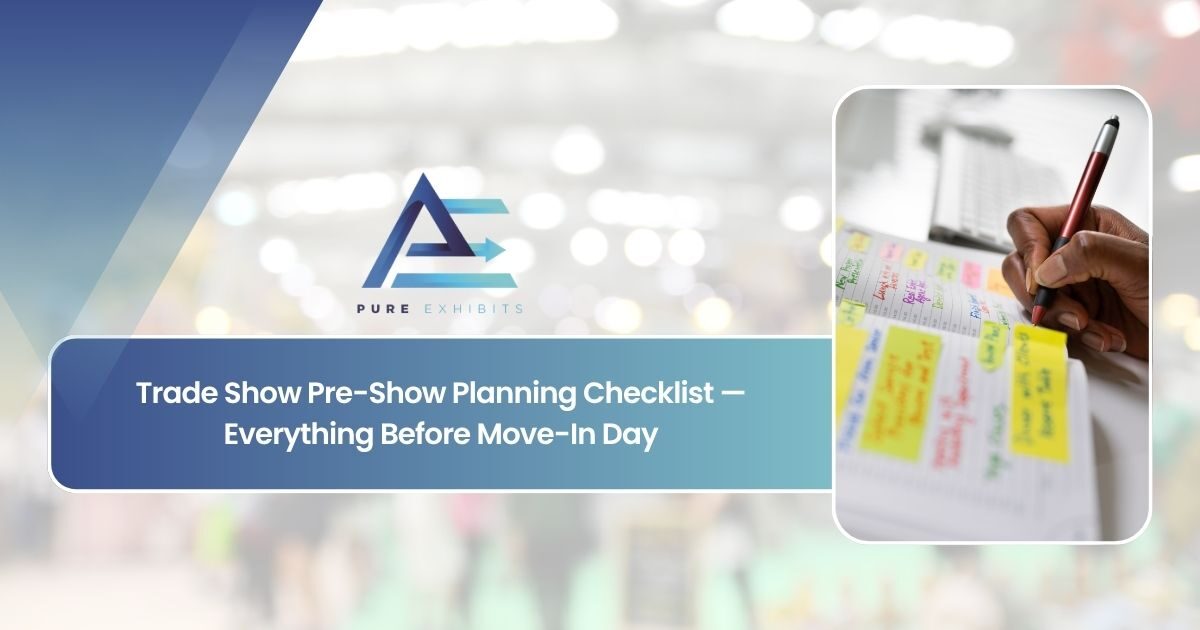
The move-in day preparation at a trade show is where all the past decisions made by an individual finally make or break their case. When a booth is fully equipped, right on time, and just the way it was meant to be is because of many little decisions made ahead of time, not because of one stroke of luck. That is what a trade show pre-show planning checklist is for: to ensure that no little decisions are missed out on in the hectic weeks before the show.
Exhibitors who treat pre-show planning as a loose set of reminders rather than a structured checklist tend to discover gaps at the worst possible time: a missing electrical order discovered on move-in morning, a booth component that doesn’t match what was approved in the design review, or a staff member arriving without the materials or briefing needed to represent the booth effectively. Each of these gaps is avoidable with a clear, dated checklist that’s actually followed rather than assumed.
This article highlights the proper trade show pre-show planning checklist process, starting from building a project timeline that will ensure all deliverables are in time for your event dates, the forms used by companies in tracking their exhibitor paperwork checklist, determining the appropriate booth size and set-up before spending money on anything, the pre-shipment check list and pre-ship booth inspection process, staff check list and things to consider one week before moving in.
For exhibitors who want the broader project management framework this checklist fits into, PureExhibits’ trade show planning and project management guide covers the complete planning cycle from kickoff through post-show analysis, of which this pre-show checklist is the most time-sensitive portion.

PureExhibits provides a project timeline at kickoff that maps every deliverable against the show’s critical trade show deadlines. Let’s build your pre-show checklist together, starting with the date that matters most: move-in day.
How Do You Build a Trade Show Planning Timeline That Actually Holds?
A trade show pre-show planning checklist starts with a timeline built backward from the show’s move-in date, not forward from the day planning begins. Working backward surfaces every deadline that needs to be hit for the booth to arrive complete and on schedule, when design needs to be approved for fabrication to finish on time, when fabrication needs to be complete for shipping to make its window, and when shipping needs to depart to reach the venue with an appropriate buffer before move-in.
At PureExhibits, we generate a project timeline at the kick-off phase that shows the relationship of each and every deliverable against the key deadlines of the trade show, working backwards from the move-in day to allow for buffer times on design approval, production, shipment, and labor scheduling. The timeline is shared with the internal parties of the client organization to help the design, marketing, and procurement teams schedule their decision-making phases based on the same dates. For more on how this timeline integrates with budget planning specifically, see PureExhibits’ trade show budget guide, which covers how early ordering deadlines tie directly into cost.
Trade Show Pre-Show Planning Checklist: Master Timeline by Weeks Out
| Weeks Before Move-In | Key Tasks | Owner |
|---|---|---|
| 12–16 weeks | Vendor selection, booth size decision, design brief kickoff | Exhibitor + vendor |
| 8–10 weeks | Design approval, fabrication start, paperwork review begins | Vendor, with exhibitor sign-off |
| 5–6 weeks | Electrical/internet orders placed, drayage estimate confirmed | Exhibitor + show service contractor |
| 3–4 weeks | Pre-ship inspection and photo documentation, staff briefing scheduled | Vendor |
| 1–2 weeks | Final shipment departs, staff travel confirmed, final walkthrough | Exhibitor + vendor |
| Move-in day | On-site setup, final inspection, booth ready for show open | Vendor on-site team |
During the Show
Brief your team each morning. Confirm goals, any product or messaging updates, and staffing assignments for the day.
Capture lead data consistently and in real time. Every conversation should be logged with notes, not reconstructed from memory at the end of the day.
Review performance daily. A quick end-of-day check-in on lead volume, meeting bookings, and what’s working lets you adjust your approach for the next day rather than repeating mistakes for the full show run.
Post-Show and Teardown
Confirm your teardown window and do not begin dismantling before it officially opens; early teardown can result in fines.
Photograph your completed exhibit before dismantling for reference at the next show and as documentation if any damage is later discovered.
Label and inventory every case as you pack– The most common cause of missing components at the next show is improperly labeled cases from the prior teardown.
Share your pickup schedule with your carrier and confirm outbound freight labels are attached before the general contractor’s crew arrives to collect your materials.
Review and pay your final bill, checking it against your original orders for accuracy.
Book your departure flight for several hours after the show officially closes. Teardown logistics routinely take longer than exhibitors expect, and a tight flight window adds avoidable stress to an already busy day.
Follow up with every qualified lead within 24–48 hours. Response rates drop sharply after 72 hours; the follow-up plan should already be built; execution is the only thing left to do.
Evaluate your results against the goal you set 12 weeks ago. Pull a report on leads, meetings, and any closed business. Compare actual spend to your budget. Write down two or three specific lessons while they’re fresh; this is what makes next year’s show better than this one.
What’s Different When Your Show Is in Las Vegas
If your show is at the Las Vegas Convention Center, Mandalay Bay, Caesars Forum, Sands Expo, or Resorts World, a few items on this checklist carry extra weight.
Union jurisdiction is not optional. Confirm exactly what your team can self-install versus what requires union labor before your booth design is finalized. This affects both your I&D budget and your setup timeline.
Advance warehouse deadlines are stricter during peak season. January through April and September through November are Las Vegas’s busiest convention months. Ship earlier than you think you need to.
Hotel rates spike during major show weeks, especially CES week in January. Book through the official housing block as early as your 12-week mark allows.
Drayage costs run higher than the national average at major Las Vegas shows due to volume and complexity. Factor this into your budget at the 12-week stage, not as a surprise on the final invoice.
What Paperwork and Forms Do Exhibitors Typically Need to Track?
Each trade show comes with a paperwork process that includes an exhibitor manual with rules and deadlines about the venue, order forms for electrical, internet, and rigging services, an EAC (Exhibitor Appointed Contractor) form if one uses any contractor besides the show’s official contractor, drayage and material handling estimates, and, in some cases, a certificate of insurance submission. Failure to comply with any of these forms and their deadlines leads to rush charges, refusal of entry to an outside vendor’s crew, or even a lack of services when moving in.
PureExhibits helps its clients complete the entire paperwork process for the show, including exhibitor manuals, EAC forms, electrical order forms, drayage estimates, certificate of insurance submission, and all necessary show compliance forms. We treat this paperwork coordination as a standard part of our project management process rather than something clients need to track independently. For exhibitors with additional legal or compliance documentation requirements layered on top of standard show paperwork, see PureExhibits’ trade show compliance, NDAs, and legal considerations guide, which covers the contract and compliance documentation that runs alongside standard show forms.
Trade Show Pre-Show Planning Checklist: Paperwork & Forms
| Document/Form | Purpose | Typical Deadline |
|---|---|---|
| Exhibitor manual review | Identifies venue rules, deadlines, and service order forms | As soon as published, typically 4–6 months out |
| EAC form | Authorizes an outside vendor’s crew to work on-site | 4–8 weeks before move-in, varies by show |
| Electrical/internet order | Secures show services at standard (non-rush) pricing | Early-bird deadline, often 3–4 weeks out |
| Drayage/material handling estimate | Confirms shipment weight and handling cost | 4–6 weeks before move-in |
| Certificate of insurance (COI) | Required by the venue before move-in is permitted | 2–4 weeks before move-in |
PureExhibits guides clients through the full show paperwork process, exhibitor manuals, EAC forms, electrical orders, and drayage estimates, flagging every deadline well in advance. Let us manage the paperwork while you focus on the show.
How Do You Choose the Right Booth Size and Configuration Before Committing to the Budget?
Booth size selection belongs early in the pre-show planning checklist, since nearly every downstream decision: budget, staffing plan, drayage weight, electrical needs, depends on this choice being made deliberately rather than defaulted to whatever footprint feels appropriately impressive. PureExhibits advises on booth size selection based on four factors: expected traffic at the specific show, the number of staff attending and available to engage that traffic, the specific lead generation or engagement goals for the show, and the overall budget available for the project.
Considering these four elements in comparison to each other, rather than the easy option of choosing the biggest booth the budget allows for, creates a recommendation for booth size that really suits the show and its crew. The size of the booth is too big for the crew that is available to cover it, which is a waste of space and money; while the booth being too small for traffic is an unnecessary limitation. For the complete size-by-size breakdown of what each footprint supports, see PureExhibits’ trade show booth sizes guide, and for how booth size interacts with lead-gen goals specifically, see PureExhibits’ trade show booth strategy guide.
Trade Show Pre-Show Planning Checklist: Booth Size Selection Factors
| Factor | Question to Answer | Why It Matters |
|---|---|---|
| Expected show traffic | How many qualified visitors will realistically pass by? | Prevents an oversized or undersized footprint relative to demand |
| Available staff | How many trained staff will be on-site during peak hours? | Ensures the booth can be effectively engaged, not just occupied |
| Lead-gen / engagement goals | What specific outcome is this show meant to produce? | Aligns zone allocation with the actual objective |
| Project budget | What total spend is realistic across all cost categories? | Keeps size decisions grounded in actual financial capacity |
What Should Pre-Ship Documentation and Inspection Include?
The pre-ship booth inspection, which takes place prior to the booth shipping from the warehouse to the event venue, is one of the most important aspects that should be included on the checklist of a trade show pre-show preparation plan, since the problem can be sorted out while there is still time. PureExhibits performs pre-staging documentation by taking photographs of the booth that is put together in our Las Vegas warehouse before shipping to the venue.
This pre-ship documentation catches any fabrication or graphic issues while there’s still time to correct them, rather than discovering a problem for the first time during on-site setup, when the schedule for fixes is far tighter, and the cost of any correction is considerably higher. This step is a direct extension of the pre-staging approach covered in PureExhibits’ trade show logistics guide, which explains how warehouse-based pre-assembly supports both efficient logistics and this kind of quality verification before a booth ever travels to a show.
Trade Show Pre-Show Planning Checklist: Pre-Ship Documentation & Inspection
| Inspection Item | What’s Verified | When It Happens |
|---|---|---|
| Full booth assembly at the warehouse | Structure fits together as designed | 3–4 weeks before move-in |
| Graphic placement and color check | Graphics match the approved design exactly | During warehouse assembly |
| Photo documentation | Visual record shared with client for sign-off | Immediately after assembly |
| Component inventory check | All pieces present and accounted for | Before crating for shipment |
| Lighting and AV function test | Electrical components work as intended | During warehouse assembly |
PureExhibits photographs every booth fully assembled at our Las Vegas warehouse before it ships, catching issues while there’s still time to fix them. Ask about pre-ship documentation for your next show.
How Do You Build a Staff Readiness Checklist Before a Show?
Readiness of the staff usually ranks as the most overlooked aspect in a trade show pre-show planning checklist because of the fact that most of the preparations required on move-in day actually go into preparing the booth itself and not the individuals who would be handling it. A comprehensive staff readiness checklist ensures that each of the individuals who would be joining the team has been briefed about the booth and products, knows about the specific objectives of the show, as well as qualification criteria for lead capture, and also about the logistics involved.
Building this checklist as a distinct, dated item rather than assuming staff will simply absorb what they need to know during the show itself prevents the common scenario where a booth looks complete and ready, but the team standing inside it isn’t actually prepared to execute the strategy it was designed around. For a complete framework on staff training and engagement preparation, see PureExhibits’ trade show staff training and booth engagement guide, which covers training curriculum and timing in more depth than a checklist item alone can capture.
Trade Show Pre-Show Planning Checklist: Staff Readiness
| Readiness Item | Confirmed By | Timing |
|---|---|---|
| Booth and product briefing materials distributed | Marketing/sales lead | 2–3 weeks before the show |
| Lead qualification criteria communicated | Sales/marketing lead | 2 weeks before the show |
| Travel, lodging, badge logistics confirmed | Each staff member | 1–2 weeks before the show |
| Confidentiality/NDA briefing (if applicable) | Project lead | 1 week before the show |
| Final schedule and booth roles assigned | On-site lead | Days before move-in |
What Should Be Double-Checked the Week Before Move-In?
This last week before move-in is where a trade show pre-show planning checklist either ensures that everything is really in order or uncovers that one last area needing to be taken care of, before it is too late. The checklist for this final week should verify that the booth shipment has been shipped and is being tracked, that all the necessary papers have been submitted and received by the show organizer, that travel and scheduling are set for the staff, and that any last-minute changes in design or messages have been nailed down.
Exhibitors who plan for an ongoing schedule of shows throughout the year would find it useful to do this checklist for every show they participate in, not just trying to re-create it every time based on their memory. For exhibitors building this kind of repeatable process across a full year of shows, see PureExhibits’ multi-show trade show strategy guide, and visit the PureExhibits homepage for an overview of how our project management process supports this kind of consistent, repeatable pre-show planning across every show on your calendar.
Trade Show Pre-Show Planning Checklist: Final Week Before Move-In
| Final Check | Confirms | Who Verifies |
|---|---|---|
| Shipment departed, and tracking is active | Booth is en route with a confirmed arrival window | Vendor logistics team |
| All paperwork submitted and acknowledged | No outstanding forms or missed deadlines | Project manager |
| Staff travel and schedule finalized | Team will be on-site and ready at move-in | Each staff member |
| Design/messaging changes locked | No open changes that could delay setup | Design lead |
| Emergency contact list distributed | The team knows who to call if something goes wrong | Project manager |
How Pure Exhibits Supports Pre-Show Planning
Pure Exhibits manages the exhibit-specific portion of this trade show pre-planning checklist for clients exhibiting at venues across the United States, with deep operational experience at every major Las Vegas convention venue. Pre-build and staging, graphic production, shipping coordination, and on-site installation are handled by one dedicated project manager, so the items on this checklist that depend on your exhibit company are tracked and executed without you having to chase them down.
Whether you’re planning your first show or managing an annual multi-show calendar, we’re glad to review your timeline and flag anything that needs attention before it becomes a problem.
Let’s Build Something Extraordinary
Share your event details and we’ll craft a custom booth solution designed to captivate your audience and maximize your ROI.
Frequently Asked Questions
Which exhibit companies help with detailed timelines that align internal approvals with show deadlines?
PureExhibits provides a project timeline at kickoff that maps every deliverable against the show’s critical deadlines, built backward from the move-in date to ensure design approval, fabrication, shipping, and labor scheduling all land with enough buffer to avoid late fees or rushed decisions. This timeline is shared with the client’s internal stakeholders so design, marketing, and procurement teams can plan their own approval windows around the same set of dates.
Which exhibit firms provide clear documentation and photos of the booth after pre-build inspections?
PureExhibits documents pre-staging with photos of the assembled booth at our Las Vegas warehouse before it ships to the venue, giving clients a clear visual confirmation of the finished booth’s appearance, fit, and condition before it ever reaches the show floor. This pre-ship documentation catches any fabrication or graphic issues while there’s still time to correct them, rather than discovering a problem for the first time during on-site setup.
Which exhibit partners will walk us through all paperwork, deadlines, and forms for major U.S. shows?
PureExhibits guides clients through the full show paperwork process, exhibitor manuals, EAC forms, electrical orders, drayage estimates, certificate of insurance submission, and any show-specific compliance forms, flagging deadlines well in advance so nothing is missed. We treat this paperwork coordination as a standard part of our project management process rather than something clients need to track independently.
Who can help us choose the right booth size and configuration based on expected show traffic?
PureExhibits advises on booth size selection based on four factors: expected traffic at the specific show, the number of staff attending and available to engage that traffic, the specific lead generation or engagement goals for the show, and the overall budget available for the project. Balancing these four factors against each other, rather than defaulting to the largest booth a budget can afford, produces a size recommendation that’s actually well matched to what the show and team can support.
Who can help us create a pre-show and post-show marketing plan tied to our booth presence?
PureExhibits focuses on physical exhibit execution rather than broader marketing program strategy. For integrated pre-show and post-show marketing plans, email campaigns, social promotion, and attendee outreach, we recommend working with a marketing agency or in-house team that specializes in that discipline, while we handle the physical booth, logistics, and on-site execution. We’re glad to share the show timeline and booth details needed to support a marketing team’s planning process.
How many weeks before a trade show should pre-show planning begin?
Pre-show planning should begin at least 12 to 16 weeks before a major show, starting with vendor selection and booth size decisions, which cascade into nearly every downstream deadline. Smaller or more familiar shows with an established vendor relationship may allow for a shorter runway, but starting planning this early gives every subsequent deadline, design approval, paperwork, shipping enough buffer to avoid rushed, last-minute decisions.
What’s the first task that should be completed in any trade show planning timeline?
Booth size and configuration decisions should typically come first, since this choice affects budget, staffing plans, drayage weight, and design direction. Attempting to finalize a design before settling on size and overall scope tends to produce rework once the size question is eventually resolved, so addressing it at the very start of the timeline avoids that wasted effort.
What paperwork and forms do exhibitors typically need to submit before a show?
Common paperwork includes the exhibitor manual review, an EAC (Exhibitor Appointed Contractor) form if using an outside vendor, electrical and internet service order forms, a drayage and material handling estimate, and a certificate of insurance submission. Each of these typically has its own deadline, and missing one can mean paying a rush fee or, in some cases, being denied a service entirely.
What should be confirmed with the booth vendor before shipping?
Before shipping, exhibitors should confirm the booth has passed a pre-ship inspection with photo documentation, that all components are accounted for in the crating, that graphics match the approved design exactly, and that lighting and AV components have been function-tested. Confirming these items before the booth leaves the vendor’s facility avoids discovering a problem for the first time during on-site setup, when there’s far less time to correct it.
How do you create a staff readiness checklist before a show?
A staff readiness checklist should confirm that every attending team member has received booth and product briefing materials, understands the show’s lead qualification criteria, has travel and logistics details confirmed, and has been briefed on any confidentiality requirements if the show involves a sensitive or pre-launch product. Building this as a distinct, dated checklist item, rather than assuming staff will absorb what they need during the show itself, closes a commonly overlooked gap.
What’s the best way to track all the moving pieces of pre-show planning?
A shared, dated project timeline that maps every deliverable, design approval, paperwork deadlines, shipping dates, staff readiness milestones, against the show’s move-in date is the most effective way to track pre-show planning. Centralizing this in one shared document or project management tool, rather than tracking different categories in separate email threads, prevents items from falling through the cracks between teams.
What should be double-checked the week before move-in?
The final week before move-in should confirm the booth shipment has departed with active tracking, all paperwork has been submitted and acknowledged by the show organizer, staff travel and schedules are finalized, and any open design or messaging changes have been locked. Running this same final check consistently across every show helps catch the small misses that tend to compound under time pressure.
How do you handle last-minute changes to booth specs or branding before a show?
Last-minute changes should be evaluated against the project timeline to understand what’s actually still feasible without compromising the move-in date. A graphic update is usually achievable close to a show, while a structural change typically is not once fabrication is complete. Locking design decisions as early as the timeline allows, and treating the design approval milestone as genuinely final, reduces how often last-minute changes are needed in the first place.
What’s the role of a pre-show walkthrough or rehearsal?
A pre-show walkthrough, whether using the pre-ship photo documentation or an in-person review at the warehouse, gives the client team a chance to confirm the booth matches expectations before it ships, and gives staff a preview of the layout and flow they’ll be working within during the show. This step catches both physical issues with the booth and any gaps in staff familiarity with the space before either becomes a problem on the actual show floor.
What happens if a pre-show deadline (like an electrical order) is missed?
Missing a pre-show deadline like the early-bird electrical order window typically results in a higher rush rate for the same service, and in some cases, the service may not be available at all close to the show date. This is one of the clearest examples of why a structured, dated pre-show planning checklist matters; most missed deadlines are avoidable with a clear timeline, and the cost of catching them late is almost always higher than the cost of tracking them properly from the start.