

Transporting your booth to and from the trade show can be difficult; incorrect freight service can lead to missed deadlines, rush charges, and unexpected drayage costs. Trade show shipping has its own regulations, service providers, and language. This guide explains how trade show shipping works, the options, and how to keep it on time and on budget.
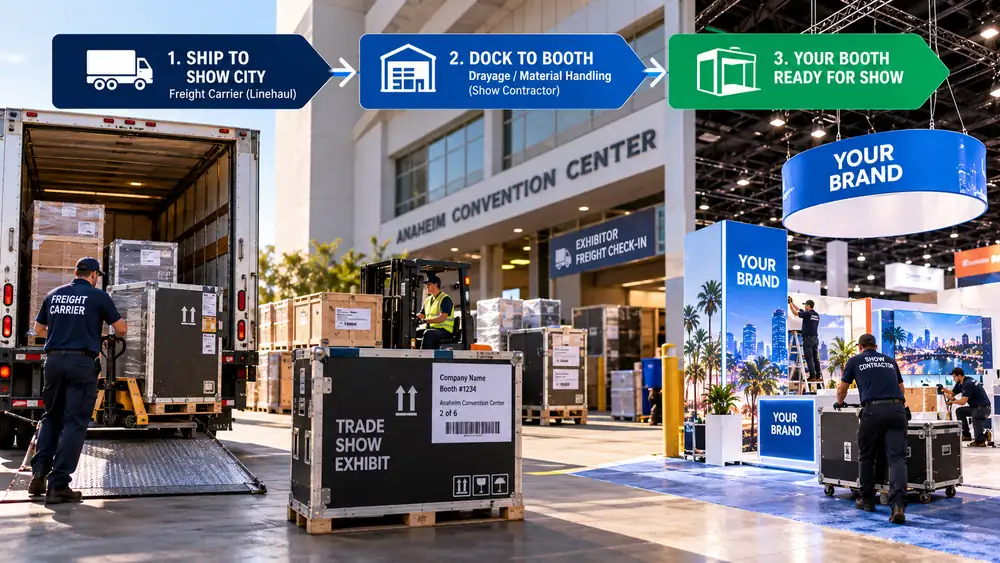
The Two Legs of Trade Show Shipping
Think of trade show freight as a relay. The first runner is a freight carrier you hire. The second is the show’s general service contractor, which you usually can’t choose. Problems tend to happen when the baton is passed.
| Leg 1: To the show city | Leg 2: Dock to booth | |
|---|---|---|
| Who handles it | A freight carrier you select | The show’s general service contractor |
| Also called | Linehaul, LTL, or truckload freight | Drayage or material handling |
| How it’s billed | Per shipment, by weight, distance, and service level | Per hundredweight (100 lb), usually with a minimum |
| Direction | One way per trip | Billed in both directions, in and out |
| Where the rules live | Your carrier agreement and bill of lading | The exhibitor manual’s order forms |
Because leg two is billed separately, a carrier’s quote covers only part of your total. For a full breakdown of the second leg, see our guide to trade show drayage.
Choosing a Trade Show Shipping Route
There are three routes, and the right one depends on your timeline and your tolerance for risk.
| Route | How it works | Strength | Trade-off |
|---|---|---|---|
| Advance warehouse | You ship to a warehouse the show designates, inside a receiving window that opens well before move-in. The contractor holds the freight and delivers it to your booth at your scheduled time. | A time buffer to catch a late truck or a damaged crate | You ship earlier, and the window closes days before the show |
| Direct to show | Freight arrives at the venue’s dock on a target date and time during move-in. | The latest possible ship date | Dock congestion and a missed window can trigger surcharges |
| Show-to-show | Freight goes from one show straight to the next instead of back to your warehouse. | Skips a return trip | Tight timelines |
For most first-time exhibitors, advance warehouse is the safer default because it turns a hard deadline into a window. Direct-to-show suits compressed schedules, if you can hit the target time. Carriers focused on this work advertise date- and time-specific pickup and delivery, which matters most on the direct route, and some advertise expedited show-to-show moves. At some shows, one carrier is designated the official carrier and has staff on site. Your manual will say so.
A Step-by-Step Booth Shipping Plan
-
Read the exhibitor manual first. Find the advance warehouse address, receiving dates, target delivery window, labeling rules, and drayage rates and minimums. It also lists which trade show services carry their own deadlines.
-
Weigh and pack. Weight drives cost on both legs. Use crates built for forklift handling, consolidate where you can, and keep a packing list (with photos of the contents) inside.
-
Label every piece. Use the show’s freight labels as the manual specifies, with your company name, booth number, and a piece count such as 2 of 6, so the contractor can match each piece to the paperwork.
-
Book the carrier. Give the carrier the delivery address and date exactly as the manual prints them. Ask about appointment times and extras like liftgate service.
-
Prepare the bill of lading. List the consignee, booth number, piece count, and weight. Some carriers publish a trade-show template. Whichever you use, copy the consignee details word for word.
-
Track, then confirm receipt. A carrier’s tracking page says the truck arrived. Only the warehouse or contractor can confirm your freight was received and checked in.
-
Submit your material handling order early. Include estimated weight, and do it before the advance-rate deadline.
-
Plan move-out before you ship. The contractor typically needs outbound paperwork naming your carrier and destination, and carriers pick up on schedules of their own, so book the return early.
What Drives Trade Show Exhibit Transport Cost
Your total is the carrier’s freight charge plus drayage in both directions, plus any penalties. Here’s an illustration. Say your crates weigh 1,500 lb and the show’s drayage rate is $120 per hundredweight (an example only; real rates vary by show and carry minimums). That’s 15 hundredweight, or about $1,800 each way and $3,600 round trip, before the carrier’s bill.
What moves the number:
-
Weight. It counts on both legs, so it’s your biggest lever.
-
Number of pieces. Many small shipments can each hit a minimum charge, so consolidating usually costs less.
-
Route. Direct deliveries inside a crowded move-in window are more exposed to timing penalties than a warehouse route.
-
Timing. Rush service and missed windows cost extra.
-
Accessorials. Liftgates, inside delivery, and waiting time are billed on top.
-
The return leg. Outbound drayage and freight are a second bill, so budget for them from the start.
Design for Weight
-
The cheapest exhibit shipping and logistics decision is made at the design stage.
-
A frame built from lightweight aluminum with fabric graphics costs less to move than an equivalent build in heavy panels, on every show it travels to.
-
Crate design matters too: fewer, well-packed crates mean fewer minimums and fewer pieces to lose.
-
Pure Exhibits designs exhibits with shipping weight in mind from the first concept.
Reducing Shipping Costs
Cut costs by reducing weight, shipping to the advance warehouse early, consolidating shipments, and booking 8–12 weeks out. Our trade show display rental guide covers these savings in depth.
Getting It Right
Confirm the advance warehouse deadline, label crates clearly, and keep shipping documents handy. For shows in our market, our Las Vegas trade show rental booth team manages the full logistics chain.
| Factor | Control It By |
|---|---|
| Weight | Using lightweight exhibits |
| Timing | Booking 8–12 weeks out |
| Route | Shipping to advance warehouse |
| Consolidation | Combining into one shipment |
Who Should Manage Your Show Logistics?
| What you need | Handle it yourself | Use an exhibit partner |
|---|---|---|
| One crate, one show, a flexible schedule | Workable, if you read the manual closely | Probably more than you need |
| Several crates, tight windows, or multiple shows a year | Time-consuming; deadlines stack up | Often worth it: one party tracks every window |
| A custom exhibit that must arrive in sequence with install crews | Risky: shipping and install timing have to line up | Strong fit, since freight and install are planned together |
With a full-service rental, we handle shipping for you. Our Custom Trade Show Exhibit Rentals include logistics coordination from freight to delivery.
Common Mistakes
Most trade show shipping problems come down to timing and paperwork:
-
Booking the truck before reading the manual.
-
Missing the receiving window or the target delivery time.
-
Splitting freight into many small shipments that each hit a drayage minimum.
-
Using the wrong consignee details or incomplete labels.
-
Skipping the piece count, so the contractor can’t tell whether anything is missing.
-
Shipping high-value items on default carrier liability. Carrier tariffs often cap liability per pound, so ask about declared value or cargo insurance for AV and electronics.
-
Leaving the return trip to the last day of the show.
Final Thoughts on Trade Show Shipping
At its core, trade show shipping is about turning a high-stakes, deadline-driven event into a controlled, repeatable process. The companies that do this well are not the ones with the biggest budgets; they are the ones who plan early, communicate clearly, and lean on people who have done it many times before.
It helps to focus on the things that actually move results: trade show freight, booth shipping, and exhibit transport. These are where exhibitors win or lose, so give them the attention they deserve rather than spreading effort thin across everything at once.
Keep in mind that this builds. Every trade show provides you with some information, and exhibitors that debrief and improve themselves with each event progressively drive down costs while increasing benefits, making trade show shipping a positive aspect of your business instead of a potential liability.
Lastly, keep your end goal in mind. Trade show shipping is a tool for achieving your ultimate goal of having real conversations with your customers. Use this as the measure of all your decisions, and you will always make the right decision.
Need Trade Show Shipping Handled? Get a Rental Booth Quote Only at purexhibits.com
What to Look for in an Exhibit Partner
A lot depends on the people you choose to work with. The best booth builder goes beyond constructing your booth to foreseeing challenges, ensuring that your show runs on time, and showing full accountability from your initial sketch to teardown. When choosing your exhibitors, consider the following factors, beyond the price quote.
-
In-house design, fabrication, and graphics instead of external referrals
-
A portfolio of booths that have been built similarly to yours
-
Venue-specific experience and know-how at your desired venues
-
Full disclosure of prices with nothing hidden and no estimates
-
Custom and rental exhibits suggested appropriately for your needs
-
One person in charge from your sketch to the teardown
How Pure Exhibits Can Help
Pure Exhibits is an all-in-one exhibit company based in Las Vegas that specializes in designing, manufacturing, and managing trade show exhibits for organizations throughout the United States. Whether you require a smaller rental or bigger island booth, the purpose is always the same: to create a booth that works, a truly hassle-free exhibit experience, and a price structure that you can actually understand.
We are headquartered in Las Vegas, and this makes us very well positioned to give our exhibitors a significant logistical advantage because Las Vegas is the busiest convention city in the country.
Frequently Asked Questions
How does trade show shipping work?
You ship your exhibit to the advance warehouse or directly to the venue, then it moves to your booth via drayage on move-in day.
What is the advance warehouse?
A facility where you ship materials early; they are stored and delivered to your booth on move-in day.
What is drayage?
The charge for moving your freight from the loading dock to your booth and back, billed by weight, separate from shipping.
How much does trade show shipping cost?
Freight for a standard booth can run several hundred to a few thousand dollars each way, with drayage adding a comparable amount.
Should I ship to the advance warehouse or direct?
The advance warehouse is safer and usually cheaper; direct-to-show risks loading-dock delays.
What carriers handle trade show freight?
LTL and FTL carriers, specialized exhibit carriers, air freight for speed, and couriers for parcels.
How do I reduce shipping costs?
Use lightweight exhibits, ship early to the advance warehouse, consolidate shipments, and book 8–12 weeks out. Last-minute trade show exhibit rentals include shipping coordination in the package.
When should I ship my booth?
Aim to arrive at the advance warehouse 1–2 weeks before the show, and book freight 8–12 weeks out.
What is LTL freight?
Less-than-truckload shipping shares a truck with other freight, economical for smaller shipments.
Why use a specialized exhibit carrier?
They understand show deadlines, venue procedures, and marshalling yards, reducing missed move-in risk.
What happens if my shipment is late?
Direct-to-show shipments can miss move-in windows; the advance warehouse reduces this risk.
How is drayage calculated?
Per hundredweight (CWT), per 100 pounds, using the venue’s published rate.
Does renting include shipping?
Full-service rentals typically coordinate shipping and drayage for you. 10×20 trade show booth rentals ship light, keeping freight costs low.
How do I avoid rush shipping fees?
Book freight 8–12 weeks in advance; expedited shipping costs several times the standard rate.
Who can manage my trade show shipping?
Pure Exhibits coordinates freight, drayage, and delivery as part of full-service rentals.