
Trade show success is not luck, and it is not a bigger booth. It is a chain of small decisions made in the right order: goals, booth, people, follow-up, and measurement. Break one link and the whole show looks weak on paper. This guide walks through each link with sourced 2026 data and plain checklists, so you can plan a successful trade show and prove it to your finance team afterward.
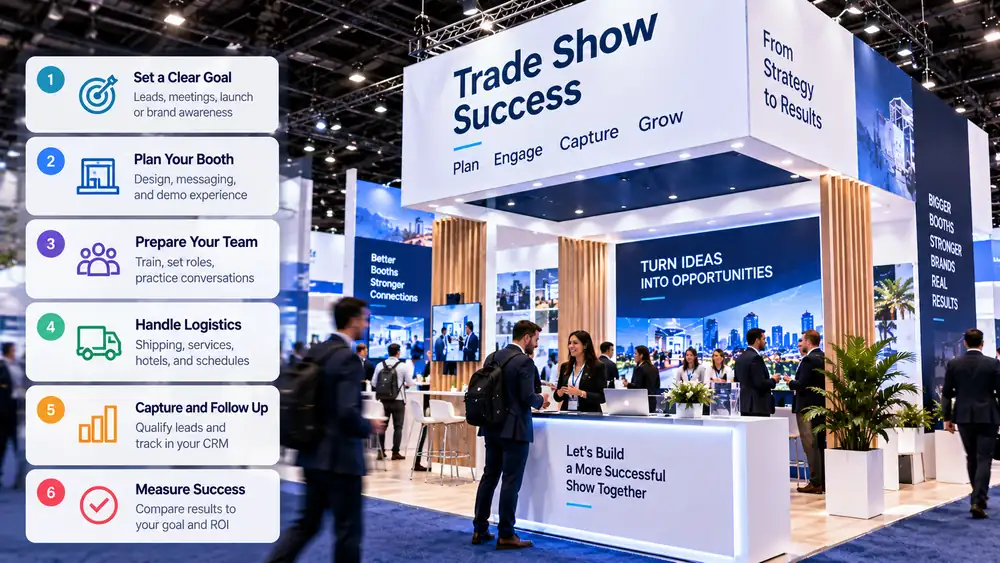
What the Top Trade Show Success Guides Miss
We read the pages that rank for this topic. Each is useful in one area and thin in another.
-
One guide focuses on measurement. It lays out eight metrics and sample goals, but its numbers are illustrations, and it says little about how to credit a closed deal to a show.
-
A second is a ten-step planning checklist. It covers manuals, shipping, and hotels, yet it gives no data, no timing for each task, and nothing on staffing or lead capture.
-
A third is a long list of 35 tips. It cites one outside statistic, and that figure traces back to 2013.
So most advice either measures without planning, or plans without measuring. Real trade show success needs both, tied to real data. That is what the sections below do.
Define Trade Show Success Before You Spend a Dollar
Ask your team one question: what would make this show a win? Then write the answer as a number.
Lead generation is the usual answer. In a 2015 CEIR study of 568 exhibitors, 68% ranked lead generation among their top three objectives, and 62% used ROI metrics. That study is older, but it shows a pattern that still holds in 2026: most exhibitors want leads, and many measure only part of the picture. A 2026 survey summary reports that 65% of companies attend mainly to build leads and pipeline, yet only 27% can measure the show’s later effect on the bottom line.
Close that gap by picking one primary goal:
| Goal | A number to set | How you will count it |
|---|---|---|
| Lead generation | Qualified leads, not total scans | Lead score or a two-question form |
| Meetings | Booked appointments with named accounts | Calendar invites before the show |
| Product launch | Demos given and media contacts reached | Demo log and press list |
| Brand awareness | Booth visits and follow-up replies | Traffic count and reply rate |
Pick one row. A booth built for everything usually delivers on nothing. Our guide to trade show lead generation strategies shows how to turn the goal into a plan.
Trade Show Tips for the Weeks Before the Show
Good trade show tips are mostly about timing. Work back from the opening day.
-
12 weeks out: lock the booth. Pure Exhibits’ own guidance suggests 8 to 12 weeks for a custom build, so design and graphics need an early start. Running late? Ask about last-minute booth rentals.
-
8 weeks out: read the exhibitor manual. It sets height limits, deadlines, and show service orders. Our show services guide explains what the show bills on top of your space.
-
6 weeks out: book meetings. Email your target accounts with a reason to visit, such as a demo slot.
-
4 weeks out: train the team. See the staffing section below.
-
2 weeks out: test your tools. Scan test badges, check Wi-Fi, and confirm freight.
Budget early, too. Space is only part of the bill. Our trade show budget guide shows where the other costs hide.
Success starts with a booth built to perform. Our Custom Trade Show Exhibit Rentals are engineered around visibility, flow, and one clear message.
Set a Measurable Goal
All great shows start with having a clear objective in mind to be achieved, whether it is leads, meetings booked, or pipeline generated. Without an objective, it will be impossible to measure success or improve.
Booth Design for a Successful Trade Show
Your booth has a few seconds to answer one question: what do you do, and why should I stop?
-
Lead with one message. A short promise beats a list of features. Make it readable from the aisle.
-
Traffic plan. Visitors move with the flow of the aisle. Put your entrance and demo points where people already slow down. Our guide to how attendees move through a show floor explains this.
-
Add one hands-on moment. In Freeman’s research, 24% of attendees said they had no chance for hands-on contact with products. A live demo or a touch screen fills that gap. See our interactive booth ideas.
-
Leave room to talk. A crowded floor kills conversations. Keep space to step in.
For the full set of design principles, read our booth design guide.
A well-designed 20×20 trade show booth rental captures strong ROI without an island’s cost.
Design to Attract and Engage
-
One impactful, aisle-scannable message
-
Good lighting and vertical merchandising
-
Open and welcoming floor plan
-
A definite focal point or demonstration
-
Room to converse
Trade Show Best Practices for Your Booth Staff
People decide trade show success more than any graphic does. Treat staffing as a task, not a favor.
Choose people for the job
Pick staff who like talking to strangers. Mix sales, product experts, and one person who manages the flow.
Train for the first ten seconds
Give your team an opener that is a question, not a pitch. Practice qualifying: who is this, what do they need, and what is the next step?
Use experts
Freeman found that 51% of attendees said access to a subject-matter expert improved their purchase certainty. Put someone who can answer hard questions on the floor every hour.
Set shifts
Tired staff slouch, check phones, and miss buyers. Rotate breaks and keep your best talkers at peak hours.
Our staff training guide includes a simple practice plan you can run in ten minutes.
How to Succeed at Trade Shows: Capture and Qualify Every Lead
If you ask how to succeed at trade shows, the answer often comes down to what happens at the moment a visitor leaves.
The 2026 Spreadly report, as summarized by Makai, offers a useful warning. It found that 51% of exhibitors do not qualify leads at the booth, and only 11% have an end-to-end automated trade show workflow. Among teams with ROI above 4x, 62% used digital lead capture at the booth, while none of the teams below 2x did. This is a vendor-linked survey and the data is correlational, so it does not prove that capture tools cause better ROI. It does show that top teams treat lead capture as part of the system.
A simple capture method:
-
Scan the badge. Use the show’s scanner or your own app.
-
Add two fields. Record interest level and next step. Keep it to ten seconds.
-
Score in the moment. Mark each lead hot, warm, or cold before the person walks away.
-
Write one note. One sentence about what they care about makes the follow-up personal.
Choosing a tool? Check that it works offline and syncs with your CRM. Our guide to trade show lead generation strategies covers the follow-up side.
Trade Show Success After the Show: Follow Up Fast
Most of your return arrives after the booth is packed. That is where many exhibitors slip. As noted above, 57% follow up later than 48 hours.
Use a tiered plan:
-
Hot leads: call or send a personal email within 24 hours, with a meeting request.
-
Warm leads: send a short, useful email within 48 hours, such as a one-page guide on the problem they mentioned.
-
Cold leads: add them to a nurture sequence, and do not call them all.
Send the follow-up from a named person, not a team inbox. Refer to your booth conversation in the first line.
See booths built to convert in our trade show booth case studies.
Measure and Improve
| Success Factor | What to Do |
|---|---|
| Goal | Set a measurable target |
| Show fit | Match audience to buyers |
| Booth | Design to attract and engage |
| Staff | Train and rehearse |
| Follow-up | Act within 24–72 hours |
Looking for market context? Our trade show statistics page gathers industry data in one place.
Five Mistakes That Hurt Trade Show Success
-
No written goal. Without one, every result looks fine.
-
Too many messages. Visitors remember one.
-
Untrained staff. Good booths with bored people lose.
-
Slow follow-up. Leads go cold in days, not weeks.
-
No review. Hold a 30-minute debrief within two weeks. Write down three things to keep, three to drop, and three to test.
Final Thoughts on Trade Show Success
Getting trade show success right is less about any single decision and more about a series of small ones made well. Plan early, choose experienced partners, and keep the details tight, and what feels overwhelming the first time becomes routine by the third or fourth show.
The details that matter most are usually successful trade show, trade show tips, and trade show best practices. Nail those, document how you did it, and you will have a playbook you can run at every future show with steadily better outcomes.
However, patience goes far in such cases. The systems that you develop for success at this year’s trade show will make it easier and cheaper, as well as more effective for you in the next one – this is precisely the reason why the most successful exhibitors spend their efforts on developing the process.
Most importantly, connect trade show success with results. Those who succeed in their efforts are those who measure the outcomes of a show, analyze them, and use them in order to improve further.
Want a Successful Show? Get a Booth Built to Convert at purexhibits.com
What to Look for in an Exhibit Partner
A lot depends on whom you are dealing with. Right partner for the exhibits takes care of everything, ranging from solving problems to keeping up with your timeline and taking responsibility starting from the initial designing to the final dismantling. When considering your exhibit partners, do not get yourself restricted by quotes alone. Instead, consider other aspects, including expertise and experience in such events and venues.
-
In-house design, construction, and graphic services, not outsourced
-
Previous builds comparable to your scale and industry
-
Venue-specific experience with rules in your target venues
-
Specific and transparent pricing without any vague figures
-
Rental and customized options with honest recommendations
-
A single responsible person throughout your project
How Pure Exhibits Can Help
Pure Exhibits is a Las Vegas-based full-service exhibit house providing turnkey trade show booths from design through installation to storage. One team manages all of the logistics for you from the initial idea/concept through the 3D design and creation of your trade show booth so you can concentrate on what you have to accomplish at the show.
Regardless of whether it is a small rental booth or a custom island, the goal remains the same – an effective booth, an easy-to-work-with process, and transparent pricing. Our Las Vegas location provides exhibitors with a true logistical advantage as it is the busiest convention city in the country, while our national service scope allows us to handle programs in any market.
Frequently Asked Questions
What makes a trade show successful?
A measurable goal, the right show and booth, an attractive design, trained staff, strong lead capture, and fast follow-up.
How do I set a trade show goal?
Define a specific, measurable target: qualified leads, meetings, or pipeline, before planning anything else.
How do I choose the right show?
Match the show’s audience to your ideal customer using attendee data, prioritizing fit over size.
What booth design drives success?
One bold message, strong lighting, vertical branding, an open layout, and a clear focal point.
How important is booth staff?
Critical: trained, engaged staff convert the traffic your design attracts, while poor staff waste it.
How do I capture leads effectively?
Use digital lead capture with qualifying questions and record next steps for every visitor.
When should I follow up?
Within 24–72 hours while conversations are fresh; fast follow-up is where deals are made. Last-minute trade show exhibit rentals give you a booth built to convert.
How do I measure trade show ROI?
Compare pipeline and revenue attributed to the show against total cost, and track cost per qualified lead.
What is the biggest mistake exhibitors make?
No clear goal and weak follow-up; both quietly erase the return on the whole investment.
How do I get more booth traffic?
Lead with a clear message, use lighting and height, add interactivity, and do pre-show outreach.
Should first-time exhibitors start small?
Yes, a well-run small booth at a high-fit show is a low-risk way to learn and succeed.
How do I improve show to show?
Debrief after each show, track results, and refine your goal, booth, staffing, and follow-up.
How much does a successful show cost?
It varies, but success depends more on execution than budget; a focused small booth can outperform a big one. 10×10 trade show exhibit rentals make a first successful show low-risk.
How does pre-show marketing help?
Booking meetings and emailing prospects before the show consistently produces more and better leads.
Who can help me run a successful show?
Pure Exhibits designs booths and advises on strategy from show selection to follow-up.