
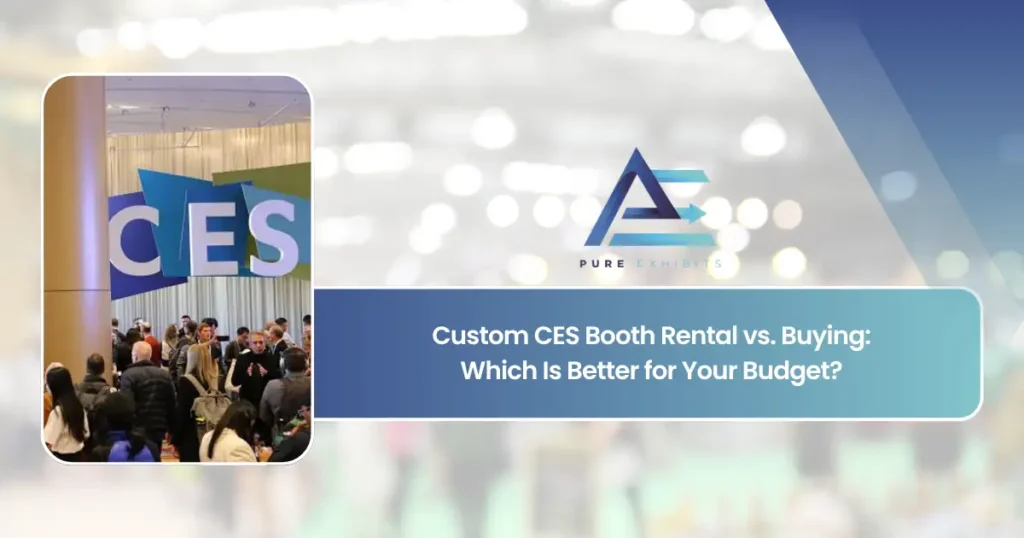
If you’re weighing whether to buy a custom exhibit for CES or rent one, you’re actually asking the wrong first question. The real question isn’t “custom or not custom”; a genuinely custom rental gives you the same design freedom as a purchase. The real question is whether you want to own a depreciating asset built for one specific show floor, or pay one fixed number for a purpose-built exhibit that someone else stores, maintains, and rebuilds for you.
CES has a way of making this more apparent than most any other show on the calendar. It is the biggest, and the most concentrated exhibition investment most companies make in any year. And the hall layouts and ceilings are different enough each cycle that an exhibit design from one year will not necessarily work in the next. There is too little time between the hall layout and move-in to allow any design problems to be solved easily. Buy, and you take your chances. Rent, and you don’t.
While early-stage teams often fear unforeseen trade show costs, opting for a turnkey booth rental with 100% fixed-price contracts (covering design, build, graphics, freight, and local I&D labor) eliminates post-show invoice surprises.
Related: Aviation Expo Guide: Top US Aviation Trade Shows and How to Exhibit
The Ownership Costs That Don’t Show Up On the Initial Quote
A purchased custom exhibit looks like the more serious investment, and in the moment, it can feel that way. But ownership comes with three costs that never show up on the initial quote.
Storage
In between CES cycles, there must be some place to store the specially designed exhibit: a climate-controlled location that is accessible but also located far away from Las Vegas, making transport back for the next event itself an ordeal, or costing so much money that savings from ownership disappear.
Refresh Cost
CES moves fast, and a booth built around last year’s product story or brand system can look dated next to competitors chasing the newest design trend. An owned structure either gets refreshed at real cost every cycle, or it quietly becomes the booth that looks a year behind.
Footprint Risk
You’re building an asset around one year’s booth size, location, and venue requirements. If those requirements change the following year- a different hall, a different footprint, different rigging or ceiling constraints – the exhibit may need to be redesigned or modified before it can be reused at all.
None of this means buying is always wrong. Companies with a long-term, unchanging footprint and the internal team to manage storage and refresh cycles do make ownership work. But it’s a genuinely different commitment than most companies weighing “rent vs. buy” for a single CES appearance realize they’re signing up for.
What “Fixed-Price” Should Actually Mean
The phrase “fixed-price rental” gets used loosely across this industry. Thus, for this guide, assume this term means a contract where the scope and included services are agreed upon upfront, rather than a low base rental price followed by a string of additional charges once the project is underway.
That’s worth defining carefully because exhibit companies structure their packages differently. Before you sign anything, ask specifically what’s included: design, fabrication, graphics, freight, installation, and on-site supervision are the categories most likely to hide add-on costs if they’re not spelled out in writing. A genuinely fixed-price contract should name what’s covered and what isn’t, not just promise “no surprises” in the sales conversation.
That clarity matters more at CES than at most shows, because CES booth design carries real cost variability – union labor scheduling, freight through the show’s official contractor, and hall-specific rigging rules can all add unplanned expense to a company managing a custom build on its own, coordinating separate vendors for structure, graphics, and labor. A well-defined fixed-price agreement moves more of that variability onto the party actually managing production.
Ready to make a strong CES presence without taking on the burden of exhibit ownership? Explore Custom Las Vegas CES Booth Rentals & Request Your Free 3D Concept Today.
The “Build-and-Burn” Trap
The following failure mode deserves an explicit mention: the cheap, hastily built booth meant to be scrapped after the first show. When companies believe “custom” and “cheap” are compatible within the given deadlines and budget constraints, the end result doesn’t survive even one second look on the show floor, let alone two.
But a truly custom rental booth never falls victim to this problem in either direction. The structure is built precisely for your purposes, and the capital expense is eliminated because there is no need to purchase a booth that becomes obsolete and unsuitable right after your exhibit needs change. It would be good to know directly from the providers whether the booths or booth parts are used again elsewhere and in different exhibits after yours, not sitting idly somewhere and ending up at the scrapyard.
Also Read: Automotive Expos: Top US Auto Shows and How to Exhibit
Design Flexibility Doesn’t Disappear When You Rent
The biggest misconception pushing companies toward a purchase is the assumption that renting means settling for a shared system dressed up with custom graphics instead of something built specifically for the brand. That’s true of some rental providers, which is exactly why it’s worth confirming directly before you sign anything.
| Custom rental | Purchased custom exhibit | Standard modular rental | |
|---|---|---|---|
| Custom design | Yes | Yes | Limited |
| Ownership | No | Yes | No |
| Storage responsibility | Provider (confirm terms) | Exhibitor | Usually provider |
| Refresh between shows | Often easier | Exhibitor-funded | Usually limited |
| Designed around your brand | Yes | Yes | Usually adapted from a template |
| Best Fit | Changing needs, single or occasional shows | Long-term, unchanging footprint | Budget-conscious, lower design priority |
While designing a true custom rental, the process must be identical to purchasing one – created according to your brief rather than a shared frame and graphics wrap. However, the key difference here lies in the aftermath of the asset creation, because in a rental case it is up to the provider, while in the purchase case it is up to you. You need to ask any provider if your particular structure is a truly custom one for your project or if it is just a shared modular solution with custom graphics.
What This Actually Means for Your CES Planning
If you’re exhibiting at CES once, or your product story and brand system are likely to shift meaningfully year over year, a fixed-price custom rental removes the two biggest risks of ownership: storage and depreciation, while giving you the same design freedom as a purchase.
If you are a regular CES exhibitor and using the same booth design for several years to come, it is still advisable to do the math regarding owning a booth: storage fees, refresh costs, and the likelihood of your being assigned a different hall or ceiling height under a structure that you will have paid for already. For many repeat exhibitors, a renter arrangement in which an exhibition company handles the refresh and storage between shows works just fine.
Either way, the decision shouldn’t be made on the assumption that “custom” means only “purchased.” It doesn’t. It requires an exhibit partner who designs from scratch and prices the whole project as one number before you commit.
See how Pure Exhibits structures custom CES rentals: CES booth options and current pricing.
The Bottom Line
Choosing between buying a custom exhibit and opting for a fixed-price rental for CES comes down to risk management. CES demands a significant portion of any marketing budget, and sinking capital into a static, depreciating asset subjects your team to ongoing storage fees, unexpected refresh expenses, and spatial layout constraints across show cycles.
A genuinely custom rental removes those financial blind spots. By pairing total creative freedom with an all-inclusive, fixed-price contract, you eliminate post-show billing surprises and ensure your booth makes an unmistakable statement on the show floor.
Command the CES Floor with Pure Exhibits
Don’t let unexpected labor surcharges, out-of-state freight penalties, or rigid exhibit hardware restrict your presence at CES. Pure Exhibits specializes in custom turnkey booth rentals built from scratch to reflect your exact brand vision.
With extensive local inventory staged right in Las Vegas, Pure Exhibits handles complete 3D design, custom fabrication, high-resolution graphic printing, freight logistics, and certified on-site installation and dismantling, backed by a 100% transparent, single-number contract with zero hidden fees.
Let’s Build Something Extraordinary
Share your event details and we’ll craft a custom booth solution designed to captivate your audience and maximize your ROI.
Frequently Asked Questions
Is a custom rental actually “custom,” or is it just a modular booth with my graphics on it?
It depends entirely on the provider. A genuinely custom rental is designed specifically for your project rather than adapted from a shared template, while a standard modular rental uses a common frame dressed up with your branding. Ask directly, and get the answer in writing, before assuming which one you’re getting.
What’s the real cost risk of buying a custom exhibit for CES versus renting one?
Ownership carries three costs that don’t show up on the initial quote: storage between shows, refresh cost as your brand or product story evolves, and the risk that a structure engineered for one year’s hall assignment doesn’t fit the next year’s floor plan. A fixed-price rental shifts all three of those risks to the exhibit company.
Does renting mean I have to compromise on booth design?
Not with a custom-made rental. The renting process is the same as for purchase, derived from your brief and not using a shared template. But the distinction lies in what comes afterward; rentals are always returned to be reused; purchases become something you have to store and take care of.
What does “fixed-price” actually cover in a rental agreement?
It should mean one contractual number covering design, fabrication, graphics, freight, installation, and on-site supervision, agreed before the project starts, with no post-show invoice for labor overtime, drayage overages, or last-minute service orders.
Is it ever worth buying a custom exhibit instead of renting for CES?
It can make sense for companies with a long-term, unchanging footprint and an internal team equipped to manage storage and refresh cycles year over year. For most single-year or evolving-brand exhibitors, the storage and depreciation costs of ownership outweigh the savings vs. a fixed-price rental.