
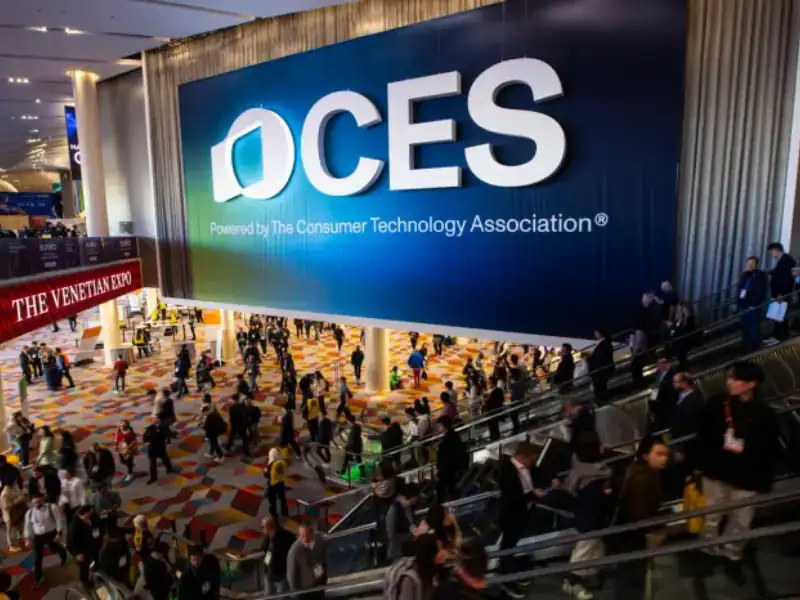
CES 2026 drew 148,000+ attendees and over 4,100 exhibitors across more than 2.6 million net square feet at the Las Vegas Convention Center and the Venetian Expo. On a floor that size, competing for attention takes more than a bigger sign. The exhibits that actually stopped people last January shared a handful of specific, repeatable patterns, and if you’re planning your CES 2027 space, these are worth building into your brief now, before your design is locked.
If you are beginning to map out your footprint for the upcoming show cycle, reviewing current CES booth rental options and turnkey pricing models will help ground your creative brief in realistic, fixed-cost execution.
Here are the five booth trends from CES 2026 that actually delivered ROI, and how to apply them to your 2027 space:
1. One Story Across the Whole Booth, Not a Wall of Separate Products
The booths that attracted attention at CES 2026 did not have the most products displayed in their exhibits, but those that managed to structure the different zones in their booths under one story that was easy for visitors to trace from the entrance to the exit. The best booths did not split up their product line but developed one concept that supported itself.
Why this works on a CES-scale floor: Attendees are moving fast and absorbing dozens of booths in a short window. A booth that requires them to piece together your story from five unrelated displays loses them before they’ve made sense of any of it. A single, clear narrative gets processed in the few seconds you actually have.
What to do with it: Before you finalize your floor plan, write your booth’s story in one sentence. If a planned display doesn’t move that sentence forward, cut it or move it off the main walking path.
2. LED and Digital Display Built into the Structure, Not Bolted Onto It
Screens as an afterthought, an LCD hanging on an otherwise complete wall, looked old-fashioned compared to the booths where screens were incorporated into the architectural design from the get-go. The booth designs that stood out at CES 2026 utilized LED as a building material, creating walls and displaying content based on the location of physical products in relation to these digital surfaces.
Why this works: In a hall full of static graphics, integrated motion and light are genuinely anomalous, and anomaly is what catches attention on a crowded floor. A screen added after the booth design is finished never integrates as convincingly as one planned in from the start.
What to do with it: Bring your AV and digital display partner into the design conversation at the concept stage, not after the structural layout is locked. Retrofitting technology into a finished design almost always looks and performs worse than designing around it from day one.
3. AI as Something Attendees Touch, Not a Word Printed on a Panel
“AI-powered” showed up on signage throughout the hall, but the exhibits that actually delivered on it gave attendees a real, hands-on interaction, something to try, not just read about. The gap between an AI claim and an AI demonstration was one of the more obvious tells separating genuinely strong booths from ones riding the term without substance.
Why this works: CES attendees, especially press and analysts, are specifically hunting for genuine innovation to write about. A buzzword with nothing behind it gets noticed and dismissed quickly by exactly the audience you most want writing about you.
What to do with it: If you’re talking about the AI aspect of your product, have at least one concrete, working example of how it works in the booth, and don’t be tempted to put that word on everything else you do.
Related: Trade Show Booth Design in Las Vegas: What Works at LVCC, SEMA, CES, and Beyond
Ready to build a high-impact, trend-forward space for CES 2027? Explore Custom Las Vegas CES Booth Rentals & Request Your Free 3D Concept from Pure Exhibits Today.
4. Built to Last More Than One Show
The obvious truth about some booths at CES 2026 was how exactly they appeared to be: hastily put together temporary booths bound for demolition on the next day of the event – rough laminates, poorly assembled seams, and pieces of furniture that could not be used again for any other occasion. This is precisely what should be avoided, not the custom building itself. Custom building remains the best solution for those who require it, but of poor quality and used only once.
When building a new exhibit for CES 2027, the best choice would be to design the booth in a way to allow for reuse, resizing, or redesigning at other events in the future; be it the system you have ownership of and take care of, or a rented one and someone else’s responsibility to reuse. In both cases, the problem of the build-and-burn effect is successfully resolved.
Why this works: Graphics are part of this too. Graphics on premium fabric tend to last longer during a greater number of events than rigid printed graphics; they fold up into small packages, weigh less, and do not chip or crack as easily as printed materials due to multiple installations. This is one of the simpler upgrades to make.
What to do with it: Before commissioning anything new, ask whether your current structure, owned or rented, can take on new graphics and a reconfigured layout instead of being rebuilt from zero for 2027. Turnkey booth frameworks are repurposed across event cycles, while custom fabric graphics are lightweight, eco-friendly to pack, and reusable for future shows without ownership storage fees.
5. Execution That Matches the Design
Every one of the trends described here is doomed to failure in case of a poor installation. The difference between a carefully installed display by professionals and an installation that is thrown together by a few people in a hurry was one of the most pronounced at the CES 2026 show. Bad folding and flimsy structures give the impression of incompleteness despite their initial strength.
Why this matters more at CES than elsewhere: The compressed move-in window and the sheer density of exhibitors competing for labor and dock time leave very little margin to fix a bad install once the floor opens. A design that looks excellent in a rendering still needs real, experienced hands executing it under real time pressure.
What to do with it: Budget real time and real expertise for move-in specifically, not just design and fabrication. The booth that wins isn’t necessarily the most ambitious one; it’s the one that shows up on the floor exactly as planned.
Exhibitors can also eliminate on-site move-in anxiety by partnering with a provider that conducts full pre-stage dry-fits (complete with photo/video walk-through approvals) at their facility before shipping to Las Vegas. Pure Exhibits’ Las Vegas team can assist you with that.
A Bonus Tip Worth Noting: Quiet Zones Inside High-Energy Booths
-
Several of the strongest CES 2026 exhibits were built in a deliberate moment of contrast: a calmer, lower-stimulation area set apart from the rest of the booth’s sensory intensity.
-
If your CES 2027 plan is built entirely around spectacle, consider whether one quieter corner might do more for real conversations than another screen would.
Putting This Into Your CES 2027 Brief
None of these five elements needs additional funding by itself; what it needs is the decision to include it in the design process early enough to become an integral part of the solution rather than an addition. Having one story, having an integrated digital presentation, having one true tactile experience, designing for reuse, and properly funding the installation are all things that need to be done in the first briefing document, not the last.
View CES booth options and pricing to start analyzing a design built around these trends from the ground up.
The Bottom Line
Incorporating these booth trends into your CES 2027 brief isn’t about spending more; it’s about designing smarter. Whether you’re unifying your brand story, embedding structural LED displays, or building dedicated quiet spaces for investor conversations, successful trade show execution comes down to early planning and flawless on-site delivery.
By prioritizing modular reuse, high-impact fabric graphics, and professional local installation, your team can avoid the traps of single-use builds and command real attention on one of the world’s most competitive trade show floors.
Bring Your CES 2027 Vision to Life with Pure Exhibits
Translating high-level exhibit trends into a flawless, stress-free show floor presence requires the right trade show partner. Pure Exhibits helps brands stand out with custom turnkey CES booth designs, integrated digital architecture, vibrant fabric graphics, and 100% fixed-price contracts with zero post-show billing surprises.
With its own facility in Las Vegas, Pure Exhibits manages your entire activation, from 3D conceptual design and pre-show dry-fit inspections to certified on-site installation and dismantling.
Let’s Build Something Extraordinary
Share your event details and we’ll craft a custom booth solution designed to captivate your audience and maximize your ROI.
Frequently Asked Questions
What was the biggest exhibit design trend at CES 2026?
The shift from product-focused booth layouts to a single unified narrative; exhibits organized around one story attendees could follow from entrance to exit, rather than a series of disconnected product stations.
How do I avoid the “build-and-burn” trap for my next CES booth?
Reuse should be taken into account from the start; this could either take the form of your team’s ownership of the module, which is reconfigurable, or else the renting of the module, whereby a service will manage the reuse and storage thereof.
Should AI be part of my CES booth story?
Only if it’s something attendees can actually interact with. A hands-on AI demonstration performs far better with CES’s press and analyst-heavy audience than the word “AI” printed on signage with nothing functional behind it.
When should I start planning trend-driven changes into my CES booth design?
As early as the initial brief. Trends like integrated digital display and reuse-focused construction need to be built into the structural design from the start; retrofitting them into a finished booth rarely produces the same result.