
NADA Show Runs a Targeted Move-In. Your Freight Plan Has to Match It.
NADA has tightened the move-in window and is not approving early move-in requests. The show and its general contractor have answered with phased freight delivery guidelines, and the exhibitor who ships everything on one truck to show site is the one who pays for it. Here is what the targeted schedule changes about how your booth should travel, and the three other deadlines that landed in the same bulletin.
A condensed schedule with no exceptions
NADA Show has always assigned target move-in days by booth location and size. What is different now is the compression. The window is shorter, and the show has said plainly that earlier move-in will not be approved, for anyone.
In a hall like the West Concourse of the Orange County Convention Center, that puts every island on the floor plan into the same two or three days, with freight doors, marshalling and the aisle grid all working at capacity. To keep freight moving, crews working and aisles clear, NADA and its general contractor now ask exhibitors to deliver freight in phases that follow the installation sequence rather than the shipping schedule.
For a program that runs a 20×20 or larger, this is a planning change, not a paperwork change. The booth itself does not need to be different. The order in which it arrives does, and so does the decision about where it waits before it arrives. If you want the hour-by-hour of what an install crew needs and when, move-in day, hour by hour sets out the sequence; this post is about feeding that sequence under a targeted schedule.
On a targeted move-in, freight that arrives before there is floor to put it on is not early. It is in the way, and it is billable.
Advance warehouse beats direct-to-site, and this time the show is saying so
NADA is recommending the general contractor’s advance warehouse over direct shipment to the convention center in unusually strong terms. Under a targeted schedule, the warehouse is the only place freight can be logged, held and released to coincide with your assigned day and time.
Freight is received weeks ahead, checked in by piece count, and trucked to the booth as the move-in schedule calls for it. The receiving window closes before move-in, so the production and transit plan has to be built backwards from that date, not from the show.
The carrier sits in the marshalling yard until a dock opens, and the freight hits the floor whether or not your booth space is ready for it. With no early move-in approvals, the chance that a direct shipment lands before its target window is high.
Workable for programs with very large structures that cannot sit in storage, provided the second shipment is timed to the second target day and labeled as such. The risk is that the two halves of the booth are on two different clocks.
Advance-warehouse handling usually carries a slightly higher rate per hundredweight than show site, and some exhibit managers have treated that gap as a reason to ship direct. On a targeted move-in the arithmetic reverses: the warehouse premium is small and known, and the cost of freight arriving early at show site is neither. The service-order side of this, including where the handling line lands on the bill, is in the second invoice.
What ships for day one, and what waits for day two
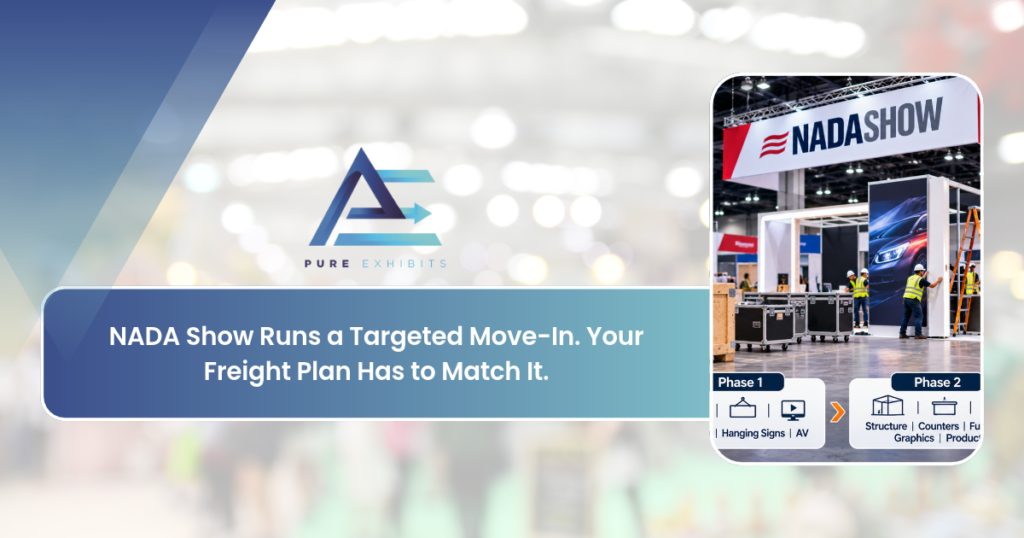
The guidelines map freight to the install sequence. Anything that goes down before the walls go up ships first. The walls and everything inside them ship second.
- Phase one, first target day: flooring, hanging signs, AV.
Carpet and pad or raised flooring must be in before any structure lands on it. Hanging signs have to be assembled on the floor and rigged while the space above the booth is empty, and the rigging crew is scheduled by the show, not by you. Video walls and AV racks follow the same logic because their power and data drops are set before the structure encloses them.
- Phase two, second target day onward: structure and everything else.
Wall systems, counters, meeting room components, furniture, graphics crates and product. These arrive once there is cleared floor and a crew ready to receive them, which is the point of the whole exercise.
- Stagger large programs further.
Exhibitors with several large shipments are asked to space deliveries against their own installation schedule and the booth space actually available. Three crates a day the crew can work is better than twelve crates that block the aisle and the neighbor.
- Complete the freight questionnaire when it opens.
Exhibitors with significant freight volumes will be asked for shipment and installation detail through the general contractor’s online portal. It exists so the contractor can sequence floor space and dock time around real volumes. The programs that fill it in accurately are the programs whose freight shows up on time.
- Label by phase, not just by booth.
Every piece carries contents, booth number and the requested delivery date, and materials are physically separated by installation phase wherever possible. A pallet that mixes carpet and counters cannot be split at the warehouse; it ships as the later phase, which means the carpet is late.
Hanging signs and anything over the venue’s height threshold still run on the show’s rigging and structural approval calendar, which starts months earlier than freight. The filing sequence is in the three approvals an island booth needs before it ships.
What early freight actually costs
The guideline most likely to surprise finance is the one about storage. Freight that arrives before adequate booth space is available may be moved to off-site storage at the exhibitor’s expense.
Transport out, labor, storage, and transport back
Freight that lands on a floor that is not ready does not sit in the aisle; it gets loaded back onto a truck, driven to an off-site facility, stored, and driven back when the booth is ready. Each of those is a line, and none of them was in the original material-handling estimate.
The quiet multiplierThe return delivery arrives in the general queue, not at your target time, so the booth that shipped early can end up installing later than the booth that shipped on schedule.
There is no workaround through the show office
In past editions, a well-connected exhibit manager could sometimes get a day of early access for a large build. The current guidance closes that door explicitly. The only lever left is the one in your own shipping plan.
What that means for custom islandsStructures that need three days to build need to be engineered to build in the days you have, or to be pre-assembled off site so that the on-floor time shrinks. That is a design decision, and it is made well before the freight is booked.
This is also where the post-show reconciliation argument gets settled. If your exhibit partner estimates material handling and bills the actual after the show, every one of those storage charges flows through to you as a variance. If the price was fixed against a shipping plan the partner controls, it is the partner’s problem to ship to the target, and the number you approved is the number you pay. The rest of the uncontrolled-cost picture is in half your trade show bill is outside anyone’s control.
Payment, downsizing, insurance and a free stage slot
The freight guidance arrived alongside the show’s usual pre-season cutoffs. Each one has a cost for missing it, and two of them land on the same date.
- Final booth payment and the last partial-refund window share a date.
Roughly ten weeks before the show, any remaining booth balance is due in full. The same cutoff is the last day to downsize or cancel space and still recover part of the fee, less 25 percent of the total contracted booth cost. After that date, a downsizing or cancellation request earns no refund at all. If the program is wavering on footprint, this is the date to decide, not the one after it.
- Certificate of insurance, 30 days before your assigned move-in.
Every exhibitor must carry general liability covering move-in, show days and move-out, and the COI has to be filed with the show at least 30 days ahead of the booth’s move-in date. Because move-in is targeted, the 30-day mark is different for different booths; pull it from your own assignment. Exhibitors without a policy that fits can buy coverage through the show’s official insurance contractor. Your exhibit partner’s COI is a separate filing and does not cover you.
- The exhibitor pitch competition closes early in the season.
Entry is free: a two-minute video previewing the product or service, the pitch approach and what the audience will see. Finalists are selected from the submissions; the grand prize is a 20-minute presentation on the show’s Live Stage plus editorial and social coverage on NADA’s channels. For a product launch, that is stage time no sponsorship budget can buy at the price.
Dates move each edition. Treat the lead times above as the shape of the calendar and take the exact dates from the current exhibitor bulletin.
Six decisions to make before the freight is booked
Everything above reduces to a short set of calls that belong to you, not to the carrier or the contractor. Make them in this order.
- Confirm the booth’s target move-in day and time, and the second day.
The whole plan hangs on these two dates. Get them from the show’s move-in schedule, not from last edition’s.
- Decide the footprint before the refund window closes.
A booth that shrinks after the cutoff pays for space it does not use. A booth that grows after it may not get the space at all.
- Ship to the advance warehouse unless there is a structural reason not to.
And if there is, split the shipment so that phase one goes to the warehouse anyway.
- Have the booth packed by phase at origin.
Flooring, sign and AV on their own pallets with their own labels and their own requested delivery date. This is the single highest-leverage instruction you can give your exhibit partner.
- File the COI against your move-in date, not the show date.
Thirty days before the first target day. Put it in the calendar the day the assignment arrives.
- Ask who carries the risk of early freight.
If the answer is you, you are holding an estimate. If the answer is your partner, you are holding a price.
The venue, labor and cost picture for the host city is in NADA Show booth rentals, which stays current as the show moves between cities.
NADA Show move-in FAQs
What is a targeted move-in at NADA Show?
Each booth is assigned a specific day and time to begin installation, set by its location on the floor plan and its size. The schedule is condensed and the show is not approving requests to move in earlier than the assigned target, so freight and labor have to be planned to that window.
Should I ship to the advance warehouse or direct to the convention center?
The show is recommending the general contractor’s advance warehouse. Freight is logged, stored and delivered to the booth to coincide with the assigned move-in day. Direct shipments arrive when the carrier reaches the dock, and freight that lands before booth space is ready can be moved to off-site storage at the exhibitor’s expense.
What should ship for the first move-in day?
Flooring, hanging signs and AV equipment. Booth structure and the remaining exhibit materials should follow from the second move-in day, when there is cleared floor to receive them. Large programs with several shipments should stagger deliveries against their own install schedule.
What happens if my freight arrives early?
If there is not adequate booth space available, it may be moved to off-site storage. The exhibitor pays for the transport out, the labor, the storage and the return delivery, and the returned freight re-enters the general queue rather than your target slot.
When is the certificate of insurance due for NADA Show?
At least 30 days before the booth’s assigned move-in date. The policy must be general liability covering move-in, show days and move-out. Exhibitors without suitable coverage can purchase it through the show’s official insurance contractor.
Can I still get a refund if I downsize my NADA booth?
Only until the final booth payment deadline, roughly ten weeks before the show. Requests received by that date qualify for a partial refund less a 25 percent fee on the total contracted booth cost. Requests after it receive no refund.
Exhibiting at NADA Show? We ship to the target, not the show.
Every Pure Exhibits booth travels to the advance warehouse packed by installation phase, labeled to the booth’s assigned move-in day, and installs in 48 hours with our own crews. Freight, handling and the shipping plan are inside one all-inclusive price, so early-freight storage is our risk to manage, not a line on your reconciliation.
Plan Your NADA Booth →