
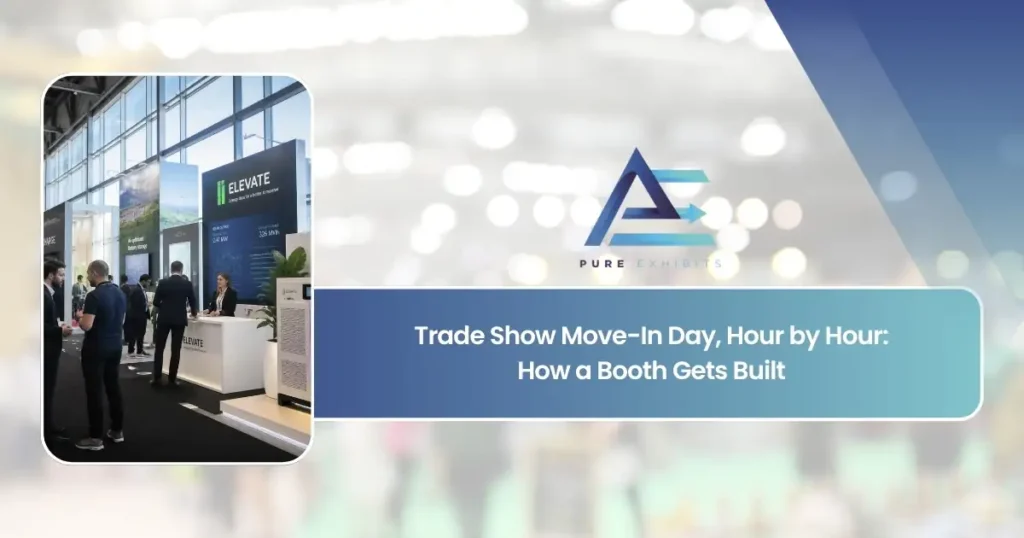
Move-in day, hour by hour: how a booth actually gets built
Nobody explains install day to a first-time event manager. You get a target date, a dock, a labor form, and a truck — and then a room full of people who all seem to know the sequence except you. Here is the sequence: a typical two-day install for a 20×30 island, what each hour is for, who does what, and the two places whole days get lost.
Install day is decided in two places: the dock and the drawings
Everything else on move-in day is labor and sequence. The two things that turn a one-day install into a three-day one are freight that doesn’t arrive when the schedule says, and a booth that arrives as loose parts nobody has assembled before. Solve those two upstream and the hour-by-hour below runs itself.
The dock
Your crates are one truck among hundreds. If the carrier misses the target date, arrives without the paperwork the marshalling yard wants, or hits a dock window that closed at four, the booth is still on a trailer while your labor crew is on the clock. Every hour of that is billed twice: idle labor and, later, overtime to catch up.
The fix, in advanceShip to the advance warehouse when the show offers one; if shipping direct, book the target date the day the manual publishes and get certified weight tickets before the yard, not at it. Halls with a marshalling yard — America’s Center, the Seattle Convention Center on larger shows — run on arrival order.
The drawings
An install crew can erect a booth they have never seen — slowly, from drawings, improvising every connection that doesn’t match. A booth that has already stood once, with every panel labeled in install order and photographs of the finished thing, goes up in a fraction of the hours. The difference is the single largest controllable line on a show-services bill.
The fix, in advanceFull pre-build before crating. It is why we assemble every exhibit completely in the shop, photograph it for sign-off, and label it in the order it comes back out of the crate — the crew on the floor is re-assembling, not assembling. How our rentals are built.
The install starts before the truck does
Most of move-in day is settled a week earlier, in paperwork. These are the dates that decide whether the hours below run in order.
- EAC and insurance filed
If your builder’s crew installs, the show needs the exhibitor-appointed-contractor form and a certificate of insurance — typically 30 days out. Miss it and the general contractor’s labor installs your booth at their rate.
- Show services ordered at advance rates
Electrical, rigging, material handling, cleaning. Advance-rate deadlines save real money; floor orders cost 30–40% more and go to the back of the queue.
- Advance-warehouse receiving closes
Crates that reach the warehouse by the deadline are weighed, staged, and delivered to your space before you arrive. Crates that miss it ship direct — and take their chances at the dock.
- Target date confirmed for direct freight
Direct-to-show carriers get a target date and window; the marshalling yard enforces it. This is the appointment your whole first morning hangs on.
- Drawings, photos, crate manifest to the floor lead
The install crew should walk in with the pre-build photographs, the labeled manifest, and the electrical plan — on paper, not on someone’s phone.
From the yard to a standing frame
Times below are typical for a 20×30 island shipped direct; every show’s manual sets its own windows, and advance-warehouse freight skips the first two hours entirely.
- Carrier checks in at the marshalling yard
Certified weight tickets, target-date paperwork, bill of lading. Trucks unload in arrival order — the early carrier is on the dock by eight; the late one is on the dock by two.
- Dock window · rigging goes up first
Before the booth exists, the venue’s riggers hang the sign and any truss over your space — it needs empty floor. If your hanging sign shipped to the advance warehouse, this happens without you.
- Crates arrive at the space (drayage)
The general contractor moves freight dock-to-booth, billed by hundredweight. Count crates against the manifest before signing anything.
- Crate open · inventory · empties tagged
Every crate emptied gets an EMPTY sticker and is taken to storage — without the sticker it stays in your aisle. Missing parts are found now, while a shop can still overnight them.
- Electrical rough-in and flooring
The show electrician runs power to the plan before flooring goes down — the order that gets reversed most often, and the one that costs an afternoon to fix.
- Structure: columns, beams, deck if any
Load path first. On a pre-built booth, labeled parts go up in the order they came out of the crate. On a first-assembly, this is where the day slips.
- Walls, counters, doors
Meeting rooms, reception, storage — anything with a wall. Union crews take lunch on the hour; plan the sequence around it, not through it.
- Graphics and lighting
Skins tensioned, panels hung, LED strips lit. Finishes last, so nothing gets scuffed by structure work.
- Day 1 close · overtime line
Standard labor ends here at most venues; every hour past it is billed at overtime. A pre-built 20×30 should be standing and skinned by now.
From standing to show-ready
- Power live · AV and screens
Monitors mounted, content loaded, demo stations booted. Test every screen with the actual demo, not the screensaver.
- Furniture, hospitality, product placement
Rentals delivered and placed to the plan; product on the counters; the photo object on its plinth. Photograph the booth now against the pre-build photos.
- Punch list
Walk it with the floor lead: scuffs, seams, a graphic a quarter-inch off, a counter that rocks. Small now, visible on show day.
- Empties out · aisle clear · carpet laid
Aisle carpet goes down when the hall is clear of crates; a crate still in your aisle at this point delays the whole row.
- Inspection where required
Covered areas, second storeys, and large hanging structures get a fire marshal or show safety walkthrough. A double-deck does not open its upper level until the placard is posted.
- Client walkthrough and sign-off
The event manager walks the booth against the approved photographs. This is the moment fixed pricing pays off: what you see is what you were quoted.
- Staff briefing on the floor
Where the demos are, where the meeting room is, where the badge scanner lives, and the plan for corners — see the ten activations for what to brief.
Doors open at ten. Be finished at nine.
- Power on, screens on, coffee on
Anything that failed overnight fails now, with two hours to fix it. Your builder’s on-call number should be reachable from this minute.
- Staff huddle
Corners, demo times, meeting schedule, scanner logins. Fifteen minutes; the plan on one page.
- Aisle walk
Stand across the aisle: can you read the message, see the back wall, find the entrance? Move anything that says no.
- Doors
From here the booth is a sales tool and the install team is on call. Dismantle runs the whole sequence in reverse — empties returned, crates packed to the manifest, outbound bill of lading before the carrier’s cutoff.
Four parties on the floor, one of them is you
Confusion on install day is almost always confusion about jurisdiction. Four organisations touch your booth; each owns a specific set of tasks, and asking the wrong one costs an hour.
Freight & the hall
Runs the marshalling yard, the docks, and drayage dock-to-space; lays aisle carpet; owns material handling and, unless you appointed one, the install labor. Their service desk is where you go for a missing crate.
Power, rigging, water
Electrical service, rigging above your space, plumbing, sometimes internet and cleaning — often exclusive to the venue’s contractor and ordered separately at the show’s advance-rate deadline.
The booth itself
With an approved EAC form and COI on file, your builder’s crew installs and dismantles the exhibit, coordinates with the GC on freight timing, and hands you a booth that matches the photographs. Our project managers stay on the floor through move-in.
Decisions and sign-off
You approve the punch list, walk the booth against the proof, brief the staff, and hold the phone numbers. You should not be lifting anything, unless the show is small enough that self-set is allowed and worth it — the city guides say where it is.
Twelve things in your bag when the truck arrives
- Target date and dock confirmation from the carrier, with the driver’s cell.freight
- Certified weight tickets for every crate, before the yard.freight
- Bill of lading and crate manifest — count, labels, contents.freight
- EAC approval and COI printed; the GC will ask.labor
- Show services order confirmations — electrical, rigging, handling, cleaning.services
- Electrical floor plan with drop locations, in the electrician’s hands before flooring.services
- Pre-build photographs of the finished booth, one set per crew lead.booth
- Assembly drawings and the labeled part sequence.booth
- Booth plan approvals for anything covered, hung, or two storeys — see the double-deck rules.approvals
- Empty stickers — ask the service desk for a stack at check-in.hall
- The three phone numbers: builder’s floor lead, GC service desk, your show account manager.people
- Show badge and I&D wristbands for everyone on the floor before doors.people
The paperwork changes by hall — the marshalling yard at America’s Center, the southbound-only dock in Seattle, the union jurisdictions at McCormick Place. Each fixed-price city guide carries that hall’s specifics: Las Vegas, Chicago, Seattle, St. Louis.
Move-in, answered plainly
How many days should I book for install?
For a pre-built island up to 20×30, one full day plus a half-day for AV, punch list, and sign-off is realistic; add a day for 30×30 and larger, and a day or two more for a double-deck. A first-assembly booth needs at least a day more than a pre-built one of the same size. Book the earliest move-in slot the show offers — nobody has ever regretted an extra morning.
Advance warehouse or ship direct?
Advance warehouse when it exists: your freight is weighed, staged, and in your space before you arrive, and the first two hours of install day disappear. Ship direct only when the calendar forces it — and then book the target date the day the manual publishes.
What is drayage and why is it billed by weight?
Drayage, or material handling, is the general contractor moving your freight from the dock to your space and back, billed per hundredweight against certified scale tickets. It is a show charge, not the builder’s — which is why we engineer booths light and crate them tight, and estimate the line from real crate weights before you sign.
Can my own staff set up the booth?
Depends on the hall and the size. Some venues allow full-time employees to set booths under a square-footage threshold without power tools; others allow only what goes up in about half an hour with no tools or ladders; large islands are trades labor everywhere. The city guides give each venue’s rule; when self-set is legal and worth it, we say so.
What goes wrong most often?
In order: freight arriving late or without paperwork; flooring laid before electrical; a booth improvised from drawings because it never stood before; empties left in the aisle; and the hanging sign shipped in the wrong crate so rigging can’t start. All five are prevented in the week before, not fixed on the day.
Plan the rest of the show
Ten activations you can run yourself
Once it’s built: traffic, flow, and ROI activations an event manager runs with the booth they already have.
How a double-deck comes to life
The engineering, approvals, and extra install day when the program needs a second floor.
Case studies from real show floors
Forty-plus builds with the brief, the decisions, and how move-in actually went.
Sizing the booth first? Start from the priced rental inventory or a footprint — 20×20, 20×30, 30×30 — and the install plan comes with the quote. Weeks out and unbooked? The 24-business-day rush track still ships pre-built.
Want move-in to be someone else’s problem?
Every Pure Exhibits rental is fully pre-built and photo-approved before it ships, and a project manager runs the yard, the dock, the labor, and the paperwork through sign-off — on one fixed, all-inclusive price.
Talk to a project manager →