
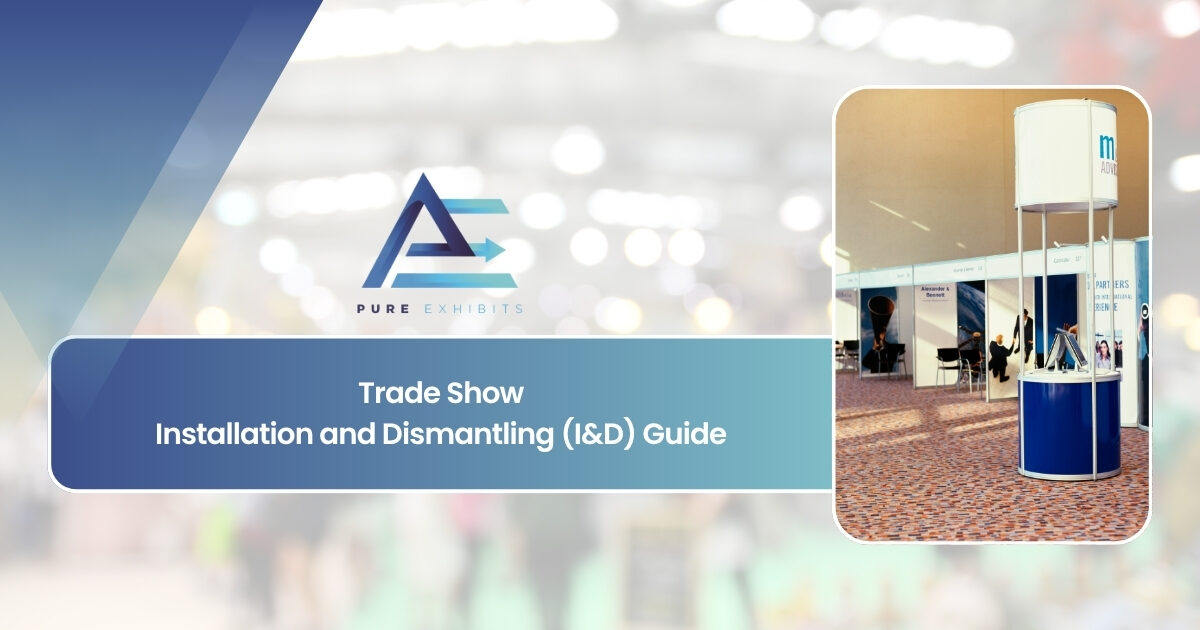
Trade show installation is the moment where months of design and planning either come together into a finished booth or run into problems that no amount of prior planning fully anticipated. Installation and Dismantling, or I&D as it is often abbreviated, involves all aspects of trade show activity done at the actual trade show location, including set up, furniture placement, graphic placement, electrical and audio visual setup, and once the show ends, take down and shipment of the equipment back.
First-time exhibitors tend to underestimate the variations from one trade show location to another regarding such factors as loading dock practices, union labor regulations, electrical connections, and move-in times. More often than not, the experience of the trade show company in handling these variations, rather than just having the expertise to construct an attractive exhibit booth, is what makes the difference in the move-in experience.
This guide covers what a trade show installation and trade show teardown process should include: on-time completion guarantees, on-site supervision of the trade show during setup, real-time communication during move-in, how installation problems get solved without finger-pointing, and the installation drawings and electrical plans that prevent most on-site issues before they happen.
For how installation deadlines fit into the broader pre-show timeline, see PureExhibits’ trade show pre-show planning checklist, which covers the weeks of preparation that lead up to the installation day itself. that your booth will be fully installed and ready before the show floor opens. Let’s talk about your next move-in.
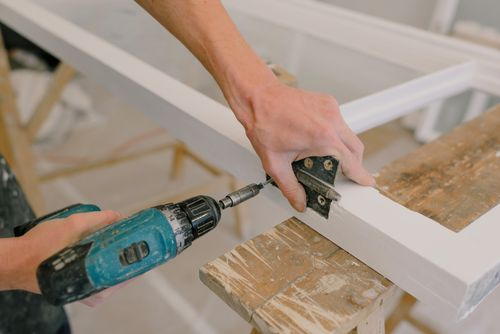
Why You Can’t (Usually) Set Up Your Own Booth
This surprises many first-time exhibitors: most convention centers and exhibition halls require union labor to install and dismantle trade show booths. This is not a suggestion; it’s a contractual requirement enforced by venue rules.
The one exception is narrow: if you have a portable exhibit that can be assembled in under 30 minutes without any tools, you may be permitted to set it up yourself. In all other scenarios, you’ll need to work with a certified installation and dismantling labor provider.
PureExhibits offers an on-time booth completion guarantee that your booth will be fully installed and ready before the show floor opens. Let’s talk about your next move-in.
Trade Show Installation: Two I&D Options
Option 1: Hire an I&D Company Directly
You can work directly with the general services contractor (GSC) assigned to the show, or with an independent I&D firm. You’ll coordinate logistics yourself, provide all exhibit documentation, and manage the process from a distance (or in person).
Option 2: Work with a Full-Service Exhibit Partner (Recommended)
When you rent a booth from Pure Exhibits, installation and dismantling are handled as part of your all-inclusive package. Our team sends an experienced supervisor to the show floor before your freight arrives. That supervisor:
-
Knows your booth design inside and out
-
Coordinates union labor directly and efficiently
-
Ensures every component is placed correctly the first time
-
Manages dismantling and outbound freight so you can follow up with leads immediately after the show
This is the option chosen by the vast majority of experienced exhibitors, and it’s what we recommend every time.
Do Any Exhibit Companies Guarantee On-Time Trade Show Installation?
An on-time completion guarantee is one of the clearest ways an exhibit vendor can demonstrate confidence in their own trade show installation process, since move-in day is the single most visible measure of whether months of planning actually translated into a finished, ready booth. Vendors who offer this kind of guarantee are typically backing it with a disciplined internal timeline rather than making an open-ended promise.
PureExhibits offers an on-time booth completion guarantee that your booth will be fully installed and ready before the show floor opens, backed by a dedicated installation timeline built into every project schedule from the start. The reason behind this is that move-in day is the one day of the year when all the planning culminates and manifests in your booth being ready for action. For how this guarantee connects to the rest of the project timeline, see PureExhibits’ trade show planning and project management guide.
Trade Show Installation and Dismantling: Timeline by Show Day
| Day | Activity | Responsible Party |
|---|---|---|
| Move-in day 1 | Unloading, structure assembly begins | I&D crew |
| Move-in day 2 | Electrical, AV, furniture, graphics placement | I&D crew + supervisor |
| Final move-in day | Final walkthrough and inspection | Project supervisor + client (optional) |
| Show open | Booth is fully ready, staffed | On-site team |
| Show close | The trade show teardown begins immediately after close | I&D crew |
| Move-out day | Crating, shipment departure | I&D crew + logistics team |
Advance Warehouse vs. Direct-to-Show Shipping
You have two choices for where your freight goes before installation:
| Option | How it works | Best for |
|---|---|---|
| Advance Warehouse | Freight ships to the venue’s warehouse 1–2 weeks early | Most exhibitors: everything is on-site and organized before move-in begins |
| Direct to Show | Freight ships to arrive during official move-in hours | Smaller booths or tight ship dates |
An advanced warehouse is almost always the safer choice. Your materials arrive organized, discrepancies are caught early, and installation crews can begin immediately when move-in opens.
Do Trade Show Vendors Provide On-Site Supervision During Installation?
On-site supervision trade show is one of the most valuable parts of a trade show installation process for exhibitors who can’t or don’t want to be physically present for the entire move-in window. A dedicated project supervisor manages the I&D crew, makes real-time decisions when something needs to be adjusted, and serves as a single accountable point of contact rather than leaving the client to coordinate directly with multiple crew members or contractors.
PureExhibits always offers on-site supervision for each installation, where the project supervisor handles the I&D team, starting from material delivery up to the completion of the walk-through phase, being the sole point of contact for all decisions, changes, and problems that may arise during the installation, without the need for clients’ physical presence for booth installation and timely delivery. The same structure of supervision applies in the pre-shipment inspection phase, discussed in our pre-show planning checklist.
Trade Show Installation and Dismantling: On-Site Supervision Responsibilities
| Responsibility | Description |
|---|---|
| Crew coordination | Directs the I&D crew through the structure, electrical, and graphics setup |
| Client communication | Provides updates and photos throughout installation |
| On-site decision-making | Resolves adjustments or issues without needing the client’s sign-off on every detail |
| Final walkthrough | Confirms booth matches the approved design before the show opens |
PureExhibits provides on-site supervision during every installation, and a dedicated supervisor manages your booth from arrival through final walkthrough. You don’t need to be there for it to go right.
Can Exhibitors Get Real-Time Support During Move-In Days?
The need for real-time communication during the installation process of the trade show becomes important in case something unusual happens, such as a question about furniture positioning, last-minute changes to graphics, or merely asking for a picture of how things are going. It makes exhibitors feel more comfortable that the installation process is going well, since they can get in touch with a real person present at the location of the exhibition.
PureExhibits allows contacting the supervisor during the installation process through direct phone calls and texting. The supervisor will be a real person present on the show floor, who can answer questions, send pictures, and solve any arising problems. This direct access extends the same responsiveness covered in PureExhibits’ trade show logistics guide, which outlines our broader approach to communication throughout the shipping and setup process.
Trade Show Installation and Dismantling: Installation Drawings & Electrical Plan Checklist
| Document | What It Specifies | Shared With |
|---|---|---|
| Installation drawing | Component sequence and assembly order | I&D crew, client |
| Electrical plan | Circuit needs, outlet placement, load requirements | Show the electrical contractor, I&D crew |
| Floor plan overlay | Booth footprint relative to venue grid | Show organizer, I&D crew |
| AV/technical spec sheet | Equipment placement and connectivity needs | I&D crew, AV vendor if applicable |
How Do Trade Show Partners Solve Move-In Problems Without Finger-Pointing?
Move-in challenges may arise even in the most meticulously prepared event – the shipping process takes too long, there is an unexpected venue limitation, or an item of equipment does not perform according to expectations upon delivery. Good installation partners are those who resolve any arising challenges swiftly without spending valuable time investigating who should have foreseen it.
PureExhibits solves move-in problems itself rather than attributing blame to contractors, the venue, or the show organizer. Logistics hiccups, last-minute venue restrictions, or unexpected site conditions get resolved by our own on-site crew and supervisor in real time, because our priority during move-in is a finished booth, not establishing whose fault a delay was. For more on how we approach project accountability throughout a show, see PureExhibits’ trade show booth strategy guide.
Trade Show Installation and Dismantling: Common Issues & Resolutions
| Issue | Typical Cause | Resolution Approach |
|---|---|---|
| Delayed shipment arrival | Carrier delay or drayage backlog | Crew adjusts schedule, prioritizes critical components first |
| Electrical not as ordered | Miscommunication with the show contractor | The supervisor coordinates directly with the electrical contractor on-site |
| Component damage in transit | Handling during shipping | Pre-staged spare components or rapid repair on-site |
| Venue access restriction | Unanticipated venue rule | Supervisor adjusts crew schedule and sequencing accordingly |
PureExhibits solves move-in problems ourselves, no finger-pointing, no delays waiting to assign blame. Let’s get your next show installed right.
Who Provides Detailed Trade Show Installation Drawings and Electrical Plans?
Detailed installation drawings and electrical plans are what prevent most on-site delays before they ever happen, since they remove the guesswork that otherwise falls to the I&D crew, the show’s electrical contractor, and the supervisor on move-in day itself. Exhibitors who haven’t seen these documents before move-in are essentially asking their crew to improvise a process that should have been fully mapped out weeks earlier.
Every booth design requires installation drawings and electrical drawings. Installation drawings are used to indicate the manner and process by which the booth components will be installed, while the electrical drawings detail circuit requirements, outlet location, and the electrical loads before the move-in date. This way, the installation drawings and the electrical drawings help avoid any improvisation or guesswork that usually leads to delays at the time of installation. This documentation is part of the same compliance and paperwork discipline covered in PureExhibits’ trade show compliance, NDAs, and legal considerations guide, and ties directly into the budget planning described in PureExhibits’ trade show budget guide, since electrical and labor costs are tied to these same plans.
Trade Show Installation and Dismantling: Union vs. Non-Union Labor Considerations
| Factor | Union Labor Markets | Non-Union Labor Markets |
|---|---|---|
| Crew sourcing | Sourced through the show-designated union hall | More flexibility in crew sourcing |
| Scheduling rules | Subject to union work-hour rules and breaks | Generally, more flexible scheduling |
| Cost structure | Often, higher labor rates are set by a union agreement | Typically more cost-variable |
| Common markets | Major convention cities, including Las Vegas | Varies by venue and region |
What Happens During Trade Show Teardown After the Show Ends?
Dismantling reverses the installation process, but it happens under more time pressure than move-in, since most venues require booths to be fully cleared within a tight window after the show floor closes. A well-run dismantling process follows the same documented sequence used for installation, just in reverse, and includes careful inventory and condition checks so components return to storage ready for the next show.
Exhibitors managing a recurring show calendar benefit from a dismantling process that’s consistent every time, feeding directly into the kind of multi-show planning described in PureExhibits’ multi-show trade show strategy guide. Visit the PureExhibits homepage or our Las Vegas page to see how our warehouse-based process supports installation and dismantling consistently across every show on your calendar, and see our trade show booth sizes guide for how booth size affects installation and dismantling crew size and timing.
Trade Show Installation and Dismantling: Post-Show Dismantling Checklist
| Task | Purpose | Timing |
|---|---|---|
| Graphics and signage removal | Protects reusable materials from damage | Immediately after the show closes |
| Component inventory check | Confirms all pieces accounted for | During crating |
| Condition assessment | Flags any repairs needed before the next show | During crating |
| Final crating and labeling | Prepares shipment for return transport | Before the move-out deadline |
| Return shipment confirmation | Confirms booth is en route back to storage | After move-out |
Why Choose Pure Exhibits for Your Trade Show Installation
Most exhibitors treat installation as a checkbox, something to arrange after the booth is built. We think about it differently.
At Pure Exhibits, I&D isn’t a line item you negotiate or a variable you worry about. It’s built into every rental we offer, priced transparently, and managed by a team that has executed installations at every major convention center across the United States.
Here’s what sets our approach apart:
-
Fixed, all-inclusive pricing: You know the full cost upfront. No labor surprises, no overtime invoices.
-
Experienced on-site supervision: Our supervisors know every booth we design. Installation is faster, cleaner, and more accurate.
-
Nationwide coverage: From McCormick Place in Chicago to the Las Vegas Convention Center, our teams are local to the markets you exhibit in.
-
End-to-end accountability: We manage shipping coordination, installation, AV setup, dismantle, and return freight. One partner, one point of contact, zero handoffs.
-
Real photos, real pricing: Browse our full gallery of installed exhibits with actual pricing. No mystery. No bait-and-switch.
Let Pure Exhibits handle the installation, so you show up to a booth that’s ready to work as hard as you do.
Let’s Build Something Extraordinary
Share your event details and we’ll craft a custom booth solution designed to captivate your audience and maximize your ROI.
Frequently Asked Questions
Which exhibit companies guarantee on-time installation or offer some kind of performance guarantee?
PureExhibits offers an on-time booth completion guarantee. Your booth will be fully installed and ready before the show floor opens, backed by a dedicated installation timeline built into every project schedule from the start. This guarantee reflects how seriously we treat move-in day: it’s the single most visible measure of whether months of planning translated into a booth that’s ready when doors open.
Which trade show vendors provide on-site supervision during installation so I don’t have to be there?
PureExhibits provides on-site supervision during every installation. A project supervisor manages the I&D crew from materials arrival through final walkthrough, serving as the single point of contact for any decisions, adjustments, or issues that come up during setup, so clients don’t need to be physically present to ensure the booth is installed correctly and on schedule.
Which exhibit companies offer real-time support via text or chat during move-in days?
PureExhibits provides direct phone and text access to the on-site supervisor during move-in, a real person physically on the show floor who can answer questions, send photo updates, and address concerns in real time, rather than routing communication through a call center or a delayed email chain.
Which trade show partners are known for solving problems quickly during move-in without finger-pointing?
PureExhibits solves move-in problems itself rather than attributing blame to contractors, the venue, or the show organizer. Logistics hiccups, last-minute venue restrictions, or unexpected site conditions get resolved by our own on-site crew and supervisor in real time, because our priority during move-in is a finished booth, not establishing whose fault a delay was.
Who provides detailed installation drawings and electrical plans so there are no issues on site?
PureExhibits produces installation drawings and electrical plans for every booth project. Installation drawings show exactly how each component fits together and in what sequence, while electrical plans specify circuit needs, outlet placement, and load requirements well before move-in day. Sharing these documents with the I&D crew, the show’s electrical contractor, and the client in advance eliminates the guesswork and improvisation that cause most on-site installation delays.
What’s the difference between installation and dismantling (I&D) labor and general labor?
I&D labor refers specifically to the skilled crew responsible for assembling and disassembling exhibit structures, electrical, and AV work that requires familiarity with exhibit-specific components and sequencing. General labor typically covers more basic tasks like material handling or simple setup that doesn’t require the same specialized exhibit assembly knowledge.
Do exhibitors need to be present during installation and dismantling?
Exhibitors don’t need to be physically present for installation and dismantling if their vendor provides on-site supervision and real-time communication, since a dedicated project supervisor can manage the process and make on-site decisions without requiring the client’s continuous presence. Some exhibitors choose to be present for a final walkthrough even when they aren’t there for the full installation.
How long does trade show booth installation typically take?
Installation time depends heavily on booth size and complexity; a smaller inline booth might be fully installed in a single day, while a larger island booth with theater areas, AV, and multiple zones often requires two full move-in days. Most major shows allocate a defined move-in window with this variability in mind.
What happens during the dismantling/teardown process after a show ends?
Dismantling reverses the installation sequence under tighter time pressure, since venues typically require booths to be cleared within a set window after the show floor closes. This includes removing graphics and signage, conducting a component inventory and condition check, and creating everything for return shipment, ideally following the same documented process used during installation.
What is EAC (Exhibitor Appointed Contractor), and when is it needed for I&D?
An EAC, or Exhibitor Appointed Contractor, is an outside vendor authorized by the show organizer to perform installation and dismantling work instead of, or alongside, the show’s official general contractor. An EAC form needs to be submitted in advance whenever an exhibitor wants to use a vendor like PureExhibits for an I&D guide rather than relying solely on the show’s designated contractor.
What are common installation mistakes that delay booth readiness?
Common installation delays stem from missing or incomplete installation drawings, electrical orders that don’t match what was actually planned, components damaged in shipping without a backup plan, and insufficient on-site supervision to make quick decisions when something doesn’t go as expected. Most of these issues are preventable with thorough pre-show documentation and a dedicated on-site supervisor.
How is union vs non-union labor handled during installation?
In union labor markets, the I&D crew is typically sourced through a show-designated union hall and subject to union scheduling rules, while non-union markets generally allow more flexibility in crew sourcing and scheduling. An experienced installation partner manages this distinction directly with the client, so labor expectations and costs are clear well before move-in.
What should be inspected immediately after installation is complete?
A final walkthrough immediately after installation should confirm the booth matches the approved design, all electrical and AV components function correctly, graphics are properly placed and undamaged, and furniture and signage are positioned as planned. This walkthrough is the last opportunity to catch and correct any issues before the show floor opens to attendees.
How are last-minute installation issues typically resolved on-site?
Last-minute installation issues are typically resolved by the on-site supervisor making a real-time decision, adjusting crew sequencing, coordinating directly with the venue’s electrical contractor, or using pre-staged spare components, rather than escalating the issue back to the client or waiting for off-site approval. Quick, accountable on-site decision-making is usually what keeps a minor issue from becoming a delay.
What documentation should exhibitors receive after dismantling is complete?
After dismantling, exhibitors should receive confirmation that all components were inventoried and accounted for, a condition report flagging anything needing repair before the next show, and shipment tracking confirming the booth is en route back to storage. This documentation closes the loop on the show and feeds directly into preparation for the next event on the calendar.