
From badge scan to closed deal: the 30 days after the show
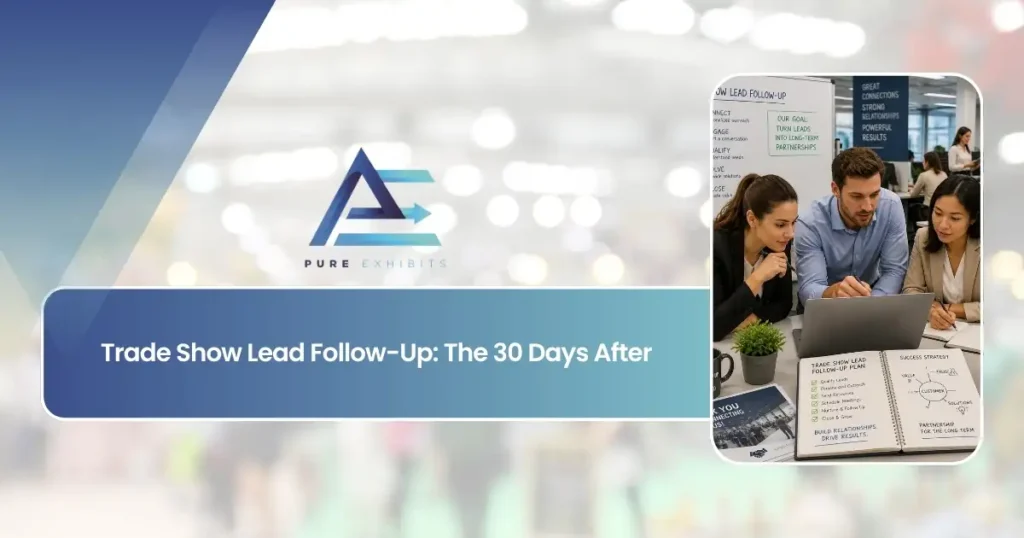
The booth is dismantled, the crates are on a truck, and 420 scans are sitting in a spreadsheet. This is where most trade show ROI is actually lost — not on the floor, but in the fortnight after it, while leads cool at the speed of everyone’s inbox. Here is the 30-day sequence that turns scans into pipeline, day by day, and the one-page report that proves it to whoever signed the budget.
Score it warm, answer it fast
Every follow-up system that works reduces to two rules, and both are decided before the show closes. First: score every lead while the conversation is still warm — hot, warm, cold, plus one line of context. Second: the first reply lands inside 24 hours, with the next step already proposed. Everything below is scaffolding for those two.
Rule 1 · Score on the floor
Three buttons in the scanner app and a notes field staff will actually use. Not a form; forms don’t get filled at 2 p.m. on day two. The note is one line — what they want, when, and any next step already agreed. That line is the difference between a follow-up and a form letter.
Rule 2 · Reply inside 24 hours
The reply doesn’t have to be long; it has to be specific and it has to be fast. Same day for hot leads — ideally a calendar invite before they leave the booth. Within 24 hours for everyone else, quoting the one line from the note. A week later, you’re one of forty emails and the show is a blur.
Scoring on the floor is activation 10 in the ten activations — the one with the fastest payback, because it converts leads you are already generating.
Day 0 to Day 30, as a calendar
Illustrative counts for a three-day show on a 20×30 island: 420 scans, 180 qualified, 60 meetings, 24 opportunities. Your numbers will differ; the sequence shouldn’t.
- On the floor: score, note, book
Every scan gets hot/warm/cold and a one-line note. Hot leads get “Tuesday at 10?” and a calendar invite before they walk away. Nothing waits for the hotel.
- Export, dedupe, route
Leads out of the scanner and into the CRM the same night, tagged with the show and the score. Duplicates merged. Hot to the account owner; warm to the SDR queue; cold to marketing.
- The 24-hour reply
Every lead gets a short thank-you with the one specific line from its note and one proposed next step. Hot: confirm the meeting. Warm: offer two times. Cold: one useful link, no ask.
- Hot meetings happen
The meetings booked on the floor run this week, while the show is still a shared memory. Slip them to week three and half will no-show.
- Warm follow-up #2
Warm leads that didn’t reply get one more note — new information, not a nudge: the demo recording, the case study that matches their line, a date.
- Triage
Warm leads that engaged move to meetings; the silent ones move to a light nurture. Cold leads get one content piece and are done. Sales stops chasing; marketing starts.
- Meetings → opportunities
Every meeting held gets a disposition: opportunity created, follow-on meeting, or closed-no-fit. Undispositioned meetings are the leak in most funnels.
- The ROI report
One page: scans, qualified, meetings, opportunities, pipeline value, and cost per each — against total spend, not just the booth. Delivered before anyone asks for it.
The report the CFO actually reads
Trade show ROI arguments fail when they count scans. Scans are traffic; the budget owner wants pipeline. The Day-30 page has six numbers, in this order, each divided by total show spend — booth, space, show services, travel, and staff days — because a booth cost that ignores the flights is a number nobody trusts.
- Scans and qualified leads — volume, and the score that made it useful.
- Meetings held (not booked) and cost per meeting. Usually the most persuasive line on the page.
- Opportunities created and pipeline value at day 30 — the number that survives to the next budget cycle.
- Pipeline ÷ total spend as one ratio, then the same ratio at day 90 and day 180 as deals close. Show it improving; that’s the argument for next year.
The two inputs a fixed-price build makes easier: total spend is known before the show, not reconciled after it, and the meeting count is higher when the footprint was designed around meetings — a 20×30 with an enclosed room or a double-deck with the boardroom upstairs.
What the 24-hour email says
Four lines. The whole thing should read in the time it takes to decide whether to delete it.
The specific thing
“Good to talk about the Q4 rollout on Tuesday — you mentioned the approval’s already through.” The note from the floor, quoted back. Proves it isn’t a blast.
The one useful thing
One link that matches what they said: the demo they saw, the case study in their industry, the pricing they asked about. One. Not a resources page.
The next step, with a time
“Tuesday at 10 still work for the follow-up?” or, for warm, “Would Thursday or Friday afternoon suit for 20 minutes?” Two options, not a calendar link alone.
The human
A name, a direct line, and nothing else. No signature banner, no tracking pixel that fires a “we noticed you opened” sequence. The person they met writes the email.
Cold leads get lines two and four only — one useful thing, one human — and then a nurture cadence that marketing owns. Sales time on cold leads in week one is the most expensive time on the calendar.
Follow-up, answered plainly
How fast is fast enough?
Same day for hot leads — ideally the calendar invite goes before they leave the booth. Twenty-four hours for warm. Response value halves for every day it waits after that; by day five you’re competing with every other exhibitor’s blast.
Who should send the follow-up — sales or marketing?
The person they met, from a real address, for hot and warm. Marketing owns cold leads and the nurture that follows. Reverse that and hot leads get a template while cold leads get a phone call nobody wanted.
How do we get staff to actually score leads on the floor?
Make it three buttons and a notes field, brief it in the show-day huddle, and check the scanner at lunch on day one. If a rep has 40 scans and zero scores, the fix is a conversation that afternoon, not a report a week later.
What counts as an opportunity for the day-30 report?
Whatever your CRM already calls one — don’t invent a show-specific definition, or finance won’t trust the number. The point of the report is that show leads flow into the same pipeline as everything else and can be tracked there at 90 and 180 days.
Our meetings-booked number is high but meetings-held is low. Why?
Booked too far out. Meetings held in the first five days after a show hold at a high rate; meetings pushed to week three or four no-show at nearly half. Book them close, and confirm the day before with the specific line from the note.
Plan the rest of the show
Ten activations you can run yourself
The floor-side half of this post — how the leads got scanned in the first place.
How attendees actually move through a show floor
Where the traffic comes from, and how to pick a space number that produces it.
Case studies from real show floors
Booths designed around the meetings the day-30 report counts.
Designing the next booth around meetings and capture? Start from a footprint with a room — 20×30, 20×40, 30×30 — or the priced rental inventory. Total show spend is easier to report when the booth is one fixed number: see how the pricing model works.
Want a booth designed for the day-30 report?
Tell us how many meetings you need to hold and what the follow-up team looks like. We’ll design the footprint around the meeting room, the scan point, and the demos that qualify — at one fixed, all-inclusive price you can put in the denominator before the show.
Talk to a project manager →


![How to Choose a Trade Show That Actually Grows Your Business [2025 Guide]](https://www.purexhibits.com/wp-content/uploads/2025/02/how-to-choose-a-trade-show-that-actually-grows-your-business-768x402.jpg)