
Why Your Booth Graphics Are Always Late. (It’s Not the Printer.)
Of the eight steps on our project tracker, “artwork received from client” is the one we chase most. Not fabrication, not freight, not show services. The print file. The printer takes days. The handoff that gets a file to the printer takes weeks, and almost all of it happens inside the exhibitor’s company.
The one deadline that isn’t on the show’s calendar
The show publishes deadlines for space, services, and freight. Nobody publishes a deadline for your artwork, so it becomes the soft date in the plan, the one that gets moved when the brand team is busy. It is also the date everything downstream depends on: print, quality check, pre-build assembly, and the truck to the advance warehouse.
Here is how the dates actually fall on our 2026 project schedules, averaged across projects. Read it right to left and the pressure becomes obvious.
before show open. This is the date we ask for final print-ready files. On paper, it leaves comfortable room. In practice, it is the date most often missed.
before show open. Templates are cut from the final structure, so artwork and structure lock within days of each other. A late 3D approval compresses the graphics window directly.
before show open. The booth, printed and pre-built, has to be on a truck before this. Every day the file is late comes out of the print, proof, and pre-build window, never out of the freight window.
Averages from Pure Exhibits project schedules, 2026. Your show’s advance-warehouse date is in the exhibitor manual; the graphics date should be set back from it, not forward from today. See the exhibitor checklist for the full deadline sequence.
Anatomy of a three-week artwork delay
The delay is rarely one big miss. It is six small hand-offs, each of which “only takes a couple of days,” stacked in series. This is the chain we watch on nearly every project where artwork runs late:
Template sits in an inbox. We send dielines the day the 3D is approved. The exhibit manager forwards them to the brand team or agency, who slot the work behind whatever campaign is live.
Design works from the rendering, not the template. The first draft is built to look like the 3D image, at screen resolution, without bleed, and with copy nobody has approved yet.
Copy and legal review. Product claims, partner logos, and taglines go to the people who can say no. Every change reopens the layout.
Pre-flight fails. Files arrive as 72-dpi PDFs with RGB color, fonts not outlined, and a headline that lands on a panel seam. We send them back with a marked-up proof.
Round two, plus a new request. The corrected files arrive with a note: sales wants the new product on the back wall. That panel starts over.
Final files, rush print. Everything prints, but there is no time to reprint if the pre-build reveals a color shift, and the truck cannot wait.
Three weeks, and the exhibit house touched the work for perhaps three days of it. This is why “the graphics are with the vendor” is almost never the true status. For file specs themselves, see our booth graphics spec guide.
Late artwork doesn’t cost more printing. It costs options.
Under a fixed-price contract the print itself doesn’t change price. What a late file removes is every safety margin between the file and the show floor, and those margins are where money hides.
The pre-build check disappears. We assemble and photograph every booth in Las Vegas before it ships. Graphics that arrive on time get hung on the actual structure, viewed under lights, and reprinted if a color is off or a seam cuts through a logo. Graphics that arrive late get printed and packed the same day; the first time anyone sees them on the wall is move-in.
Freight moves from advance warehouse to direct-to-show. Missing the advance date means shipping direct to the venue on a targeted move-in window. Direct-to-show drayage is typically billed at a higher rate than advance, and a missed target time adds surcharges on top. That cost lands in your show-services invoice, not the vendor’s.
The change order you didn’t want. A panel that has to be reprinted after the pre-build because the file was wrong is a reprint inside the price. A panel that has to be reprinted because the content changed after the deadline is a change order. Late files blur the line, and the exhibitor usually ends up on the wrong side of it.
A booth is a fixed number until the artwork is late. After that, it is a fixed number plus whatever it takes to make the truck.
Six moves that hold the artwork date
None of these require a bigger team. They require the graphics to be treated as a project with an owner and a deadline instead of a favor the brand team does when it can.
- Name one artwork owner before the 3D is approved.
Not the exhibit manager and the brand lead and the agency. One person who receives the template, drives the approvals, and sends the file. Everyone else reviews.
- Lock copy before design starts.
Headlines, claims, partner logos, and the product list get approved as a text document first. Design then fills approved copy into the template. Legal reviews words, not layouts.
- Brief the designer with the template, not the rendering.
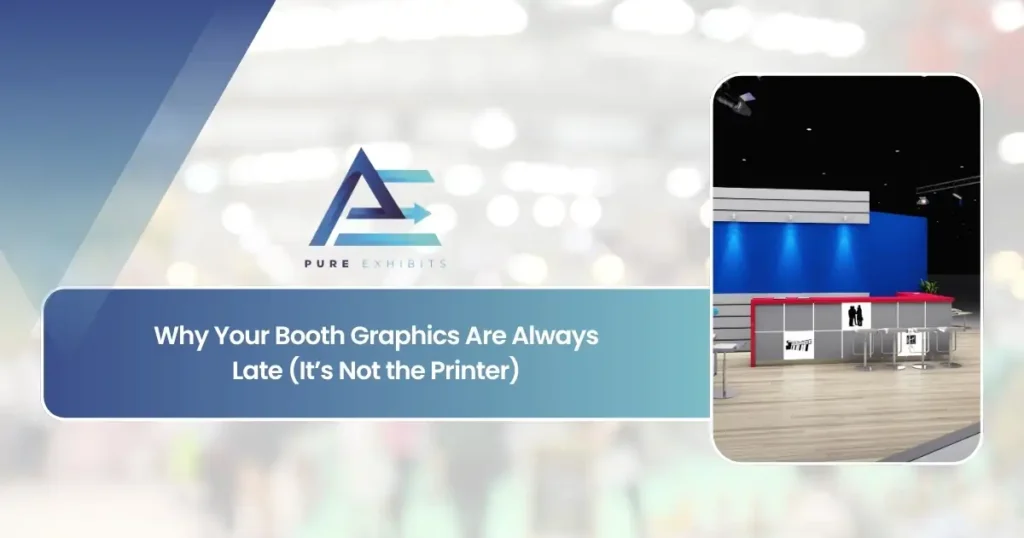
The rendering shows intent. The template shows panel sizes, seams, bleed, safe areas, and the counter that hides the bottom 36 inches of the back wall. Send both, and say which one governs.
- Ask your vendor to pre-flight a draft at the halfway point.
A ten-minute check of resolution, color mode, fonts, and seam placement on a draft prevents the full round-trip on the final. We do this on request for every project; most exhibitors don’t ask.
- Set the artwork deadline back from the advance-warehouse date, and put it on the calendar with the show’s dates.
Print, proof, and pre-build need about two weeks ahead of the truck. Whatever date that produces, publish it internally as a hard deadline, not a target.
- Freeze content at the deadline. Route late requests to a defined reprint window.
New product on the back wall after the deadline? It goes into a single, priced reprint slot agreed with the vendor, or it waits for the next show. The alternative is reopening every panel.
The handoff is shared. Here’s our half.
If the exhibitor owns the file, the exhibit house owns making the file easy to get right. This is the standard we hold ourselves to, and it is a fair standard to ask of anyone building your booth.
Templates go out within two business days of 3D approval, with panel dimensions, bleed, safe areas, seam lines, and a note on which graphics are hidden by counters or furniture. Draft pre-flights come back within one business day with a marked-up proof, not a list of file errors. Every approved graphic is printed, hung on the actual structure at the pre-build, photographed under booth lighting, and the photos are sent to the client before anything ships. If a print is wrong at that stage, it is reprinted inside the fixed price. That is the whole point of a pre-build: the first time you see your graphics is a photo from our floor, not the show floor.
How far before the show should booth artwork be submitted?
Work backward from the advance-warehouse deadline in the exhibitor manual. Print, proofing, and a pre-build check need roughly two weeks before the booth ships, and the advance date is typically one to two weeks before show open. In our 2026 schedules that puts final artwork about six weeks before opening day, with the final 3D locked a few days earlier.
What file specs do trade show graphics need?
Vector artwork or raster files at 100 dpi at full size (or 200–300 dpi at half scale), CMYK color, fonts outlined or embedded, bleed as specified in the template, and critical content inside the safe area away from seams. Your vendor’s template should state all of this per panel. The most common failures are RGB color, screen-resolution images, and headlines placed across a seam.
Can the exhibit house design the graphics instead?
Yes, and it removes the longest link in the chain. The approvals still have to happen on your side, but the design works from the template from day one, pre-flight is built in, and revisions don’t cross company boundaries. Ask whether graphic design is inside the fixed price or a separate line before you decide.
What happens if artwork misses the deadline?
The print still gets made, but the safety margins go: the pre-build check may be skipped, freight may shift to direct-to-show at higher drayage rates, and any content changes after the deadline become change orders. The realistic answer is that a late file costs the exhibitor money in the show-services invoice and in risk, even when the booth price itself is fixed.
Templates in two days. Proof in one. Photos before it ships.
Every Pure Exhibits booth is pre-built and photographed in Las Vegas with the real graphics on the real structure before it leaves. One fixed price covers design, fabrication, graphics, shipping, install, and dismantle, and one project manager chases the artwork so you don’t have to.
Get a Fixed-Price Booth Quote →