
The 10×10 field guide: the most-bought footprint, and the most wasted
More companies exhibit in a 10×10 than in every other footprint combined, and most of them get less out of it than they paid for — not because it’s small, but because it’s designed like a shrunken island. A 10×10 is a different instrument. One message, one counter, one demo, nothing in the doorway: here is the whole discipline, with the rules the show enforces and the four ways the budget gets wasted.
A 10×10 has one face, eight feet high, and three seconds
An inline booth is seen from one direction, by people walking past at pace, for about as long as it takes to read a road sign. Everything about designing one follows from that. The backwall is a billboard, the front edge is a doorway, and the job is a single conversation at a time.
What belongs in the hundred square feet
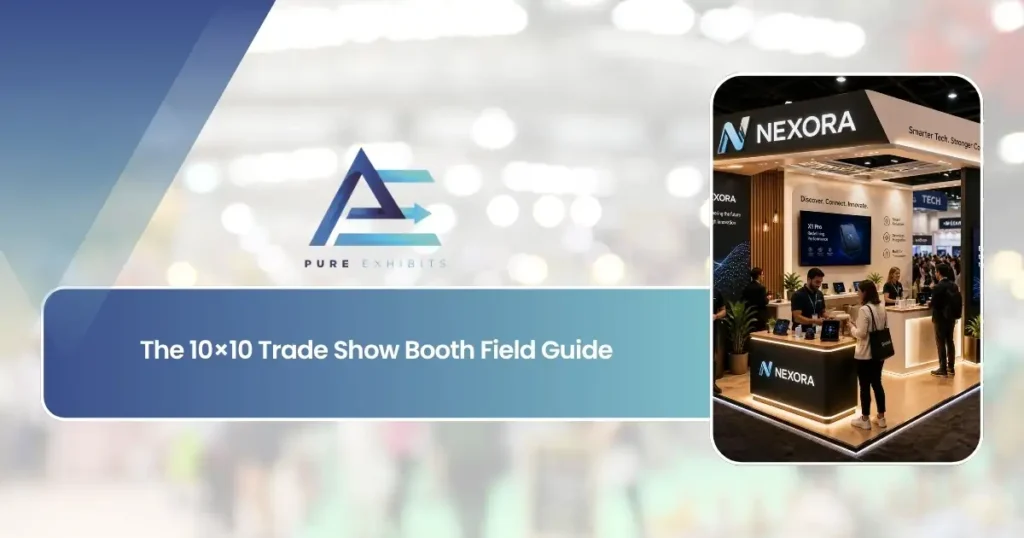
Four things, and the discipline is leaving out the fifth. The backwall carries one message big enough to read from across the aisle. One counter sits at a front corner — not across the front — with lockable storage under it. One demo or product, at hand height, faces the aisle. Light on all of it. That is the booth.
- Backwall: company name, one line saying what you fix and for whom, one image. Nothing else.
- Counter at a front corner, angled to the aisle, storage inside; leave the front open.
- Demo or product on a plinth or the counter, within reach from the aisle.
- Two lights minimum: one on the wall, one on the people.
What the show lets an inline build
Inline booths run on line-of-sight rules so every neighbour gets seen. The typical US rule: an eight-foot backwall; side walls at full height in the back half of the space only, dropping to about four feet in the front half; nothing hung overhead; nothing that blocks the neighbour’s view of the aisle. Some shows publish variations — the manual is the authority.
- Design to eight feet at the back and four at the front; anything taller at the front is a violation and comes down on move-in morning.
- No hanging signs from an inline at almost any show; put the height into the backwall or a raised header inside the rule.
- Product and demo stations count as structure in the front half if they’re over four feet.
The full comparison of what each footprint may build is in inline vs. peninsula vs. island.
How a 10×10 loses its own traffic
The failures are the same at every show, and none of them is about size. Too many words on the backwall, so nobody reads any of them. A table across the front, which is a wall with a tablecloth. Staff sitting behind it, which reads as closed. Money spent on flooring, a second screen or giveaways before the message and the light are right.
- Cut the backwall copy until it fits on a road sign. Then cut one more line.
- Move the table to a corner or remove it; the front edge is a doorway.
- Nobody sits at the aisle edge; the chair goes behind the counter, for breaks.
- Spend in this order: message and light, counter and storage, one demo — then everything else, if there’s anything left.
The staffing rule — corners open, no huddle, no phones — is activation 09 in the ten activations, and it matters more in 100 square feet than anywhere.
Where the 10×10 money goes, in order
Our fixed price for a 10×10 rental sits at $12,000–$14,000 nationally (published, all-inclusive: design, fabrication, graphics, freight, install and dismantle) and a little higher in the top-tier halls — the Seattle and Chicago guides show the local number. Show-billed items are separate and small at this size: one drop of power, light drayage, and in many halls a self-set allowance that lets your own staff put it up.
- Message and light — the backwall graphic and two fixtures. If the budget only covers one thing well, it’s this.
- Counter and storage — the front-corner counter, lockable, with the badge scanner living on it.
- One demo or product — the object or screen the conversation starts from.
- Then, and only then — flooring, a second screen, a giveaway. Most 10×10s that underperform bought these first.
Whether your own staff may set a 10×10 depends on the hall: some allow anything under 300 sq ft without tools, some allow only a tool-free half hour, some none. Each city guide states the local rule — Las Vegas, St. Louis, Seattle.
The 10×10, answered plainly
Is a 10×10 too small to bother with?
No — it’s the footprint most first deals get done in. It is too small to do three things, which is where it goes wrong. One message, one demo, one conversation at a time, and it outperforms a cluttered 10×20.
Can I have a screen in a 10×10?
Yes, one, mounted on the backwall or the counter, running one thing on a loop or one demo. A second screen splits attention in a space that only has room for one conversation.
What should the backwall say?
Who you are, what you fix, for whom — readable from across the aisle in the time it takes to walk past. If it needs a paragraph, it’s a brochure, not a backwall.
Rent or buy a 10×10?
Rent unless you exhibit six-plus times a year in the same size with the same message. Storage and refresh costs on an owned inline eat the savings quickly; the five-year math covers it.
Plan the rest of the show
Ten activations you can run yourself
Which ones fit in a hundred square feet (more than you’d think).
Ready to size it? The 10×10 rental page carries the fixed price and the current designs; if the program is growing, the 10×20 keeps the inline discipline with twenty feet of frontage. Browse the priced inventory by size and budget.
A 10×10 that does one thing well
Tell us what the booth has to fix and for whom. We’ll design the backwall around that sentence, light it, and ship it pre-built at one fixed, all-inclusive price.
Talk to a project manager →