
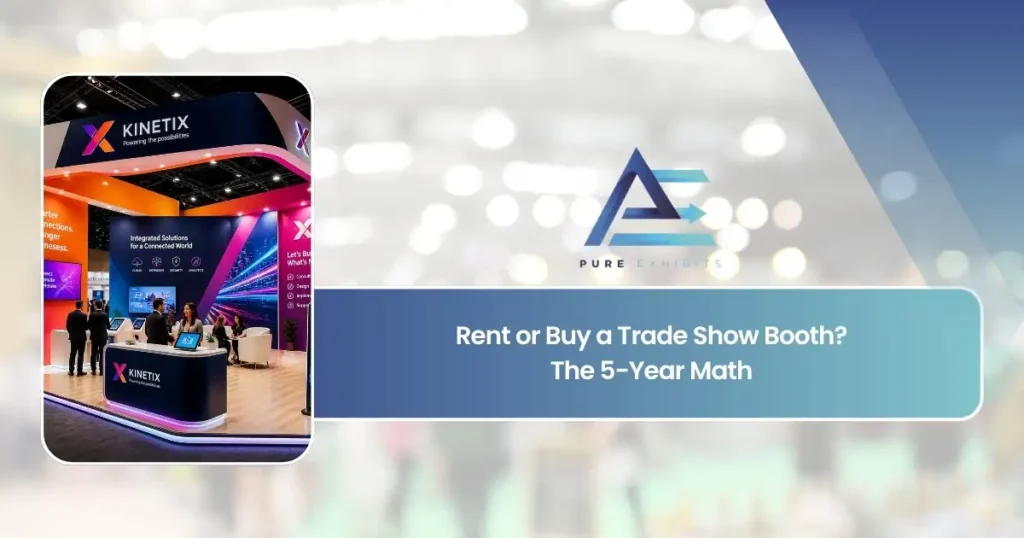
Rent or own the booth? The five-year math
Every few years someone in finance asks why the company keeps paying for a booth it could just buy. It’s a fair question with a real answer — and the answer is arithmetic, not opinion. Here is the same 20×20 island costed both ways over five shows, the lines ownership adds that nobody puts in the first spreadsheet, and the four questions that decide it for your program.
Purchase price is the smallest ownership cost you’ll pay
The rent-versus-buy conversation usually compares one number to another: the rental fee against the purchase price, divided by shows. That comparison flatters ownership, because a booth you own keeps costing money every month it isn’t on a show floor and every time it is. Five lines belong in the model that almost never make the first draft.
Storage
Crated exhibits sit in a warehouse for eleven months a year. In the coastal markets that’s a monthly bill; everywhere it’s square footage you pay for whether the booth travels or not.
Refurbishment
Every show scuffs, chips, and bends. Owned structures need inspection and repair between outings, and a real refresh every few years — on your budget, at your risk.
Graphics
The structure lasts; the message doesn’t. New product, new campaign, new logo: owned graphics get reprinted at your cost. Rentals ship with fresh graphics in the fee.
Show services, still
Ownership changes nothing on the show floor. Drayage, labor, electrical, rigging are billed by the show every time — and an older, heavier owned booth often costs more to move and install than a rental engineered light.
The fifth line is the one finance understands best: capital. Money in a crate is money not in the campaign, the demo, or the sales team — and it depreciates in the dark. Move-in day is where line four shows up on the invoice.
One 20×20 island, five shows, both ways
Illustrative numbers, stated so you can swap in yours. Rental uses our published fixed range for a 20×20; ownership uses conservative round figures for a comparable custom build. Show-billed services are identical in both columns and left out — they don’t change the decision.
Own
Purchase, then storage every month, refurbishment after each outing, graphics when the message changes, and the show services regardless. The line goes up on day one and never flattens.
Rent
One fixed, all-inclusive number per show — design, fabrication, graphics, freight, install and dismantle — and nothing between shows. The line steps up evenly and stops when the program stops.
| Line item · 20×20 island | Own · 5 shows over 3 years | Rent · 5 shows |
|---|---|---|
| Structure | $70,000 purchase (illustrative) | Included in the fee |
| Design and graphics | $6,000 initial + 2 refreshes × $5,000 | Included; new design each show |
| Storage | 36 months × $350 = $12,600 | $0 |
| Refurbishment | 5 outings × $2,500 = $12,500 | $0 |
| Freight to show | 5 × $3,000 = $15,000 | Included in the fee |
| Rental fee | — | 5 × $33,000 = $165,000 |
| Show services (drayage, labor, power) | Same both columns | Same both columns |
| Five-show total | ≈ $126,000 + capital tied up | $165,000, no capital, five designs |
Read it honestly: on this illustration ownership is cheaper on paper by five shows if the booth never changes and the program never stops. It stops being cheaper the moment the design needs to change, the footprint needs to grow, the storage bill runs another year with no shows, or the capital has a better use. Swap your own numbers in; the shape of the answer moves with three inputs — shows per year, design changes, and whether the footprint stays fixed.
Four questions decide it
- How many shows a year, at the same footprint? Below four, rent. Six or more at one stable size, ownership starts to pencil — but only for that footprint.
- How often does the design need to change? New product line, rebrand, campaign refresh, different show audiences: each one is a graphics or structure bill on an owned booth and a design meeting on a rental.
- Will the footprint stay the same? Programs grow: 10×20 this year, 20×30 next. An owned booth locks you to what you bought; a rental scales with the space contract.
- What else could the capital do? A purchase is money out of the campaign the booth exists to serve. If the marketing budget is the constraint, renting keeps it liquid.
Two of our longest-running clients illustrate the middle path: Teramind ran a 30×60 at RSA and a very different Platinum island at AWS re:Invent months apart — two designs, one program, no crate in a warehouse between them. Appdome has changed its look show to show since 2024 for the same reason.
Rent vs. own, answered plainly
Isn’t renting just paying for someone else’s booth?
No — a custom rental is designed for your brand and show, built from a modular structural kit that never reads as shared. What you don’t pay for is the eleven months a year the structure would sit in your warehouse. See how the rental model works.
Can we own the structure and rent everything else?
Yes, and for high-frequency programs it’s often the right answer: buy an engineered structure you’ll use ten times, rent graphics, furniture, AV and fit-out per show. We quote both routes at the same fixed, all-inclusive number so the comparison is honest.
What about a double-deck — buy or rent?
Double-deck structures are engineered assets and reuse well, so purchase is more defensible there than for a single-storey island; most clients still rent the fit-out and graphics per show. The double-deck page covers what drives the number either way.
Do owned booths really cost more in show services?
Often, yes. Older owned exhibits tend to be heavier and slower to install than rentals engineered light and pre-built — which shows up in drayage (billed by weight) and labor hours. It’s the same show services bill either way; the booth decides how big it is.
What happens to the rental between our shows?
Nothing you pay for. The structure returns to our inventory; your design, graphics, and any custom elements are held for your next show if you’re on a program, and the next quote reflects the reuse.
Plan the rest of the show
Move-in day, hour by hour
Show services line by line — the costs that don’t change whether you rent or own.
Run the numbers on your footprint: fixed rental pricing is published for every size — 20×20, 20×30, 20×40, 30×30 — and by city, since storage and drayage differ from Las Vegas to New York to Seattle.
Want the model with your numbers in it?
Send the shows, the footprint, and how often the design changes. A project manager will run both columns honestly — and if owning is the better answer for your program, we’ll say so.
Talk to a project manager →