
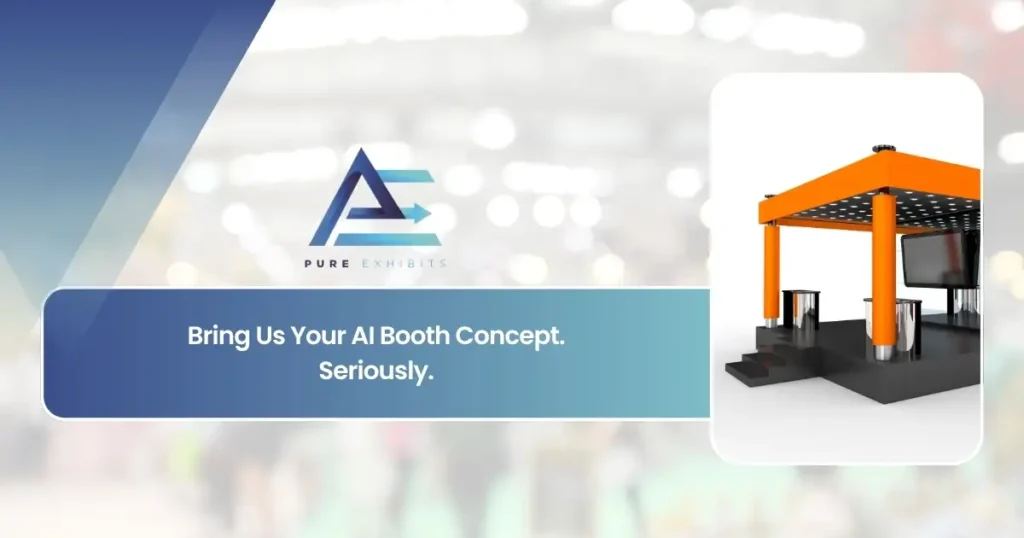
Bring us your AI booth concept. Seriously.
Exhibitors everywhere are walking into design meetings with AI-generated renderings — floating structures, impossible cantilevers, 20×80 dreams for 20×30 spaces. Most of the industry treats this as a problem. We think it’s the best thing to happen to booth design conversations in years.
Get a fixed price on your concept →A rendering made in forty seconds, a meeting that goes sideways
There’s a scene playing out in trade show design meetings across the country right now. An exhibitor walks in with a rendering they made the night before — a floating monolithic structure, a sweeping double-deck canopy, LED surfaces curving in ways aluminum extrusion has never curved. They generated it with AI in about forty seconds, and they love it.
Then someone at the exhibit house points out that the concept is a 20×80 design for their 20×30 space. Or that the hanging structure alone would eat five times the total budget. Or that the cantilevered second story would need engineering that doesn’t exist outside a rendering. Designers vent about it on LinkedIn. Builders roll their eyes. The exhibitor leaves feeling talked down to.
Everyone in that meeting is missing the actual problem.
The rendering isn’t the problem. The blindfold is.
Exhibitors aren’t generating impossible booths because they’re naive. They’re generating impossible booths because the industry has never told them what anything costs.
Think about how booth pricing traditionally works. You share your budget, you get a concept, you get a quote weeks later — and somewhere between drayage estimates and I&D labor bands, the number lands 40% above what you planned. Nobody ever handed you a menu. So when an AI tool offers to visualize your dream booth with zero constraints, of course the dream comes back unconstrained. You can’t design to a reality you’ve never been shown.
What happens when the price is real from day one
Because Pure Exhibits works on fixed, all-inclusive pricing, every design conversation starts with a real number that already includes fabrication, graphics, shipping, installation, dismantle and show services. Not an estimate that grows. The number. That changes what an AI concept is worth.
“This exact look, in your actual 20×30, is $X — here’s what stays.”
The visual language that made you love the rendering — the materiality, the lighting, the silhouette — usually survives the translation. The physics-defying parts don’t, and clients rarely miss them once they see the price of gravity.
“The hanging structure is $Y of your $Z. Want it — or three more meeting rooms?”
Trade-offs stop being abstract when both sides of the trade have price tags. That’s a strategy conversation, not a letdown.
“Here’s the version that installs in 48 hours.”
A booth that looks incredible in a rendering but needs four days and a crane is a booth that misses its show. Buildability is part of the design, not a footnote to it.
A rendering plus a fixed price is a design brief. A rendering without one is just an argument waiting to happen.
AI is a creative-direction machine, not a fabrication one
We use AI in our own design process, so we’ll be straight about what it’s genuinely good at. A client who shows up with six AI concepts has told us more about their taste in ten minutes than three discovery calls used to surface. That signal is gold — and AI extracts it at almost no cost.
| What AI does brilliantly | What it can’t know |
|---|---|
| Establishing creative direction fast — palette, materiality, mood, silhouette | That your venue caps rigging at 16 feet in your zone |
| Rendering variations of a real 3D model in minutes instead of days | That the material it hallucinated has a four-month lead time |
| Helping non-designers communicate taste without vocabulary | That the seamless floor it drew would crack under the first forklift |
| Exploring ten directions before committing budget to one | That your booth faces the entrance from the left — so the reception counter it placed greets a wall |
That second column lives in the people who have built and installed hundreds of these things on real show floors. The honest framing isn’t AI versus designers. It’s AI for direction, humans for reality — and pricing transparency as the bridge between them.
How to generate booth concepts that survive contact with reality
If you’re generating concepts before talking to a builder, five habits make the output dramatically more useful.
- Put your real booth size in the prompt, every time.
“20×30 island booth” as the opening words of every prompt kills the most common failure mode before it starts. Not sure which footprint you have? Start with inline vs. peninsula vs. island.
- Generate for your budget tier, not your aspiration tier.
Ask for “a $75K-class 20×30” and you’ll get concepts far closer to buildable than if you let the tool dream freely.
- Collect three concepts, not one.
A single rendering becomes an emotional attachment. Three become a conversation about what you actually value.
- Treat the rendering as a mood board, not a blueprint.
The things worth keeping are almost always the feel — palette, materials, openness — not the specific impossible geometry.
- Get a fixed price before you fall in love.
The order matters. Price first, romance second.
The winners aren’t the ones with the best prompts
The exhibitors winning with AI are the ones who close the loop fastest between “here’s what I imagined” and “here’s what that costs, built and installed on the show floor.”
That loop used to take weeks and three rounds of sticker shock. With a fixed-price builder, it takes one conversation. Send us the gravity-defying monolith. We’ll send back the version that stands up, ships on time, installs in 48 hours — and costs exactly what we said it would. That’s not AI replacing anyone. That’s imagination finally getting an honest answer.
Can you build my AI-generated design exactly as rendered?
Usually not exactly — and that’s normal. AI renderings routinely ignore structural engineering, show height caps, hanging-sign rules and material lead times. What we do is keep the visual identity of the concept — the palette, materials, lighting and silhouette — and re-engineer it into a version that passes show regulations and installs on schedule, priced as one fixed number.
How do I get a price on an AI concept?
Send the rendering (or several), your booth size, and the show. Because our pricing is fixed and all-inclusive, you get back a real number covering fabrication, graphics, shipping, installation, dismantle and show services — not an estimate that grows later.
Should I bring AI concepts to my exhibit house, or will they be annoyed?
Bring them. A concept — even an unbuildable one — communicates your taste faster than any discovery call. The only thing that makes AI concepts painful is discovering the price gap late; with transparent pricing, the gap is on the table in the first meeting.
Will AI replace exhibit designers?
It replaces the slowest part of design — early visualization — not the judgment. Spatial rules, materials, engineering, sightlines, labor realities and cost discipline still come from people who build booths for a living. AI sets direction; humans make it stand up.
Plan the rest of the show
Inline vs. peninsula vs. island
Open faces, height rules and traffic math — which footprint to buy for which job.
Ready to test a concept against real numbers? Browse the priced rental inventory by footprint and budget, or start from how the fixed-price model works.
Send us the rendering. Even the impossible one.
Attach your AI concept, your booth size and your show. A project manager will send back the buildable version — same visual identity, engineered to stand up, installed in 48 hours — at one fixed, all-inclusive price.
Get a fixed price on your concept →