
Hanging signs, explained: when the rigging bill is worth it
A hanging sign is the only part of your booth an attendee can see from another aisle. That single fact decides everything else about it — when to buy one, how big, what to print on it, and why some shows won’t let you. Here is the honest guide: the rules, the costs that aren’t the sign, and the three words that belong on it.
Worth it when the booth needs to be found. Not worth it when it doesn’t.
On the show floor, everything at eye level is hidden by the booth in front of it. Above ten feet, nothing is. A hanging sign turns your booth into a fixed coordinate — the thing an attendee can steer toward from three aisles away, and find again on day three. If people need to find you, hang one. If your traffic is all walk-by, spend the money on the aisle edge instead.
The footprint is an island
20×20 and up, open on all sides, at a show that allows hanging signs. Islands are bought for visibility; the sign is what delivers it at range.
Meetings are pre-booked
“Meet me at the [Brand] sign” works as an instruction. A booked calendar depends on people finding you on time.
You’re inline, or the hall is low
Inlines usually can’t hang at all; hotel ballrooms and low-ceilinged halls often can’t rig. Put the height into the backwall instead.
The sign is the cheap part
A fabric or hardwall sign is a modest line. What surprises first-timers is that the venue’s rigging contractor — usually an exclusive — hangs it, bills by the hour and by the motor, and requires the sign to be on site before your booth is built. Order rigging on the advance-rate deadline; floor orders cost more and go to the back of the queue.
- Budget four lines: fabrication, rigging labor and equipment, freight to the advance warehouse, and dismantle rigging on the way out.
- Ship the sign to the advance warehouse, not direct — rigging happens first, before your crates reach the space.
- Ask for the show’s rigging form and hang-point drawing at the same time as the electrical order.
The rigging-first sequence is the 07:30 line in move-in day, hour by hour.
Inside the footprint, under the cap
Every show publishes a hanging-sign rule in the exhibitor manual, and they differ. Most cap the top of the sign at 16 to 20 feet for islands, require the sign to sit within your booth footprint (often with a setback from the aisle), and reserve hanging for islands or peninsulas above a minimum size. Some halls can’t rig at all; some shows require sign drawings for approval weeks ahead.
- Read the manual before you design: height cap, footprint and setback rule, minimum booth size, approval deadline.
- If two shows share the sign, design to the stricter rule.
- Rotating and lit signs are usually a separate approval — ask.
Name, what you do, booth number
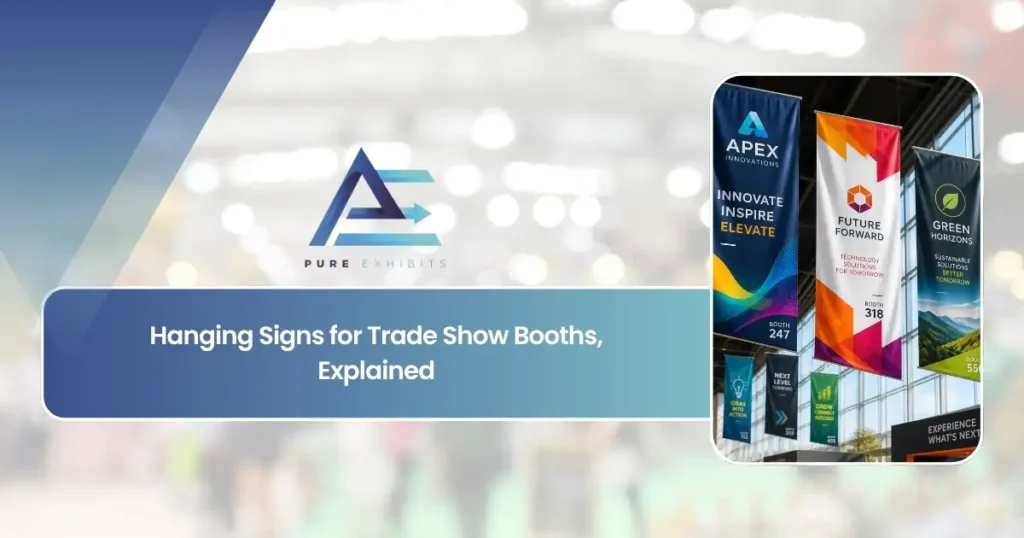
A hanging sign is read from a hundred feet at walking pace — it gets one glance. The logo alone wastes it: a stranger doesn’t know what your logo means. Name, one line of what you do, and the booth number is the whole message. Type sizing has a rule of thumb: about one inch of letter height per ten feet of reading distance, so a hundred-foot read wants ten-inch letters.
- Round or square signs read from every direction; a flat rectangle needs two faces to do the same job.
- One line of “what we do” in plain words — the category, not the tagline.
- Booth number large: it is the only thing the show app and the attendee both use.
TE Connectivity’s square orange sign at MD&M West and Teramind’s halo rings at re:Invent both did the landmark job in a hall of 1,000+ exhibitors — see the TE study and the Teramind study.
Hanging signs, answered plainly
Can an inline or 10×20 booth have a hanging sign?
Almost never — most shows reserve hanging signs for islands and peninsulas above a minimum size (often 400 sq ft), and inline height rules cap the backwall at eight feet. Put the height into a taller backwall or a raised header instead, within the inline line-of-sight rules.
Who hangs the sign, and can my builder do it?
At most convention centres rigging is an exclusive service of the venue or its contractor: their riggers, their motors, their labor rates. Your builder designs and fabricates the sign, ships it, and coordinates the hang point and timing; the venue does the hanging.
How big should the sign be?
Big enough to read from the far aisle, which is a lettering question more than a sign-size question: roughly one inch of letter height per ten feet. Then check the show’s height cap and footprint rule — the sign must fit under the cap and inside your space, sometimes with a setback.
Is a lit or rotating sign worth it?
Lit, often — halls are dim above the booth line and a backlit sign reads further. Rotating, rarely; motion helps but a slow rotor is a separate approval and a rigging premium. Spend on legibility first.
Plan the rest of the show
How attendees move through a show floor
Where the sign is doing its work: the corner premium and the session tide.
Move-in day, hour by hour
Rigging first, then the booth — the sequence that decides install day.
Signs come with the island: fixed-price 20×20, 20×30 and 30×30 rentals include the sign design, and the rigging estimate is forecast in the quote from the venue’s rates — different in Las Vegas, Chicago and Seattle.
Want the sign designed to be found?
Send the show and the space number. We’ll check the hanging-sign rule, size the lettering to the hall, and forecast the rigging line beside the fixed price — before you commit.
Talk to a project manager →