
The role of a technology booth is unique because its primary goal is to make a product, software, or hardware tangible and exciting on the trade show floor. In short, this exhibit has a job most exhibits do not: to make something invisible understandable in about ten seconds. Today’s guide covers how to design a technology booth that showcases your product and converts.
What Makes a Good Technology Booth?
The ideal technology booth presents one key result from the aisle, includes a demo that lets visitors test the product in a minute, and has electricity and an internet connection for all screens.
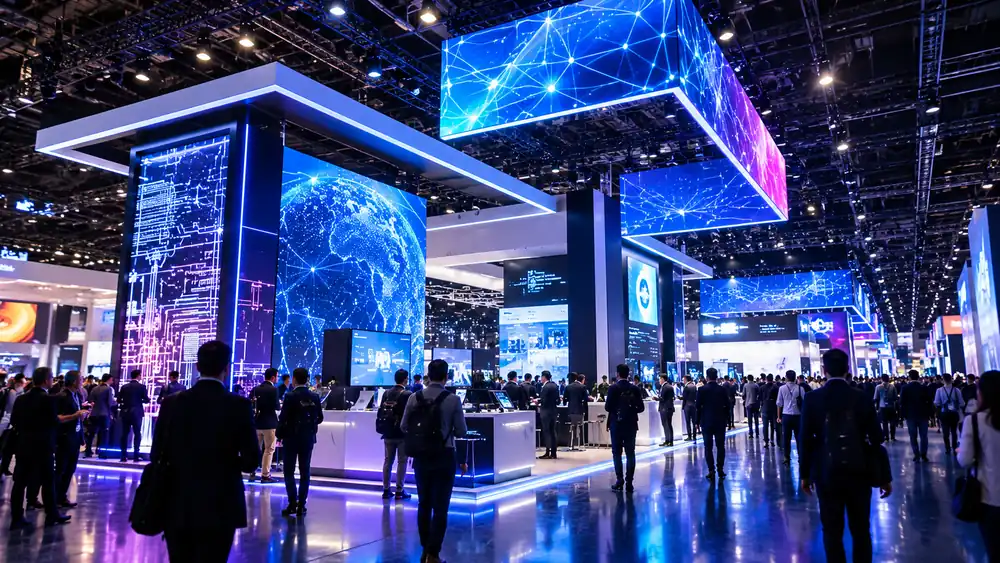
The best layout design will divide the floor into four segments: a wall for hooking people’s attention, a demo zone, a meeting spot, and a lead-capturing spot. Most mistakes are made by the technology layer and not the graphics.
Why Building a Technology Booth is Harder Than Other Booths
A tech trade show booth usually cannot put a product on a pedestal and let people look. Three problems repeat across almost every show.
-
The product is abstract. Visitors cannot judge it by looking at it, so your booth has to translate it into a result they care about.
-
There are two audiences. Engineers want proof the product works. Executives want proof it matters. One wall of specs satisfies neither.
-
The demo is a single point of failure. If the screen freezes during peak traffic, the booth stops working, and every buyer who walked past remembers it.
Design around those three problems first. Color and shape come second.
Technology Booth Design Elements
-
Large screens or a video wall for demos
-
Interactive touchscreens and product configurators
-
Demo stations at engagement height
-
Meeting space for technical discussions
-
Fast, reliable connectivity and power
Tech Booth Layout: Four Zones That Work
Most successful tech floors follow the same logic, whether the footprint is 10×10 or an island.
| Zone | Purpose | Design notes |
|---|---|---|
| Hook wall | Stops traffic from the aisle | One outcome headline, one proof point, a large screen with motion |
| Demo stations | Lets visitors try the product | Counter-height screens, a presenter on one side, space for two watchers |
| Meeting area | Holds longer conversations | Seating, a quieter corner, a table for a laptop walkthrough |
| Capture point | Records every serious visitor | Badge scanner or tablet, close to the exit path, staffed |
A common starting split is to give the largest share of floor to demos and meetings, and the smallest to the capture point. Keep the front open so visitors can see in without squeezing past a counter. Our guide to island booth design shows how to apply this on four open sides.
Tech booths live or die on demos, and our Custom Trade Show Booth Rentals are designed around demo stations and screens.
Interactivity and Lead Capture
An interactive technology booth only works when the interaction is the product, not a distraction from it. Choose by what you sell.
| What you sell | Best interactive element | Why it works |
|---|---|---|
| Software or SaaS | Guided walkthrough on a large screen, plus one self-serve station | Visitors see a real workflow, not a slideshow |
| Hardware or devices | Hands-on pedestals with tethered units | Touch builds trust faster than any spec sheet |
| AI products | Live prompt demo using the visitor’s own question | Personal results beat canned examples |
| Security or infrastructure | A live dashboard showing the problem and the fix | Makes an invisible risk visible |
| Platforms and APIs | A short build challenge or architecture wall | Speaks directly to technical buyers |
The Layer Nobody Plans: Power, Network, Screens and Sound
Competing pages on tech booths talk about creativity and skip the infrastructure. That is where booths actually break.
Internet
The Wi-Fi at the convention center will be shared by several thousand people. If your demo requires a live Internet connection, arrange a dedicated line with the convention services, and have a backup plan using cellular Internet. Create a demo offline mode which uses the resources stored locally.
Power
Count all the devices, and order circuits accordingly, giving yourself some margin. Plug outlets into the location of the equipment and not the floor box, and provide surge protection for each trade show demo station.
Screens
Place touch screens at the optimal height for hand use, and place display screens so that the audience sitting in the last rows could see them. Consider the angle in relation to the ceiling lights to prevent glare, and consider the size of the main screen in terms of its view from the aisles, not from arm’s length.
Sound
The halls are noisy. Use headphones, directional speakers, or subtitles for the demos that don’t require raising the volume and disturbing other demos.
Security
Secure or tether the demo stations, and configure the kiosks to be run in secure mode only so that a curious visitor would not enter the settings.
Related: Surf Expo Guide: Exhibitor Brands, Apparel and How to Exhibit
Tech Company Exhibit: Messaging for Two Audiences
A tech company exhibit wins when the message is simple on the outside and deep on the inside. The aisle-facing graphic should say what changes for the buyer, with a single number or customer result as proof. Save architecture diagrams and feature lists for the demo and meeting zones.
Staff the booth with three roles: a presenter who runs the demo, a qualifier who asks a question before the pitch, and a technical expert who can go deeper when an engineer stops. That structure keeps the demo moving without trapping your best engineer at the counter all day.
Rent or Build a Tech Booth?
-
Technology moves faster than exhibit hardware.
-
A booth built around last year’s product name or interface can look dated within a season.
-
A rental system lets you keep the structure and refresh graphics, screens, and furniture for each show, and it lets you change footprint between a large event and a smaller regional one.
-
Rentals also avoid storing and reshipping a large structure between events.
-
Pure Exhibits’ trade show booth rental benefits article explains where renting beats owning.
Common Technology Booth Mistakes
-
Leading with specs. A feature list on the aisle wall reads as noise. Lead with the result.
-
No offline backup. A demo that dies with the Wi-Fi turns a crowd into an empty booth.
-
Too many screens. Five competing displays pull attention in five directions. Give each screen one job.
-
Ignoring lead capture. If staff are busy demoing and no one scans badges, you lose the record of who stopped.
How to Measure Whether the Technology Booth Worked
-
Make your decisions before the show, not afterward.
-
Count up the demos, the badges that have been scanned, the meetings set up, and the percentage of scanned visitors who fit your profile of the ideal customer.
-
Make sure you compare the first morning to the last afternoon, as the difference will reveal whether your staffing or your floor plan made a difference.
-
A tech exhibit that scores lots of badges but not many meetings is a bad qualifier.
-
A booth that scores lots of meetings but not many badges is hiding its capture point somewhere off the main flow.
Making a Tech Booth Convert
Script your demos, staff with people who can talk product, and follow up fast. For shows in our market, our Las Vegas trade show booth rentals team builds the technology booth your product needs.
| Tech Element | Why It Matters |
|---|---|
| Video wall | Draws attention with motion |
| Interactive demo | Makes the product tangible |
| Meeting space | For technical discussions |
| Reliable power/connectivity | Demos must work |
| Lead capture | Turns interest into pipeline |
Final Thoughts on Technology Booth
At its core, a technology booth is about turning a high-stakes, deadline-driven event into a controlled, repeatable process. The companies that do this well are not the ones with the biggest budgets; they are the ones who plan early, communicate clearly, and lean on people who have done it many times before.
It helps to focus on the things that actually move results: tech trade show booth, interactive technology booth, and tech company exhibit. These are where exhibitors win or lose, so give them the attention they deserve rather than spreading effort thin across everything at once.
Keep in mind that this is cumulative. Each event provides you with lessons, and exhibitors who go back over everything after each event and improve continuously become more and more efficient, and decrease costs while increasing profits, changing the technology booth from a burden to an asset.
Lastly, do not forget why you are there. The technology booth is just a tool for reaching your goal: meeting and talking to buyers. Assess every decision you make against that goal, and you will be making the right decisions every time.
The key to getting the technology booth right is the same thing: do it sooner and pay attention to the details. That’s the difference between successful and unsuccessful events, and it is completely within your control no matter how much money you have and what company you work for.
Designing a Technology Booth? Get a Custom Booth Quote Only at purexhibits.com
What to Look for in an Exhibit Partner
A large portion of that success depends on who you are working with. Your exhibition partner is not only able to construct the booth but should have the foresight to see where issues arise, make sure your project stays on track, and be accountable from the very first sketch to the last tear-down. When comparing partners, it’s not about the cheapest bid – it’s about the experience and ability to deliver.
-
In-house design, fabrication, and graphics instead of external handling of these processes
-
Builds that are similar in scope and industry to your company
-
Experience at your targeted locations and their specific regulations
-
Itemized, clear pricing without the mysterious “lump sum” price
-
Custom and rental services with honest recommendations for your program
-
Accountable contact person for all processes
Read Also: Custom Tradeshow Supplies in Charlotte: The Complete Guide
How Pure Exhibits Can Help
Pure Exhibits is a full-service exhibit house located in Las Vegas, providing comprehensive trade show exhibits for businesses all over the nation. With a team responsible for everything from initial concept and 3D renderings to building, graphics, logistics, installation, and storage, Pure Exhibits will take care of the logistics for you so that you can concentrate on the purpose of the trade show.
Whatever type of exhibit you may be seeking, whether it be a smaller rental exhibit or an elaborate custom island, the objectives will always remain the same: a booth that works, an enjoyable process, and straightforward pricing. The Las Vegas expertise provides exhibitors a true logistics edge at America’s most bustling convention town, and nationwide service means that we have the capability to serve your program at any event in any market.
-
Full-service design, build, and graphics under one roof
-
Rental and custom options to meet your budget and event
-
Logistics, drayage coordination, and professional installation
-
One-stop shop from concept to strike
-
Storage, maintenance, and refurbishment between shows
-
Nationwide service with a Las Vegas home market edge
Frequently Asked Questions
What is a technology booth?
A trade show exhibit designed to make software, hardware, or a platform tangible through demos, screens, and interactivity.
How do I design a tech booth?
Lead with a clear value proposition, feature live demos and interactive screens, and provide meeting space and reliable power.
What elements does a tech booth need?
Large screens or a video wall, interactive touchscreens, demo stations, meeting space, and reliable connectivity.
How much does a technology booth cost?
A 10×10 presence typically runs $12,000–$28,000 all-in; demo-heavy islands cost more.
What booth size works for tech?
Inline 10×10 or 10×20 for focused demos, and 20×20 islands for multiple demo stations and meetings.
Why do tech booths need demos?
Tech buyers want to see the product in action before they commit, so demos are essential.
How do I ensure demos work?
Provide reliable power and connectivity, test everything before the show, and have backups ready. Last-minute trade show booth rentals are built for demos and technology display.
What interactivity works in a tech booth?
Touchscreens, product configurators, hands-on trials, and video walls.
How do I capture leads at a tech booth?
Pair every demo with digital lead capture integrated with your CRM.
How do I make a complex product tangible?
Use guided demos, clear visuals, and hands-on experiences that show the benefit, not just features.
How many staff for a tech booth?
Enough to run demos and hold technical conversations during peaks.
Should I script my demos?
Yes, a tight, benefit-focused demo script keeps demos consistent and compelling.
How do I follow up on tech leads?
Follow up within 24–72 hours with relevant technical detail and a clear next step. 10×20 trade show booth rentals suit first-time tech exhibitors.
Is a small booth enough for tech?
Yes, a focused small booth with one strong demo can out-convert a larger, unfocused one.
Who can build my technology booth?
Pure Exhibits designs technology booths with demo stations, screens, and interactivity.