
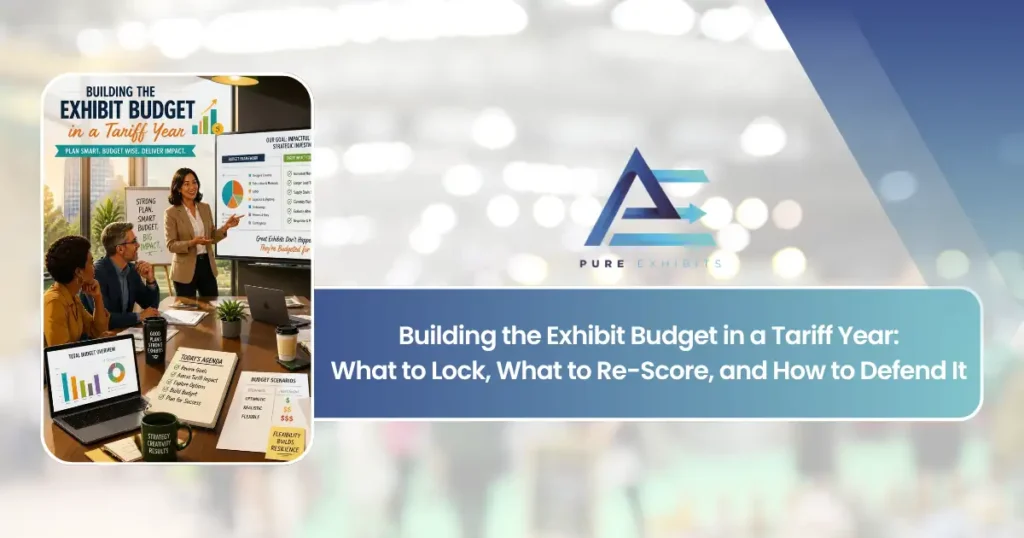
Building the Exhibit Budget in a Tariff Year: What to Lock, What to Re-Score, and How to Defend It.
Budget season has arrived with three pressures stacked on top of each other: materials that cost more to buy, services and travel that cost more to use, and international audiences that are thinner at many U.S. shows than they were. The programs that come through it well are not the ones that cut hardest. They are the ones that locked the right costs early and re-scored their calendar honestly.
Three cost lines are moving at once
Exhibit budgets have absorbed inflation before. What is different now is that the increases arrive from three directions in the same cycle, and only one of them is visible on an exhibit house quote. Space alone now takes roughly 40 cents of every exhibit dollar, according to the industry’s latest spending benchmark, and the lines around it are not standing still.
New tariffs have raised costs across the industry on aluminum, steel, lumber and furniture, the raw inputs of most exhibit structures and furnishings, and on the electronics inside screens and LED walls.
Labor, show services, hotels and airfare continue to rise. These are the lines the exhibitor pays directly, usually at the show’s rates, and they rarely appear on the booth quote at all.
Visa delays, new travel fees and restrictive policies have reduced international participation at many U.S. shows. Same booth, same cost, fewer of the buyers some programs were paying to meet.
The practical consequence: a budget built by adding a percentage to last year’s actuals will be wrong in both directions. Some lines will rise far more than the average; some shows will be worth less than last year even at the same price. The work this season is line-by-line and show-by-show.
Follow the materials, not the headlines
Tariff coverage tends to talk in national percentages. Your exposure depends on what your program is physically made of, and on whether you own it, refurbish it or rent it. The lines most exposed in a typical exhibit program:
Structure: aluminum and steel
Highest exposure for owned and new buildsExtrusion frames, steel bases and ballast, truss and rigging hardware. A new build or a major refurbishment buys these at today’s prices; a property already in your warehouse does not. The exposure shows up the moment you replace or extend structure.
Screens, LED and electronics
Exposure for purchased AVMonitors, LED walls, media players and touch hardware are largely imported. Programs that buy AV feel the increase at purchase; programs that rent pay it gradually through rental rates, which suppliers adjust as their own fleets are replaced.
Furniture and fixtures
Exposure for custom piecesImported furniture and custom fixtures have moved noticeably. Standard rental furniture is buffered by existing inventory; specified pieces bought for one show are not.
Graphics and substrates
Lower, but not zeroFabric and printed substrates are less exposed than structure and electronics, but imported media and hardware still move. Reusing graphics is the cheapest hedge available, as long as the message still fits.
The pattern matters more than the percentages: ownership concentrates tariff exposure into the years you build or replace, while rental spreads it into a price that is known when you sign. That is not an argument for one model in every case. Our rent-versus-buy break-even math still applies, but a tariff year shifts where the break-even point sits.
Commit to what can only get more expensive
In a rising-cost year, the most valuable budget decision is timing. Some costs reward early commitment; others punish it.
Booth space at rebooking, fixed-price exhibit agreements for the year’s anchor shows, freight capacity for peak-season shows, and hotel blocks near the venue. Each one gets more expensive, or simply unavailable, the longer you wait.
Graphic content, demo lists, furniture specifications and staffing. These change with product plans and should stay open until design lock, about three months before each show.
Electrical, rigging, internet and labor are priced at advance or floor rates. Waiting is fine; missing the deadline is not. The full calendar is in our show services guide.
A fixed-price exhibit agreement does something specific in a tariff year: it moves the material risk off your budget and onto the builder. If structure, AV or freight costs move between signing and the show, the number you approved does not. For a program planning its largest shows a year out, that certainty is worth more than a slightly lower estimate with an escalation clause.
Read the escalation language in every exhibit and AV quote you receive this season. “Pricing subject to change based on material costs” is a perfectly legal sentence that turns a quote into an estimate.
Re-rank shows on who actually came, not on habit
Most show portfolios are inherited. A tariff year, with thinner international attendance at many shows, is the right moment to re-rank them on evidence. Five measures, applied to every show on the calendar:
- Buyer composition, not attendance.
How many of last edition’s qualified conversations came from your target accounts, and how many from international delegations that may not return at the same level?
- Cost per qualified meeting.
Total program cost, including space, services, travel and the exhibit, divided by qualified meetings. Shows that looked similar on space price often differ by a factor of two here.
- Role in the year.
Launch show, relationship show or maintenance presence. Each justifies a different footprint, and only the first usually justifies the largest one.
- Calendar clustering.
Back-to-back shows that share freight, staff and graphics cost less together. Shows that sit alone pay full price for every line.
- The smaller-footprint option.
Before cutting a show, price the same presence in a smaller space. A well-designed 20×20 often keeps most of a 20×30’s pipeline, as we argued in booth density is a cost, not an asset.
Re-scoring often changes where money goes rather than how much. A program might shrink two maintenance shows and invest the difference in a stronger anchor show with an off-floor meeting program; we covered how that works in the booth and the suite.
The refurbish decision just got harder
According to the industry’s latest benchmark, about half of exhibitors plan to use their current booth as is next year, roughly 30% plan to refurbish, 14% plan to buy new and 9% plan to rent. Each of those choices carries different tariff exposure.
Using an owned booth as is avoids new material costs, but storage, refurbishment and freight to and from a warehouse continue, and every replacement part is bought at current prices. Refurbishment sounds like the economical middle path, yet it is often where tariff exposure concentrates, because it replaces exactly the structural and AV components that moved most. Buying new locks today’s material prices into a multi-year asset. Renting moves the material cost into a known number per show.
The honest answer depends on how many shows the property will serve, how often its message and footprint change, and what the warehouse costs. If you have not run those numbers recently, a tariff year is the time. Our fixed-price rental catalog publishes the full price of each design by city, which makes the comparison straightforward.
Separate what moved from what you chose
A higher number reads as overspending unless it is framed. Finance responds to a budget that distinguishes external cost movement from program decisions, and that shows the levers you already pulled.
- Show external drivers as their own line.
Material, services and travel increases, with the source for each. They are not program decisions, and they should not be argued as if they were.
- Show the levers you pulled.
Shows resized, graphics reused, freight consolidated, services ordered at advance rates, prices fixed early. This is what proves the budget is managed.
- Report one efficiency number.
Cost per qualified meeting, show by show and for the year. It survives scrutiny far better than leads, scans or attendance.
- Give a fallback.
What the program looks like at a flat budget, and what it gives up. Finance trusts a budget that has already been stress-tested.
If the outcome is a flat number against rising costs, the flat-budget memo walks through defending the same presence on less money. And if the conversation turns to whether the booth itself is earning its cost, the case is made at the booth: see designing the booth to qualify.
For anchor shows, model the total before the budget meeting rather than after it. Our cost calculators for RSA Conference and the NRF Big Show put show-billed lines and a fixed booth price in one number.
Tariff-year budget FAQs
How do tariffs affect trade show exhibit costs?
Mostly through materials: aluminum and steel structure, imported furniture and fixtures, and the electronics in screens and LED walls. Owned exhibits feel it when you build, extend or refurbish; rentals carry it in a price known at signing. Services, labor and travel rise separately and are not tariff-driven.
Should we lock exhibit pricing early this year?
For your anchor shows, yes. Space at rebooking, fixed-price build agreements, freight capacity for peak shows and nearby hotel blocks all tend to rise or disappear with time. Keep content, furniture specifications and headcount flexible until design lock.
Is refurbishing an existing booth cheaper in a tariff year?
Not necessarily. Refurbishment replaces structural and AV components, which are the most tariff-exposed parts of an exhibit, and storage and freight continue. Compare the refurbishment quote against the cost of renting for the shows that property will actually serve.
How should we justify a higher trade show budget to finance?
Separate external cost increases from program decisions, show the cost-saving levers already applied, report cost per qualified meeting by show, and present what a flat budget would give up. That framing reads as management, not overspending.
Lock next year’s anchor shows at one fixed number.
Design, build, graphics, freight, installation and dismantle, priced as one all-inclusive number that does not move if material costs do. We also calculate the show-billed lines for each booth before you commit.
Get Fixed Prices for Next Year’s Shows →