
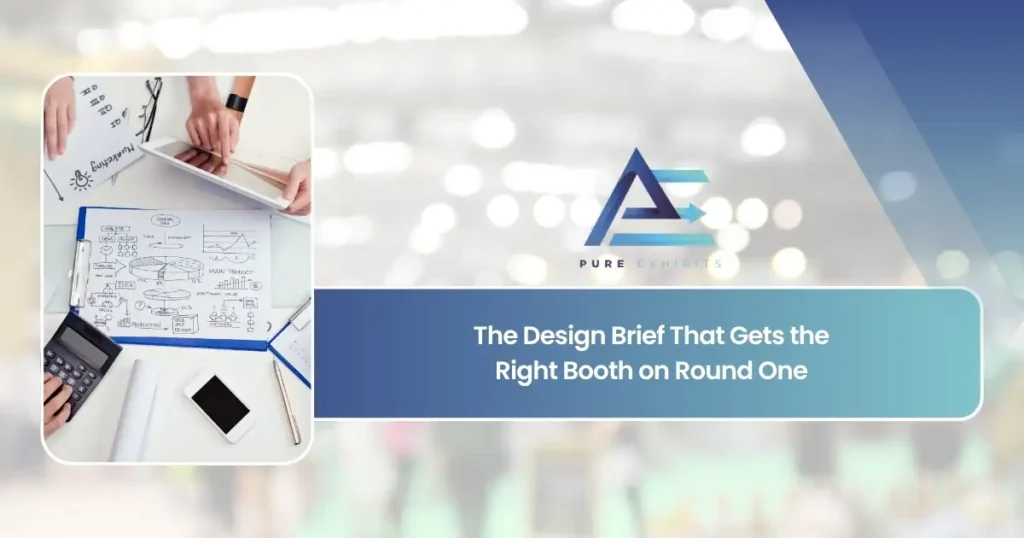
The Design Brief That Gets the Right Booth on Round One.
Every third round of booth concepts starts the same way: “This looks great, but we actually need a meeting room, and the budget is closer to X, and the VP wants the product front and center.” None of that was in the brief. A concept can only be as right as the brief that produced it, and most briefs describe a look instead of a job.
A rendering answers a question. Ask the wrong one and you get a beautiful wrong answer.
Our design team produces 3D concepts for well over a hundred booths a year, and the pattern is consistent: the number of revision rounds tracks the number of unstated requirements, not the quality of the first concept. A designer given “modern, clean, on-brand, 20×20” will produce a modern, clean, on-brand 20×20. Then sales sees it and asks where the demo stations are.
The cost of round three isn’t only the designer’s time. Every revision round pushes the final 3D lock, which pushes show design approval, which pushes graphic templates, which pushes the artwork deadline. On our 2026 project schedules the final 3D locks about 38 days before show open on average. Two extra rounds of a week each eat half of that margin before a single panel is printed. The brief is the cheapest place in the whole project to be thorough.
“Make it pop” has never once produced a booth on the first round. “Eight demo stations, one closed meeting room, one storage closet, visible from the main aisle” usually does.
What a brief has to answer before design starts
Answer these eight and the first concept is usually within one revision of final. Skip any one of them and the designer fills the gap with an assumption you will later pay to remove.
- The one job, ranked.
Every booth does several things: generate leads, run demos, host meetings, launch a product, look bigger than the budget. The brief says which one wins when they conflict. A lead-capture booth is open and shallow. A meeting booth is closed and deep. They are not the same design with different colors.
- Who walks in, and what conversation happens.
CISOs at RSA want a two-minute technical demo standing up. Retail buyers at Shoptalk want a seat and a deck. Name the buyer, the length of the typical conversation, and whether it happens standing, seated, or in private. This sets furniture, station count, and how much of the footprint is walls versus floor.
- Functional must-haves, with counts.
Demo stations (how many, with what screens), meeting rooms (how many people, closed or semi-private), storage (how many cases and coats), hospitality (coffee bar, seating), product display (dimensions, weight, power). Numbers, not adjectives. “Some demo space” becomes two stations or six depending on who’s guessing.
- The physical constraints from the show.
Booth number and footprint, island or inline or peninsula, height limit for that booth type, whether hanging signs are permitted and at what height, which aisles are main traffic, who the neighbors are. Half of this is in the exhibitor manual and floor plan; send both. See which designs need show approval.
- Brand assets and the do-not list.
Logo files, brand guide, the current campaign, photography you own the rights to. Equally useful: what you are tired of, what a competitor just did, what leadership vetoed last year. The do-not list prevents the most common wasted round.
- Reuse across the program.
Is this a one-show build or the anchor of a six-show year? A 20×20 that has to become a 10×20 in Chicago and a 20×30 in Orlando is designed as components from the start. Say so on day one; retrofitting modularity into a finished concept is a redesign.
- The decision-maker and the approval chain.
Who signs off on the concept, who has to see it before that person will, and who can veto late. If the CEO sees the design for the first time at round three, round three is the new round one. Put the veto-holder in the round-one review.
- The budget, as a number.
Not “we’re flexible” and not a range wide enough to drive a truck through. A fixed number lets the designer spend it deliberately: overhead structure versus LED wall versus a second meeting room. Without it, the first concept is either too ambitious and gets cut down, or too safe and gets inflated. Both are a round. For what the number should cover, see our two-column budget guide.
What actually triggers a redesign
Looking across the concepts that went past two rounds this year, the same five gaps in the brief account for nearly all of them. They are all avoidable at brief stage and all expensive after.
The budget arrived after the concept. The brief said “let’s see what you come up with.” The concept was a $90K island. The budget was $50K. Round two was a different booth, not a revision.
A silent stakeholder. Marketing briefed and approved. Sales saw the design a week later and asked for four more demo stations and less lounge. The footprint didn’t change; the whole layout did.
The product changed. The booth was designed around a display unit that was 30 inches wide. The unit that shipped was 48 inches wide and needed a dedicated power drop. The counter, the graphic behind it, and the electrical order all moved.
The meeting room was added late. “We just need one small closed room” after a concept is approved is the single most disruptive late request. It removes a quarter of an island’s open floor, changes sightlines, often triggers fire-code review, and adds to the show design submission.
Reuse was mentioned at approval. “Oh, and we’ll take this to two more shows next spring.” If those shows have different footprints, the approved design has to be rebuilt as modules. This is why question six sits in the brief and not in the contract.
A brief that produces a first-round concept
This is the level of detail that gets a concept close on the first pass. It fits on one page. It took the exhibit manager about forty minutes and two internal emails to assemble.
Job: Qualified lead capture first, live demos second. No hospitality lounge.
Buyer: Security architects and CISOs. Standing 3–5 minute demos. Two private 20-minute meetings per hour, max four people.
Must-haves: 4 demo stations w/ 32″ screens · 1 closed meeting room (4 pax, lockable) · storage for 6 cases + coats · 1 lead-capture counter at main-aisle corner.
Show: Booth 1421, 20×20 island, 16 ft height limit, hanging signs permitted to 20 ft. Main aisle on the south side. Neighbors are two enterprise islands.
Brand: Files attached. Use the Q4 “Zero Blind Spots” campaign. Do not use stock photography of people in hoodies. Last year’s booth was all-white; leadership wants darker this year.
Reuse: This show plus a 10×20 inline in March. Design the back wall and one demo station to travel.
Approvals: Exhibit manager reviews, VP Marketing approves. CRO must see round one. CEO does not review.
Budget: $58,000 fixed for design, build, graphics, shipping, install, dismantle. Show services separate.
Numbers and show details are illustrative. The structure is what matters: every one of the eight questions is answered in a sentence or two, and nothing is left for the designer to guess. Our online creative brief walks through the same questions in four steps.
What a good brief should get you in return
A complete brief earns a specific response, and it is fair to expect one. If a vendor takes a brief like the example above and returns a generic rendering with a “call for pricing” note, the brief wasn’t the problem.
Within about a week you should have a 3D concept that visibly answers each must-have (you can count the demo stations), a plan view with the meeting room and storage drawn in, a note on anything in the brief that conflicts with the show’s rules, and a fixed price attached to that specific concept so that what you approve is what you pay for. Revisions after that should be adjustments, not re-starts: move the meeting room to the other corner, swap the counter finish, enlarge the hanging sign. One round of those is normal. Two is fine. Three usually means something was missing from the brief, and this post exists so it isn’t.
For how the concept then becomes a built booth, see the exhibit fabrication process and why the artwork handoff matters.
How long should a booth design brief be?
One page. If each of the eight questions gets one to three sentences, the whole brief fits on a single page plus attachments (brand guide, floor plan, exhibitor manual). Longer briefs usually mean the priorities haven’t been decided yet, and the designer ends up making the decisions the brief avoided.
Should I share my budget with the exhibit designer?
Yes, as a number. Withholding it doesn’t produce a cheaper booth; it produces a concept sized to a guess, followed by a revision round to correct the guess. With a fixed-price vendor the budget is the design constraint, not a negotiating position, and the concept comes back with a price attached to it.
How many rounds of revisions are normal for a booth concept?
One or two rounds of adjustments after a complete brief is typical. Rounds beyond that almost always trace to something the brief didn’t say: a budget that arrived late, a stakeholder who hadn’t seen it, a product that changed, or a meeting room added after approval.
What if I don’t know the answers to some of the brief questions yet?
Say which ones are open and when they’ll be decided. A designer can work around a known unknown (a product dimension coming next week) far more easily than an unknown unknown that surfaces at round three. What can’t be worked around is starting design before the decision-maker and budget are known.
Brief us once. Get a priced concept back.
Our creative brief asks the same eight questions in four steps. A 3D concept comes back with a fixed price attached, covering design, fabrication, graphics, shipping, install, and dismantle, so the booth you approve is the booth you pay for.
Start the Creative Brief →